
In June 2026, SpaceX paid $60 billion to acquire Anysphere, the company behind the AI coding tool Cursor. It is, by most counts, the largest venture-backed startup acquisition ever recorded. A month earlier, Cognition AI, the company behind the coding agent Devin, closed a Series D above $1 billion at a $26 billion valuation, on the back of revenue that grew from $37 million to $492 million in twelve months, according to TechTimes' coverage of the round. Neither of these companies sells to a single industry. Both sell infrastructure that every industry will eventually run on.
At the same time, a different kind of AI company was raising money in 2026: Legora, Harvey, and Ironclad, each closing rounds of at least $150 million, all selling into one industry alone, law. Legal AI pulled in roughly $1.0 billion, a third of all disclosed vertical AI capital this year, according to New Market Pitch's funding analysis.
These are not the same bet. One group is racing to become the default rails every AI product will need. The other is racing to own a single, regulated, high-stakes industry before anyone else gets there. Most "AI trends 2026" content treats these as one undifferentiated boom. They are not. They run on different economics, attract different investors, and reward different kinds of founders. Knowing which game you are actually playing, before you write a line of code, is the difference between building something defensible and building something a foundation model update erases in a quarter.
<TL;DR: AI product development in 2026 has split into two distinct games. Vertical AI (legal, healthcare, proptech, construction, insurance) competes for a share of the 13% of US GDP spent on business labor inside regulated industries. Horizontal AI (coding tools, agent infrastructure, observability, voice, browser automation) competes to become the default infrastructure every vertical product will eventually depend on. This article breaks down the top five niches in each category, with named companies, YC batch signals, and 2026 funding data, so you know which game you're actually building for.>
The new game: why vertical and horizontal AI run on different economics
Vertical AI is not a smaller version of horizontal AI. It is a different market with a different ceiling. a16z partners have made the comparison explicit: vertical AI is a 10x larger opportunity than vertical SaaS, because it competes for the 13% of US GDP spent on business labor, not the 1% spent on IT budgets. A legal AI copilot is not pitching against a competitor's software line item. It is pitching against the cost of an associate's billable hour, a category of spend that dwarfs any software budget a law firm has ever approved.
That distinction explains why four industries, legal, healthcare, construction, and insurance, now capture nearly three-quarters of all disclosed vertical AI dollars, according to MarketScale's 2026 venture analysis. These are the industries where regulation, liability, and document volume have kept the work manual and expensive for decades. AI does not need to be perfect to win here. It needs to be better than an overworked human doing the same task at scale.
Horizontal AI plays a different game entirely. a16z GP Sarah Wang has argued that the traditional "system of record," the database every vertical SaaS product was built to own, is losing primacy to autonomous workflow engines. If that holds, the moat is no longer who owns the client data. It is who owns the infrastructure the agents run on: routing, memory, evaluation, voice, and the rails connecting one agent to another. That is why $1.8 billion flowed into AI agent infrastructure startups in July 2026 alone, according to aifunding.me, spread across companies that sell to every industry at once rather than one.
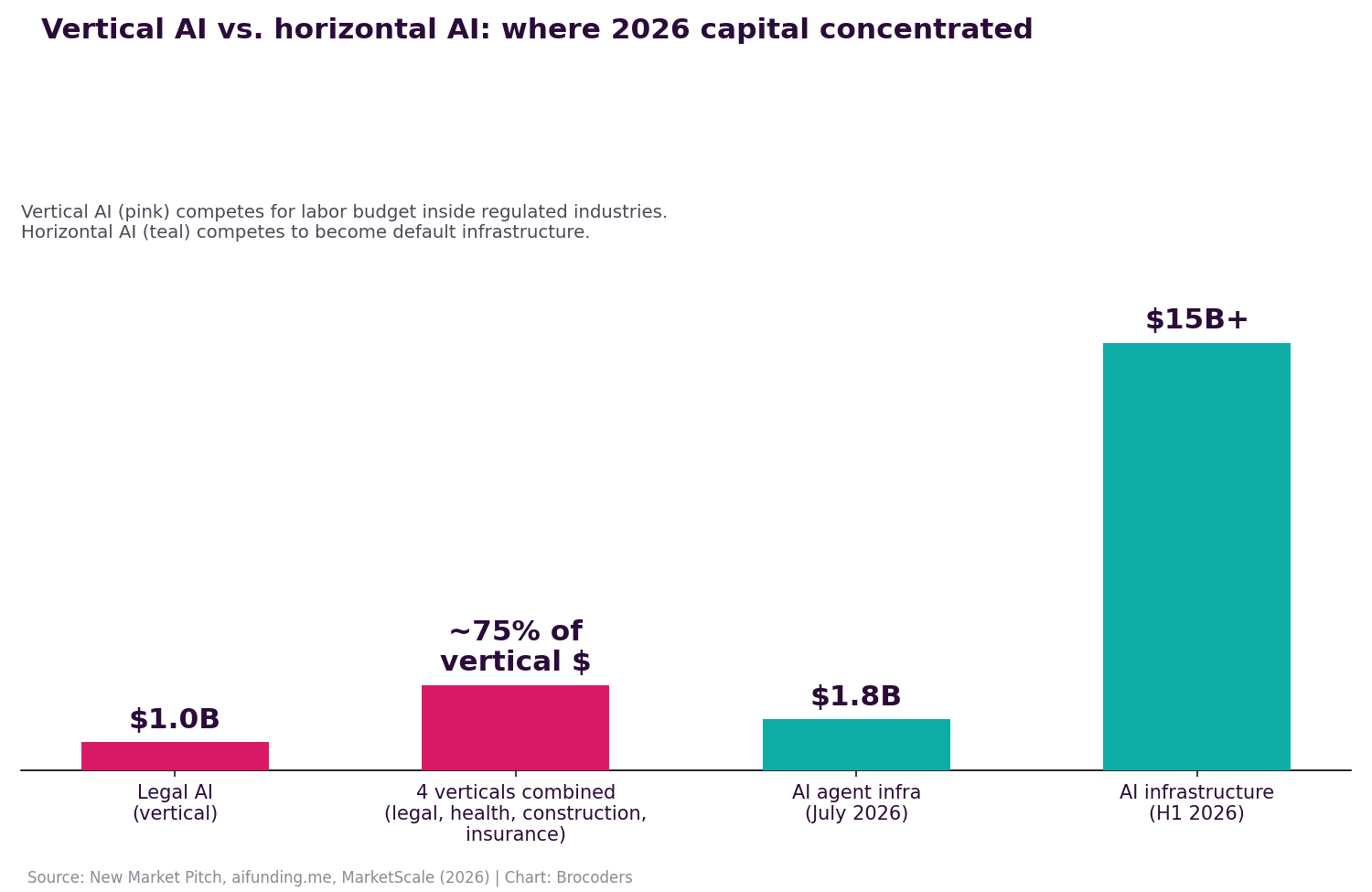
Vertical AI competes for labor budget inside regulated industries. Horizontal AI competes to become default infrastructure. Sources: New Market Pitch, aifunding.me, MarketScale.
Neither game is inherently better. But building a vertical product with a horizontal go-to-market, or the reverse, is how founders burn a year discovering they were measuring themselves against the wrong benchmark.
The scale of both games is visible in the money moving through them. Global AI companies raised $149.5 billion in equity funding in Q2 2026, the second-highest quarterly total on record after Q1's $237.6 billion, according to CB Insights' State of AI Q2 2026 report. Nearly all of it concentrated at the top: 89% of that funding, $132.5 billion, went into just 142 mega-rounds of $100 million or more. That concentration produced 37 new AI unicorns in the quarter, the highest count since Q2 2022, and one landmark exit, Cerebras's $40.6 billion IPO, the quarter's largest.
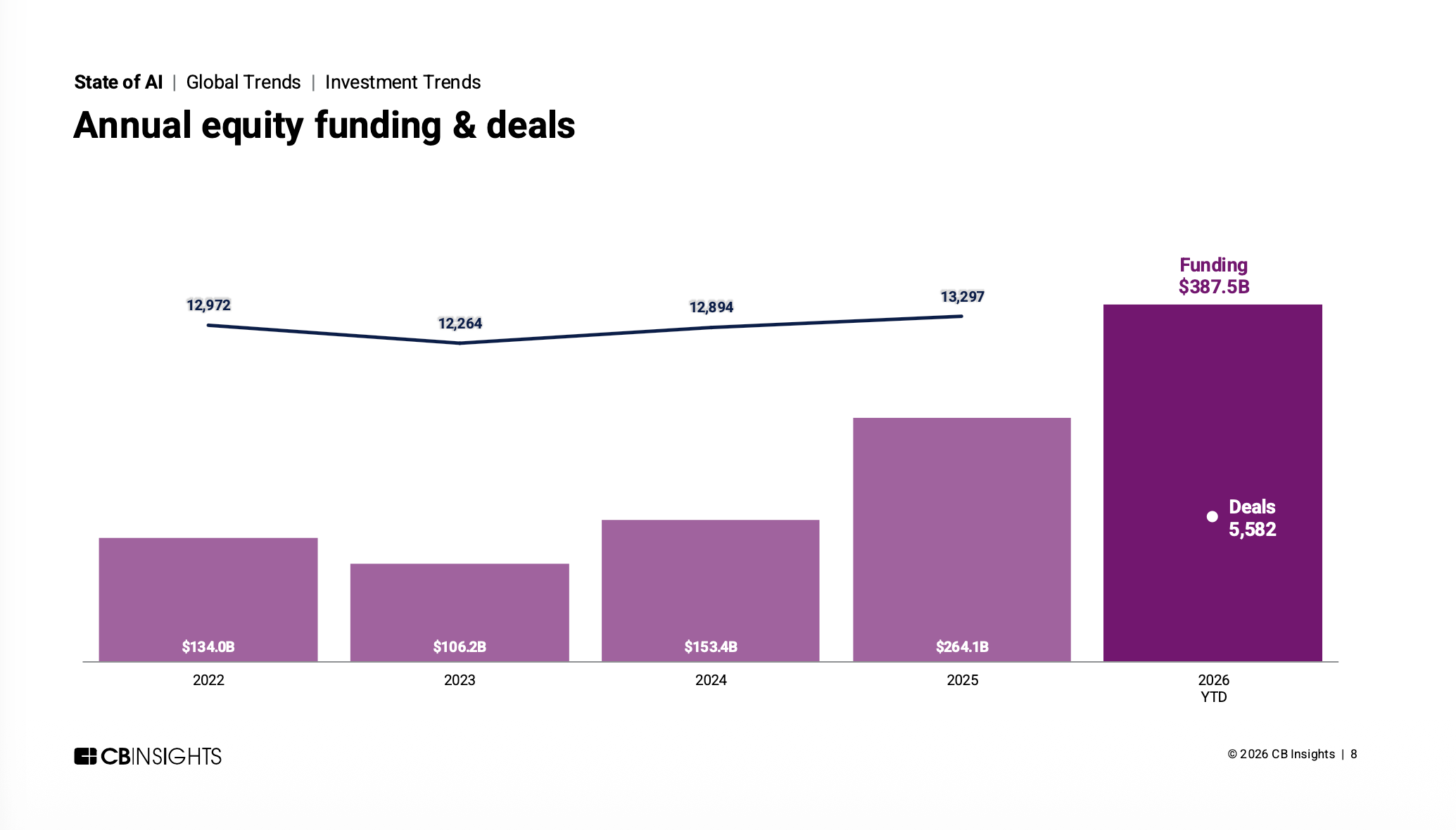
The mega-round pattern shows up directly in the names already in this article. Five of Q2 2026's largest rounds went to Anthropic, which closed a $50 billion Series H at a $965 billion valuation, followed by three additional Anthropic raises of $10 billion and $5 billion, Project Prometheus at $12 billion, and DeepSeek at $7.5 billion. Cognition's $1.0 billion Series D, already cited above, sits inside that same wave of capital concentrating in fewer, larger checks rather than spreading across more companies.
Geographically, the US pulled in $112.0 billion across 924 deals in Q2 2026 alone, more than five times Asia's $19.4 billion across 495 deals and Europe's $15.0 billion across 503 deals, according to CB Insights.
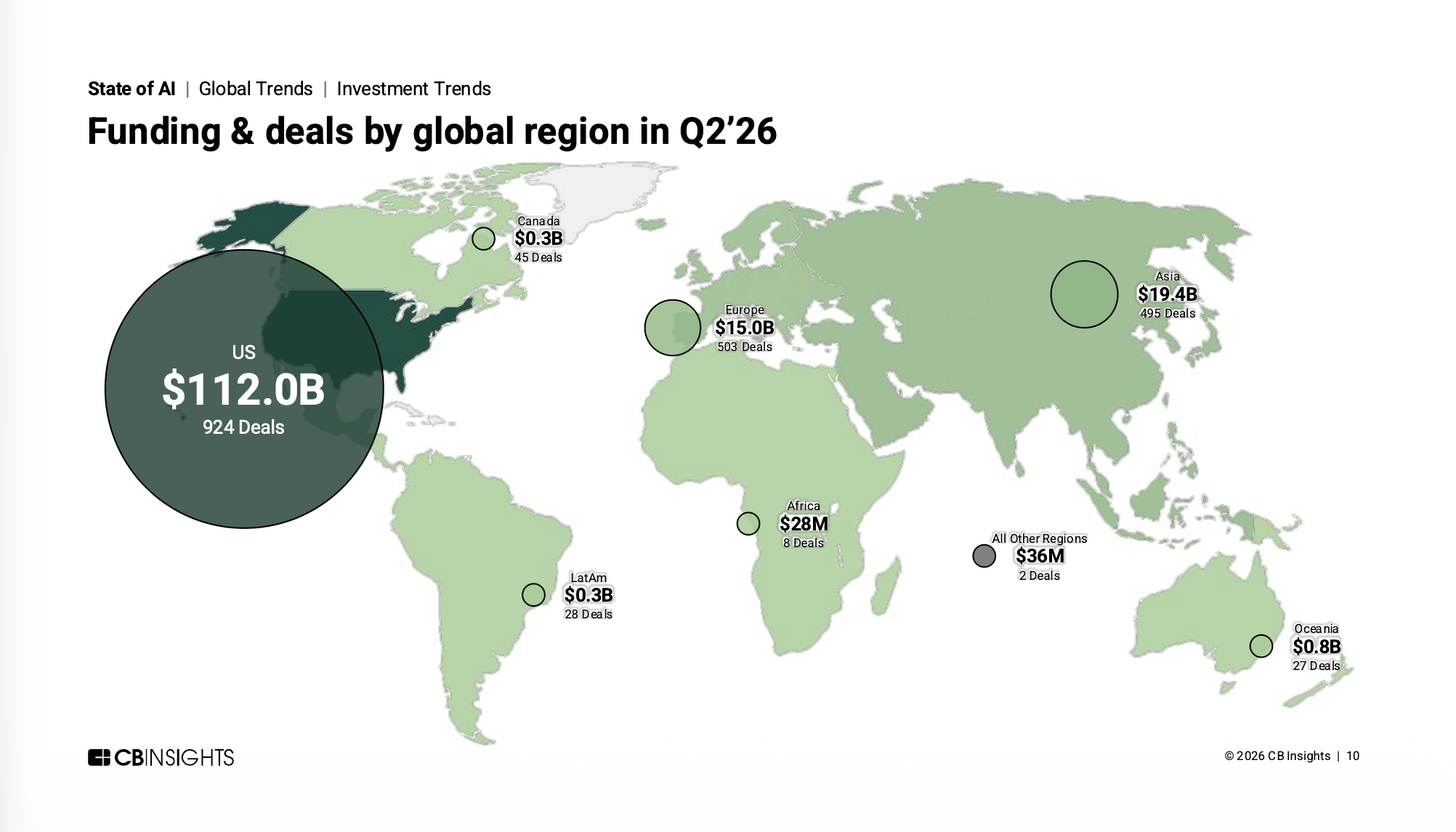
Source: CB Insights, State of AI Q2 2026
Top 5 vertical AI niches in 2026
Here in Brocoders, we track where AI capital and delivery demand actually land, not where the headlines point. These five verticals are where 2026's real budget, YC batch activity, and funding rounds are concentrated.
1. Legal AI
Legal is the largest single capital category in vertical AI this year, capturing $1.0 billion, or 33.5% of total vertical AI dollars (New Market Pitch). The work being automated is document-heavy and billed by the hour: contract review, litigation document automation, medico-legal case management, and legal research and drafting. Docura Health, part of YC's Winter 2026 batch, sits at the exact intersection this vertical rewards, an AI-native medico-legal firm using AI to handle medical-legal documentation and case management, a category TechCrunch called mature enough for AI precisely because it was previously too risky for startups to touch.
The workflow shift is concrete. Associates and paralegals used to review contracts and case files manually, billed hourly, one document at a time. Now AI drafts the first pass and humans review only the exceptions, cutting cycle time and cost per matter. Legora, Filevine, Harvey, EvenUp, and Ironclad each raised rounds of at least $150 million in 2026, and Series B rounds alone captured $443 million of total legal AI capital, a signal that investors see this as a repeatable, scalable category, not a one-off bet.
2. Healthcare AI
Close to 10% of YC's Winter 2026 batch built in healthcare, according to onhealthcare.tech's field notes on the demo day. The products span prior-authorization engines, medical coding and revenue-cycle automation, regulatory-filing copilots for pharma and medtech, and patient scheduling and insurance-verification agents. Named companies from that batch include Patientdesk (scheduling and insurance verification), Ritivel (regulatory filings for pharma and medtech), Overdrive (medical coding and claims automation), and Zatanna (an agent that adapts to each organization's admin processes).
The old workflow buried admin staff in paperwork and denials. The new one lets agents handle the first pass on claims, coding, and prior authorization, with humans stepping in only for appeals and exceptions. Atlas Discovery, from YC's Summer 2026 batch, builds foundation models of patient drug response directly from pre-clinical and clinical data, a signal that healthcare AI investment is moving past administrative automation into drug discovery itself.
3. Proptech and real estate AI
Venture firms invested $16.7 billion in property technology in 2025, a 67.9% increase over 2024, and January 2026 alone brought in $1.7 billion, up 176% year over year, according to The AI Consulting Network. Four AI-native proptech companies became unicorns in 2026: EliseAI at $2.2 billion (AI leasing for multifamily), Bedrock Robotics at $1.75 billion (autonomous construction vehicles), Vantaca at $1.25 billion (AI HOA management), and Juniper Square at $1.1 billion (AI investor relations and fund administration), according to Bisnow.
Leasing agents and property managers used to screen tenants and coordinate maintenance manually. Now AI handles the first-line leasing conversation, tax appeals, and fund reporting, freeing human staff for the judgment calls that actually need them. Cambio raised an $18 million Series A in January 2026 at a $100 million valuation for AI asset-management software aimed at institutional CRE investors, and Ownwell raised $50 million in February for AI property-tax appeals, both signs, per MarketScale, that proptech AI has moved well past leasing chatbots into back-office finance functions.
4. Construction and field operations AI
Proptech's next growth phase is landing less in consumer-facing platforms and more in the back-office and field-operations layers that have historically resisted digitization, a pattern MarketScale flagged directly in its 2026 construction-tech coverage, and one that sits at the center of what we in Brocoders build through Fieldera, our own field operations platform currently in design-partner stage. FlowManual, from YC's Summer 2026 batch, reads contracts, specifications, bids, and invoices for HVAC and MEP contractors, automating a task estimators used to spend days on.
That shift is measurable. Rebar, which builds an AI operating system for HVAC, electrical, and plumbing suppliers, reports that computer-vision blueprint analysis cuts quote generation time by 60 to 70% and boosts win rates two to three times over, according to SaaSRise's coverage of the round. Field AI raised a $405 million growth round in June 2026 for a software-first autonomy stack aimed at construction robotics, and Xpanner closed an $18 million Series B in May for construction-site robotics. Estimators reading blueprints by hand for days is becoming the exception, not the norm.
5. Insurance AI
Insurance sits alongside legal, construction, and healthcare as one of the four verticals capturing nearly three-quarters of all disclosed vertical AI dollars in 2026 (New Market Pitch). The products automate claims processing, underwriting, damage assessment, fraud detection, and policy servicing, work that used to mean adjusters manually inspecting damage over weeks. AI now triages claims and flags fraud in near real time, with human review reserved for genuine exceptions.
Named 2026 funding rounds specific to insurance AI were harder to isolate publicly than in the other four verticals this year, a gap worth flagging rather than papering over. What we can point to directly is our own delivery experience in the category: Ekora Insurance, an insurtech platform we built here in Brocoders integrating Stripe, DocuSign, FMCSA compliance checks, and OpenAI, is a concrete example of what the shift from manual underwriting to AI-assisted policy servicing looks like in practice.
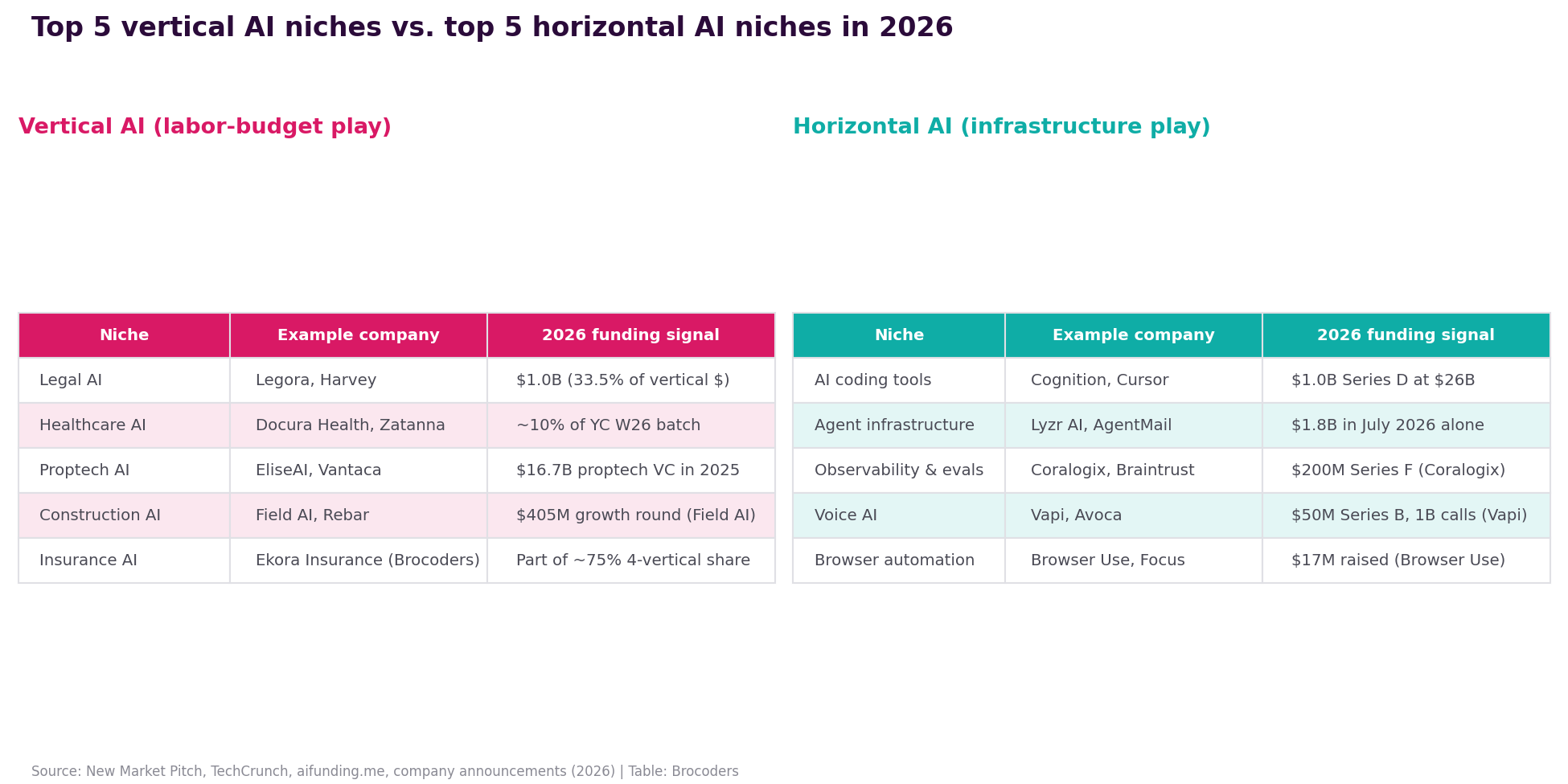 Sources: New Market Pitch, TechCrunch, aifunding.me, company announcements (2026)
Top 5 horizontal AI niches in 2026
1. AI coding tools
This is the fastest-scaling revenue category in AI software. Cognition AI, the company behind Devin, grew revenue from $37 million to $492 million in twelve months, a 13x increase, and closed a Series D above $1 billion at a $26 billion valuation, with customers including Goldman Sachs, Citi, Palantir, and NASA, according to TechTimes' coverage of the round. Cursor's parent company, Anysphere, closed a $2.3 billion round at a $29.3 billion valuation in late 2025, then was acquired by SpaceX for $60 billion in June 2026, the largest venture-backed startup acquisition on record.
The two companies represent different bets on the same shift. Devin delegates entire coding tasks to an autonomous agent. Cursor assists a human engineer pair-programming inside their editor. The market is pricing Cognition at roughly 53 times revenue against Cursor's 30 times, a signal that investors are betting more heavily on agent-first architecture replacing the assistant model than the reverse.
2. AI agent infrastructure
AI agent startup funding hit $1.8 billion across more than twelve deals in July 2026 alone, with median post-money valuations up 40% from Q1's $200 million median, according to aifunding.me. Lyzr AI raised a $25 million Series A for an enterprise agent production platform, and AgentMail is building email infrastructure purpose-built for AI agents rather than humans. Broader AI infrastructure funding topped $15 billion across 53 companies in the first half of 2026, including Nebius's $6.3 billion round for European GPU sovereignty, per aifunding.me's infrastructure analysis.
The shift here is structural. Agents used to be built as one-off scripts with no shared infrastructure underneath them. Now dedicated payments, inference, search, and messaging rails are being built specifically for agent-to-agent and agent-to-system interaction. We have direct experience building on this layer: CompressorWorld's AskAC.ai runs on LlamaIndex and OpenAI for retrieval-augmented recommendations, Perspection.ai uses Gemini for decision intelligence, and BrainBox deploys LLM agents behind Google SSO for enterprise workflows, all delivered here in Brocoders.
3. AI observability and evals
Production reliability, not model capability, is now the bottleneck for companies running agents at scale. Coralogix raised a $200 million Series F in June 2026, co-led by Advent, CPPIB, and Greenfield, bringing total funding to $550 million, according to Advent International's announcement. Braintrust raised an $80 million Series B at an $800 million valuation in February, per its own announcement. New Market Pitch's analysis of the category is blunt about where the market is heading: evaluation and red-teaming are moving beyond one-off testing into continuous monitoring, production observability, and live protection.
The old approach was manual QA, spot-checking model outputs after the fact. The new approach is automated tracing and live guardrails running across the full agent lifecycle, catching failures before they reach a customer rather than after.
4. Voice AI
Enterprise voice has moved past IVR replacement into full call-handling agents. Vapi raised a $50 million Series B in May 2026, led by Peak XV with participation from Microsoft's Venture Fund and Kleiner Perkins, after reaching one billion calls processed and hitting a $500 million valuation when Amazon Ring chose it over 40 competing platforms, according to TechCrunch. Avoca raised more than $125 million across its Seed, A, and B rounds to reach a $1 billion valuation, building AI voice agents specifically for service businesses, HVAC, plumbing, automotive, and moving companies, as reported by GlobeNewswire.
That last detail matters here in Brocoders. Avoca's target customer overlaps directly with Fieldera's field service ICP, evidence that voice AI and field operations software are converging on the same buyer from two different directions. The old model was scripted IVR with human overflow. The new one is AI handling scheduling, follow-ups, and full conversations autonomously, with humans stepping in only on exceptions.
5. AI browser automation
Three developments converged to make browser agents viable in 2026, according to ACTGSYS's analysis: models like GPT-4o, Claude 4, and Gemini 2.5 became reliable enough to interpret page structure, understand navigation patterns, and plan multi-step actions without constant human correction. Browser Use raised $17 million for an open-source Python library and cloud service that automates agent web interaction, per its listing, and Focus, which automates back-office tasks agentically, announced funding in June 2026, as covered by Firecrawl.
Traditional RPA scripts broke the moment a target website changed its layout. LLM-reasoning agents adapt to those changes instead of failing on them, handling multi-step web tasks without hardcoded selectors that need constant maintenance.
The expert disagreement nobody resolves
Not every credible voice in this space agrees on the timeline, and that disagreement is worth sitting with rather than smoothing over. Andrej Karpathy, OpenAI's co-founder, has compared today's coding agents to interns: capable of real work, but not yet able to operate without a person guiding them, and he expects that gap to close over roughly a decade, not a quarter. Dario Amodei, Anthropic's CEO, takes the opposite position, arguing AI is already becoming a general labor substitute for humans across industries, not a decade out but now.
Both men build frontier models for a living. Neither is speaking from the sidelines. The honest takeaway is not that one of them is wrong, it is that the pace of this shift is genuinely contested by the people closest to it, which should temper any roadmap that assumes agents will be fully autonomous by a specific date rather than building in room for the slower path too.
What this means if you're building right now
Start by naming which game you are actually in. If you are building for a regulated, labor-heavy industry, legal, healthcare, construction, insurance, or a similar category, your benchmark is the labor cost you are replacing, not a software line item, and your moat is domain-specific accuracy and compliance, not raw model access. If you are building infrastructure, agent orchestration, evals, voice, or automation rails, your benchmark is becoming the default layer other builders depend on, and your moat is being the rails, not the application sitting on top of them.
The a16z framing worth holding onto is that in 2026 vertical AI, the real moat is coordination, agents negotiating and synchronizing across multiple parties, not raw task automation. Automation alone is commoditizing fast as foundation models improve. Multi-party orchestration, the kind that requires deep domain knowledge of how a legal matter, an insurance claim, or a construction bid actually moves through an organization, is harder to replicate and slower to erode.
Here in Brocoders, we build across both games rather than picking one, because the delivery discipline that matters, senior architects owning the system design while AI accelerates execution, applies whether the product is a vertical insurance platform like Ekora or a horizontal agent layer like the ones behind CompressorWorld's AskAC.ai and Perspection.ai. That discipline is what our AI product development services are built around, whichever game you're playing. Fieldera, our own field operations product, is our clearest vertical bet, currently in design-partner stage rather than deployed at scale, and it sits exactly where the construction and field-ops research above points: the back-office and field layers that have resisted digitization the longest.
Conclusion
The founders who win in 2026 are not the ones chasing the loudest AI headline. They are the ones who can name, precisely, which game they are playing, a labor-budget play inside a regulated industry, or an infrastructure-layer play racing to become the rails everyone else depends on, and who build their moat, coordination depth or infrastructure defensibility, accordingly. If you are weighing where your own AI product fits into either game, we in Brocoders build across both and would welcome the conversation.
Frequently Asked Questions
Vertical AI builds products for a single industry, legal, healthcare, insurance, competing for a share of that industry's labor budget. Horizontal AI builds infrastructure and tooling used across every industry, agent orchestration, coding tools, observability, competing to become the default layer other AI products depend on.
Legal, healthcare, construction, and insurance together captured nearly three-quarters of all disclosed vertical AI dollars in 2026, with legal alone pulling in roughly $1.0 billion, according to New Market Pitch's funding analysis.
Neither is inherently bigger. a16z partners frame vertical AI as a 10x larger opportunity than vertical SaaS because it taps labor budgets rather than IT budgets, while horizontal infrastructure investment topped $15 billion in the first half of 2026 alone. The right choice depends on whether your team's edge is domain expertise in a regulated industry or infrastructure-building capability that serves many industries at once.
Global AI equity funding reached $149.5 billion in Q2 2026, the second-highest quarter on record, with 89% of that capital ($132.5 billion) going into 142 mega-rounds of $100 million or more, according to CB Insights' State of AI Q2 2026 report. The US accounted for $112.0 billion of that total across 924 deals.
Named examples include Docura Health and Atlas Discovery in healthcare and legal, Patientdesk, Ritivel, Overdrive, and Zatanna in healthcare administration, and FlowManual in construction, drawn from YC's Winter and Summer 2026 batches.
SpaceX's acquisition of Anysphere, announced June 16, 2026, is the largest venture-backed startup acquisition on record, reflecting how central AI coding infrastructure has become to companies building software at scale.
The most defensible 2026 products go beyond single-task automation into coordination, agents negotiating and synchronizing information across multiple parties in a workflow, which is harder to replicate than automating one isolated task and slower to be commoditized by the next model release.
We deliver both vertical and horizontal AI products with the same discipline: senior architects own the system design while AI accelerates execution. Ekora Insurance and Fieldera represent our vertical work, and CompressorWorld's AskAC.ai, Perspection.ai, and BrainBox represent our horizontal agent infrastructure work.