
A founder picks usage-based pricing because the benchmarks say it grows revenue faster. Three weeks later, engineering comes back with a problem: the product can't measure usage cleanly enough to bill for it. The pricing page is ready. The product underneath it is not.
This happens constantly. Pricing gets treated as a marketing decision, a slide owned by finance and growth, when the model you can actually charge for is the one your product can measure, enforce, and bill. That part lives in the architecture, and it's the part most pricing guides skip.
The market is big enough to make the stakes real. The global SaaS market reached roughly $390 to $408 billion in 2025 and is projected to land near $465 to $512 billion in 2026, depending on how each research firm defines the category (Statista, Precedence Research). Gartner now calls software the fastest-growing IT spending category for 2026, at 14.7% year-over-year growth (Gartner).
TL;DR: SaaS pricing models fall into 7 main types, from flat-rate to usage-based, and the market is shifting hard toward usage and hybrid models. The model you can charge for is the one your product can measure, enforce, and bill, so the real constraint on your pricing strategy is your billing and metering architecture, not your pricing page.
What SaaS pricing models are, and how they differ from pricing strategy
A SaaS pricing model is the mechanism you use to bill customers: a flat fee, a charge per user, a charge per unit of usage, or some mix. A pricing strategy is the thinking above it: who you target, how you package value, where you set your tiers.
The distinction matters because the two get built in different places. Strategy lives in spreadsheets and positioning docs. The model lives in your code: in how you meter consumption, enforce entitlements, handle proration, and push invoices to a billing provider like Stripe. A strategy can change in a meeting. A model change ships through engineering.
That's why so many SaaS companies feel stuck with the pricing they launched with. The strategy moved on, and the product couldn't follow.
The 7 SaaS pricing models, and what each one demands from your product
Here are the seven models most SaaS companies use, with the engineering reality attached to each. The table covers the basics; the notes underneath cover what it takes to run them.
| Pricing model | How it works | Pros | Cons | Examples | Best for |
|---|---|---|---|---|---|
| Flat-rate | One fixed fee, all features, any usage | Predictable revenue, simple to sell | Leaves money on the table with heavy users | Basecamp | Single-product tools with steady usage |
| Usage-based | Charge by consumption: API calls, data, transactions | Fair, scales with customer value | Revenue is harder to forecast | Twilio, AWS | Infrastructure and API products |
| Tiered | Several packaged plans with rising limits and features | Captures different segments, drives upsell | Tier design is hard to get right | HubSpot, Mailchimp | Products with a wide range of buyers |
| Per-user (per-seat) | Charge per user account | Easy to understand and forecast | Customers share logins to save money | Slack, Microsoft 365 | Collaboration tools |
| Per-active-user | Charge only for users active in the period | Feels fair, lowers adoption risk | Needs reliable activity tracking | Slack (active model) | Tools with uneven usage across seats |
| Per-feature | Charge for specific features or modules | Flexible, customers pay for what they need | Can confuse buyers, complex to bill | Atlassian add-ons | Products with clearly separable features |
| Freemium | Free base tier, paid upgrades | Fast adoption, large top of funnel | Free-to-paid conversion is the hard part | Dropbox, Notion | Products with viral or bottom-up growth |
Flat-rate is the easiest to build. One price, one entitlement, no metering. The engineering cost shows up only when you outgrow it and need to add tiers later.
Usage-based pricing is where most teams underestimate the work. You need accurate, real-time metering you can defend on an invoice, plus a way to handle overages, proration, and disputes. If your event tracking is approximate, your billing is wrong, and customers notice fast. This model carries the highest commercial value in the cluster, with a US cost-per-click around $14 in paid search, which tells you how much buyers are searching for it.
Tiered pricing needs an entitlements system that can turn features and limits on and off per plan, cleanly, without a developer editing code each time you adjust a tier. Get this wrong and every pricing experiment becomes a deploy.
Per-user and per-active-user models depend on identity and activity tracking. Per-active-user in particular requires you to define "active" precisely and measure it consistently, or finance and customers will disagree about the bill.
Per-feature and freemium both lean on the same entitlements layer as tiered pricing, plus clean upgrade and downgrade paths. Freemium adds the load of supporting a large non-paying base without letting infrastructure costs eat the model.
Why pricing models break in production
Most pricing models fail in the same few places, and all of them are technical.
Metering you can't trust is the first. Usage-based and per-active-user models only work if the numbers on the invoice match what the customer believes they used. Approximate event logging, dropped events during outages, and timezone bugs in billing periods all turn into refund requests and churn.
Entitlements you can't enforce is the second. If a customer on the Basic plan can reach Pro features through an unguarded API endpoint, your tiers are decorative. Enforcement has to live at the API and data layer, where UI checks alone can't reach.
Billing logic that can't handle the edges is the third. Proration on mid-cycle upgrades, overage charges, annual-to-monthly switches, taxes across regions, failed payments and retries: each is a small system, and skipping them is how revenue leaks.
Legacy systems that can't change is the fourth, and the most expensive. A monolithic back end built for one pricing model often can't support a new one without a rebuild. We've seen companies pay a five-figure monthly platform bill while only 20% of the system serves their actual workflow, because the cost of changing it feels higher than the cost of staying.
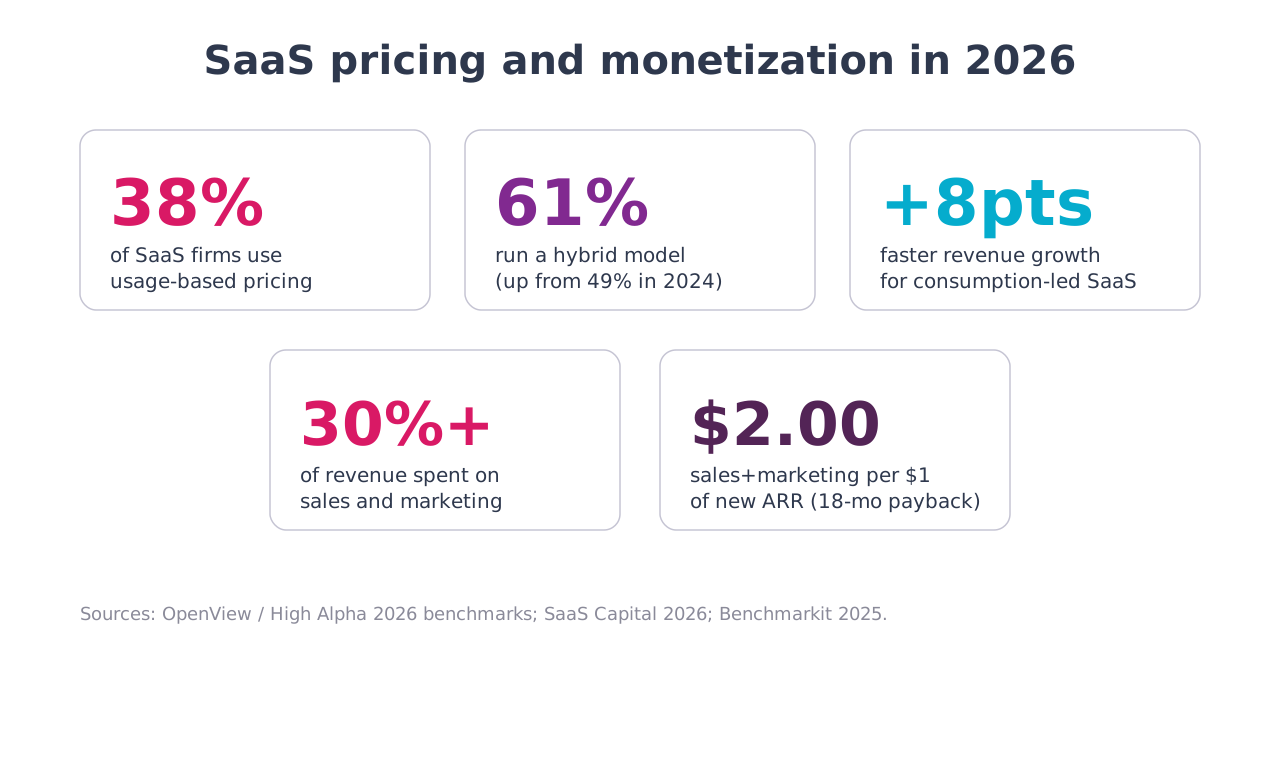
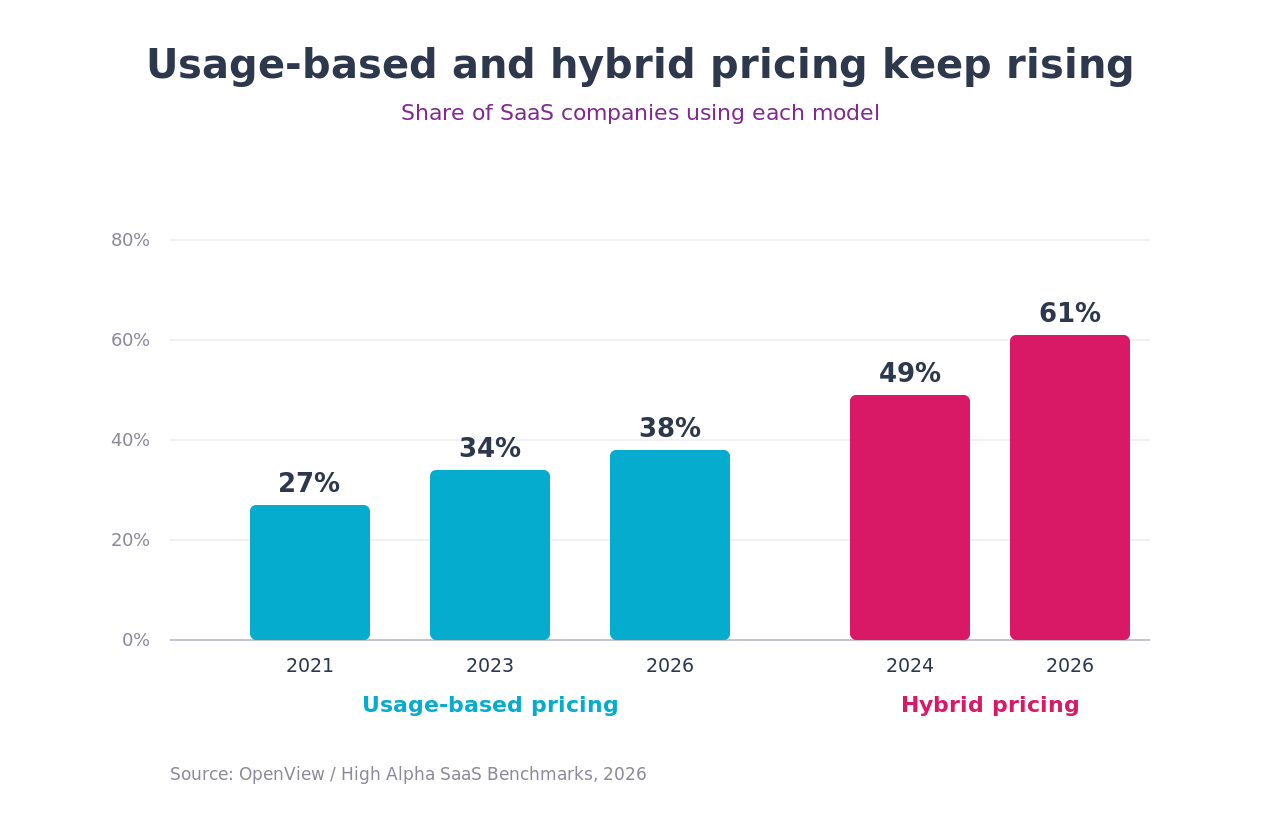
The market is moving exactly toward the models that demand the most engineering. As of 2026, 38% of SaaS companies use some form of usage-based pricing, up from 27% in 2021 and 34% in 2023, and 61% now run a hybrid model that combines a base subscription with usage, up from 49% in 2024 (OpenView / High Alpha benchmarks). Companies leaning consumption-based grow revenue around 8 percentage points faster than flat-rate-only peers. The pricing the market rewards is the pricing your product has to be built to support.
What it looks like when the architecture supports the model
When the system underneath the pricing page is built right, the business can change its model without a crisis. Here are three builds where that played out.
Lake rebuilt its back end and grew connected properties 80x. Lake's vacation-rental platform ran on a monolithic back end that couldn't scale, which capped how many properties it could connect and, by extension, how much it could ever charge. We in Brocoders rebuilt the architecture in 3 months. The result: an 80x increase in connected properties, from roughly 500 to 40,000, and a 210% spike in website activity (case study). The pricing ceiling was an engineering ceiling, and moving one moved the other.
Revenue Boosters got a route-management SaaS built from scratch in 3.5 months. Revenue Boosters, a US amusement operator running coin-operated machines across many locations, needed a real SaaS platform for route management and revenue tracking, with a web dashboard and mobile apps for collectors. We built it in 3.5 months with the role model and tracking designed in from day one, using React, NestJS, and React Native (case study). When billing logic and roles are part of the original design, the pricing model has somewhere solid to sit.
AreaButler scaled its SaaS product with an embedded engineering team. AreaButler, a German proptech company, offers personalized location analysis to real estate professionals as a subscription SaaS. We augmented their team with remote engineers to accelerate development of the product and its multi-language, AI-assisted features (case study). Steady engineering capacity is what lets a SaaS keep evolving its packaging instead of freezing it. We did the same for a Canadian payroll SaaS, building dedicated billing and banking modules that reconcile fees, failed payments, and payroll runs.
The common thread: in each case the pricing model the business wanted was only possible because the product could measure, enforce, and bill for it.
How pricing and the sales motion fit together
Your pricing model also sets your sales motion, so they have to be chosen together.
Low-touch, self-serve pricing (flat-rate, freemium, simple usage tiers) pairs with a self-service sales model: the product and the pricing page do the selling, and customers sign up without talking to anyone. Mid-complexity pricing pairs with transactional sales, where a rep runs demos and answers questions. Enterprise pricing, with custom terms and SLAs, pairs with a full enterprise sales motion and longer cycles.
This matters for budgeting, because sales and marketing is the largest line item in most SaaS companies. Median spend now runs above 30% of revenue for B2B SaaS, roughly 15% of ARR on selling and 8% on marketing (SaaS Capital). The model you pick decides how much of that engine you need.
Contact us for a free consultation and technical expertise
Get a free consultation for your SaaS product
Talk to our expertHow to choose your SaaS pricing model: 5 questions
Pick your model by testing what your product can actually support. Five questions sort it out:
- Can you meter the thing you want to charge for, accurately and in real time? If not, usage-based and per-active-user models are off the table until the metering exists.
- Can you enforce tiers and entitlements at the API and data layer? If enforcement only lives in the UI, tiered and per-feature pricing will leak.
- Can your billing handle proration, overages, and failed payments? These edge cases are where revenue quietly disappears.
- Can the system change when your pricing changes? If a new tier means a rebuild, your strategy is hostage to your architecture.
- Who owns the metering and billing data, and is it trustworthy? Finance, product, and engineering need to agree on one source of truth before you bill against it.
If the answer to several of these is no, the first project isn't a pricing change. It's the billing and metering work that makes the pricing change possible.
The metrics that tell you the model is working
Track these to know whether your pricing model is doing its job:
- Monthly recurring revenue (MRR): the recurring base your model produces.
- Net revenue retention (NRR): whether existing customers expand; hybrid and usage models tend to lift this.
- Churn rate: how fast customers leave, and a fast read on whether pricing matches value.
- Customer acquisition cost (CAC): now around $2.00 of sales and marketing spend per $1 of new ARR, up 14% year over year (Benchmarkit).
- CAC payback period: median 18 months, with best-in-class under 12.
- Customer lifetime value (CLV): the long-run revenue per customer your model supports.
Building the system behind your pricing
The pricing model you can charge for is the one your product can measure, enforce, and bill. Choosing flat-rate, usage-based, tiered, or hybrid is the easy part. Making it run cleanly in production, with metering you can defend and billing that handles the edges, is the work that decides whether the model holds.
That's the work we do here in Brocoders. We build the SaaS products underneath the pricing page: the metering, the entitlements, the billing integrations, and the rebuilds that let a pricing model scale. If your pricing strategy has outrun your architecture, our SaaS development team can help you close the gap.
Frequently Asked Questions
The seven most common are flat-rate, usage-based, tiered, per-user, per-active-user, per-feature, and freemium. Most companies combine two or more, most often a base subscription plus a usage component.
Usage-based pricing charges customers by what they consume, such as API calls, data processed, or transactions handled. It aligns cost with value, and it requires accurate, real-time metering to bill correctly.
Subscription pricing gives you predictable revenue and is simpler to build. Usage-based pricing tracks customer value more closely and tends to grow revenue faster, around 8 percentage points faster than flat-rate-only models, but it needs reliable metering and billing infrastructure.
Hybrid pricing combines a fixed base subscription with a usage-based component. As of 2026, 61% of SaaS companies use some form of hybrid model, up from 49% in 2024, because it balances predictable revenue with expansion.
Start with what your product can support: whether you can meter usage accurately, enforce tiers, and handle billing edge cases. Match the model to that capability and to your sales motion, then test and adjust with real customer data.
Because the model lives in the product itself, down in the code that runs the pricing page. Changing it usually means new metering, new entitlement enforcement, and new billing logic, and on a legacy system it can require a back-end rebuild.
Median spend is above 30% of revenue for B2B SaaS, roughly 15% of ARR on sales and 8% on marketing. The figure rises with deal complexity and the sales motion your pricing model requires.