
CB Insights' March 2026 analysis of 431 venture-backed startups that shut down since 2023 found poor product-market fit behind 43% of the failures. A minimum viable product (MVP) partner lowers that risk in one way: it challenges the scope before the build starts, so the first release tests the riskiest assumption first.
Most "top MVP development companies" lists rank vendors by logos and badges. This one ranks 10 companies by what they publish and what a founder can check. That means a named client with a number, a stated MVP timeline, a published price, and a Clutch profile read review by review.
Brocoders wrote this list. We build MVPs ourselves, so we left ourselves out of the ranking. Our own entry sits unranked in How this list was made, judged by the same test.
TL;DR: The 10 MVP development companies below are ranked by how much of their MVP work you can verify before a sales call. DBB Software, Emerline, and Relevant Software publish the most: named MVP clients with numbers, stated timelines, and, for 2 of them, prices.
Published MVP build windows run from 8 weeks (Emerline) to 6 months (ScienceSoft on a low-code base). Published MVP prices run from $5,000 for a basic build at Emerline to $300,000 for a SaaS MVP at ScienceSoft. Before you sign with anyone, ask for a feature they talked a client out of building, the list of discovery outputs, and post-launch terms in writing.
How this list was made
Brocoders wrote this page, and we sell MVP development services, so you know who built the shortlist. We read each company's Clutch profile, its MVP service page where it has one (8 of 10), and its published case studies by hand, checked on Oct. 16, 2026. We did not use other listicles as a source, and no vendor paid to be listed.
The order follows one question: how much of the company's MVP work can a founder verify before the first call? A company moves up for a named MVP client with an outcome number, a published MVP timeline, a published price, and a Clutch record with enough reviews to read patterns in. Every entry also lists its weaknesses, written by the same rule.
Brocoders (Tallinn, Estonia): AI-native MVP builds and takeovers (author, not ranked)
Overview: Brocoders is an AI-native software development company from Estonia that builds new products and takes over software a business already runs. AI-native development means AI writes code into a fixed, open-source architecture, while senior engineers own the architecture, tests and security review. Founded in 2014, we hold 5.0 Clutch rating from 38 reviews and have 87 engineers, about 60% of them senior.
Core focus:
- SaaS and AI MVPs, from discovery to launch, with the client owning all the code
- Takeovers and modernization of MVPs and platforms other teams built: 23% of our delivered client engagements were takeovers or modernizations of software the client already ran
- Healthcare, proptech, martech, field operations, and education products
- $45 to $55 an hour (Clutch band $50 to $99), with a Code and Architecture Audit from $5,000 in 5 business days before any rebuild quote
Real project examples & client quotes:
- CoreHealth (UK, name changed under a nondisclosure agreement): we built a working doctor consultation platform in 6 weeks, from the start of design on Aug. 3 to a recorded demo on Sept. 15, 2023. The full MVP followed in October 2023, and the same codebase later took on pharmacy and custody consultations. CoreHealth case study.
- Revenue Boosters, by Business Connections IT (Kentucky, US): we built a route management SaaS with a web dashboard and iOS and Android apps for collectors. The MVP was delivered in 3.5 months. Revenue Boosters case study.
"The whole Brocoders team took this project and made it a complete masterpiece." David Finley, Owner, Business Connections IT
- A martech AI client: we built a video-to-creative-brief MVP on n8n, a workflow automation tool, and a large language model (LLM) pipeline. It took 75 hours and cost $3,375, about 17% under the $4,050 estimate, with the harder personalization features moved to a documented second iteration.
- A micro-learning product: swipeable card courses, a filmstrip editor, and an AI course generator, built by a 3-person team in 2 weeks.
Strengths:
- 4 delivered builds with stated durations, from 75 hours of work (martech AI) to 3.5 months (Revenue Boosters)
- A published hour-by-hour estimate for a 9-module SaaS MVP, so you can check our numbers before a call
- We built our own field service product, Fieldera, from one requirements document in 5.5 days: 82 database models, 343 API endpoints, and about 454 automated tests.
- The audit can come back with “don’t rebuild”, and the client keeps every artifact either way.
Weaknesses / considerations:
- Netguru has 73 Clutch reviews to our 38, so a buyer who needs a large public review record has a better sample there
- A team of 50 to 249 people can't put 30 engineers on one build in week one
- We don't publish a discovery price or a warranty length either, so ask us the same questions as everyone else
Scope Discipline Test (public record): Signals 1 and 3 shown (the martech MVP's documented second iteration, published module hours). Signals 2 and 4: ask on the first call. Signal 5: not tested.
Key stats:
- Employees: 50 to 249 (Clutch), 87 engineers (company)
- Clutch reviews: 38
- Average rating: 5.0/5.0
- Hourly rate: $45 to $55 (Clutch band $50 to $99)
- Typical project budget: $10,000+ minimum
- Founded: 2014
- Headquarters: Tallinn, Estonia
- Distinction: The author of this list, held to the same test, with 4 delivered builds and their durations on record.
If you want our process in detail, the MVP development process article walks through it with real timelines, and our MVP case studies collect the rest.
The Scope Discipline Test: 5 signals
Most MVP budgets go to features no user has tested yet. That is how a product reaches launch on time and still fails on product-market fit, the reason behind 43% of the shutdowns CB Insights analyzed. The 5 signals below show whether a company will help you build less, with evidence, before you pay for more, and you can run them on any vendor you shortlist.
Signal 1: They can name a feature they talked a client out of building
Ask: "Tell me about a feature you convinced a client not to build, and what happened next." A team that cuts scope remembers the cut, the client, and the result.
Classic Informatics gives a public example: for the Australian travel startup RoamingDuck, the team recommended one responsive web app over separate iOS and Android apps. Our martech AI MVP made a similar call: we moved the harder personalization features to a documented second iteration, which kept the build at 75 hours and $3,375.
Signal 2: Discovery is a paid phase with listed outputs
Three companies on this list publish their discovery phase with a length or a price.
DBB Software runs a 2- to 3-week Scope Workshop and sells the Scope & Design Document from $1,777. Altar.io runs a 15-day Product Scope. Emerline lists a 1- to 2-week discovery sprint.
Whatever the format, ask for the list of outputs before you pay: an architecture diagram, a user story map with acceptance criteria, a third-party integration check, a phased roadmap, and a risk register. If the vendor can't list them, the discovery fee buys a sales conversation.
Signal 3: They can explain how their tooling changes the estimate
Most vendors on this list now mention AI in their pitch. The Stack Overflow 2026 Developer Survey found that 73% of developers who use AI coding assistants use them daily, so the tools themselves prove little.
In a July 2025 METR randomized trial, experienced open-source developers took 19% longer with early-2025 AI tools, while believing the tools had made them 20% faster. METR's February 2026 update found a likely speedup with newer tools but called its own evidence weak.
So ask for the mechanism: hours by module (sign-up and login, user management, admin panel, and billing) and what the tooling changes in each. Our published estimate for a 9-module SaaS MVP puts the sign-up and login module (called authorization there) at 60 hours and the whole build at about 600 hours. At the $45 blended rate in that 2026 SaaS MVP cost guide, that comes to around $27,000.
Signal 4: Post-launch terms are written down before signing
Ask for a warranty period that covers bugs in delivered scope, severity tiers, and response times per tier. The line between "bug" and "new feature" is where most billing disputes start, so get it defined in the contract. We found no warranty length on the websites of any of the 10 companies, so this is a question for every company here.
Signal 5: They answer your first inquiry fast
Response time to a first sales email is an early proxy you can check for response time to a production incident. A reply within 1 business day with a proposed agenda is a good sign. An auto-reply followed by a calendar link 3 days later shows you the pace you'll work at.
Quick comparison of the top MVP development companies
All figures come from each company's Clutch profile and MVP page, checked Oct. 16, 2026. Client outcomes in the entries below come from each company's own published case studies, read the same week.
| Rank | Company | Clutch HQ | Hourly rate | Min. project | Clutch rating | Published MVP timeline | Test signals shown publicly | Best for |
|---|---|---|---|---|---|---|---|---|
| 1 | DBB Software | Krakow, Poland | $25 to $49 | $25,000+ | 5.0 (33) | 10 to 15 weeks | 1 of 4 (discovery) | Pre-seed founders who want a fixed price after scoping |
| 2 | Emerline | Miami, US | $50 to $99 | $25,000+ | 4.9 (25) | 8 to 10 weeks | 1 of 4 (discovery) | Founders who want published prices and a fixed 10-week option |
| 3 | Relevant Software | Lviv, Ukraine | $50 to $99 | $50,000+ | 4.9 (32) | 10 to 12 weeks | 1 of 4 (scope challenge) | Fintech and investor-demo MVPs with a senior team |
| 4 | ScienceSoft | McKinney, US | $50 to $99 | $5,000+ | 4.8 (43) | 2 to 6 months | 0 of 4 | Regulated MVPs that need documented process |
| 5 | Netguru | Poznań, Poland | $50 to $99 | $50,000+ | 4.8 (73) | 12 weeks | 0 of 4 | Design-led consumer and fintech MVPs |
| 6 | SolveIt | Warsaw, Poland | $25 to $49 | $10,000+ | 5.0 (53) | Within 3 months (homepage), 2 to 6 typical | 0 of 4 | European founders building mobile-first MVPs |
| 7 | Altar.io | Lisbon, Portugal | $50 to $99 | $25,000+ | 4.9 (28) | 15-day scope, then build | 1 of 4 (discovery) | First-time founders who want a scoping partner |
| 8 | TeaCode | Warsaw, Poland | $50 to $99 | $25,000+ | 4.9 (38) | Not published | 0 of 4 | Marketplace and React Native MVPs |
| 9 | Cheesecake Labs | San Francisco, US | $50 to $99 | $50,000+ | 4.9 (65) | Not published | 0 of 4 | US founders who need same-day overlap, fintech, and blockchain |
| 10 | Classic Informatics | Gurugram, India | $25 to $49 | $10,000+ | 4.9 (39) | Not published | 1 of 4 (scope cut) | Budget-led builds with one team from MVP to scale |
| Not ranked | Brocoders (author): AI-native MVP builds and takeovers | Tallinn, Estonia | $50 to $99 | $10,000+ | 5.0 (38) | 4 delivered builds: 75 hours of work (martech AI) to 3.5 months (Revenue Boosters). Fieldera, our own product, built from one requirements document in 5.5 days: 82 database models, 343 API endpoints, about 454 automated tests | 2 of 4 (scope cut, module hours). Audit can return "don't rebuild"; client keeps every artifact either way | SaaS and AI MVPs from discovery to launch (client owns all code); takeovers and modernization of existing software (23% of delivered engagements); healthcare, proptech, martech, field operations, education |
Signals counted: 1 to 4. Signal 5 (reply speed) was not tested, because we sent no sales inquiries.
1. DBB Software (Krakow, Poland): fixed price after a paid scope
Overview: DBB Software was founded in Dnipro, Ukraine, in February 2015 and now lists Krakow first on Clutch, with a 5.0 Clutch rating from 33 reviews. It reports 100+ delivered projects and a 97% client satisfaction rate. DBB publishes the most complete MVP process on this list, from a priced scoping document to a stated launch window.
Core focus:
- MVPs for pre-seed and seed founders, plus AI agents and SaaS platforms
- A 2- to 3-week Scope Workshop, then an 8- to 12-week build, about 10 to 15 weeks from kickoff to launch
- Tiers: proof of concept in about 2 to 4 weeks, MVP in 8 to 12 weeks, and scale-ready MVP in 12 to 16 weeks
- Builds quoted at a fixed price after scoping
Real project examples & client quotes:
- Choo Choo (UK): DBB built a rail-ticketing MVP in 12 weeks after 4 discovery sprints. The product sold over £300,000 in tickets in its first 4 months of trading and reached 10,000+ active users in its latest 2 months.
- XQL Group: an AI agent for a B2B marketing agency.
"In just two weeks, we received a functional MVP ready for internal testing." Elina Chumak, Fractional CMO, XQL Group (Clutch)
Strengths:
- The only company here that sells its scoping document at a listed price (from $1,777), so you can test the discovery before committing to a build
- Choo Choo carries a stated 12-week MVP timeline and revenue numbers on one public page
Weaknesses / considerations:
- The fixed build price only exists after the Scope Workshop, so you can't compare DBB's build cost against other quotes until you've paid for scoping
- Clutch lists Krakow and Dnipro, so US founders should agree on overlap hours before the build starts
Scope Discipline Test (public record): Signal 2 shown (a priced scoping document). Signals 1, 3, and 4: ask on the first call. Signal 5: not tested.
Key stats:
- Employees: 50 to 249 (Clutch), 100+ (company website)
- Clutch reviews: 33
- Average rating: 5.0/5.0
- Hourly rate: $25 to $49
- Typical project budget: $25,000+ minimum
- Founded: 2015
- Headquarters: Krakow, Poland
- Distinction: The most fully published MVP process on the list, with a priced scope and a named client with revenue numbers.
2. Emerline (Miami, US): published MVP prices
Overview: Emerline has operated as part of the LeverX group since 2011, with headquarters in Miami and offices in the US and Europe. It holds a 4.9 Clutch rating from 25 reviews and reports 800+ employees, 400+ completed projects, and 100+ launched startups. Its MVP price ranges are the most detailed on this list.
Core focus:
- A startup practice covering discovery, proof of concept, MVP, and post-launch scaling
- Discovery sprint in 1 to 2 weeks, MVP build in 8 to 10 weeks, with a fixed 10-week option
- Published prices: basic MVP $5,000 to $15,000, medium $20,000 to $50,000+, and complex $50,000 to $150,000+
Real project examples & client quotes:
- SquareDash (US): Emerline rebuilt the MVP of a fintech platform for roofing and restoration contractors into a production platform. The work took 14 months, and the platform was production-ready by the end of April 2024.
"Emerline worked closely with us to take the best ideas from our MVP and integrate them with transactional capabilities for digital payments ..." Matt Fruge, Founder and CEO, SquareDash
- Tribela (Germany): a native iOS social app MVP for teenagers aged 13 to 16, with moderation across text, image, video, and audio. It reached beta at about 6 months and the App Store 9 months from kickoff.
- trueLedger (Switzerland): an MVP for an IT consulting company, reviewed on Clutch.
"Since the beginning of the project, we were sure that we have chosen the right development partner." Heiri Angele, Co-founder and CTO, trueLedger (Clutch)
Strengths:
- Prices for 3 MVP tiers and for proofs of concept ($5,000 to $15,000) sit on the MVP page, so you can budget before the first call
- A fixed 10-week MVP option puts a deadline in the offer itself
Weaknesses / considerations:
- A record of 25 Clutch reviews is a small sample for a company that reports 800+ employees
- Tribela took 9 months from kickoff to the App Store, and SquareDash's 14 months covered a production rebuild, so ask which parts of your scope the 10-week option covers
Scope Discipline Test (public record): Signal 2 shown (a 1- to 2-week discovery sprint). Signals 1, 3, and 4: ask on the first call. Signal 5: not tested.
Key stats:
- Employees: 250 to 999 (Clutch), 800+ (company website)
- Clutch reviews: 25
- Average rating: 4.9/5.0
- Hourly rate: $50 to $99
- Typical project budget: $25,000+ minimum
- Founded: 2011, as part of LeverX
- Headquarters: Miami, FL, US
- Distinction: The clearest published MVP pricing on the list, from $5,000 for a basic build.
3. Relevant Software (Lviv, Ukraine): MVPs in weeks for investor demos
Overview: Relevant Software has built custom software since 2013 from offices in Lviv, Warsaw, and Valencia. It holds a 4.9 Clutch rating from 32 reviews and reports 246 delivered projects, a 98% client satisfaction rate, and 92% senior talent. Its MVP page promises a functional MVP in 10 to 12 weeks.
Core focus:
- MVPs and AI MVPs for fintech, healthcare, logistics, and SaaS
- Full-cycle teams covering discovery, architecture, development, QA, and support
- Scope-based pricing, no published packages
Real project examples & client quotes:
- FirstHomeCoach (UK): Relevant Software built a homebuying app MVP for a London fintech in 3 months. The product reached 50,000 users in its first year and 280,000+ consumer users since.
- Intended Future (Sweden): an investor-demo MVP for an automotive startup, delivered in 4 weeks with no scope changes and no budget overrun.
- 55th Degree (Clutch review): a client describes how the team pushes back on ideas.
"They are committed to crafting an outstanding end product and aren't hesitant to 'challenge' our ideas for the better." Jessica Dawson, CEO, 55th Degree (Clutch)
Strengths:
- Intended Future's 4-week investor demo is one of the shortest dated MVP timelines on this list
- A client review describes the team challenging the client's ideas, which is Signal 1 in the client's own words
Weaknesses / considerations:
- The $50,000 Clutch minimum rules out most pre-seed budgets
- Clutch shows 50 to 249 employees while the website says 100+ in-house plus a network of outside specialists, so ask who on your team is in-house
Scope Discipline Test (public record): Signal 1 shown (a client review on challenged ideas). Signals 2, 3, and 4: ask on the first call. Signal 5: not tested.
Key stats:
- Employees: 50 to 249 (Clutch), 100+ in-house (company website)
- Clutch reviews: 32
- Average rating: 4.9/5.0
- Hourly rate: $50 to $99
- Typical project budget: $50,000+ minimum
- Founded: 2013
- Headquarters: Lviv, Ukraine
- Distinction: Two named MVPs with dated timelines, one of them 4 weeks from start to investor demo.
4. ScienceSoft (McKinney, US): regulated MVPs with published cost ranges
Overview: ScienceSoft was founded in 1989 and is headquartered in McKinney, Texas, with over 750 IT professionals and 4,300+ projects for clients in 80+ countries. It holds a 4.8 Clutch rating from 43 reviews. Its MVP page publishes both timelines and cost ranges, and its strongest work is in healthcare and other regulated fields.
Core focus:
- MVPs for startups and enterprise product teams, with 10 years of startup consulting
- Published timelines: prototype in 2 to 4 weeks, proof of concept in 1 to 3 months, and MVP in 2 to 6 months on a low-code base (4 months to 2 years from scratch)
- Published costs: mobile MVP $40,000 to $120,000, web MVP $80,000 to $160,000, and SaaS MVP $120,000 to $300,000
- Medtech, healthcare compliance, and fintech
Real project examples & client quotes:
- GlamRush2U (US): ScienceSoft built a beauty delivery MVP with a mobile app, a partner portal, and an admin panel, launched in about 6 months in November 2025. The founder then raised $500,000+ in pre-seed investment.
"ScienceSoft has driven the project with a focus on efficiency and speed." Yolanda Mack, Founder, GlamRush2U (Clutch)
- S.A.E. Orthopedics (US): the AcuFlex movement-assessment MVP, covering firmware, mobile, web, and back end. As of February 2026 the client was preparing a 510(k) submission to the FDA.
Strengths:
- The only company on the list that publishes MVP costs by product type, so you can sanity-check other quotes against it
- The lowest Clutch minimum on the list at $5,000
Weaknesses / considerations:
- The published SaaS MVP range ($120,000 to $300,000) sits well above most other companies here, and a from-scratch MVP can run up to 2 years by its own page
- With 750+ people across many service lines, ask who will lead your build and what MVPs that person has shipped
Scope Discipline Test (public record): No signal shown on the MVP page. Signals 1 to 4: ask on the first call. Signal 5: not tested.
Key stats:
- Employees: 250 to 999 (Clutch), 750+ (company website)
- Clutch reviews: 43
- Average rating: 4.8/5.0
- Hourly rate: $50 to $99
- Typical project budget: $5,000+ minimum
- Founded: 1989
- Headquarters: McKinney, TX, US
- Distinction: Published MVP cost ranges by product type and a documented delivery process since 1989.
5. Netguru (Poznań, Poland): design-led MVPs with the largest review record
Overview: Netguru has built digital products in Poznań since 2008 and reports 2,500+ delivered projects with 400+ people on board. It holds a 4.8 Clutch rating from 73 reviews, the largest review record among the 10 ranked companies. Its MVP page promises a launch within 12 weeks.
Core focus:
- Design-led MVPs for consumer apps, fintech, and retail
- Discovery, UX research, and product design sprints run before and alongside development
- Firebase, React, Flutter, React Native, and Webflow
Real project examples & client quotes:
- Prospero.ai (US): Netguru built a fintech mobile MVP that went live on both app stores in about 5 weeks, under budget. The client gave the project a Net Promoter Score (NPS) of 10, the top of the scale.
- Moove: a fully functional MVP of an Android super-app for drivers at a mobility fintech, built by 5 cross-functional teams.
- Encounter Nature (Clutch review): a nature-journaling app for a first-time founder.
"They adapted to work with a founder (me) with no technical experience, not an easy thing." Melissa Harrison, Founder, Encounter Nature (Clutch)
Strengths:
- Netguru's 73 Clutch reviews give you enough data to read the 3- and 4-star reviews and see patterns a small sample would hide
- Prospero.ai shows a 5-week MVP with a client satisfaction score attached
Weaknesses / considerations:
- The $50,000 Clutch minimum limits access for pre-seed founders
- Netguru's own pages give different headcounts (400+ in the page body, 630+ in the homepage description), so confirm team size and who stays on your project for its full length
Scope Discipline Test (public record): No signal shown on the MVP page. Signals 1 to 4: ask on the first call. Signal 5: not tested.
Key stats:
- Employees: 250 to 999 (Clutch), 400+ (company website)
- Clutch reviews: 73
- Average rating: 4.8/5.0
- Hourly rate: $50 to $99
- Typical project budget: $50,000+ minimum
- Founded: 2008
- Headquarters: Poznań, Poland
- Distinction: The largest independent review record of the 10, plus a 12-week MVP promise.
6. SolveIt (Warsaw, Poland): mobile-first MVPs for European founders
Overview: SolveIt has built web and mobile products since 2016 from offices in Warsaw, Stockholm, and San Francisco. It holds a 5.0 Clutch rating from 53 reviews. The homepage promises a fully functioning MVP within 3 months, and the MVP page lists builds from $35,000.
Core focus:
- Mobile-first MVPs in Flutter and React Native, plus web
- In-house team of 50+, split 55% senior, 30% middle, and 15% lead by the company's own count
- MVP pricing from $35,000, typical timeline 2 to 6 months
Real project examples & client quotes:
- Reganosa (Spain): SolveIt built the OIIO energy-saving app MVP for a Spanish energy company to validate the idea with real users. Beta users saved an average of 23% on electricity bills, rising to 26% in the first days after launch.
- Out (LGBTQ+ social app): SolveIt took over an app that was 20% ready and released it 7 months later with no budget increase. It recorded 2,000+ downloads and 30+ transactions in its first 2 days.
"SolveIt has built the app earlier than expected." Anna Harissis, CEO and Co-founder, Out
Strengths:
- A 5.0 rating across 53 reviews is a larger perfect-score sample than any other company's on the list
- Warsaw and Stockholm offices give European founders same-day working hours
Weaknesses / considerations:
- The $35,000 MVP starting price on the website is higher than the $10,000 Clutch minimum suggests, so budget from the MVP page
- The healthcare cases we read on its website don't name the client, so ask for a reference in your industry
Scope Discipline Test (public record): No signal shown on the MVP page. Signals 1 to 4: ask on the first call. Signal 5: not tested.
Key stats:
- Employees: 50 to 249 (Clutch), 50+ in-house (company website)
- Clutch reviews: 53
- Average rating: 5.0/5.0
- Hourly rate: $25 to $49
- Typical project budget: $10,000+ minimum, MVPs from $35,000
- Founded: 2016
- Headquarters: Warsaw, Poland
- Distinction: A perfect Clutch score across 53 reviews and a named MVP with a measured user outcome.
7. Altar.io (Lisbon, Portugal): founder-side scoping
Overview: Altar.io is a Lisbon product studio with a 4.9 Clutch rating from 28 reviews and 80+ delivered projects by its own count. Every build starts with a 15-day Product Scope. Its pricing page lists past projects with their cost and timeline, which few studios publish.
Core focus:
- First products for founders, mostly fintech, marketplaces, and social apps
- A 15-day Product Scope before any build
- Past examples on the pricing page: an arts marketplace in 2 months for €18,000, and a community management platform in 3 months for €40,000
Real project examples & client quotes:
- Fave (US): Altar.io built the first release of a fandom social app as an MVP. The company went on to raise $4.3 million and was named one of Fast Company's 10 most innovative social media companies of 2022.
"Altar.io added value to the project far beyond the intended scope of work." Jacquelle Amankonah Horton, Founder and CEO, Fave
- Apiax (Switzerland): a RegTech product taken from Product Scope to a clickable prototype to a full build over 1 year. Apiax has since raised $8.1 million and grown to 75+ people.
Strengths:
- Real past project costs and timelines on the pricing page give you a benchmark before the first call
- Two named clients went on to raise follow-on funding
Weaknesses / considerations:
- Clutch lists 10 to 49 employees, so a large or fast-growing build may wait for capacity
- One MVP page gives the Product Scope as 7 days and others as 15, so confirm its length and price in writing
Scope Discipline Test (public record): Signal 2 shown (a 15-day Product Scope). Signals 1, 3, and 4: ask on the first call. Signal 5: not tested.
Key stats:
- Employees: 10 to 49
- Clutch reviews: 28
- Average rating: 4.9/5.0
- Hourly rate: $50 to $99
- Typical project budget: $25,000+ minimum
- Founded: 2015
- Headquarters: Lisbon, Portugal
- Distinction: A small studio that publishes what past MVPs cost.
8. TeaCode (Warsaw, Poland): marketplace and React Native MVPs
Overview: TeaCode was founded in Warsaw in 2017 and has 50+ professionals. It holds a 4.9 Clutch rating from 38 reviews. Its case studies carry some of the clearest post-launch growth numbers on this list, though it no longer publishes a separate MVP offer.
Core focus:
- Web and mobile MVPs for startups, with a "prove the idea first" startup track on its homepage
- Marketplaces, real estate, and travel products
- React Native for cross-platform mobile MVPs
Real project examples & client quotes:
- Plannin (travel): TeaCode designed and built the MVP of a travel booking portal. After launch the product grew revenue 70% month over month and bookings 30% month over month.
- Best Utah Real Estate (US): a cross-platform mobile app MVP with 30,000+ listings, launched in May 2025. Leads grew 50% and sessions 70% to 80% year over year.
"The quality of TeaCode.io's work is amazing." Kristopher Larson, President and Owner, Best Utah Real Estate (Clutch)
Strengths:
- Both MVP cases report growth after launch, which is the number that shows whether the MVP found users
- Best Utah Real Estate shipped 30,000+ listings in a React Native MVP
Weaknesses / considerations:
- No MVP service page, timeline, or package is published, so every estimate starts from a call
- The 50+ headcount on the website is at the low end of Clutch's 50 to 249 band, so check availability for your start date
Scope Discipline Test (public record): No signal shown publicly. Signals 1 to 4: ask on the first call. Signal 5: not tested.
Key stats:
- Employees: 50 to 249 (Clutch), 50+ (company website)
- Clutch reviews: 38
- Average rating: 4.9/5.0
- Hourly rate: $50 to $99
- Typical project budget: $25,000+ minimum
- Founded: 2017
- Headquarters: Warsaw, Poland
- Distinction: Two named MVPs with measured growth after launch.
9. Cheesecake Labs (San Francisco, US): US-hours nearshore for fintech and blockchain
Overview: Cheesecake Labs was founded in 2013 and works from San Francisco and Florianópolis, Brazil, with 300+ products shipped. It holds a 4.9 Clutch rating from 65 reviews and says it ranks first in Clutch's AI category. The Brazil engineering base works in US time zones.
Core focus:
- Product engineering, AI, and modernization for US companies
- Mobile, fintech, and blockchain (the MoneyGram wallet runs on Stellar)
- Engineering from Florianópolis, Brazil, in US time zones, with 300+ products shipped
Real project examples & client quotes:
- MoneyGram (US): Cheesecake Labs built a non-custodial wallet, where users hold their own keys, on the Stellar network from scratch. Architecture took about 4 weeks, and a beta launched about 3 months into the project, at Meridian 2023. The full MVP launched in 2024 and drew 2,000 new user registrations after its launch campaign.
- Tapcart (US): the native Android version of a startup's product, which has since launched 1,000+ Android apps.
- Clip Collective (US): a web app and admin portal for a wedding-industry startup.
"Overall, we were very pleased with the experience." Nathan Scarbrough, Founder and CEO, Clip Collective (Clutch)
Strengths:
- Same-day working hours with US teams from a nearshore base
- Blockchain and fintech work at enterprise scale, verified by the MoneyGram case
Weaknesses / considerations:
- No MVP service page, timeline, or price on the website, since the company now leads with AI and modernization
- The $50,000 Clutch minimum, and a best-known case at MoneyGram's scale, put it above most pre-seed budgets
Scope Discipline Test (public record): No signal shown publicly. Signals 1 to 4: ask on the first call. Signal 5: not tested.
Key stats:
- Employees: 50 to 249
- Clutch reviews: 65
- Average rating: 4.9/5.0
- Hourly rate: $50 to $99
- Typical project budget: $50,000+ minimum
- Founded: 2013
- Headquarters: San Francisco, CA, US
- Distinction: US-hours nearshore delivery with a fintech MVP shipped for a global payments company.
10. Classic Informatics (Gurugram, India): one team from MVP to scale
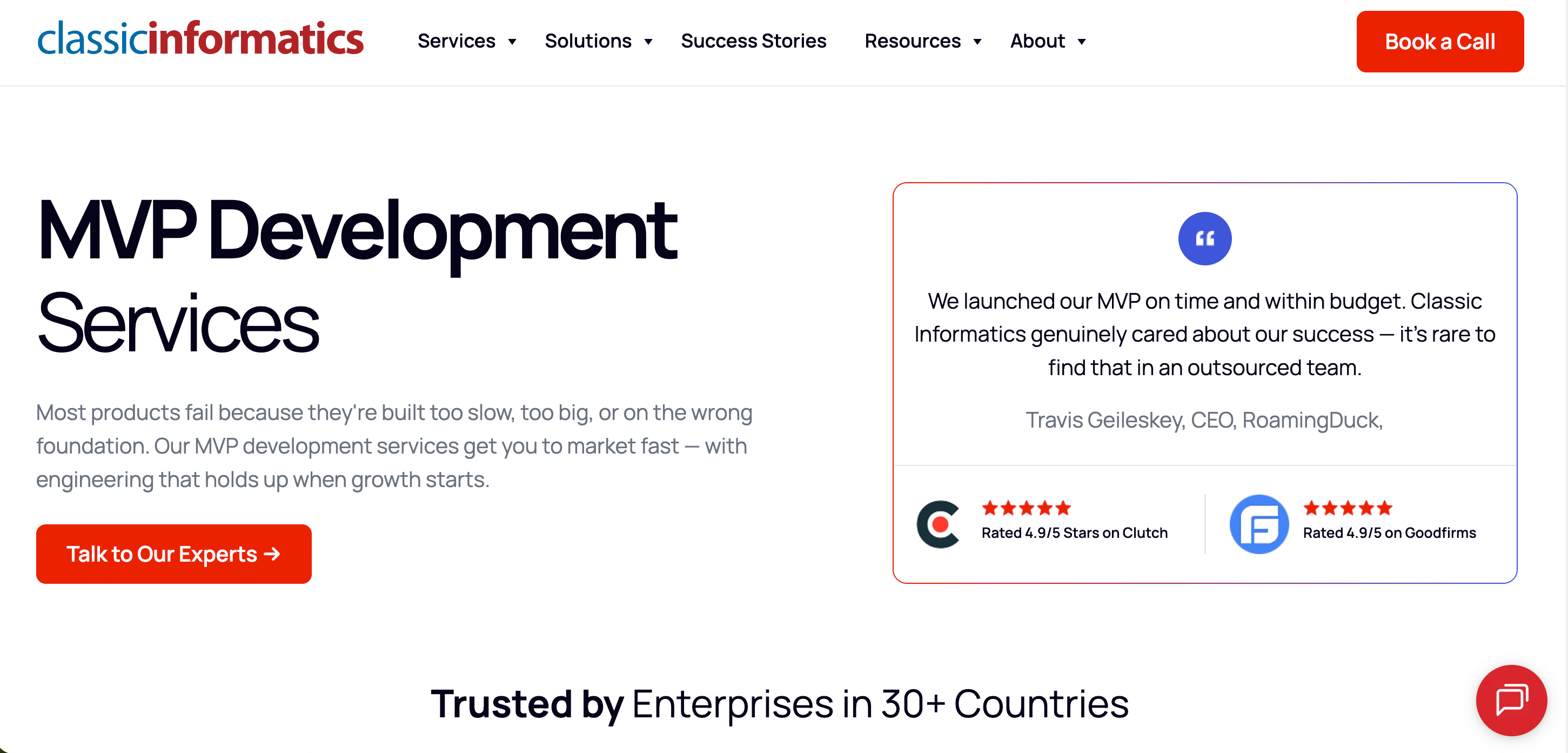
Overview: Classic Informatics was founded in New Delhi in 2002 and works from Gurugram, Chandigarh, Sydney, and London. It holds a 4.9 Clutch rating from 39 reviews and reports 3,000+ delivered projects for 500+ clients in 30+ countries, with 95% retention. The team that builds the MVP can stay on to scale it.
Core focus:
- MVPs for startups, plus enterprise product work
- Web and mobile builds, from first version to scale
- $25 to $49 an hour with a $10,000 Clutch minimum
Real project examples & client quotes:
- RoamingDuck (Australia): the team recommended one responsive web app over separate iOS and Android apps for a travel-planning startup. The MVP covers itinerary planning, expert chat, and budgets for travelers, travel experts, and admins.
"They genuinely cared about our success." Travis Geileskey, CEO, RoamingDuck
- Addressya (Sweden, operating in Uganda and Rwanda): an early-stage digital addressing product taken to web, iOS, and Android, reported at 100,000+ contacts.
Strengths:
- A $25 to $49 rate band with a 4.9 rating across 39 reviews
- RoamingDuck is a public example of scope cut before the build (Signal 1)
Weaknesses / considerations:
- No published MVP timeline, price, or outcome number on the MVP cases, which is why it ranks last on this test
- Founders on the US West Coast work across a 12.5- to 13.5-hour time difference, so plan for written, asynchronous updates
Scope Discipline Test (public record): Signal 1 shown (the RoamingDuck scope cut). Signals 2, 3, and 4: ask on the first call. Signal 5: not tested.
Key stats:
- Employees: 50 to 249 (Clutch), 200+ (company website)
- Clutch reviews: 39
- Average rating: 4.9/5.0
- Hourly rate: $25 to $49
- Typical project budget: $10,000+ minimum
- Founded: 2002
- Headquarters: Gurugram, India
- Distinction: Delivery since 2002 at $25 to $49 an hour, with one team from MVP to scale.
How to choose an MVP development company: 5 questions for the first call
The 5 signals turn into 5 questions you can ask any company on this list or off it. Each answer either names something specific or it doesn't.
1. "What did you decide not to build for your last client?" A good answer names the feature, the client, and what happened after launch. RoamingDuck's single web app at Classic Informatics and the second iteration of our martech AI MVP are examples of the shape to listen for.
2. "What does your discovery phase deliver, and what does it cost?" DBB Software, Altar.io, and Emerline already publish part of the answer. From everyone else, ask for the list of outputs and the price before you agree to a series of discovery calls.
3. "How many hours does a sign-up and login module take you, and why?" The reasoning matters as much as the number. Our own estimate is 60 hours for that module inside a 600-hour SaaS MVP. A team that uses boilerplates and AI tools daily should be able to say what each one saves on modules like it.
4. "What do you cover after launch, and for how long?" We found no warranty length on the websites of any of the 10 companies. Ask for the period, the severity tiers, and the response times, and get them into the contract.
5. "When can the people on my project start, and will they stay?" Netguru's own pages give 2 different headcounts, and Relevant Software says part of its team comes from an outside network. Ask for named roles, start dates, and what happens if someone leaves mid-build.
MVP development cost in 2026: what the companies publish
A first-call quote is hard to judge on its own. Most founders hear a single number with no breakdown and nothing to compare it against. Five companies on this list publish prices, 4 for an MVP or its scoping phase and Altar.io for past projects, and together they give you that comparison.
| Company | What the price covers | Published price | Published timeline |
|---|---|---|---|
| Emerline | Proof of concept | $5,000 to $15,000 | 2 to 4 weeks |
| Emerline | Basic, medium, and complex MVP | $5,000 to $15,000, $20,000 to $50,000+, and $50,000 to $150,000+ | 8- to 10-week build |
| DBB Software | Scope & Design Document | From $1,777 | 2 to 3 weeks |
| SolveIt | MVP | From $35,000 | 2 to 6 months |
| ScienceSoft | Mobile, web, and SaaS MVP | $40,000 to $120,000, $80,000 to $160,000, and $120,000 to $300,000 | 2 to 6 months (low-code base) |
| Altar.io | Arts marketplace (past project) | €18,000 | 2 months |
| Altar.io | Community management platform (past project) | €40,000 | 3 months |
| Brocoders | AI MVP for a martech client (delivered) | $3,375 | 75 hours of work |
The wider market sits in the same band. Clutch's software development pricing guide, updated in September 2026, puts the typical project at $10,000 to $49,999 and the average at about $132,480. Its mobile app pricing guide gives an average app project of about $90,780 over roughly 11 months.
Those are full app projects. Most published MVP prices on this list sit below them, but ScienceSoft's SaaS MVP range runs above both. Our own 9-module SaaS MVP estimate comes to about 600 hours, around $27,000.
Rates drive most of the spread. Accelerance's 2026 rate trends put European outsourcing at $31 to $39 an hour for junior developers and $64 to $76 for seniors. Latin America sits at $33 to $45 and $60 to $75, and Asia at $24 to $31 and $31 to $41.
For comparison, the US Bureau of Labor Statistics reports a median salary of $135,980 for software developers in May 2025, before benefits and hiring costs.
Our own SaaS MVP cost breakdown prices a 9-module build hour by hour if you want to see where the money goes inside one estimate.
Choose the MVP partner whose work you can check
The 10 companies above all ship MVPs. The order reflects how much of that work you can check before you sign, and the 5 questions work on any shortlist. If you want to run them on us, our MVP development services page shows how we scope and price a build, and our SaaS development services cover what comes after the first version.
Frequently Asked Questions (FAQ)
Published prices from the companies on this list run from $5,000 for a basic MVP at Emerline to $300,000 for a SaaS MVP at ScienceSoft. SolveIt starts MVPs at $35,000, and Clutch's September 2026 data puts the typical software project at $10,000 to $49,999. The biggest cost drivers are scope, the number of integrations, compliance needs, and the team's hourly rate.
Published MVP build windows on this list run from 8 weeks (Emerline) to 6 months (ScienceSoft on a low-code base), and 4 of the 10 publish an 8- to 12-week build. Dated cases run faster and slower: Relevant Software delivered an investor-demo MVP in 4 weeks, while Emerline's Tribela reached the App Store in 9 months. At Brocoders, CoreHealth reached a recorded working demo 6 weeks after design started, and Revenue Boosters' MVP took 3.5 months.
On published proof, DBB Software, Emerline, and Relevant Software rank highest in October 2026. The best fit depends on your budget and product: SolveIt suits mobile-first European founders, Netguru design-led consumer apps, ScienceSoft regulated products, and Cheesecake Labs US teams that need same-day overlap.
A prototype shows how a product will look and flow, and usually doesn't run on real data. An MVP runs in production with real users and tests whether they will use and pay for it. ScienceSoft publishes the split clearly: prototypes in 2 to 4 weeks, MVPs in 2 to 6 months.
Ask what they convinced a client not to build, what discovery delivers and costs, and how their tooling changes estimates for standard modules. Then ask what post-launch terms they put in writing, and notice how fast they answered your first email. Finally, check one named case study and read the 3- and 4-star reviews on their Clutch profile.
A senior freelancer can be the right choice for a clickable prototype or a single-feature MVP. For a production SaaS MVP with payments, roles, and integrations, a company brings project management, QA, and continuity if someone leaves. Under $10,000, a narrow AI MVP is possible with a company too: our martech video-to-brief MVP took 75 hours and cost $3,375.
Most offer it, but we found no warranty length on any of the 10 ranked companies' websites. Ask for a defined period covering bugs in delivered scope, severity tiers, and response times. Scope and price ongoing maintenance separately from the MVP contract.
Brocoders wrote this list and sells MVP development, so ranking ourselves would ask you to trust our judgment of our own work. Our proof sits unranked in How this list was made, held to the same test as the 10 companies above.