CondoGenie: a modernized condo management SaaS, run by a senior pod
How Brocoders rebuilt a 9-year-old condominium management system as a multi-tenant SaaS with a resident portal, migrated its customers, and keeps it current.
Industry
Proptech
Location
Canada
Client since
2018
Status
Ongoing
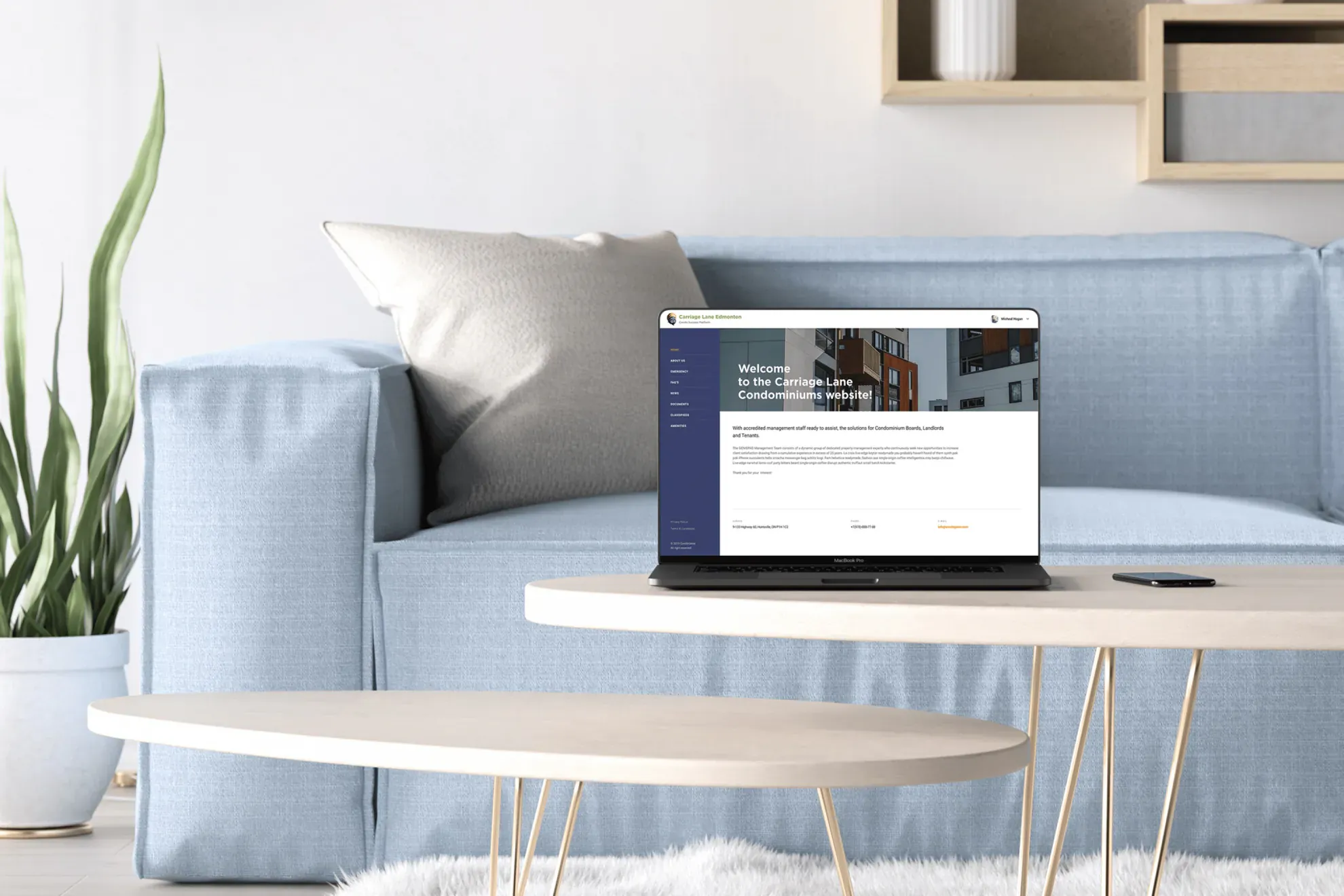
CondoGenie is a subscription condominium management SaaS built to close the communication gaps between a condo board, its property manager, and the residents they serve.
It supports unlimited users and units across condominiums, stratas, HOAs, and co-ops, and keeps announcements, documents, maintenance requests, and amenity bookings in one resident portal. Boards reach every resident by portal, email, text, or voice call. Residents raise a request and follow it to an answer.
+1,282%
19,324 active users in 2025, up from 1,398 in 2019
6 → 23
platform features since launch
8 years
of continuous delivery, 2018 to 2026
5.0
client rating
CondoGenie at a glance
Client
Rafal Dyrda, CEO and Founder, condogenie.com, Canada
Industry
Proptech, condominium and HOA management
Legacy system
GeniePad, built 2009
Engagement
2018 to present, eight years, ongoing
What was replatformed
GeniePad to CondoGenie, from 2018, first release after 18 months
What was modernized in place
Rails upgrade (August 2025), Playwright test suite (2025), Stripe API version (February 2026), frontend toolchain moving to Node 24 LTS
Active users
19,324 in 2025, up from 1,398 in 2019
Scale, October 2026
Over 550 condominium and HOA associations, over 80,000 registered users
First release
18 months
Services
Application modernization, SaaS product development, senior engineering pod
Architecture
Three-tier multi-tenant SaaS with per-tenant subdomains
Condo management SaaS with a resident portal, property manager portal, maintenance tickets, and billing integrations
Engagement model
Senior engineering pod, 2018 to present
CondoGenie, 2018 to 2026: what was replatformed and what was modernized in place
CondoGenie has been modernized twice over. In 2018 the platform was replatformed: a new codebase was built to reproduce GeniePad's behavior deliberately, and GeniePad's users and data moved onto it. Since the first release, the same codebase has been modernized in place, one upgrade at a time, on a live platform with paying accounts.
Replatform, from 2018
First release after 18 months. New codebase, new name, new interface, three-tier multi-tenant structure. The product logic, user accounts, documents and histories, and the customers all carried over.
Modernization in place, since the first release
Rails upgrade (released 15 August 2025), test suite moved to Playwright (June to September 2025), Stripe API version migration (February 2026), frontend toolchain moving to Node 24 LTS. The codebase, the data and the release cadence stayed.
Engagement
2018 to present, ongoing.
Not ours
GeniePad, built by Rafal in 2009. Brocoders built CondoGenie and has run its development since.
Modernizing CondoGenie in place, 2019 to 2026: Rails, Playwright, Stripe, Node 24
Most of the CondoGenie engagement is modernization in place: upgrades made to the live codebase while it serves paying accounts. This is legacy application modernization performed continuously rather than as a one-off project.
Runtimes and build tooling are reviewed as they age out, scoped with the client, and sequenced into the roadmap alongside feature work.
Every one of those upgrades is proposed as a retention argument rather than an engineering one. A founder paying for development out of subscription revenue funds what keeps accounts, so we scope infrastructure work as the investment that keeps the platform ahead of the tools his customers could switch to.
The current codebase runs 1,806 modules across 4,241 files in two repositories. Recent work against it:
Ruby on Rails version upgrade
Scoped June 2025, released 15 August 2025. Framework upgrade on a live platform with no customer-facing downtime.
Test suite migration to Playwright
June to September 2025. Full replacement of the existing suite, with the residual Cypress tests retired in 2026.
Stripe API version migration
February 2026. Payment API version upgrade against live subscriptions.
Frontend toolchain modernization
Scoped August 2026, in progress. Moving the build and runtime to Node 24.19.0 LTS ahead of the older versions reaching end of support, which requires replacing the retired CRA and Webpack builder, and that in turn unblocks the TypeScript and React upgrades.
node-sass to dart-sass
August 2026. Dependency retirement identified in the same scoping.
Daily Summary query optimization
August 2026. Removed a standing source of server CPU load.
Global Settings restructure
2025 to 2026. Tabbed navigation and centralized task categories, a structural refactor rather than a visual one.
Sentry runs in production, so defects surface to us before they reach Rafal or his customers.
The sequence is what makes this work on a live platform: Node before the builder, the builder before TypeScript, TypeScript before React.
Migrating nine years of GeniePad data to CondoGenie, run by run, while the business kept running
Migrating GeniePad's existing user data into CondoGenie was the highest-risk part of the engagement, and it ran alongside feature development rather than after it.
Early migration runs surfaced schema mismatches and records that did not map cleanly, the normal result of moving data out of a system that had accumulated 9 years of exceptions. Every one was fixed or restored, under the release timelines the business needed to keep. Rafal's end users reported anything they spotted directly to us, which shortened the fix cycle.
How GeniePad, a 2009 condo system, became CondoGenie
Rafal Dyrda is a Canadian entrepreneur who moved to a condominium in downtown Edmonton in 2003, joined the condo board, and built software to fix what he found there.
"One day we needed to get our door buzzer reprogrammed. This task took six months. Till then, we had to run down to let our visitors in. Soon after that, I decided to join the condo board. I was fed up with everything and wanted to see if I can make a difference.
After being exposed to the problems first hand, I realized that the condo board and property manager didn't have the right tools to communicate with the residents. The condo board met once a month. That is when they reviewed all the letters from that correspondence mailbox. Then it took another month to make the decisions and reply to the resident.
I had to put a stop to this."
The tool he built for his own board became GeniePad, a product sold to condominiums across the United States and Canada, and Rafal joined the Canadian Condominium Institute on the back of it. This is the classic path of turning an internal tool into a SaaS, and it carries the classic problem with it. Nine years of features had accumulated on an architecture originally built for one building, and it could not carry the multi-tenant, self-serve product Rafal wanted to sell next.
He came to Brocoders in 2018 looking for a proptech software development team that could rebuild the platform without losing the customers already on it.
The 2018 decision on CondoGenie: replatform GeniePad rather than extend it
Request
A brief that asks for new features, a new interface, and a new name can be delivered two ways, by extending the system that exists or by building a new one. That question came before any code.
Audit
We ran requirements elicitation with an in-house business analyst first, working through the existing system's behavior and its undocumented edge cases.
Verdict
The answer was to build new. So the development process was set up in accordance with the existing system, and the new platform was built from scratch. Every behavior the legacy system had was mapped and reproduced deliberately. That distinction is the whole engagement in one line: the rebuild was of the code, not of the product logic, which stayed continuous for users who had been on GeniePad for years.
Rebranding GeniePad as CondoGenie, and redesigning it without losing its users
Modernization is usually sold as backend work. On CondoGenie the visible half was the harder half, because the platform was being renamed at the same time it was being rebuilt.
Rafal asked for a complete rebrand, including a new product name. GeniePad, the name his customers had used since 2009, became CondoGenie. A rename of a live B2B product is a commercial decision before it is a design one, and it carried the whole interface with it.
Against that, one constraint from the client that shaped every screen. The majority of GeniePad's users were non-technical condo board members and residents who had learned one interface and had no appetite to learn another. The new product had to look current to a prospect and familiar to an existing user, at the same time.
So the design work ran as a loop rather than a handover. We built prototypes, Rafal put them in front of his real end users, and we changed them on that feedback rather than on design opinion. Development ran in Scrum with small increments, and each module was demoed to Rafal before it was accepted, with several demos for the Account module because of its size.
Multi-tenant architecture for condominiums, HOAs, and property management companies
CondoGenie is a multi-tenant SaaS platform. Three tenancy levels carry different permissions, different billing, and different administration:
Account
One condominium, or several buildings grouped under a single legal entity. Each account is self-registering and gets its own condo subdomain.
Management company
A property management firm administering many accounts at once, with its own reporting and cross-account views. Management companies are provisioned by the super admin.
Super admin
Platform-level administration, provisioning, and support tooling.
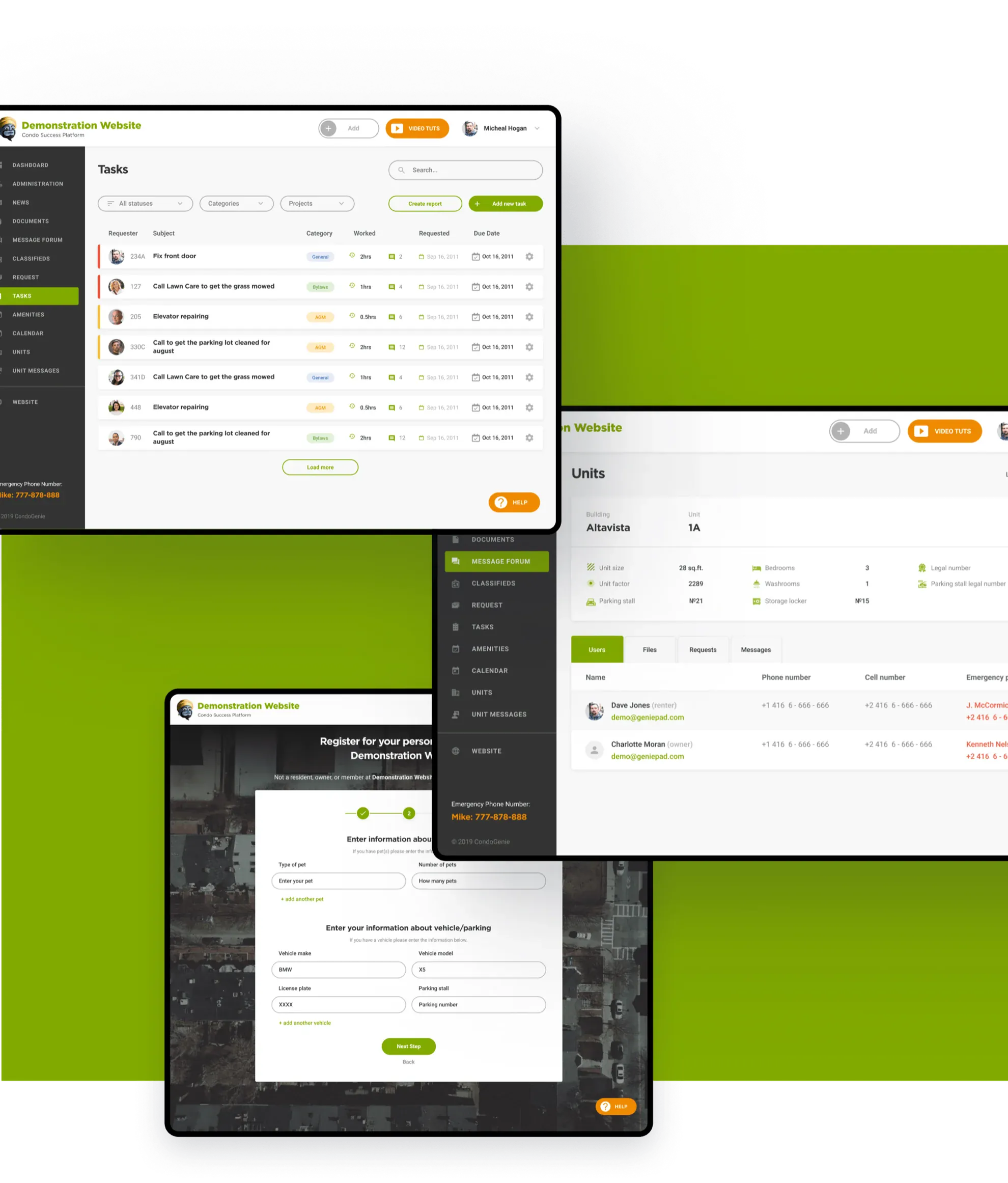
Property managers, boards, owners, and renters each get their own view of the same account. Tenant workflows run through the resident portal: maintenance tickets, amenity bookings, document access, and building announcements.
Four user roles sit inside that structure and behave differently: administrators (board members and head-office staff) work in news, documents, buildings, and requests; managers work in forums, classifieds, and announcements; owners and renters live in the community and maintenance modules. Access control is enforced at category level across documents, forums, and forms, with default groups for owners, administrators, board members, and general residents.
Real multi-tenancy is proved by its edge cases. In August 2026 an account arrived with 34 buildings registered at a single street address, a shape the registration flow had never met. We found it, unblocked the account, and changed the flow. Unit numbering is configurable at account setup, odd, even, or sequential, for the same reason: condominium buildings in the wild do not agree on how to number anything.
We applied the same multi-tenant model later on an HOA management platform for a different client.
5.0
"I had very great communication with the team.
Upon launching the project, we were able to increase client satisfaction and provide our clients what they were asking for, improve their workflow as well as make the software more powerful and easier to use than the previous software that was developed."
The CondoGenie resident portal: 6 features at launch, 23 today
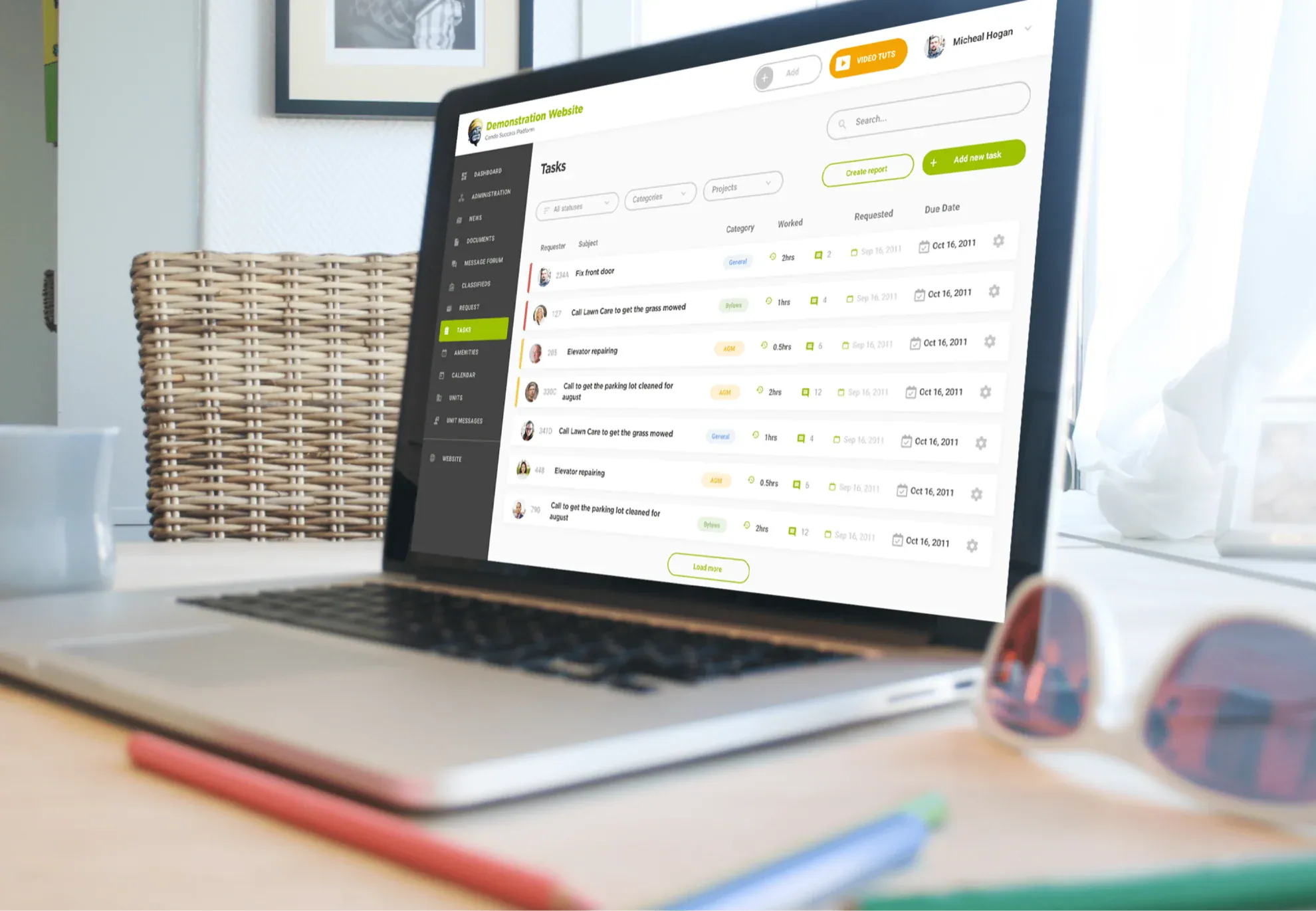
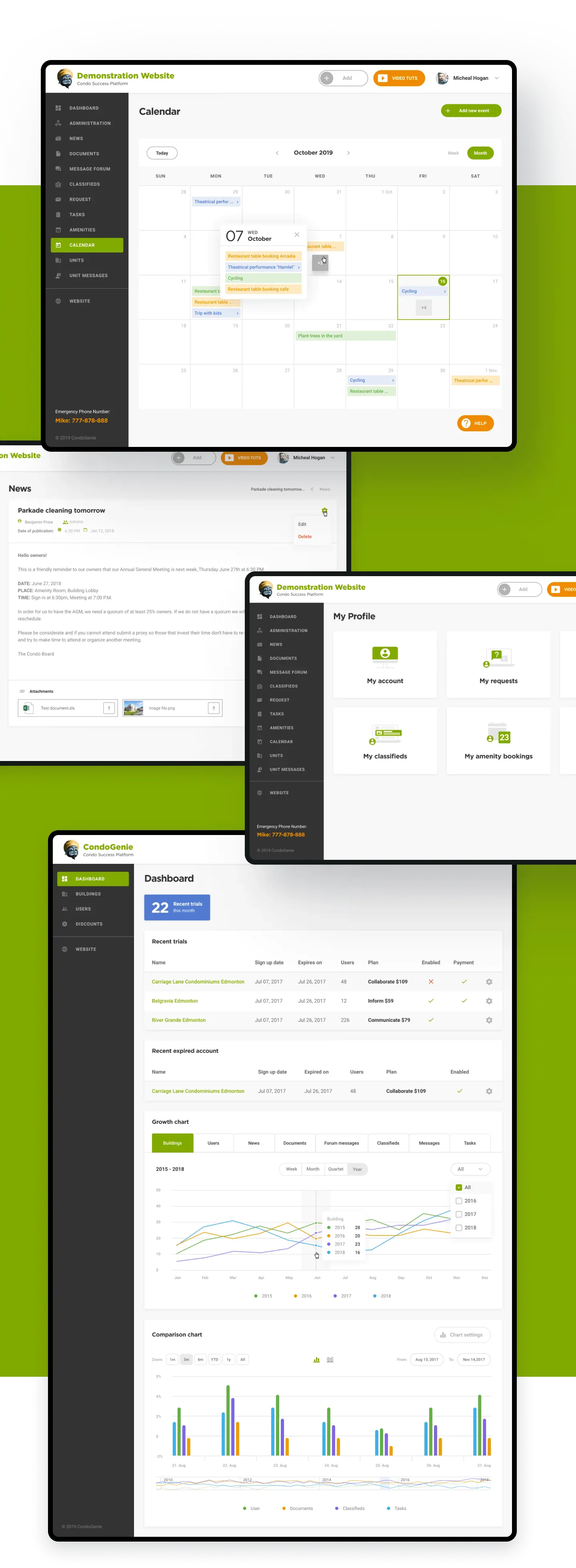
The first CondoGenie release took 18 months and shipped six features: news posting, document posting, tasks, calendar events, amenity bookings, and emergency SMS.
CondoGenie today runs 23: unlimited users and units, a public website and private resident portal, automated email notifications, news and announcements, AI news generation, unlimited document storage, FAQ, classifieds, message forums, requests, unit messages, SMS broadcasts, phone voice broadcasts, tasks, projects, reports, amenities and bookings, calendar, analytics, surveys, maintenance, parking, and forms.
Requests are the platform's maintenance ticket system, and 40% of resident requests are maintenance and repair, ahead of community rules and complaints at 15%, and document retrieval at 12%. The maintenance module was built on that distribution, with asset overviews, QR-code access to maintenance records, recurring inspection schedules, customizable checklists, and multi-user task assignment.
Building resident requests on top of the tasks module would have forced access-control compromises, because tasks carry permissions that residents should not hold. We reused and extended the requests module instead.
What CondoGenie does today: the full feature set
Twenty-three features, grouped the way a condo board and a property manager actually use them.
Communication and announcements
News and announcements
AI news generation
Automated email notifications
SMS and text broadcasts
Phone voice broadcasts
Unit messages
Community
Message forum
Classifieds
Calendar
Surveys
FAQ
Requests, tasks, and maintenance
Requests
Tasks
Projects
Maintenance
Amenities and parking
Amenities and bookings
Parking
Documents, forms, and records
Unlimited document storage
Forms
Reports
Analytics
Platform
Unlimited users and units
Public website and private portal
Subscription billing and billing integrations for property management accounts
CondoGenie sells subscriptions to condominiums and management companies across four tiers, Inform, Communicate, Collaborate, and Manage, and until 2026 every plan change between them went through a human.
Plan Upgrade Automation was delivered on 13 May 2026. Accounts now change plan themselves, with the prorated difference calculated automatically for annual accounts, an invoice generated on the spot, and a 7-day payment window before the change lapses. Monthly-to-monthly and yearly-to-yearly shipped first, with the cross-period switches scoped as a second phase.
Billing also gained an active payment method display, immediate invoice generation on a plan switch, and date-range filtering. Payments run through Stripe for cards and Rotessa for Canadian pre-authorized debit, with Xero on the accounting side. On CondoGenie the annual accounts pay largely by pre-authorized debit, so a Canadian condo platform needs that rail alongside cards. A referral program reached staging on 31 August 2026.
Shipping an AI feature inside a modernized proptech platform
Condo boards write announcements, and most board members are volunteers who do not enjoy writing them.
Genie, released in August 2025, drafts announcements from a short prompt inside the news module. The client named it as a character rather than as a capability, and the button reads "Generate with Genie", which is the opposite of how condo management competitors present AI. It has been live in production since August 2025.
How the CondoGenie senior engineering pod runs
CondoGenie is founder-led, and Rafal chose to put his budget into product rather than into building an engineering and product department.
So the senior engineering pod on CondoGenie does the work a product organization would do. A pod is a dedicated team of senior engineers, resized as the roadmap changes.
Between them they author the roadmap, the requirements documents, the mockups, the release notes, and the analytics plan. Rafal sets the direction, reviews staging, and gives go or no-go. Writing the specification is our job, not his.
Biweekly and monthly written reports to the client, unbroken from July 2025 through August 2026
Five production releases in August 2026 alone, on the 3rd, 4th, 13th, 18th, and 31st
Ongoing production support and bug fixing as a standing commitment through 2026
Since August 2026, a formal requirements step: dependencies and current logic are analyzed on staging before a task enters development, which is how a platform this old avoids regression surprises
Our team
Project
manager
Business
Analyst
Product
designer
QA
Engineer
Backend
Engineers
Frontend
Engineers
DevOps
Engineer
Results: CondoGenie, 2018 to 2026
Active users grew from 1,398 in 2019 to 19,324 in 2025. Engagement rose with the user count: the share of registered users who are active went from roughly 18% to 26%.
Feature set grew from 6 to 23, including a shipped AI feature.
Over 550 condominium and HOA associations on the platform, with over 80,000 registered users (admin panel, October 2026).
A senior engineering pod runs maintenance and new features after the replatform, ongoing since 2018, with five production releases in August 2026.
Modernization without pausing the business, including a Rails upgrade, a Stripe API migration, and a full test-suite replacement, all delivered against a live paying customer base.
CondoGenie technology stack
React · Ruby on Rails · Node.js · TypeScript · AWS Lambda · ActiveAdmin · PostgreSQL · Stripe, Rotessa, and Xero · Twilio (SMS and voice) · Sentry · Playwright · Zendesk · Crowdin · GA4 and GTM
Can you upgrade a SaaS platform that is on an unsupported framework version without pausing our roadmap?
Yes, and CondoGenie is the example. The Rails upgrade was scoped in June 2025 and released in August 2025 while feature work continued in parallel. The move to Node 24.19.0 LTS is sequenced the same way, with each step scoped so the platform stays releasable throughout.
Was CondoGenie a rebuild or a modernization?
Both, in sequence. In 2018 GeniePad was replatformed onto a new codebase, with its users and data migrated across. Since the first release that codebase has been modernized in place: the Rails upgrade in August 2025, Playwright in 2025, the Stripe API version in February 2026, and the frontend toolchain now moving to Node 24 LTS.
Should we refactor our legacy platform or rebuild it?
It depends on whether the data model can carry the product you want to sell. GeniePad's could not, because it assumed a single building and the new product needed management companies above accounts. When the shape of the data has to change, a rebuild that deliberately reproduces existing behavior usually costs less than refactoring around old assumptions. When the shape holds, refactoring is cheaper and safer, and we say so.
Can we rename or rebrand the product while we rebuild it?
CondoGenie was renamed from GeniePad during the rebuild, on the client's brief. The rule we worked to was that the product had to look current to a prospect and familiar to an existing user, so prototypes went to real end users for feedback before anything was built.
What happens to our existing users during a replatform?
They move with the product. We migrated nine years of GeniePad accounts, documents, and user histories into CondoGenie while the business kept running, repairing mismatches run by run rather than taking the platform offline.
Do you build multi-tenant architecture?
Yes. CondoGenie runs three tenancy levels, account, management company, and super admin, with per-tenant subdomains and category-level access control. We built the same model again for an HOA management client.
How do you handle an undocumented legacy codebase?
With a business analyst on the audit before any code is written, and with a standing requirements step once delivery starts. On CondoGenie, dependencies and current logic are analyzed on staging before a task enters development.
We have no product manager in-house. Can you cover that?
Yes, and on CondoGenie we do. The roadmap, requirements documents, mockups, release notes, and analytics plan are authored by our team and brought to the client for a decision. Founder-led SaaS companies often prefer to put budget into the product rather than into a product department, and this is the model that makes that work.
Can we meet the engineers before we commit?
Yes. Named engineers, a technical interview, before anything is signed. A senior engineering pod is a fixed monthly price against named delivery KPIs on a three to six month term, resized quarterly, so who is in it is the thing worth checking first.
Will you stay after the launch?
We have been on CondoGenie since 2018. The first release took 18 months, and since then the senior engineering pod has carried maintenance and new features, with five releases in August 2026 alone, monthly written reporting, and a standing production support commitment.
Build or modernize a property management platform with Brocoders
If you are building a condo management platform, a property management SaaS, or an HOA product, and your existing system cannot carry what the business needs next, that is the work we do. We run it as a full-stack senior engineering pod in React, Node.js, and Ruby on Rails, on real estate workflows.
Most engagements of this shape start with a Code and Architecture Audit, an independent read of the codebase that tells you whether to modernize it or rebuild it before anyone commits a development budget. On CondoGenie the answer in 2018 was rebuild. It is not always. See how we build proptech and real estate software, or compare the field in our review of real estate software development companies.
Want to develop something similar?
We are thrilled about the opportunity to provide software development services for your business
Rodion Salnik
CTO and Co-founder at Brocoders
Pick a date that works for you to see available times to meet with me and discuss your project needs. Looking forward to meeting you!