
Search "AI property management software" and you'll find the same article written a hundred different ways. AppFolio, Buildium, EliseAI, Yardi. Feature lists. Pricing tables. A shortlist. A recommendation.
Those names should look familiar. Search "property management software" two years ago and you'd have seen the same results. The search trend changed. The top results didn't.
Legacy platforms added AI modules, updated their marketing, and kept their rankings. The category looks full of AI options. Most of what's there is old architecture with new feature names.
That framework is reasonable. For a standard residential portfolio, evaluating SaaS platforms is the right place to start.
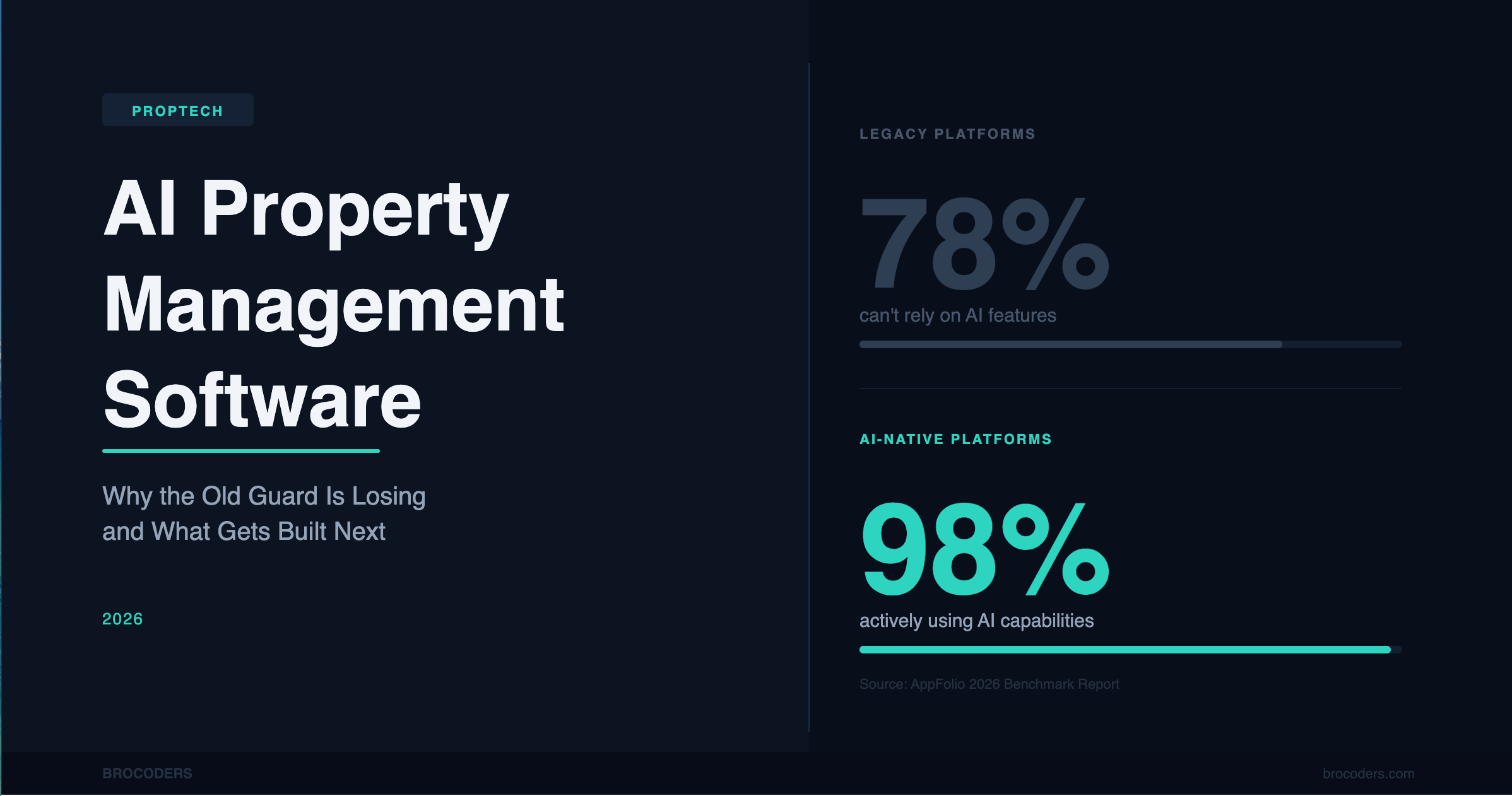
But AppFolio's own 2026 benchmark report published a number worth reading before you get there: 78% of property managers using legacy property management software cannot rely on the AI features in those tools.
That came from the market leader. About its own segment. And it points at a structural problem no comparison article will explain, because the sites writing those articles earn money when you subscribe to the tools they're recommending.
So here's the explanation.
What AI property management software actually does in 2026
The category covers a wide range of applications. Worth understanding what the tools are supposed to do before getting into why many of them don't.
Virtual leasing agents handle inbound inquiries from prospects, pre-qualify leads, schedule showings, and answer questions around the clock without a staff member involved. Maintenance triage processes work orders, categorizes urgency, and dispatches vendors automatically. Lease abstraction pulls key terms, dates, and obligations from documents without manual review. Predictive maintenance flags likely failures before they happen, based on property history and equipment data.
On the financial side: automated invoice processing, anomaly detection, and reconciliation that reduces the manual entry burden. On the communication side: AI trained on property-specific data that answers common resident and tenant questions without routing them to a staff member.
The 2026 category is also moving toward agentic AI: systems that don't just assist human decisions but execute multi-step tasks on their own. Scheduling, lease renewals, maintenance dispatch, move-out coordination. AI that acts, not just informs.
AppFolio's benchmark data shows AI adoption among property managers rose from 21% in 2023 to 34% by 2025. Buildium's 2026 industry report shows an even sharper jump: from 20% to 58% in a single year.
And only 8% of companies have fully automated any process.
The logos are on the website. The workflows didn't change. That gap is the story.
Why 78% of property managers still can't rely on the AI in their software
Property management platforms were built for task management. A staff member logs in, completes a task, and logs out. The underlying data model was designed around that interaction: it records what happened, not what a system would need in order to anticipate, decide, and act.
AI added on top of that architecture can only work within what the original system allows. It can access the data the legacy platform was designed to expose. No more.
Real-time data access is the first place this creates problems. An AI leasing agent that lacks live integration with the underlying property management system produces wrong answers. It doesn't know the unit was rented an hour ago. It cites a rent price that changed last week. The tenant gets incorrect information, and a staff member spends time correcting it. The AI tool that was supposed to remove work has created it.
Commercial lease nuance makes this worse. CAM reconciliation, exclusive use clauses, option periods: these have to be explicitly modeled in workflow logic. AI that doesn't have those structures built into its foundation can't enforce them. It will produce confident, wrong outputs.
The portal utilization data tells the same story from a different direction.
TownSq's 2026 HOA and Property Management Industry Survey found that 89% of community managers are already using HOA software. 20% of them still spend a significant portion of every working day answering homeowner inquiries. The software is there. The manual work isn't going away.
Buildium's renter research is consistent: 66% of renters say having a resident portal is important. When it comes to actual communication, they prefer text (59.3%) and email (52.4%) over any portal. Getting residents to use a portal, as Buildium put it, "can feel like an uphill battle." Not because residents resist digital tools. Because the portal doesn't solve the actual problem, and residents sense that immediately.
68% of property managers are dissatisfied with traditional PMS, according to Future Market Insights, specifically due to poor integration and weak tenant communication. That figure reflects 15 years of bolt-on features that never quite close the gap.
Build vs. Bolt: the architecture distinction that determines whether AI works
Two fundamentally different ways AI ends up in property management software.
Bolt-on: A platform built a decade or more ago adds AI modules to the existing system. The data model, user permissions, workflow logic, and API structure all predate AI. The new AI features sit on top and operate within the constraints of the old architecture. This describes AppFolio with Lumina AI, Buildium with AI Bill Scan, Yardi with its AI add-ons. These are capable tools added to capable platforms. The constraint is the foundation they're sitting on.
There's a second layer to this. Legacy platforms adapted AI for the workflows they already supported: standard residential leasing, basic maintenance requests, invoice processing. If your operation runs on those workflows, the bolt-on AI has something to work with. If your workflows are different, the AI was never built for your situation. It was built for theirs.
AI-native: AI is part of the architecture from the start. The data model was designed to support real-time AI queries. The permission structure was built to enforce what AI agents can see and act on. The workflow logic assumes AI will be making decisions and executing tasks, not just suggesting them.
The same AppFolio report that found 78% of legacy users can't rely on their AI features also found that 98% of AI-native platform users are actively using AI capabilities. Same research. Same year. 20-point gap. That gap is architecture.
For property management use cases with complex stakeholder structures (residents, board directors, property managers, multi-lot owners each needing different data access and permissions), the foundation problem is acute. Legacy systems weren't designed to hold those permission models. AI built on top can't enforce them either.
This distinction matters practically for two groups of people. The first is building a proptech product from scratch and needs to make the architecture decision now. The second is already running on legacy SaaS and is trying to understand why the AI features they're paying for aren't delivering. For both, the answer is the same: the foundation determines what's possible.
Who's building from scratch, and why
Two different types of operators arrived at custom development through different paths. Both ended up at Brocoders for the same reason: the tool they needed didn't exist.
The proptech entrepreneur
Rafal Dyrda joined his condo board because a door buzzer reprogramming took six months. He wanted to see whether he could make a difference.
What he found: the board met once a month, reviewed correspondence from a physical mailbox, then took another month to make decisions and respond to residents. Emergency maintenance requests sat in that queue alongside routine administrative questions. Residents had no visibility into anything. The board had no way to reach residents without going through the same slow loop.
"After being exposed to the problems first hand," Dyrda said, "I realized that the condo board and property manager didn't have the right tools to communicate with the residents."
He looked at what was on the market. Nothing handled the three-way operational relationship between residents, board directors, and property managers simultaneously. Each existing platform was built around one of those user types. Nobody had designed for all three together.
So he built CondoGenie with Brocoders. The result was a platform that changed the behavior that existing portals couldn't. Residents actually using it. Boards communicating through it. Property managers coordinating with both groups on one system.
"Upon launching the project," Dyrda said, "we were able to increase client satisfaction and provide our clients what they were asking for, improve their workflow as well as make the software more powerful and easier to use than the previous software that was developed."
Read case study of Condogenie development
The operator with a specific system
C.I.A. Services has been managing homeowners associations in Houston and San Antonio since the early 1990s. By the time they approached Brocoders, they had around 150 HOA clients and over 50,000 properties under management. They also had a proprietary backend called Reddog, built specifically for their operation decades ago.
No SaaS platform was designed to work with Reddog. And a third-party developer who had already built an API on top of it couldn't take the next step: that developer, as C.I.A. Services found out, "didn't have the expertise needed to build a consumer-facing app."
The result: homeowners had to call staff to get any information. Invoices went out by mail, email, or fax. A company managing 50,000+ properties was running its homeowner communication the way a company managing 50 would.
Brocoders built the consumer layer. A Progressive Web App with four user roles (property owners, multi-lot owners, board members, employees), deployed on Microsoft Azure per the client's infrastructure requirements. The integration work included identifying defects in the third-party API and coordinating fixes with the external developer to make the whole system function.
Now residents can access their financial data, compliance information, and community news without calling anyone. The manual communication workload dropped. C.I.A. Services can grow its portfolio without hiring proportionally to manage the communication volume.
Ralph Troiano, President and CEO of C.I.A. Services: "I am very excited and thankful for the accomplished work. It was great to work with such a professional and well-organized team. All tasks were delivered on time and were well-tested by QA specialists and our users."
Read case study here
These are not the same project. One is a founder building a new product because the market gap was real. One is an established operator whose 30-year infrastructure left no room for off-the-shelf tools. The decision path was different. The conclusion was the same: what they needed had to be built.
What the market is moving toward
The 45% consolidation figure from AppFolio's 2026 benchmark is worth sitting with. Nearly half of property managers are actively planning to move away from legacy task tools toward unified platforms that connect leasing, maintenance, and finance. Not a prediction about future behavior. An intention people stated this year.
Property management software is projected to grow from $6.13 billion in 2024 to $13.2 billion by 2032. Every market analysis attributes that growth to AI-native, cloud-native platforms. Legacy system upgrades don't appear in those projections as a growth driver.
The SERP for "AI property management software" is already fragmenting. AI-native startups like EliseAI, Boom, and MagicDoor are appearing in the top 10 alongside AppFolio and Buildium. A year ago that mix didn't exist. The incumbents are working harder to hold their positions, not expanding them.
For the entrepreneur building a new proptech product, this window is specific. The 45% of operators planning to consolidate away from legacy tools need products to consolidate toward. The gap between what legacy platforms deliver (78% can't rely on the AI features) and what AI-native platforms can offer (98% actively using AI) is the market that's open right now.
For the operator still paying monthly fees for software that isn't delivering, the math is changing. Custom development costs what it costs. The ongoing cost of manual workarounds, failed automation, and staff hours spent on work the software should be doing is also a number, even when it doesn't show up on an invoice.
Building with Brocoders
Brocoders builds property management software from scratch.
Not a consultancy that evaluates your SaaS options. A development shop that has built live proptech products for a HOA management company in Texas, a condo management SaaS founder in Canada, and a real estate platform in Germany. Three different markets, three different operator structures, all built from scratch with the specific workflows of each client as the starting point.
The development model is AI-native internally: AI-assisted coding supervised by senior architects, AI-augmented QA, AI-integrated CI/CD pipelines. This is what AI-native delivery looks like in practice. A team of 4 can match what a traditional team of 10 produces. Timelines are shorter. Scope is tighter. The code is better because senior architects are still making the decisions that matter.
60% of the Brocoders team are senior developers. The first candidate interview happens within 7 days of engagement. The model is a dedicated team on a fixed monthly rate, managed directly by the client's technical or product lead. The team is yours, not a bench assignment.
If you're building a proptech product and need a development partner who has built in this domain before: that's the conversation.
If you're an operator who has been working around software limitations for too long and has decided the workarounds are more expensive than the alternative: that's also the conversation.
Start here: brocoders.com/industries/proptech-software-development-services
Enhance your proptech platform with intelligent capabilities through our AI development and integration.
Brocoders is an AI-native software development company with a dedicated proptech practice. Past proptech projects include CondoGenie (condominium management SaaS, Canada), C.I.A. Services HOA Management Application (Texas, USA), and AreaButler (real estate platform, Germany). Start a conversation about your project.
Frequently Asked Questions (FAQ)
Property management software that uses AI to handle or improve specific operational tasks: leasing workflows, maintenance triage, tenant screening, financial reconciliation, resident communication. The term covers both bolt-on AI (features added to existing platforms like AppFolio or Yardi) and AI-native software (platforms where AI is part of the core architecture from the start). The distinction matters because the two deliver very different results in practice.
Most likely because the platform was built before AI, and the AI features were added on top of existing architecture. Real-time data access, multi-stakeholder permission structures, and workflow logic capable of supporting AI decision-making weren't in the original design. Bolt-on AI operates within what the legacy system allows. AppFolio's 2026 benchmark found 78% of managers using legacy PMS can't rely on their AI features. That's an architecture constraint, not an adoption problem.
Traditional property management software was built for task tracking. AI-native software has AI as a foundational layer: the data model, permission structures, and workflow logic are designed to support AI queries, decisions, and automation from the start. AI-native platforms can access real-time data, enforce complex permission structures, and execute multi-step automated workflows because the architecture was built for it. Legacy platforms with AI modules added later can't, because the foundation predates those requirements.
Three situations: your workflow doesn't map to standard PM processes (HOA governance, multi-stakeholder condo management, niche verticals where generic tools miss the specifics), your existing backend can't integrate with standard SaaS APIs, or you're building a new proptech product and need AI-native architecture from day one. If any one of those applies, the calculation changes.
It depends on scope, team size, and timeline. CondoGenie has been in continuous development since 2018 and is a full multi-party SaaS platform. Simpler, more focused builds can be scoped much smaller. Brocoders works on a dedicated team model with a fixed monthly rate, starting from one full-stack developer and scaling as needed. A realistic starting point for a scoped MVP: 3 to 6 months, 3 to 4 people.
The highest-value applications for HOA and condo contexts are resident communication AI (handling the inquiry volume that buries community managers), maintenance dispatch automation, document and governance management, and community coordination tools like voting and event calendars. These are workflow-specific features that generic PM platforms underserve. C.I.A. Services and CondoGenie are both examples of HOA and condo operations that found no off-the-shelf solution fit their specific stakeholder structure.
A focused MVP can be built in 3 to 6 months with a small, experienced team. A production-ready multi-stakeholder platform like CondoGenie is a longer engagement: 12 to 24 months for the core product, ongoing development from there. Timeline depends on complexity, the number of user roles, and how much existing infrastructure needs to be integrated. The AI-native development model at Brocoders (AI-augmented coding and QA) shortens timelines compared to traditional approaches.