
Agile Software Development Methodology Guide (2026)
Most articles about Agile describe ceremonies: sprint planning, standups, retrospectives. What they rarely tell you is whether the team is actually shipping working software continuously — or running "sprint theater." For startups and founders hiring a dev partner, that distinction defines whether Agile delivers its promised speed or just its promised meetings.
What Is an SDLC?
A software development life cycle (SDLC) is a methodology followed to create high-quality software. By adhering to a standard set of tools, processes, and duties, a software development team can build, design, and develop products that meet or exceed their clients' expectations.

The main SDLC models include:
- Waterfall: Follows a sequential model of phases, each of which has its own tasks and objectives
- Cleanroom: A process model that removes defects before they cause serious issues
- Incremental: Requirements are divided into multiple standalone modules
- V-Model: Processes are executed sequentially in a V-shape (each step comes with its own testing phase)
- Prototyping: A working replication of the product is used to evaluate developer proposals
- Big Bang: Requires very little planning and has no formal procedures; however, it's a high-risk model
- Agile: Uses cyclical, iterative progression to produce working software
The last one on the list, Agile, is what we're focusing on today. You see, a traditional SDLC (like Waterfall) front-loads the work – so if you require a large product, it can take a long time before the team even builds a working prototype. Most software development startups don't have the financial means to wait that long. Well-funded competitors could beat them to the market; so, to make processes more rapid without compromising on quality, many development companies are embracing the Agile software development methodology.
The 12 Key Principles of Agile Methodology
The Agile Manifesto is the approach to software project management that helps companies to be more flexible, responsive, and ready to face new challenges. This Manifesto was the answer to the problems that occurred in the software industry in the 1990s. There was an enormous time lag between the corporate software requirement specifications (SRS) and the software development for the needs of those requirements. Many customer requests changed during this lag, which led to the cancellation of a great number of projects. As a result, in 2001, a group of 17 leaders met and signed the Agile Manifesto in order to change the situation for the better.
The Manifesto consists of four basic values and twelve principles that define the process of software development. Each team applies them in different ways, but all of them are an essential part of the delivery of high-quality software to businesses.
The four values of the Agile Manifesto include:
- Individuals and interactions over processes and tools.
- Working software over comprehensive documentation.
- Customer collaboration over contract negotiation.
- Responding to change over following a plan.
These values are designed to make a software development process focused on quality and oriented to meeting customers' needs.
The Twelve Agile Manifesto Principles
The 12 Agile principles support the core values by promoting a work environment that puts the customer first, gives structure to business goals, and responds quickly to changes in market forces and user needs. They also give developer teams an opportunity to modify each stage of the development process and make the environment comfortable for the team instead of needing to focus on the surrounding circumstances.
The twelve principles of Agile development are presented below.
1. Customer satisfaction through early and continuous software delivery
As we can see, the satisfied customer is the top priority of all the 12 principles. Early and continuous delivery helps meet customers' needs and increases the return of investment (ROI). Regularly receiving working software also makes customers much happier, as they are usually not huge fans of waiting for updates. By applying this principle, the software developers will be able to respond to challenges much faster.
2. Accommodate changing requirements throughout the development process
It's essential to meet the deadlines and avoid delays when a new requirement appears or a new feature needs to be introduced. Requests to change something should not cause fear, even if they occur at the final stage of the project execution. Such customer demands should be met eagerly, as they are usually the most valuable ones.
3. Frequent delivery of working software
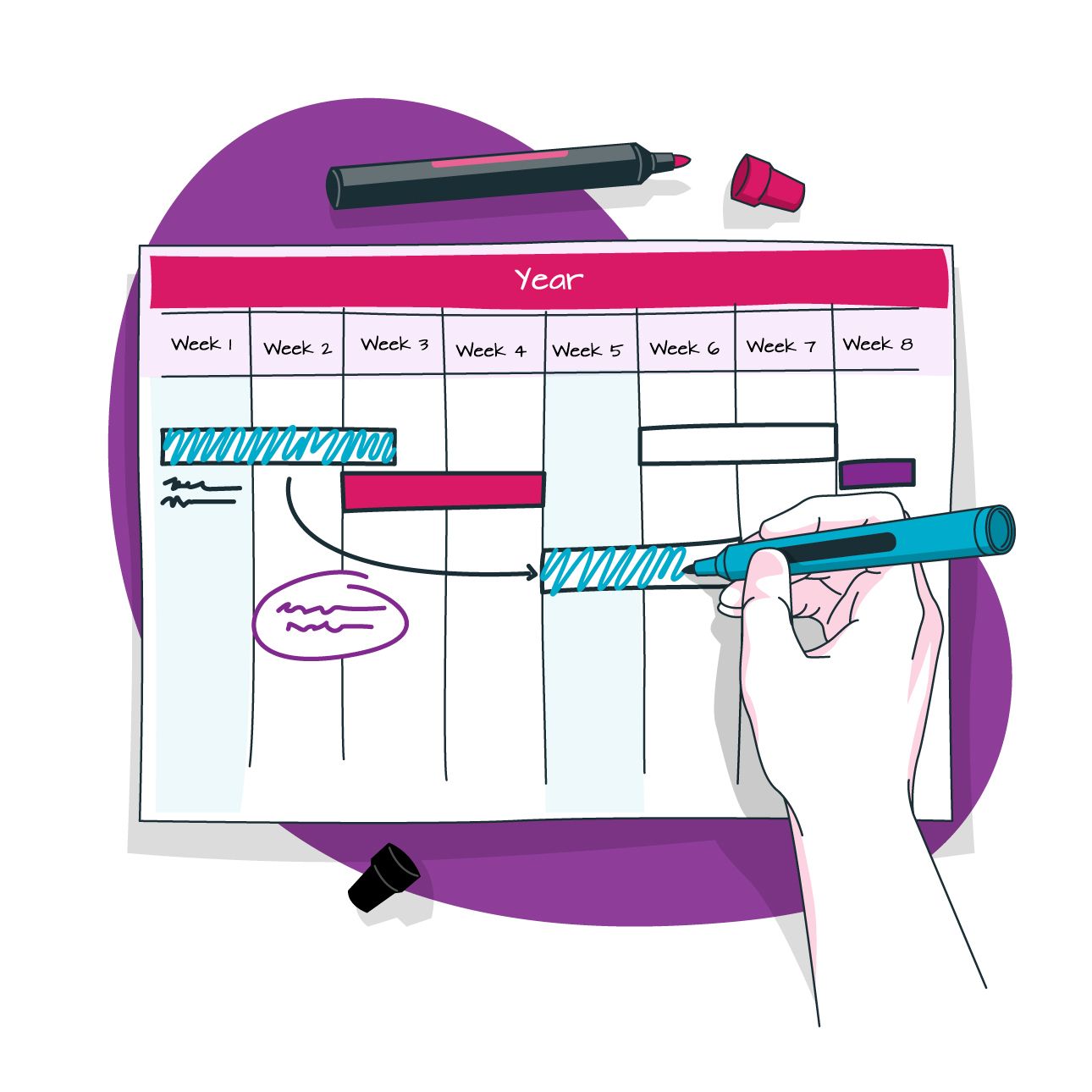
Regular delivery of debugged software becomes possible when the whole development process is divided into smaller stages. In addition, this principle facilitates better validation of implemented ideas and approaches.
4. Collaboration between the business stakeholders and developers throughout the project
Regular collaboration between the business and the developer team significantly improves the quality of the decisions taken and makes the communication process between the stakeholders much easier. The main goal of this principle is to achieve the synergistic effect between the people who make software and those who use it for their own purposes.
5. Support, trust and motivate people involved
Developers who don't think about basic needs and have a comfortable working environment are much more likely to operate better and achieve higher results. When motivated individuals get all the trust and support they need, the job is usually done well and in time.
6. Enable face-to-face interactions

Having the opportunity to discuss different aspects of the development process in person makes communication between members of the team much more effective. Unfortunately, the COVID-19 pandemic put some restrictions on personal collaboration, and many software developers moved to an entirely online environment. This led to slowing down and postponing many projects.
7. Working software is the primary measure of progress
Delivery of high-performing software to the customer is the main KPI for the team's performance assessment. It doesn't matter how many sleepless nights were invested in the project, how many lines of code were written, or how many bugs were fixed. If the software doesn't operate in the way it was initially expected, the work can't be considered finished.
8. Agile processes support a consistent development pace
Team members need to discuss and establish a maintainable pace at which they can comfortably operate and deliver working software on a regular basis. When this principle is applied in practice, its main goal is to avoid professional burnout and the necessity of heroic deeds. Optimization of basic processes is the solution.
9. Attention to technical detail and design enhances agility

A well-chosen set of skills and design solutions gives the developer team an opportunity to maintain the speed of the project, constantly improve the code, face the challenges, and respond to them effectively. All these aspects of the development process make it much more agile. Operational excellence makes the difference between a true professional and an ordinary team member.
10. Simplicity
Complex decisions can slow down the whole software development process. The amount of effort must be just enough to do the task at that time. If something can be done in a simple way with a medium amount of effort without loss of quality, it should definitely be done this way. One important thing to remember is that the customers are paying for the result, not for hard work.
11. Self-organizing teams encourage great architectures, requirements, and designs
Experienced and motivated teams who make decisions, take responsibility, regularly communicate, and share ideas with each other are able to deliver high-quality solutions through a sustainable development process. The team that has to be pushed by its leader on a regular basis should revise its whole approach.
12. Regular reflections on how to become more effective
Last but not least, the twelfth principle states that constant personal growth, skill and process improvement, and self-organization are the key factors for efficient work and final success. Continuous improvement can be achieved through repeating the four basic steps: plan – do – check – act. If something goes wrong, the team can always discuss it and move on.
Final Thoughts on the Agile Manifesto
The ultimate goal of Agile is to unite the software development process with business needs. A lot of web development companies follow Agile in building products. Projects built on the basis of the Agile values and principles focus on the customers and encourage their direct involvement and participation in the process. The implementation of the Agile Manifesto all over the software industry proved its effectiveness and positive impact on many processes.
Strengths and Weaknesses of Agile
The Agile methodology is well-suited for small and medium-sized organizations – after all, the fewer people there are on the team, the easier it is to collaborate and make decisions. When you hire a software development company that follows Agile principles, you will benefit from these strengths:
- Faster deployment of software, so you get value sooner
- Because your hired development team is working on up-to-date tasks, they waste fewer resources
- It's easier for the team to adapt to your requested changes
- Developers quickly detect and fix issues
- Less time is spent on busywork and bureaucracy
However, Agile also has its downsides, namely:
- Because you must constantly interact with the developers, it demands more energy and time
- The scope could creep up over time
- Without CI/CD pipelines and automated testing, "Agile" teams can run sprints without shipping production-ready increments — increasing integration risk at release time
When to Choose Agile
Agile and Waterfall are two of the most commonly used SDLC – but how do you know which one is right for your project? Waterfall works best for projects that have well-defined deliverables and concrete timelines. So, if you can provide the software developers with clear requirements, Waterfall is a good choice.
On the other hand, if your project's constraints are unclear, Agile is the better SDLC, as it enables the developers to be more flexible; they can evolve the project's planning as the work progresses. Your software development team will likely follow Agile principles if:
- You don't have a concrete timeline or fixed budget
- They don't know all of the requirements
- You don't have a complex bureaucracy that would delay decision-making
- You need to capture the market quickly
| Agile | Waterfall |
|---|---|
| The plan evolves over time | The plan is developed at the beginning |
| Iterative and incremental processes | Phased and sequential processes |
| Produces working outcomes on a regular basis | Delivers a final product at the end |
| Cross-Functional Teams | Functional Teams |
For startups hiring an outsourced team specifically: confirm that your vendor's Agile practice includes continuous integration (not just sprint cadence), automated test coverage, and shared delivery dashboards. These are the practices that separate fast outsourced delivery from slow outsourced delivery — not the choice between Scrum and Kanban.
Agile Methodologies
Not every organization implements Agile SDLC in the same way; there are several possible frameworks – Kanban, Scrum, Extreme Programming, Feature-Driven Development, Crystal, Lean, and Dynamic Systems Development Method. And, to make things more convoluted, there can be hybrids. For instance, Scrum + Kanban = Scrumban.
Today, though, we're just going to look at Scrum and Kanban, which are the most popular non-hybrid Agile methodologies.
Scrum vs. Kanban

Scrum divides a project into short iterations, usually between 1 – 4 weeks in length. Each iteration is called a "sprint". The Scrum Master leads the team, and they work together to deliver an iteration at the end of each Sprint. A Scrum team boosts collaboration and discusses progress during daily standup meetings, and they use a Scrum Board to manage and monitor their project.
Kanban focuses on visualizing work, limiting the amount of work in progress, and maximizing flow. The team uses a Kanban board, which is broken down into visual signals (sticky notes, tickets), workflow columns (to-do, progress, complete), work-in-progress limits, a backlog section, and a delivery point.
| Scrum | Kanban | |
|---|---|---|
| Roles | Roles are must and include the Product Owner, Scrum Master, and Development Team. | There are two optional roles: Service Delivery Manager and Service Request Manager. |
| Planning | At the beginning of each Sprint, work is planned and divided into smaller "user stories". | Rather than planning big batches of work, Kanban does "just-in-time" planning. |
| Commitment | Commitment is determined using sprint forecasting. | Team members finish a task before picking a new one. |
| KPIs | Metrics include Velocity and Projected Capacity, and they are measured on Burndown charts and Team Velocity charts. | Metrics include Lead Time and Cycle Time, and they are monitored on Burndown charts and Velocity charts. |
Steps of a Scrum Workflow

There are 5 phases within Scrum: product backlog creation, sprint planning, working on the Sprint, testing/demonstrating, and retrospective.
First, in product backlog creation, the Product Owner works with the Scrum team to prioritize items based on:
- Custom priority
- Feedback urgency
- Difficulty of implementation
- Relationships between items
Various items are included in the backlog, like features, bugs and defects, information attainment, and technical work. Large items are transformed into "user stories" and "epics".
Epics – Large chunks of work that can be divided into stories
User Stories – Short requirements written from an end user's perspective
Epics and user stories can both be put into the product backlog, but only user stories are included in the sprint backlog.
Next comes sprint planning and creating the sprint backlog. The Scrum team selects the most important user stories and breaks them up into smaller tasks. User stories need to be made as small as possible, as the average Sprint only lasts 2 weeks.
After the Sprint is planned, it's time to get to work. Throughout the Sprint, daily Scrum meetings are held. These last for about 15 minutes and aim to gather the status of each team member.
Full life cycle testing is carried out, as each task is a working product. After testing, each Sprint is demonstrated to the customer.
Retrospective is next, in which the team discusses what went well, what can be improved, and the lessons learned during the Sprint. After that, the next Sprint is planned, and the cycle begins again.
Phases of Agile SDLC: The Brocoders Approach

Discovery Phase
Description
Discovery is the first phase within service design and delivery. By conducting user research, our team identifies the problems the solution needs to solve, prioritizes user needs, and establishes a shared understanding between client and development team.
Before AI, discovery was a slow process by necessity. Workshops had to be followed by days of manual note-taking, email clarifications, and document assembly. Requirements elicitation and specification together took 4–8 weeks — and even then, inconsistencies between the PM's notes, the BA's interpretation, and the developer's understanding were common.
With AI, the same discovery outcomes are now delivered in 1–2 days.
Every workshop is recorded and transcribed in full by an AI notetaker. That transcript becomes the single source of truth for the entire project — not someone's interpretation of what was said, but what was actually said. Anton, one of Brocoders' project managers, describes the shift:
"Everything comes from the transcript. The client explains their business, we discuss functionality, all decisions get captured. Then we feed all of that to AI, and the documentation writes itself — correctly, because it's grounded in what was actually said."
From that single transcript, three AI agents run in parallel to produce the project's foundational documents:
- Toranaga (PM/Product Owner agent) produces the PDR — Product Requirements Documentation: user stories, business requirements, and user flows — the document that bridges client language and development language.
- Kiwari (Software Architect agent) produces the SRS — Software Requirements Specification: technical stack decisions, architecture, and integration requirements. Intentionally concise — it doesn't over-explain patterns the team already knows.
- Miyabi (UI/UX Designer agent) generates the UI Design Documentation: design system definitions, component hierarchy (atoms → molecules), and React component specifications.
"The agents know our standards. We don't need them to explain how to write a button component. We need them to define what the button means in this product's design system — and that's what they produce."
All three documents are then cross-audited against each other and against the original transcript. Conflicts are resolved by returning to the transcript — not by debating interpretation.
Finally, Claude Cowork pushes the approved requirements directly into Jira as epics, sprints, user stories, and sub-tickets, and into Notion as living project documentation — with no manual ticket writing.
"We don't write tickets manually anymore. By the time the development team opens Jira, the sprint structure is already there — built from the same transcript the client signed off on. There's no telephone game between what the client said and what the developer builds."
Specification includes the following techniques:
- Questionnaires
- Interviews
- Brainstorming
- Change of perspective
- Analogy technique
- Document-centric techniques
- Mind mapping
- Workshops
- User stories and use case modeling
- Prototypes
Techniques involved in requirements specification include:
- Prototyping
- Decomposing user stories into use cases and tasks
Participants
- Stakeholders
- Business Analysts
- Project Manager
Brocoder's Discovery Responsibilities
During discovery, the team is responsible for:
- Establishing success metrics
- Developing user personas
- Creating a prioritized list of user stories
- Conducting market research and competitor analysis
- Assembling a development team lineup
- Specifying system requirements
As a result of the discovery phase, the client receives:
- Work Breakdown Structure

- Feature decomposition

- Low fidelity prototype

View Figma - BROtotype Web App UI Kit 1
- Project timeline
- Project cost
Stakeholder's Discovery Responsibilities
The stakeholder is responsible for:
- Providing input and insight on requirements
- Helping to determine priorities
Design
Description
During this stage, the designer, product manager, business analyst, and stakeholders decide what the product will look like from both sides: architecture and UX/UI. Stakeholders need to be involved in verifying that their requirements are correctly interpreted, and can use the design documents to plan for necessary changes to business processes while developers work on the code.
Before AI, the design phase was the first major bottleneck after discovery. Translating requirements into wireframes, aligning stakeholders on visual direction, and producing a prototype typically took 2–4 weeks — with multiple revision rounds before a client could see anything close to the real product.
With AI, a working low-fidelity prototype can be prepared and presented to the client in 1 day.
The Miyabi agent — Brocoders' AI UI/UX designer — generates the UI Design Documentation directly from the PDR produced in Discovery: design system definitions, component hierarchy from atoms to molecules, and React component specifications. Because Miyabi works from the same transcript and requirements that Toranaga and Kiwari used, the design system is already aligned with the product logic before a human designer opens a single tool.
Human designers then supervise, refine, and iterate on the AI-generated foundation — focusing their expertise on decisions that require taste, context, and client relationship knowledge rather than starting from a blank canvas.
"AI doesn't replace the designer's judgment. It removes the blank page. By the time our designer sits down, the structure is already there — they're shaping it, not building it from scratch." — Anton, Project Manager at Brocoders
The result is that clients see a real, interactive prototype in the first design session — not a description of what the prototype will eventually look like.
Building the Design System: The Atomic Design Approach
At Brocoders, we build every design system using Atomic Design methodology — a modern, component-first approach that structures UI from the smallest reusable unit upward:
- Atoms — the foundational elements: buttons, input fields, labels, typography, and color tokens. These are the building blocks that everything else inherits from.
- Molecules — functional groups of atoms: a search field combining a label, input, and button; a form row combining a label and an input.
- Organisms — complex UI sections assembled from molecules: a navigation header, a product card grid, a login form.
- Templates — page-level layouts that define structure without specific content, ready to be handed off to development.
- Pages — final, content-specific screens that represent what the user actually sees.
[IMAGE PLACEHOLDER — insert Atomic Design diagram: atoms → molecules → organisms → templates → pages]
This approach directly speeds up the design phase because every component is defined once and reused everywhere. When Miyabi generates the UI Design Documentation, it maps the product's requirements directly onto this hierarchy — producing a system where React components in development correspond 1:1 to the design system's molecules and organisms. There is no translation gap between what the designer specified and what the developer builds.
Participants
- Designer
- Product Manager
- Business Analyst
- Stakeholders
Brocoder's Design Responsibilities
During design, the team is responsible for:
- Architecture envisioning
- Iteration modeling
- Model storming
- Preparing UX/UI screens
- Updating requirements
Stakeholder's Design Responsibilities
The stakeholder is responsible for:
- Attending weekly meetings with the designer
- Providing feedback
- Gathering feedback after user testing

Development and Coding
Description
Before AI, development was the longest phase by a significant margin. Developers wrote boilerplate from scratch, code reviews were done manually by the team lead for every push, architectural consistency depended on individual discipline, and a typical feature took a full 2-week sprint to implement, review, and stabilise. Repetitive work — setting up API endpoints, scaffolding components, writing standard CRUD logic — consumed hours that could have gone to business logic.
With AI, the same feature delivery now takes a fraction of the sprint. Two agents work alongside the development team on every project:
Takumi — Brocoders' AI full-stack developer — generates implementation-ready code from user stories defined in the PDR. Named after the Japanese concept of the master craftsman (匠), Takumi handles boilerplate, component scaffolding, API integrations, and routine implementations using React.js, React Native, and Node.js. Developers review, shape, and extend what Takumi produces — focusing their expertise on business logic, edge cases, and decisions that require product judgment.
Kiwari — the Software Architect agent — continuously validates structural consistency as the codebase grows. Rooted in 木割, the traditional Japanese system of architectural proportions, Kiwari ensures that new code fits the established patterns, flags structural drift before it becomes technical debt, and keeps the system coherent across sprints.
"We use AI to write code the same way a senior engineer uses a junior — you set the direction, review the output, and step in where judgment matters. The difference is that AI never gets tired and never forgets the architecture." — Anton, Project Manager at Brocoders
At Brocoders, we call this delivery model "Continuous Everything" — a trunk-based, CI/CD-driven pipeline where code is integrated, tested, and deployable at every sprint boundary. Automated unit tests and end-to-end regression cycles run on every commit, Jira roadmaps drive continuous planning, and monitoring tools (Sentry, NewRelic, logz.io) catch regressions before users do.
The main stages of "Continuous Everything" include:
- Continuous planning
- Continuous development
- Continuous integration
- Continuous testing
- Continuous delivery
- Continuous feedback
Participants
- Project Manager
- Product Owner
- Development Team
Continuous Project Planning
Project planning is the key to successful product delivery within the agreed timeline and budget. Because Brocoders uses proper project planning, our team experiences better risk management, improved motivation, and boosted coordination.

The Project Manager "owns" project planning; they are responsible for setting up and improving the development and delivery process, as well as making sure the team is adhering to it.
Brocoder's Continuous Project Planning Responsibilities
The project manager's responsibilities include:
- Creating a development communication plan and meeting notes
- Introducing the team and leading project onboarding
- Creating a RACI matrix for development team responsibilities
- Setting up a task manager, such as the next-gen Atlassian Jira
- Defining a project roadmap and milestones
- Creating and prioritizing the backlog
- Sprint planning: defining sprint goals and priorities, feature requirements, issues breakdown, issues re-estimates, and risk analysis
- Sprint demos and collecting feedback
- Providing team leadership and motivation: team standup meetings, face-to-face meetings, team building activities, problem-solving
- Driving process improvements and introducing new, relevant tools and approaches
Stakeholder's Continuous Project Planning Responsibilities
The stakeholder is responsible for:
- Meeting team members
- Participating in sprint planning meetings
- Following project progress (we add them to our Jira board)
- Reviewing the project roadmap and timeline
Continuous Coding & Development
Project development represents coding and task execution following established best practices — in this case, using Agile augmented with AI. With Agile, proactivity and communication are the keys to successful development. At Brocoders, developers work within the same office space, so they can quickly and effectively share ideas, problems, and solutions.
Brocoder's Continuous Coding & Development Responsibilities
Our development team is responsible for:
- Using modern web and mobile development frameworks: React.js, React Native, Node.js
- Supervising and extending AI-generated code with Takumi, ensuring quality and business logic correctness
- Validating architectural consistency with Kiwari across every sprint
- Front-end/back-end developer specialisation: deep knowledge for specific problems
- Using open-source libraries (GNU GPL, MIT licensing)
- Working with AWS infrastructure and Gitflow
- Adhering to test-driven development principles
- Reviewing each other's code: the team lead reviews all code pushed
- Following security best practices, including token-based authentication and user data encryption
- Documenting development
Stakeholder's Continuous Coding & Development Responsibilities
The stakeholder is responsible for:
- Participating in weekly meetings and daily standups
- Prioritizing tasks with the project manager and setting up sprint goals
- Participating in sprint demos/release demos
- Providing the team with feedback and change requests
- Reviewing reports
What to ask any vendor about their Agile delivery process:
- Do you use CI/CD pipelines? What triggers a deployment?
- What is your automated test coverage (unit + e2e)?
- How do you share delivery metrics with clients (velocity, lead time, deployment frequency)?
- Are milestones tied to demoable, production-ready increments — or sprint hours?
- What monitoring tools are in place to catch regressions after deployment?
- Do your developers supervise AI-generated code, or rely on it unsupervised?
Testing
Description
Before AI, testing was the phase most likely to compress under sprint pressure. QA engineers wrote test cases manually from requirements documents, regression suites grew unwieldy over time and ran slowly, and bugs discovered late in the sprint often forced a choice between delaying the release or shipping with known risk. A thorough QA cycle before a major release could take 3–5 days — and still miss edge cases that only surfaced in production.
With AI, continuous testing runs automatically on every commit. The QA cycle no longer exists as a discrete pre-release phase — it runs in parallel with development, throughout the sprint.
Takumi, the full-stack development agent, generates test cases directly from user stories at the time the feature is written — not after. Unit tests, integration tests, and end-to-end test scaffolding are produced alongside the implementation, so the codebase always has coverage that matches its current state. QA engineers then review, extend, and validate what Takumi generates, focusing their expertise on user behaviour, edge cases, and scenarios that require human judgment to anticipate.
Bug detection is handled proactively by the monitoring stack — sentry.io, NewRelic, and logz.io — running continuously in staging and production. These tools surface regressions and anomalies before users encounter them, and flag them with enough context for a developer to resolve without a full QA reproduction cycle.
"Before, testing was something that happened at the end of a sprint. Now it happens on every push. The QA engineer's job has changed — they're no longer finding bugs the developer missed, they're validating behaviour the AI couldn't anticipate." — Anton, Project Manager at Brocoders

Participants
- Project Manager
- QA Team
Brocoder's Testing Responsibilities
This can vary between teams, but at Brocoders, we follow best QA practices:
- Conducting a product analysis and forming a test plan
- AI-assisted test case generation from user stories (via Takumi), reviewed and extended by QA engineers
- Conducting unit tests, ensuring each software component is safe to modify
- Performing end-to-end automated tests, protecting releases from possible regressions
- Functional testing
- Getting early feedback via user acceptance testing
- Using regression testing cycles — each new release needs to be better than the last one
- Using a test management system (at Brocoders, we use Jira for test cases, test planning, and tracking test cycle executions)
- Tracking bugs with AI-assisted severity classification via Sentry, NewRelic, and logz.io
Stakeholder's Testing Responsibilities
The stakeholder is responsible for:
- Expressing expectations for test results
- Validating test environment changes from the POV of an end-user
- Making the user group aware of process modifications resulting from software improvements
Deployment
Description
Before AI, deployment was the highest-risk moment in any sprint. Teams worked through manual pre-launch checklists, deployment steps were executed by hand, and identifying a breaking issue in production meant relying on user reports or a developer noticing something wrong in the logs. Rolling back a bad release was a stressful, time-consuming operation with no guarantee of catching everything that had changed. A full production deployment could take half a day to execute safely.
With AI, deployment is a pipeline event — not a manual operation. Every change that reaches deployment has already passed automated build checks, AI-powered security scans, and regression detection before a human approves the release.
Kiwari — the Software Architect agent — validates that the deployment configuration matches the system architecture defined in the SRS before the release goes out. Any structural drift between what was built and what was specified is flagged automatically, not discovered in production.
The monitoring stack — Sentry, NewRelic, and logz.io — uses AI-powered anomaly detection to watch every deployment in real time. Unusual error rates, latency spikes, or behavioural changes trigger alerts immediately, giving the team the signal to roll back before an issue scales. Rollback strategies are defined and version-controlled as part of the deployment pipeline itself, not assembled under pressure after something breaks.
"Deployment used to be an event everyone was nervous about. Now it's a checkpoint. The pipeline does the verification — we just make the final call." — Anton, Project Manager at Brocoders
All production servers remain hosted on the client's accounts across the three major cloud platforms — AWS, DigitalOcean, and Azure — with AWS as the most common choice.

Participants
- Project Manager
- Development Team
Brocoder's Deployment Responsibilities
Team members are responsible for:
- Running through the AI-verified pre-launch checklist to confirm the product is fully functional
- Maintaining a version-controlled rollback strategy, executable without manual intervention
- Doing launch testing, including full feature scope tests, A/B tests, and User Acceptance Tests
- Monitoring post-deployment behaviour with Sentry, NewRelic, and logz.io for anomaly detection
Stakeholder's Deployment Responsibilities
Stakeholders are responsible for:
- Setting up an account on AWS, Digital Ocean, or Azure
- Buying a domain (preferably from AWS or one that can be transferred to AWS)
- Providing information about the SSL certificate they would like to buy
- Providing production repositories
Feedback and Review
Description
Before AI, the feedback loop was the phase most prone to information loss. Sprint retrospectives relied on what team members remembered, backlog updates were made manually by the PM after the review meeting, and patterns across multiple sprints — recurring blockers, velocity trends, scope drift — were only visible if someone took the time to compile them by hand. Preparing a thorough sprint review could take a full day of coordination.
With AI, retrospective insights are generated automatically and the backlog is updated before the next sprint begins.
Satori — Brocoders' AI Business Analyst agent, named after the Japanese concept of sudden clarity (悟り) — analyses sprint data, user feedback, and monitoring signals after every sprint. It surfaces recurring blockers, identifies patterns across retrospectives, and flags scope or velocity drift before it compounds into a delivery risk. What previously required a PM to manually cross-reference notes across sprints now arrives as a structured briefing.
Toranaga — the PM/Product Owner agent — takes Satori's retrospective analysis and applies it directly to the backlog: reprioritising items, adjusting story estimates based on observed velocity, and preparing the sprint planning agenda for the next cycle. The PM reviews and approves, but does not build the update from scratch.
"The retrospective used to be about remembering what happened. Now Satori has already done that — it shows you what the sprint actually looked like across all signals, not just what people recall in the meeting. The conversation becomes about decisions, not reconstruction." — Anton, Project Manager at Brocoders
In order for a product to be considered demonstrable at the sprint review, it must be developed, tested, integrated, and documented. After the demonstration, feedback is acquired and the PM uses it — together with Satori's analysis — to tailor the backlog for the next sprint.
Participants
- Project Manager
- Development Team
- Product Owner
Brocoder's Feedback and Review Responsibilities
The PM is responsible for:
- Reviewing Satori's retrospective analysis and approving backlog updates generated by Toranaga
- Reviewing the Sprint's results and explaining if any items for the backlog were not completed
- Updating the backlog and restating the project scope going forward
- Collaborating on the next steps
The team is responsible for:
- Discussing the successes and challenges they experienced during the Sprint
- Holding a live demo of the product
- Answering any questions about the increment
- Collaborating on the next steps
Stakeholders Feedback and Review Responsibilities
The stakeholder is responsible for:
- Asking questions about the backlog and the product demonstration
- Collaborating on the next steps
How AI Is Changing Every Phase of the Agile SDLC
AI doesn't replace the Agile SDLC — it compresses the time each phase takes and removes the manual bottlenecks that make iterations slow. In a traditional Agile team, humans handle sprint planning, test case writing, code review, and retrospective analysis. In an AI-augmented development team, these tasks are partially or fully automated — which means developers spend less time on process overhead and more time shipping features. Here's what changes at each phase.
| SDLC Phase | What AI changes | Specific tools / practices |
|---|---|---|
| Discovery | AI analyzes interview transcripts, generates draft user stories, and runs competitive research in minutes instead of days. Requirements gaps are flagged before specification is finalized. | Toranaga (PDR), Kiwari (SRS), Miyabi (UI DD), Claude Cowork → Jira + Notion |
| Design | AI generates UI component suggestions, flags UX patterns that conflict with accessibility standards, and proposes architecture options based on similar project profiles. Designers iterate on AI-generated wireframe variants rather than starting from blank. | Miyabi, Atomic Design methodology, v0, Cursor for front-end scaffolding |
| Development & Coding | AI writes boilerplate, suggests implementations, generates documentation, and flags security anti-patterns in real time. Senior architects review and guide — AI accelerates, architects ensure it's right. | Takumi (full-stack), Kiwari (architecture validation), GitHub Copilot, Cursor |
| Testing | AI generates test cases from user stories, identifies regression risk areas after each commit, and classifies bugs by severity automatically. Test coverage expands without growing the QA team. | Takumi (test generation), Sentry, NewRelic, logz.io with anomaly detection |
| Deployment | AI monitors deployment pipelines for anomalies, runs automated security scans on every build, and flags configuration drift before it causes incidents. | Kiwari (architecture validation), AI-augmented CI/CD, Sentry/NewRelic |
| Feedback & Review | AI synthesizes sprint retrospective patterns, surfaces recurring blockers, and reprioritizes the backlog based on observed velocity and user behavior data. | Satori (retrospective analysis), Toranaga (backlog reprioritization) |
The net effect is not a faster Agile — it's a leaner one. A traditional team of 8–10 people running Agile can be matched in output by an AI-augmented team of 4–5, where senior engineers focus on architecture and judgment while AI handles implementation speed and process overhead. This is the model Brocoders operates on: not AI instead of engineers, but AI that makes every engineer more effective at every phase.
Why Continuous Integration Makes or Breaks Agile Delivery
Most Agile failures in outsourced projects share a common root: sprints are running, but integration is not continuous. Features are developed in isolation across two-week windows, merged in a rush before demo day, and released in batches that concentrate risk at the end of each sprint. The result looks Agile on paper — velocity charts, burndowns, sprint ceremonies — but behaves like mini-Waterfall in practice.
The fix is not a different process. It's a different engineering baseline. At Brocoders, we call this baseline Continuous Agile Delivery — a five-pillar practice model that every Agile delivery team should be able to demonstrate:
| Pillar | What it means in practice | How to verify with a vendor |
|---|---|---|
| Full-stack-first delivery | Features are delivered end-to-end (front + back + infra) in each sprint — no front/back handoff debt accumulating across sprints | Ask: "Show me a sprint where a user-facing feature shipped fully to staging." |
| AI-assisted dev & QA | Code generation and automated test creation reduce cycle time without cutting architectural oversight — AI writes faster code; architects make it the right code | Ask: "What AI tools does your team use, and how are they supervised by senior engineers?" |
| Continuous Feature Integration | Every commit merges to trunk/main with automated CI checks and tests — no integration branches pending for weeks | Ask: "What is your branching strategy? When does code merge to main?" |
| Outcome-based engagement | Milestones are tied to demoable product outcomes, not billed sprint hours | Ask: "Can you show a sample milestone schedule from a past project?" |
| Transparency & Metrics | Clients have shared access to delivery dashboards covering lead time, deployment frequency, velocity, and change fail rate | Ask: "What metrics do you share with clients, and how often?" |
These pillars map directly to the practices already described in this article: Continuous Everything (CI/CD, automated tests), Jira roadmaps and sprint demos, monitoring with Sentry/NewRelic/logz.io, and production hosting on client accounts. Continuous Agile Delivery is not a new methodology — it's what Agile looks like when the engineering baseline is honest.
Final Thoughts on the Agile Lifecycle
Agile works. But it works differently depending on whether your vendor runs it as a ceremony or as a delivery system. The practices described above — CI/CD pipelines, automated test coverage, continuous integration, outcome-based milestones, AI-assisted development, and shared dashboards — are what transform Agile from a project management method into a product delivery engine.
If you're evaluating outsourced development partners and want to understand how Brocoders applies Continuous Agile Delivery to startup and SMB projects, start with a project estimate → or explore our case studies. Learn more about our proven MVP development process.
This approach proves especially effective in SaaS development, where rapid iterations and continuous value delivery are essential. Discover how the Brocoders team provides SaaS development services tailored to startup and SMB needs.
FAQ
A repeating cycle of short development sprints (typically 1–4 weeks) where a cross-functional team plans, builds, tests, and ships working software increments. Unlike Waterfall, it doesn't front-load all planning upfront — requirements evolve through continuous client feedback, and working software is delivered at the end of every sprint rather than at the end of a long project.
Agile is a way of building software in small, working pieces delivered frequently — rather than one large delivery at the end. The team adjusts the plan as feedback arrives, instead of following a rigid specification. The result is faster time to market, less wasted development effort, and a product that reflects real user needs.
Core Agile skills include: writing and prioritizing user stories, running sprint ceremonies (planning, standup, retrospective, demo), managing a product backlog, applying Scrum or Kanban frameworks, collaborating across cross-functional teams, and interpreting delivery metrics like velocity, lead time, and cycle time.
Agile requires active stakeholder involvement throughout the project, which takes time and energy. Scope can grow if the backlog isn't managed carefully. And critically: without CI/CD pipelines and automated testing, sprint outputs can accumulate technical debt that only surfaces at release time — turning "Agile" into a slower process than intended.
Scrum predates the Agile Manifesto. The Scrum framework was developed in the early 1990s by Ken Schwaber and Jeff Sutherland. The Agile Manifesto was written in 2001 by 17 software practitioners — including the Scrum creators — who codified the shared values already present in methods like Scrum, XP, and DSDM into a unified set of principles.
The 12 principles of the Agile Manifesto cover: customer satisfaction through early delivery, welcoming changing requirements, frequent delivery of working software, business-developer collaboration, motivated individuals, face-to-face communication, working software as the measure of progress, sustainable development pace, technical excellence, simplicity, self-organizing teams, and regular reflection on effectiveness. They are all covered in detail in the section above.
Agile principles prioritize people over processes, working software over documentation, customer collaboration over contract negotiation, and responding to change over following a fixed plan. These four core values, along with the 12 supporting principles, define how Agile teams approach delivery and continuous improvement.
The 12 principles were created by the 17 signatories of the Agile Manifesto, who met in Snowbird, Utah in February 2001. The group included Ken Schwaber and Jeff Sutherland (Scrum), Kent Beck (Extreme Programming), and other leading software practitioners of the era.
Continuous Integration (CI) means that every developer's code changes are automatically built, tested, and merged into the shared main branch multiple times per day. It eliminates the "integration hell" that happens when teams merge large, divergent codebases infrequently. In Agile delivery, CI is the foundation that makes sprint goals achievable — without it, teams risk discovering integration failures only at release time.
AI is applied at every phase of the Agile SDLC: generating user stories and requirements documentation during Discovery (Toranaga, Kiwari, Miyabi), producing design systems and prototypes during Design (Miyabi), writing and reviewing code during Development (Takumi, Kiwari), generating test cases and detecting regressions during Testing (Takumi), validating deployments and monitoring anomalies during Deployment (Kiwari), and synthesizing retrospective insights during Feedback & Review (Satori, Toranaga). In AI-augmented teams, the result is leaner delivery: a team of 4–5 engineers with the right AI tooling can match or exceed the output of a traditional team of 8–10.
Ask: Do you use CI/CD pipelines, and what triggers a deployment? What is your automated test coverage across unit and end-to-end tests? How do you share delivery metrics with clients — velocity, lead time, deployment frequency? Are milestones tied to demoable product outcomes or billed sprint hours? What AI tools does your team use, and how are they supervised by senior engineers? What monitoring tools are in place to catch regressions after deployment?