Enterprise architecture platform rebuilt in 8 weeks, with an AI planner added
A European software company's platform could not carry planning at enterprise scale. After a 4-week discovery, we rebuilt it in 8 weeks and added an AI planner that turns a written strategic goal into a proposed set of changes.
Industry
Enterprise software
Location
Europe
Client since
June 2026
Status
Delivered, September 2026
8 weeks
Development, from start to first release
4 gates
Milestone gates, none moved
13,900
Unit tests, plus 1,950 end-to-end
25 min
To build a full environment
Development ran July 29 to Sept. 25, 2026, after a 4-week discovery. The first release went to a 2-person acceptance group, and the platform is in user acceptance testing.
Ask our assistant
At a glance: the enterprise architecture platform
Client
A European software company that sells an enterprise architecture platform to large organisations
Product type
Enterprise architecture platform: a configurable metamodel, master data of applications, capabilities, processes, and integrations, scenario planning, and initiatives
What we did
Audited the existing platform, rebuilt it ground-up, built a new AI planning module, and built the environments as code
Engagement
Discovery and prototype, then an 8-week build in 4 sprints of 2 weeks, with a milestone gate at the end of each
Architecture
React single-page app, NestJS API, background worker, PostgreSQL, a modular monolith of 10 business contexts, a database per tenant, and AWS described in Terraform
AI
A planner that turns a short written strategic goal plus attached documents into a target-state scenario grounded in the customer's own master data
Dates
Proposal June 1, 2026. Kickoff June 29. Development from July 29. First release Sept. 25, 2026, less than 4 months after the proposal
A production platform rebuilt, and an AI planner added, in 8 weeks of development.
“After three years of working on our enterprise architecture platform, we were impressed by how quickly Brocoders understood its complex requirements. They delivered both the existing EA management capabilities and the new AI planning capabilities quickly and effectively.”
Client team, European software company
What an enterprise architecture platform does, and who uses it
An enterprise architecture platform is a shared model of how a large organisation works: its business capabilities, processes, applications, data, integrations, and technologies, and how they depend on each other.
A real enterprise runs hundreds of applications and thousands of integrations, and dozens of change programmes reshape them at the same time. A change programme, which this product calls an initiative, is a planned body of change with an owner, milestones, and objectives, such as replacing a finance system. No one person can hold that picture in their head. Enterprise architects and the business owners who plan with them need one place that shows what runs today and what each programme will change.
So the platform does 2 jobs. It holds the current state: every application, capability, process, and integration, with their dependencies, shown in views and a dependency tree. And it holds the planned state as scenarios. A scenario is a proposed set of changes to the landscape that can be reviewed, approved, and applied, and once applied it becomes the new current state.
Current state1Master dataApplications, capabilities, processes, and integrations, with their dependencies
→↓
Planned state2InitiativesChange programmes, each with an owner, milestones, and objectives
→↓
Planned state3ScenariosProposed changes, in sequence, in parallel, or as alternatives
→↓
New current state4Approve and applyThe approved scenario is written into master data
How planning works in an enterprise architecture platform: changes are planned as scenarios against the current state, and an approved scenario becomes the new current state.
Building that picture is a project of its own: describing a whole enterprise in detail can take a month. The structure comes first (the metamodel, often following a standard such as ArchiMate), then the data that fills it. Links can be generic ("related to") or specific ("used by"), so picking one element shows everything that depends on it. A scenario then answers a question such as: what happens if we drop the video-call tool that 3 of 4 departments pay for? It shows who uses the tool, what depends on it, and what dropping it saves, before anything changes.
When the client came to us, its platform was in production with its first large customer on it, and it modelled the current state well. Planning at enterprise scale was where it stopped. Enterprise planning means tens of initiatives, each carrying scenarios in sequence, in parallel, and as alternatives: hundreds of scenarios in total.
What the client asked for
The client had already concluded that the platform needed a full rebuild, not more fixes. It had grown up around its first large customer over about 3 years and could not be sold to the next customers as it was. In discovery, the request came down to 7 requirements.
Planning at enterprise scale. The platform had to carry hundreds of scenarios and dozens of initiatives on large data sets, which is where the existing one failed.
Data in fast. Customers fill the platform from spreadsheets, so bulk import had to work at volume and say row by row what failed.
A data model that would not cause rework. Customers define their own object types and relationships, so the model had to change without code changes or production schema changes.
Software that proposes changes. A report that lists what is outdated does not tell an architect what to do about it. The client wanted the platform to propose the target state from a written strategic goal and the documents behind it. That became the AI planner. Its exact shape was not known at the start, so the first statement of work carried an estimated budget for it.
AI cost under control. Generation runs on a paid AI provider, so its spending had to be capped and visible per customer.
Environments the client runs alone. The client's own team had to create and ramp down environments without calling us.
Security an enterprise reviewer accepts. The client's customers run security reviews, so access control, the separation of customer data, and AI-specific risks had to be covered.
The stack was left open: the client asked us to lead the architecture. Our technical proposal was approved after 2 to 3 review rounds, in which the client asked not only what we would build but exactly how.
What a 3-day audit found in the existing enterprise architecture platform
Before proposing anything we read the existing system: 4 repositories, audited in 3 days, July 1 to 3, inside a 4-week discovery. The system was a frontend and 3 backends, described as a microservice architecture. We wrote tests to pin down how it actually behaved, and turned what we found into a full feature list.
1
The 3 backends were forks of one codebase. Between 80 and 90% of the code was duplicated across them. Which copy served traffic was decided in the frontend's service URLs. About a quarter of what looked like working code in one service was a dead fork. To find which copy was live we cross-referenced all 3 against the frontend, controller by controller. That is a large part of why discovery ran 4 weeks instead of the planned 2. It also confirmed what the client had assumed going in: software built incrementally over 3 years needed a rebuild rather than another round of fixes.
FrontendIts service URLs picked which copy served traffic
↓↓↓
Backend copy 180 to 90% the same code
Backend copy 280 to 90% the same code
Backend copy 380 to 90% the same code
↓↓↓
One PostgreSQL database, sharedTables created at runtime, and one table written by all 3 copies
Finding 1 in a picture: 3 backend copies of one codebase, writing to one shared database whose tables were created at runtime.
2
The 3 services shared one PostgreSQL database. One table of scenario items had a model and write paths in all 3 codebases, so 3 deployables with 3 release cycles wrote to 1 physical table.
3
The schema was generated at runtime. Creating a portfolio type (a category of thing the customer models, such as applications or business capabilities) ran CREATE TABLE. Adding a field ran ALTER TABLE, against the production database, from 6 replicas at once.
One shared database and schema, 3 deployables, and 3 drifting copies of the same logic: refactoring would have meant reconciling the copies before any improvement, so the rebuild was chosen.
Why the platform was rebuilt, and how the work was phased
The existing code became a feature inventory, a precise record of what the product does and which parts were already dead, and the platform was designed from the requirements.
Before
FrontendIts service URLs picked which copy served traffic
↓↓↓
Backend copy 180 to 90% the same code
Backend copy 280 to 90% the same code
Backend copy 380 to 90% the same code
↓↓↓
One PostgreSQL database, sharedTables created at runtime, and one table written by all 3 copies
After
React single-page app
↓
One NestJS backend and a background workerA modular monolith: each business context is reachable only through its own entry point10 business contexts
↓
A database per customerOwn credentials and file bucket; customer types stored as data, so tables never change at runtimeCustomer 1Customer 2Customer 3
Before and after: 3 copies writing to one shared schema, replaced by one backend of 10 business contexts and a database per customer.
The work ran in 3 phases.
Discovery and a prototype on the client's real data. Discovery ran 4 weeks instead of the planned 2, because the codebase could not be read at face value. We raised that at the first steering meeting and proposed compressing the next phase. A prototype on the client's own data was walked through with the client's product owners.
An agreed specification, refined sprint by sprint. Functional scope, non-functional requirements in 2 tiers (core for the first release, deferrable after it), solution design, delivery plan, and acceptance criteria. The scope detail was firmed up at each sprint boundary rather than frozen up front, which is why the requirements document kept its version numbers into September. Brocoders wrote the product requirements document from the discovery calls. Open questions were listed as gaps and answered in the client's written comments.
The build, in 4 sprints of 2 weeks. The team started with 2 developers and grew to 5 along a roadmap agreed up front. Each sprint ended in a demo, a milestone gate, and a steering review. The model was time and materials in project mode: a scoped delivery with milestone checkpoints, with decision tickets (open product questions logged for the client's product owners to answer).
What was built: the enterprise architecture platform
A data model each customer shapes, without database changes
The metamodel is the structure each customer sets up before entering any data: which kinds of things they track (portfolio types, such as applications or business capabilities), which fields each one has, and how they link to each other.
In the old platform, that structure lived in the database itself. Creating a portfolio type created a new table, and adding a field changed a table in the live production database.
We kept the product's concepts, because customers already worked with them: master data for what runs today, scenarios as changes to it (each change recorded as add, modify, or remove on a specific record), and initiatives that group scenarios under an owner, milestones, and objectives. What we changed is how the structure is stored. A customer's portfolio types, fields, and link rules are now data, saved as structured documents keyed by property id inside a fixed set of tables. Adding a portfolio type now adds rows to existing tables. Each customer's database has 34 business tables, and that number does not grow.
Before
A customer adds a portfolio type or a field
↓
CREATE TABLE or ALTER TABLERun against the live production database
↓
The database structure changesOne more table for every new portfolio type
After
A customer adds a portfolio type, a field, or a link rule
↓
Saved as dataA structured document keyed by property id, added as rows
↓
34 business tables per customerThe same tables for every customer; the number does not grow
Before and after: a change to a customer's model used to change the live database; now it is saved as data in 34 fixed tables.
Why this is better: a customer's edit to their model is now an ordinary save of a record, so it never touches the live database's structure. Every customer has the same tables, so one set of code, tests, and updates covers all of them. And because the model is data, every change to it goes into the change log, where it can be traced and rolled back.
This flexibility was the hardest part of the build. A customer can start from a blank page: add a field, set its validations, and link it to another field, for example to separate recurring costs from one-time costs. All of that had to stay validated and consistent on the 3 levels of the product (the metamodel, the master data filled into it, and the scenarios) and in every import format.
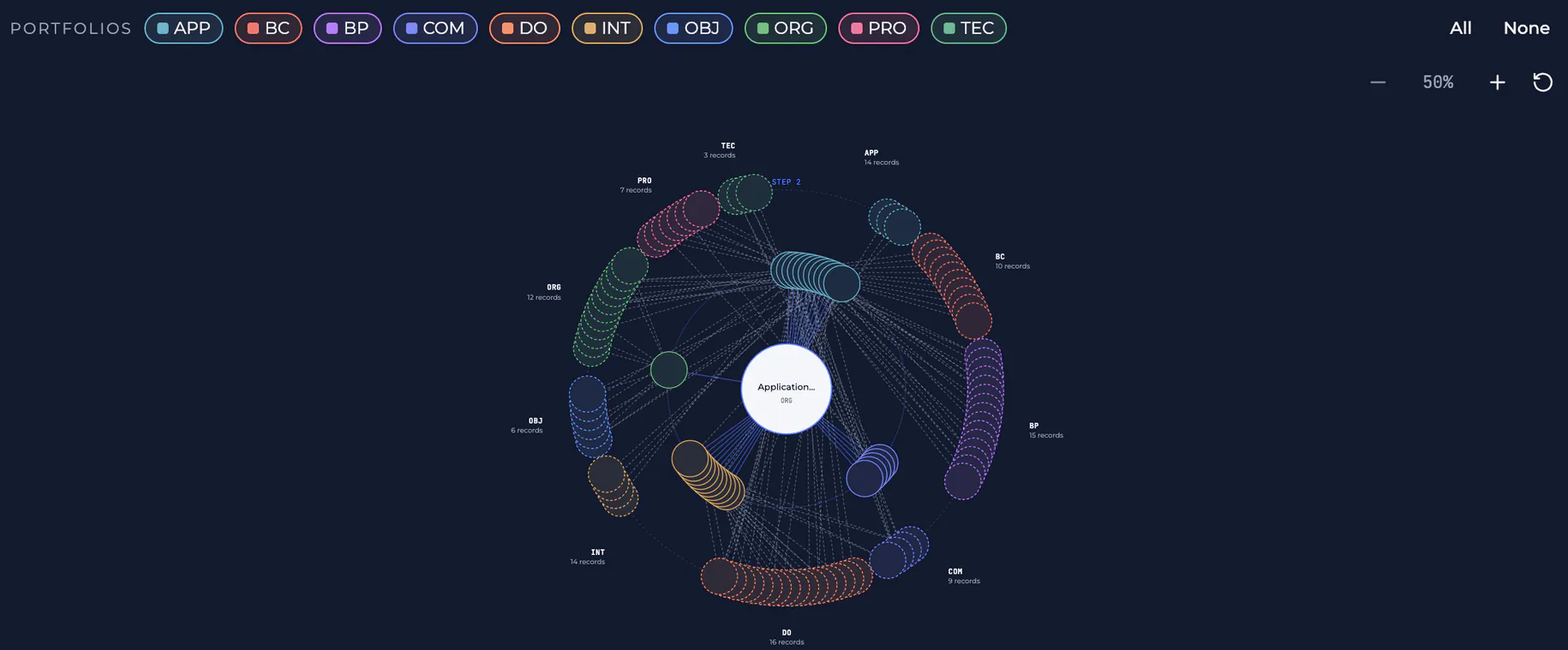
The connection map of one record. Each colour is a portfolio type, such as applications (APP), business capabilities (BC), and business processes (BP).
Master data and import
Every record carries a change log: who changed what, when, from where, and the value before and after, so any change can be traced and rolled back. A single wrong link can misstate an enterprise's costs by a million, which is why the log covers every level. Import and export work on all 3 levels, from the metamodel to the scenarios. Bulk import runs from spreadsheets with live progress and a per-row outcome report. A rejected row tells the user what to fix, and the rest of the file still lands.
An uploaded file goes straight to object storage, and the background worker processes it, so the user never waits on the server for a large import. In our tests a file of hundreds of thousands of rows, 10 to 20 MB, was processed in 20 to 30 seconds.
A deleted portfolio is soft-deleted, so it can be restored. The client wanted no confirmation dialogs in the way of the user, so a delete offers a 10-second undo instead.
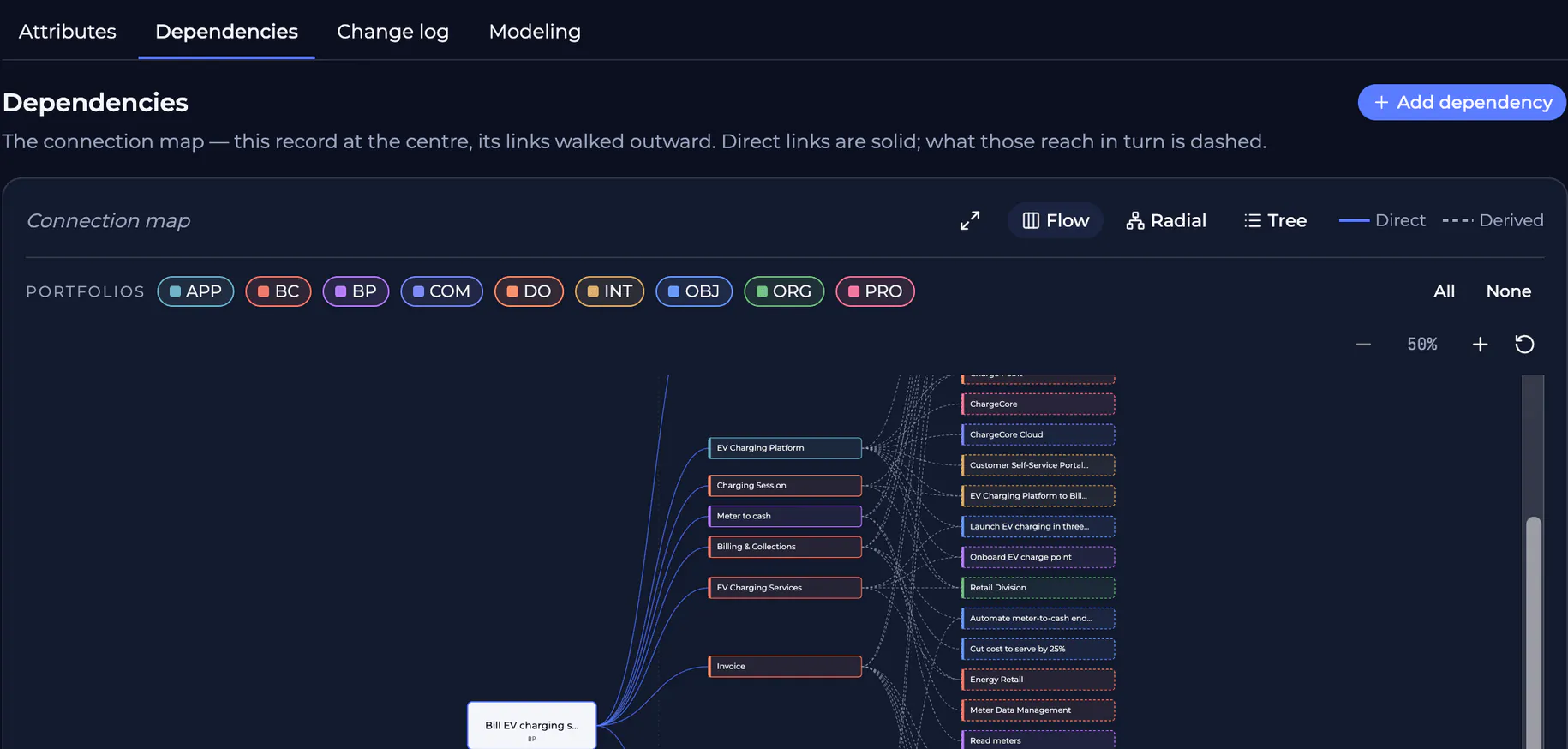
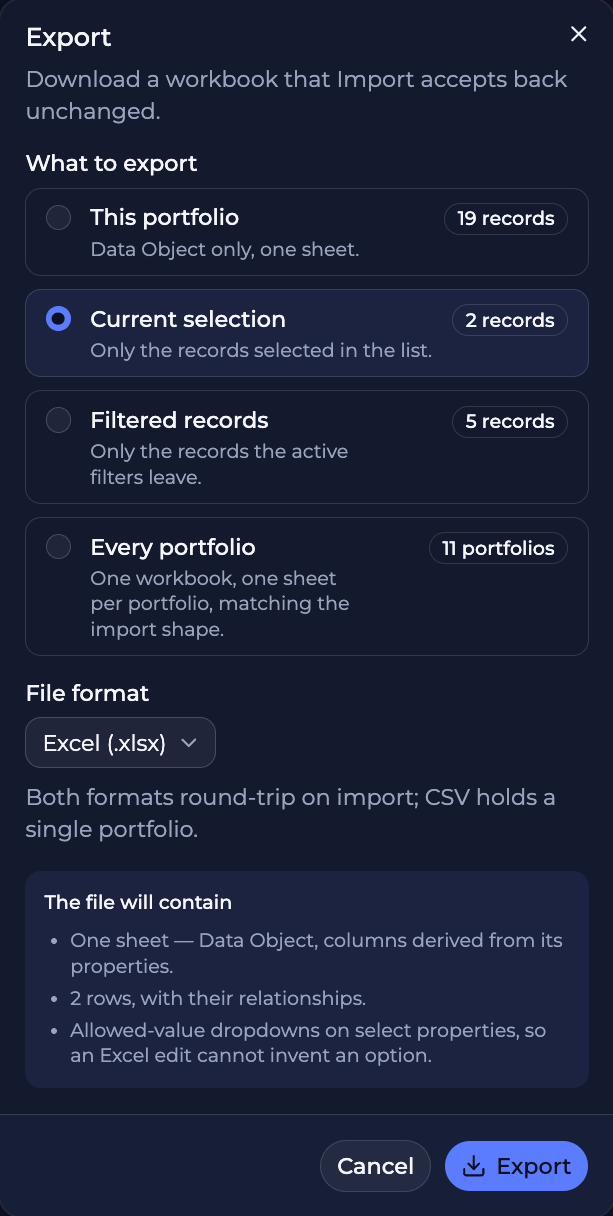
A record's dependencies in the Flow view: direct links are solid, what they reach in turn is dashed. Attributes, the change log, and modeling sit on the tabs above.Export writes a workbook that import accepts back unchanged: one portfolio, a selection, the filtered records, or every portfolio.
Scenarios
A scenario has items, links, members, an approval path, and apply to master: once approved, the scenario's changes are written into the live landscape in one transaction and the scenario is closed. Validation runs before the state changes. Where a scenario has problems the action is refused, and every problem is listed against the item it belongs to.
Tenancy and operations
Every tenant gets its own database, database credentials, and file bucket. A shared database with a tenant column on every table was ruled out: one query that forgets the tenant filter would send one customer's data to another. The tenant comes from the signed access token. Selecting one through a request header is impossible in production, and a startup check enforces that. Lint rules and architecture tests block raw database access outside the platform layer (the shared data-access code every context goes through), and dedicated tests prove the isolation holds through the ORM, raw SQL, the query builder, and concurrent requests.
The backend is a modular monolith of 10 business contexts. Each exposes only a facade (one public entry point per context) and its contracts, so any one can be extracted into its own service later. One command builds a complete environment in about 25 minutes, against a requirement of 2 to 3 hours.
Releases run blue/green: the new version starts on a second environment and traffic moves across, with no failed requests. Deployment runs through short-lived federated credentials, with no long-lived cloud keys and no SSH access. In failure drills the API returned to service about 6 seconds after its process was killed, the worker reconnected in about 7 seconds, and a full host reboot restored every service in about 30 seconds.
"The main problem we solved was flexibility. A customer can start from a blank page: this field, these validations, linked to that field. We had to make that flexibility correct and validated on every level, so the chaos stays under control."
The AI planner: from a written strategic goal to a target-state scenario
The planner turns a short written strategic goal plus attached documents into a target-state scenario against the customer's own master data. It is the feature the rebuild was for.
Before, a consultant did this by hand. Given a goal such as entering a new market, they worked out on boards and in documents which decisions it needs, who owns each one, and what evidence supports it. The planner builds the same structure as a decision tree: each decision has an owner and its evidence, and solutions are joined by logical conditions, such as "Solution 1 works if Decision 1 and Decision 2 hold, or if Decision 3 does". The client's consultants had already tested their method with a general-purpose AI assistant; we turned it into a product feature that follows the method step by step.
Architect1Goal and documentsA few sentences on what should change, plus PDF, Word, presentations, and spreadsheets
→↓
Platform2GenerationA background job against the customer's own metamodel and records
→↓
Output3Target-state scenarioA decision tree and typed changes to existing master data, with gaps listed
→↓
Architect4Review and approvalThe same validation and approval as a hand-written scenario
Around every run
Only the background worker reaches the AI provider
Data sent from an allow-list, no user accounts or person fields
Spending capped per run and per tenant per day
Every call recorded with tokens, latency, and cost
Documents deleted at the provider after use
A deployment never costs a user their generation
The AI planner step by step, and the safeguards around every run.
What comes back. The scenario names the applications, capabilities, processes, and dependencies the goal implies, in the platform's own structure, so validation treats it like any scenario an architect wrote.
Documents. Uploaded files are converted to text inside the platform. Scanned documents with no text layer are transcribed by the model.
Deployments. Progress streams to the browser live. A run that spans a release finishes on the worker being retired, which stops taking new jobs but completes the ones it holds, and the stream resumes where it left off.
Spending caps. The caps per run and per tenant per day are configured per customer and are not published.
"While the team rebuilt the platform, I worked with the client on the planner: designing the feature, writing the requirements, running workshops. When we saw its full scope, about a month before the end, it was complex, but it fit the budget we had set aside for it."
Portfolio types, custom properties, named and generic relationships, permissions, and display views. Schema changes without a release
Master data
Record management, dependency management, a dependency tree browser, views, filtering and search, and a change log recording the source of every change
Import and export
Per-portfolio and cross-portfolio spreadsheet import and export carrying relationships in the file, partial-import handling, and clear error reporting
Scenario planning
Change as typed changes against master data, a single-approver workflow, and apply to master in one transaction with a closed applied state
Access
Sign-in with corporate identity federation, Viewer, Editor, and Admin roles, and mandatory multi-factor authentication (MFA) on local accounts
The planner
Goal capture, decision structure, solution structure, generation from attached documents, gaps listed, and review and approval
6 functional areas, with schema changes that need no release.
How the engagement ran: 4 gates in an 8-week build
Four milestone gates ran between Aug. 14 and Sept. 25, 2026, inside the 8-week build that started July 29, and none moved. Weekly steering carried a cumulative cost tally and milestone estimates, which the client asked for in the first month.
Gate
Date
What was demonstrated
M1, concept and foundation
Aug. 14, 2026
Platform foundation running: architecture, data layer, access management, and model configuration begun. All 5 exit criteria met
M2, design and prototyping
Aug. 28, 2026
Model configuration complete, master data and dependency management in place, and a live demo on staging. All 4 criteria met
M3, build
Sept. 11, 2026
Full planning cycle demonstrated: import at scale, scenario planning, and apply to master
M4, first release
Sept. 25, 2026
First release to users. The planner running on live master data (generation engine demonstrated Sept. 18). Core non-functional requirements verified
What kept the 8-week build on plan
An estimate the team owned. The 2 engineers who started the project made the estimate and owned it, with the end result and the final architecture clear before the team grew.
A team ramp planned up front. We proposed starting with 2 developers and adding engineers along the roadmap: 2 more, then 1, to 5 at peak. Extra people were budgeted for 2 sprints only.
A buffer for the one unknown. The planner was the one part nobody could size at the start. When its full scope became clear, about a month before the end, it fit the buffer, and it took 1 engineer from the existing team instead of the 2 planned.
Design from scratch. Our team designed every screen from the technical description of each feature. The client accepted the design with no round of changes.
A knowledge base we built. Processes, task descriptions, and reports were written down in full, which AI-assisted development needs. New engineers started with something small and concrete and got up to speed fast in a very specialised domain.
Testing split by risk. Automated tests, AI-assisted testing, and manual checks on specific features, with 1 QA engineer deciding which feature needed which.
"This project was as controlled as it gets, from start to finish. We met the deadlines at the start and at the end, and some parts were delivered ahead of schedule."
Every pull request in both application repositories was reviewed by an automated reviewer built on Claude Code. It reads each change in an isolated checkout and posts inline review comments. When the author pushes a fix it reviews again, verifies the fix, and resolves the comments addressed. When a frontend change depends on the backend, it reads the backend repository too and checks that the requests and responses match. Among the problems it caught were missing database indexes and redundant ones that would have slowed queries.
The reviewer approves only when nothing blocking remains and the quality gate is green on that exact commit. It has read-only access: it cannot change code, history, or repository settings. In September 2026 it worked through 77 pull requests.
In October 2026 a separate review of the security-critical code, run by Brocoders with Claude Code, covered authentication, MFA enrolment, sessions, invitations, password reset, multi-tenancy, and object storage. It found no critical defects. The suggestions were implemented and covered by tests.
The product specification was written through an AI-assisted pipeline with every requirement anchored to a named source, a call, an email, or a decision, and unresolved items flagged as gaps. Estimates were produced by more than one model and reconciled where they disagreed.
Two rules kept the AI tooling honest. AI assistant configuration and our engineering standards live outside the product repositories, so they never reach the source code or the environments the client receives. And the quality gate is the same for every change, whether a person or a model wrote it.
"I started by reviewing every pull request by hand. As the team grew, people were waiting for me. So I automated it: the critical issues are fixed before I look."
Vladyslav Shchepotin Backend engineer, Brocoders
Results for the enterprise architecture platform
First release to users 58 days (8 weeks) after development started, and 88 days after kickoff, including a 4-week discovery.
All 4 milestone gates passed on their dates.
About 13,900 unit tests and about 1,950 end-to-end tests run against real PostgreSQL, queue, storage, browser, and sign-in including MFA. There are no skipped, focused, or snapshot tests.
The API has 156 endpoints documented with OpenAPI, and each tenant has 34 business tables.
A complete environment builds from one command in about 25 minutes, against a requirement of 2 to 3 hours.
The platform enforces MFA, signs users in through Microsoft Entra ID with single sign-on (SSO), exposes only the content delivery layer to the internet, and encrypts data in transit and at rest. The full git history of every repository was scanned for secrets, and none were found.
The platform is in user acceptance testing. The first release went to a user group of 2 people. The architecture is designed for hundreds of scenarios and dozens of concurrent initiatives.
Team
Project
manager
5
developers
QA
engineer
DevOps
engineer
Project manager 1, developers 5, QA 1, DevOps 1, at peak in September 2026. Discovery ran with the project manager and 1 developer. Development started with 2 developers, added 2, then 1 more.
Stack
Also Microsoft Entra ID, a hosted large language model (LLM) provider, and Claude Code (delivery tooling).
Questions buyers ask about rebuilding an enterprise architecture platform
It can be, if the product's model is sound and the data lives in the customers' own imports. This one was. The new platform started clean and was populated through spreadsheet import, with per-row outcome reports. The master data model, scenarios as typed changes, and initiatives carried over unchanged. The storage underneath them did not.
Because the 3 services shared one database and a schema generated at runtime, every improvement would have meant untangling them first. We pinned down how the existing system behaved with tests, turned that into a feature list, and rebuilt the platform from the requirements.
Development took 8 weeks, in 4 sprints of 2 weeks with a gate at the end of each. Before it, discovery and a prototype on real data took 4 weeks, so the first release came 88 days after kickoff.
The programme's cost is not published under the client agreement. The software audit that precedes a rebuild like this starts at $5,000 for one application in 5 business days (Essential). A production platform with several services and repositories is the Standard tier: $9,900 in 10 business days.
Generation runs against the customer's own metamodel and records and returns typed changes against existing master data. Anything it could not resolve is listed as a gap. The output goes through the same validation and approval workflow as a hand-written scenario, so nothing reaches master data without a person approving it.
Each tenant has its own database, its own database credentials, and its own file bucket. The tenant is read from the signed access token, never from a request header, and a startup check enforces that in production. Tests prove the isolation through the ORM, raw SQL, the query builder, and concurrent interleaved requests.
Brocoders wrote the product requirements document from the discovery calls, listing 28 open questions as gaps for the client's product owners to answer in writing. The client's product owners answered them in written comments on the document.
Put an estimated budget for it into the first statement of work and design it while the platform is rebuilt. Here the planner was sized about a month before the end, fit the buffer, and needed 1 engineer instead of the 2 planned.
Pin it down first. We wrote tests against the existing system to record how it behaved, turned the results into a feature list, and built the new platform against that list and the requirements.
A generation that spans a release finishes on the outgoing worker, and the progress stream resumes where it left off. Releases run blue/green, so a deployment does not cost a user their run.
If your product is in production and the architecture underneath it cannot carry what customers bring to it, start with the software audit. You get a read of the codebase and a written verdict in 5 to 10 business days, depending on the tier, before anyone proposes a rebuild.