Accounting firm owner launches a tax deadline SaaS in 9 weeks
Pacholi Monitor, built from the founder's own specification, reached 500+ users within 3 months. Of them, 8% pay.
Industry
Fintech, accounting SaaS
Location
Ukraine
Client since
April 2026
Status
Ongoing
9 weeks
Kick-off to release
500+
Registered users
8%
Of registered users on a paid plan
100+
Tax deadline templates at beta
Users and paid share as of October 2026. Templates as of the June 2026 beta.
Pacholi Monitor is a subscription SaaS for accountants who run sole-proprietor and LLC clients. The accountant adds a client, picks its legal form and tax system, and the app builds 12 months of report and payment deadlines for that client.
The client's owner can connect and see task statuses without asking the accountant. Brocoders built the SaaS product from the founder's specification and released it on Accountant and Auditor Day, July 16, 2026.
Fintech, accounting software for outsourced accountants, Ukraine
Product type
Tax deadline calendar app sold as a subscription SaaS, built as a mobile-first progressive web app with an admin panel
Engagement
SaaS MVP from the client's specification, then subscription billing, then Phase 2 in estimated batches
Timeline
First contact April 5, 2026, kick-off May 12, release July 16, paid tariffs Aug. 5
Team
1 full-time full-stack developer, a project manager who also covered business analysis, UI, and QA, with a QA engineer joining at the beta, and delivery and account managers
Stack
React 19, TypeScript, Vite, NestJS, PostgreSQL, a progressive web app with Web Push, a Telegram bot, Cloudflare Pages, Railway, Sentry, and Monobank acquiring (Monobank's card-payment service)
Pacholi Platform in the founder's words
I am the founder and CEO of Pacholi Platform, a Ukrainian ecosystem of digital tools for accountants. Our first product, Pacholi Monitor, is an organizer of tax deadlines and a workspace for accounting practice.
The project grows on bootstrapping: it is funded from my own money, with no investors or grants. My responsibility is to invest not in an abstract startup but in the professional community that I am part of myself.
It matters to me that this is a Ukrainian product for Ukrainian professionals, built together with a Ukrainian development team. The company is registered in Ukraine, operates under Ukrainian law and makes its own contribution to the Ukrainian economy, small as it is for now.
Why an accountant with more than 25 years in practice built a tax deadline app
Liudmyla Shtohryna runs an accounting and audit firm with 11 employees. She had seen the same gap from both sides: business owners who came to her firm after an outsourced accountant left them in trouble with the tax office, and accountants whose work their clients never see.
A business owner who hands accounting to an outsourced accountant cannot see whether a report was filed or a tax paid. The accountant does a large amount of work before each filing, and the client sees none of it.
Her product's own page puts a missed deadline at a fine of 340 to 5,100 hryvnias (UAH).
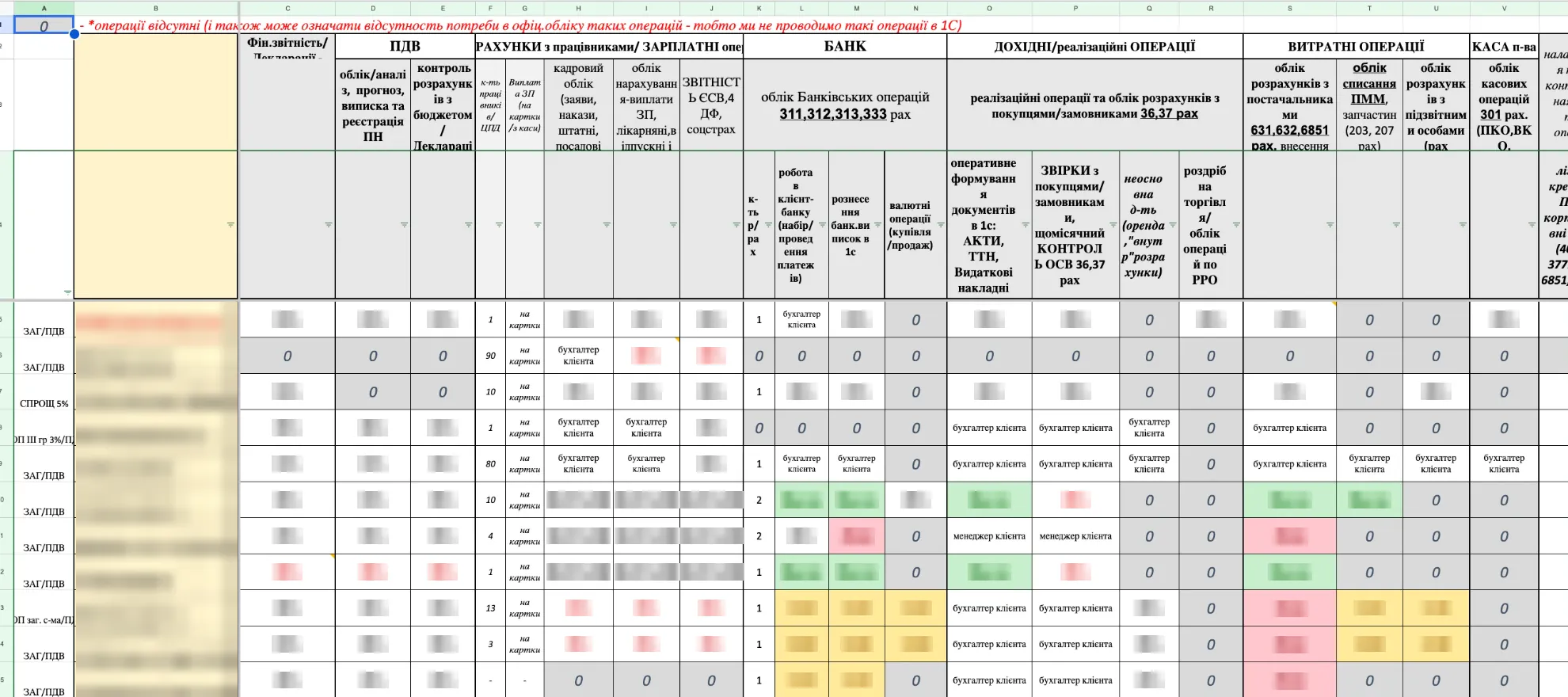
Inside her firm, assignments lived in an Excel workbook she built herself, later moved to Google Sheets: clients against processes, with an employee's name where they cross. It showed who owned what. It did not show whether a task was done.
The firm's former duty matrix in Google Sheets. Client and employee names are blurred.
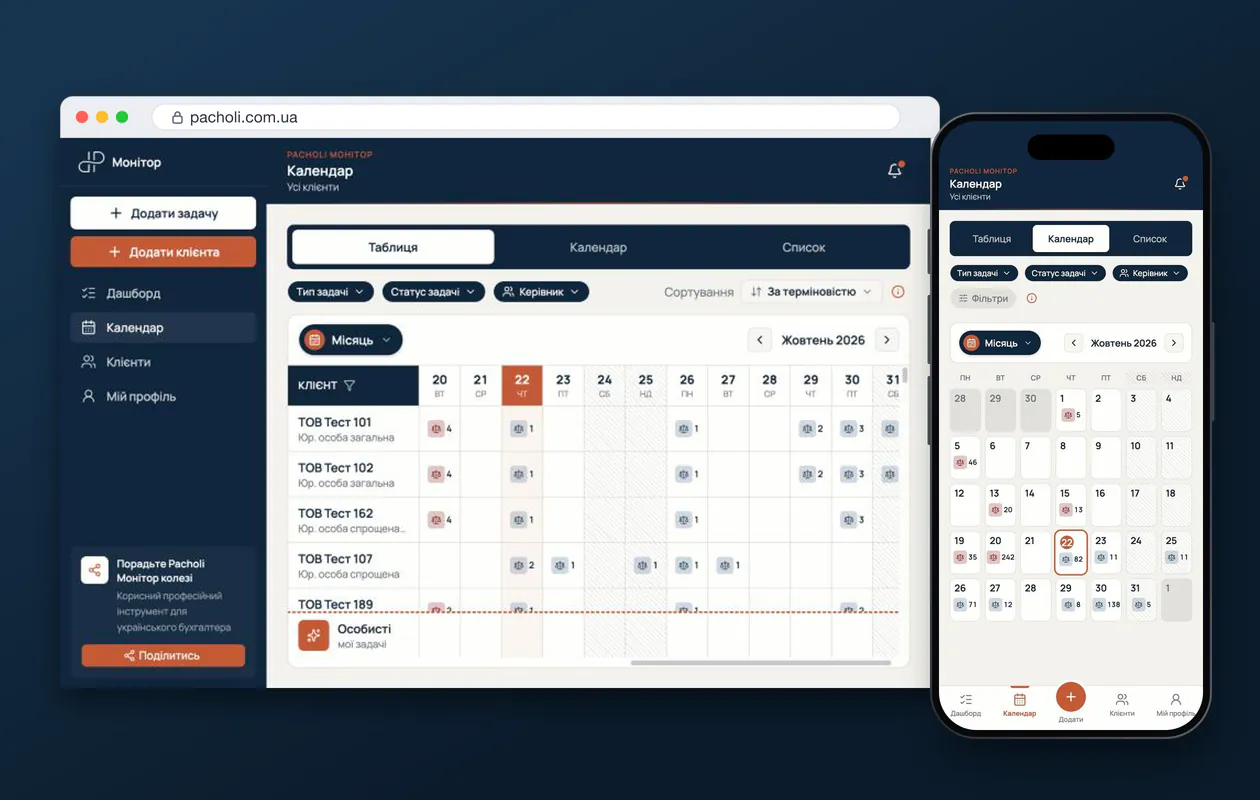
Pacholi Monitor keeps the sheet's clients-in-rows layout. Its columns are days, its cells hold the deadlines due that day, and every task carries a status.
"An Excel table won't fill itself in or check its own formulas... Here I give them a ready solution that costs about two cups of coffee... It's at least three to four hours a week."
How Pacholi chose a team to build its tax deadline app
Liudmyla decided the product would be built from a written description. She spent a few weeks writing one with Claude: documentation, mockups, and business logic.
Then she and her team ran a structured search:
16 agencies on the shortlist, 11 or 12 calls, and 3 finalists who received the specification
Her first message reached Brocoders through a form on brocoders.com on April 5, 2026: "We are preparing to launch a niche web platform for accounting services in Ukraine. The project is already specified in detail: documentation, mockups and business logic."
One finalist answered with a long list of conditions and an offer to consult. Another asked questions that showed it had not read the description.
At Brocoders' first meeting, a Brocoders project manager said she would run the description through the team's AI agent and come back with answers.
"The Brocoders project manager said honestly that they'd run it through their own agent that processes client descriptions and come back with an answer. That really won me over."
From an accountant platform to one tax deadline app: the MVP Lite decision
The specification described 2 products: Pacholi Platform, a marketplace for hiring accountants, and Pacholi Monitor, the deadline app. The founder's fixed date was Accountant and Auditor Day, July 16. Brocoders estimated the Platform and 3 versions of Monitor, and the client chose the smallest version that could ship on that date.
Option
Scope
Decision
Platform MVP
Hiring marketplace with candidate, employer, and expert roles
Postponed. Listed as "coming soon" on pacholi.com.ua
Monitor MVP v1
A first Monitor scope, estimated before v2 added real-time sync and billing
Replaced by v2
Monitor MVP v2
Deadline app plus magic-link sign-in (a one-click login link sent by email), real-time WebSocket sync (updates without a page reload), 2 role-specific app icons, a billing schema, and a trial
Accountant flow first: client companies, auto-generated calendar, owner invitation with view-only access, dashboards, admin, and notifications
Chosen on May 11, 2026
Moved to Phase 2: the 2 app icons, real-time sync, billing and trial, and a 10-minute undo for completed tasks.
The tax calendar engine behind Pacholi Monitor
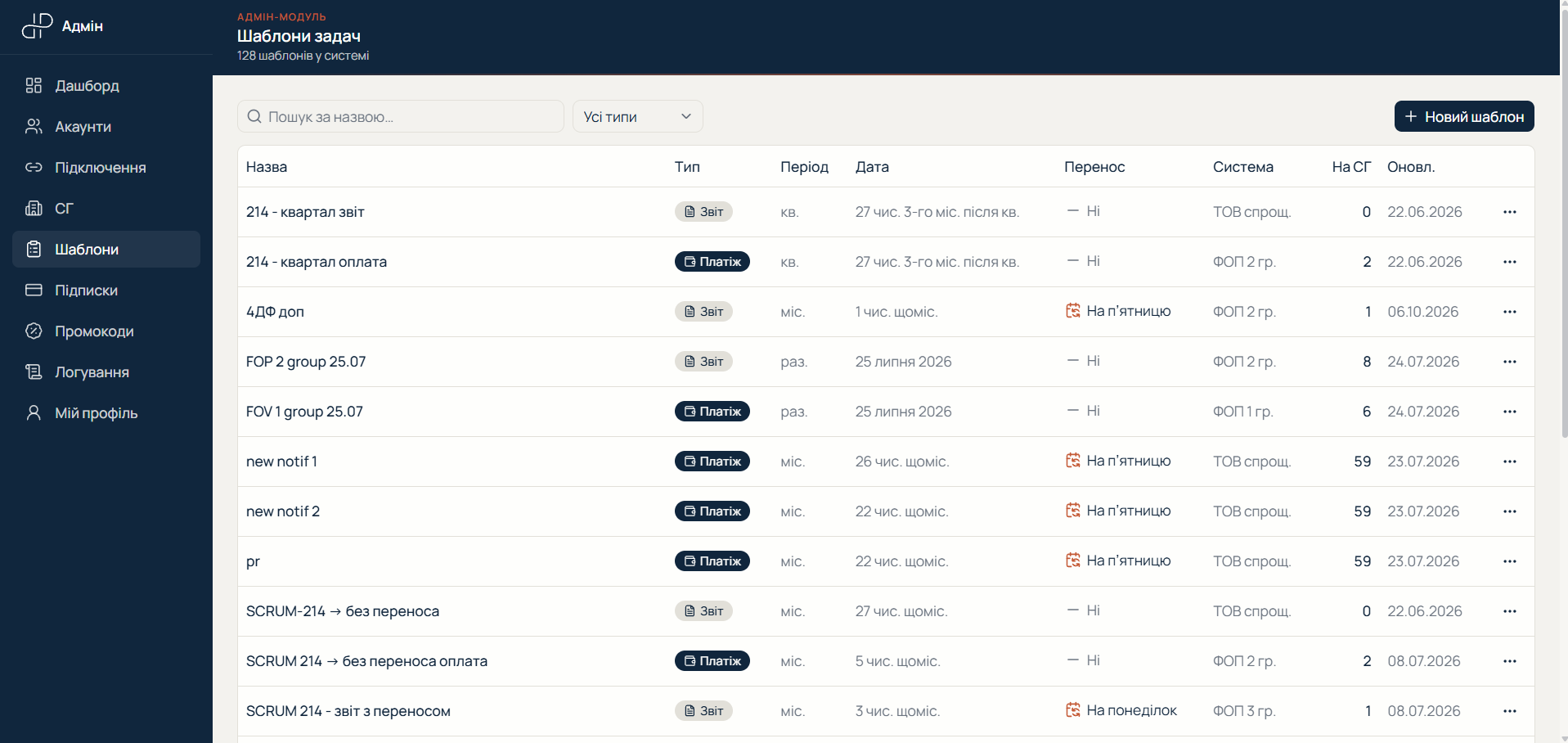
The founder supplied the rules as a matrix of 171 rows. Brocoders turned it into admin-managed templates that generate each client's compliance calendar. By the beta on June 20, the app carried more than 100 statutory deadline templates.
Legal form (sole proprietor or LLC) and tax system set the base. Attributes add to it: VAT, employees, revenue above or below 40 million UAH, land, property and vehicles, excise goods, foreign trade, agricultural producer status, military registration, Diia City status (Ukraine's special legal and tax regime for tech companies), and environmental tax.
A fixed date, a number of calendar days after the period ends (one field for quarters and years), and "by the 5th" kept apart from "on the 5th".
Reports move to the next Monday and payments to the Friday before. Tax invoice registration dates never move, so each template has a switch for the shift rule.
An "all systems" option applies one template, such as the monthly VAT return, to every matching combination of legal form, tax system, and attributes.
When a client's profile changes, the app rewrites only future system tasks. Completed and in-progress tasks stay as they are. QA covered VAT switched on, a move from single-tax group 2 to group 3 (2 tiers of Ukraine's simplified tax system), added employees, and duplicate tasks.
Each template stores a link to the law it comes from, ready for updates when legislation changes.
"If my calendar says it's a filing date, I didn't decide that. The Tax Code did."
Building the deadline app for accountants in 9 weeks
1
May 12, kick-off
Weekly sprints with a demo each week, a Tuesday status call, and Jira open to the client.
2
May 26, first build in the founder's hands
At about 60% of scope, the client got a demo with admin access. Testing it showed that a magic link opened from a messenger does not sign the user into an installed iOS web app, because iOS keeps the 2 cookie stores apart. The owner's sign-in moved to a one-time code from the accountant, then the owner's own email and password.
3
June 3, the accountant's view
The founder asked for the table accountants work in: client companies in rows, dates in columns. It became the default calendar view.
4
June 11, handover for client testing
Handover came 23 working days after kick-off. It included 9 functional modules and both optional extras: Web Push and a "recommend to a colleague" share. It also had 10 admin screens where the contract asked for 3 admin functions.
5
June 12 to 19, rules review
New tax systems and client attributes went in from the founder's template matrix.
6
June 20, beta on production
The founder's colleagues and outside accountants tested it, with feedback collected in a Telegram group. By July 15, the team had received 121 feedback items and completed 108.
7
July 16, release on Accountant and Auditor Day
Load testing with 100 client companies and about 12,600 tasks returned 0 errors in 1,409 requests.
Pacholi Monitor features for accountants and business owners
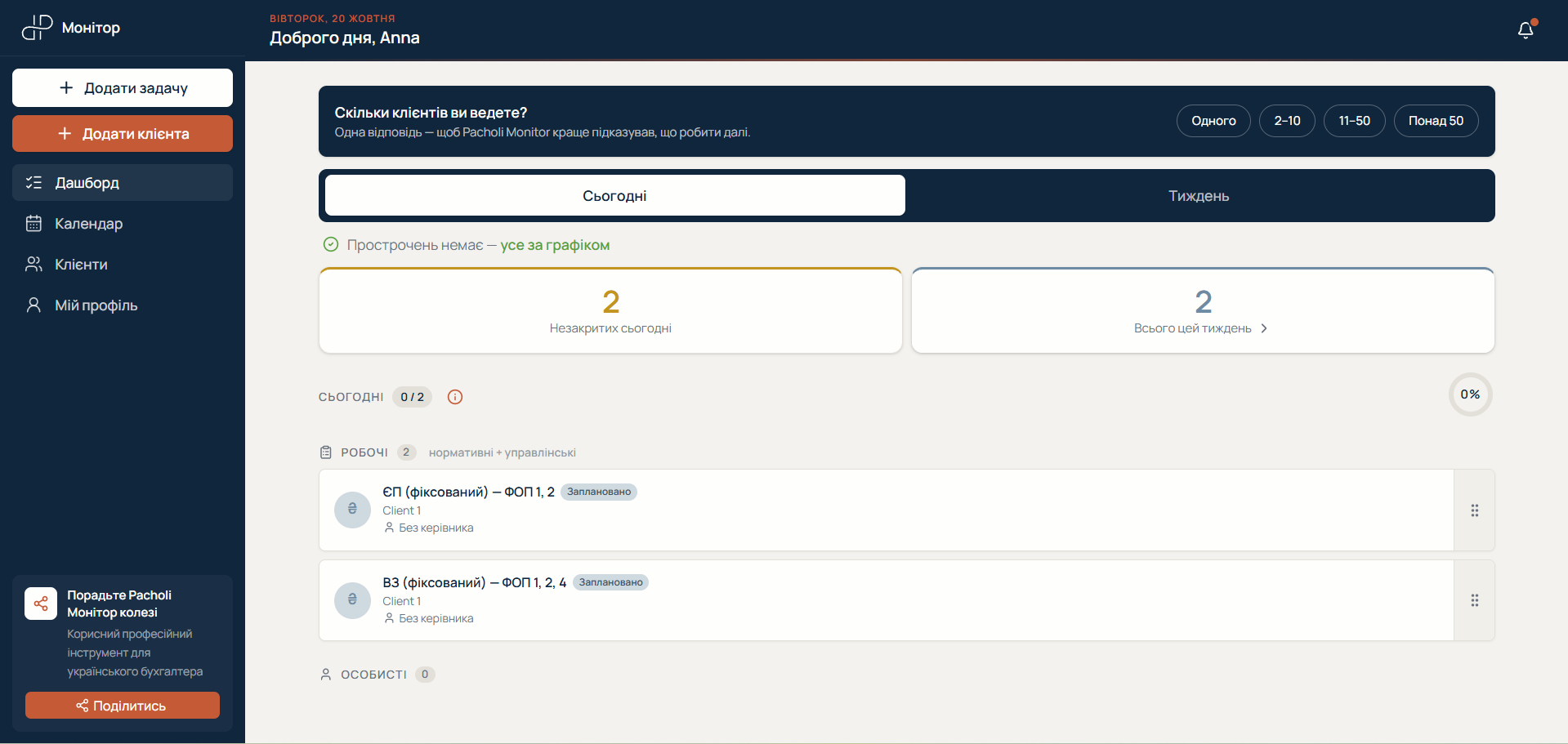
All clients in one calendar: sole proprietors and LLCs on different tax systems, with deadlines for the week, month, or year ahead
A client's 12-month calendar built from its legal form and tax system the moment the client is added
Reminders a week, 3 days, and a day before each deadline, by email, Telegram, and push
Statuses on every task: in progress, filed, or done
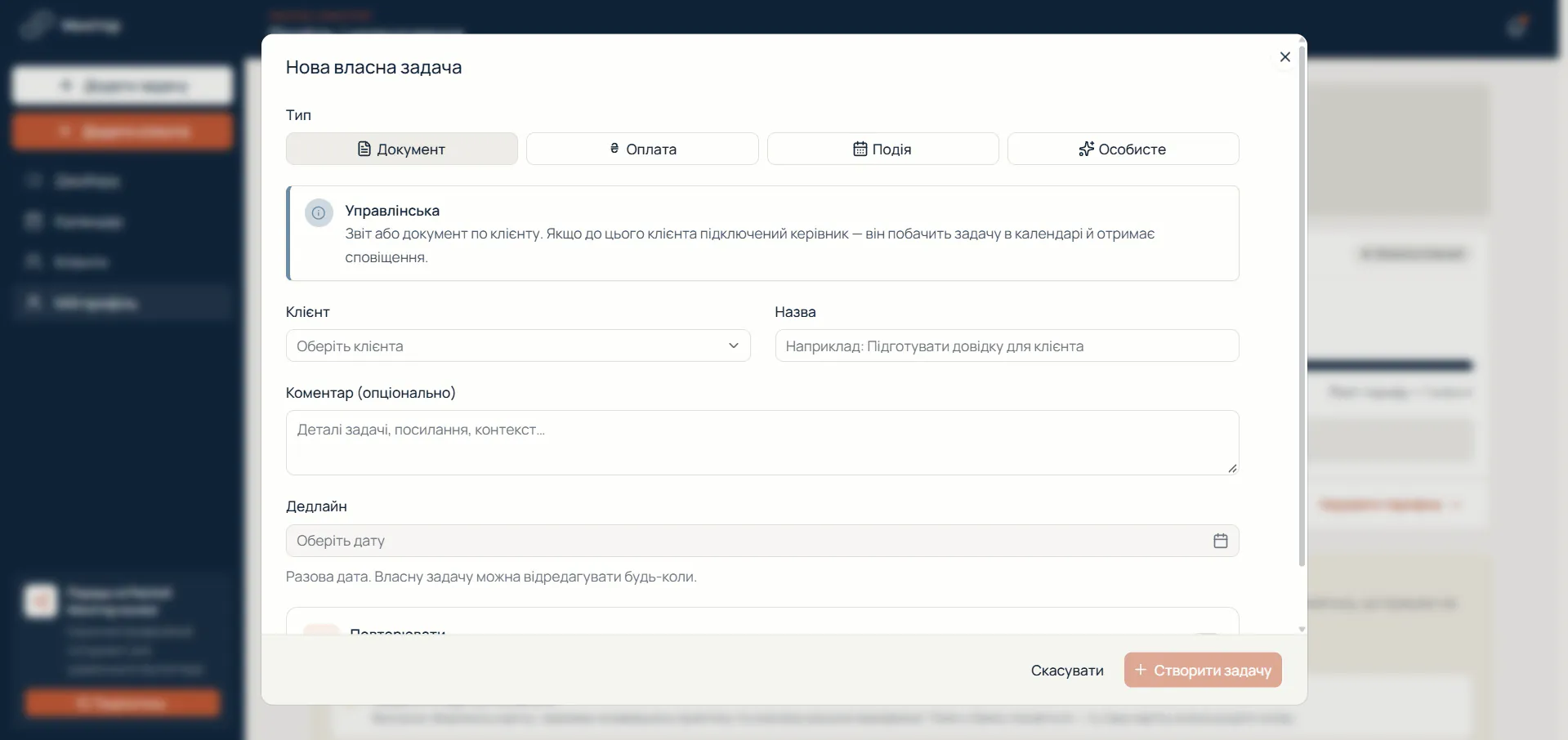
The accountant's own tasks next to the statutory calendar, including recurring ones
Table, calendar, and list views
Built by Brocoders: the table view came from the founder's request on June 3 and became the default; Web Push shipped at the June 11 handover
Connection with a code from the accountant
Statuses of the company's reports and payments, updated as they change
View-only access to the owner's company, never to the accountant's other clients
Built by Brocoders: code-based sign-in, designed around the iOS rule that keeps browser and installed-app cookies apart
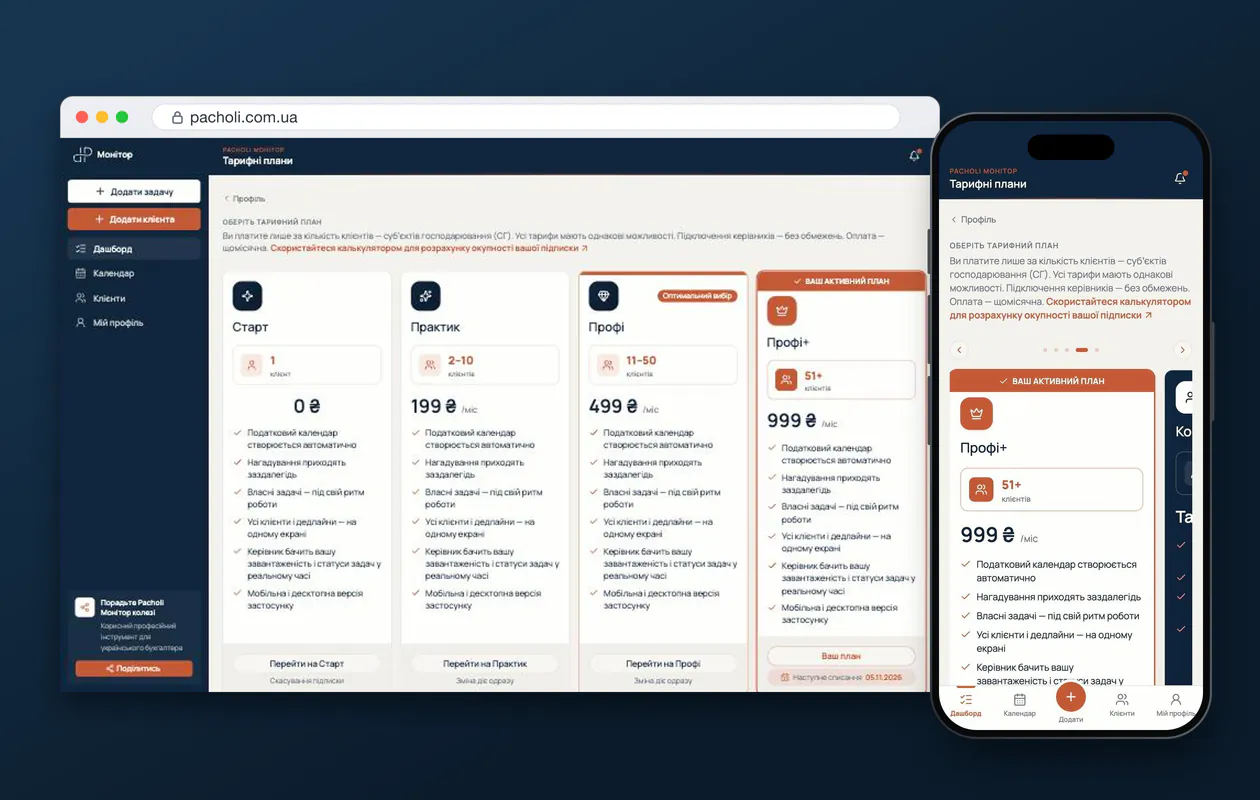
Start: 1 client, free
Praktyk: 2 to 10 clients, 199 UAH a month
Profi: 11 to 50 clients, 499 UAH a month
Profi+: 51 clients and more, 999 UAH a month
Team: for accounting firms, in development
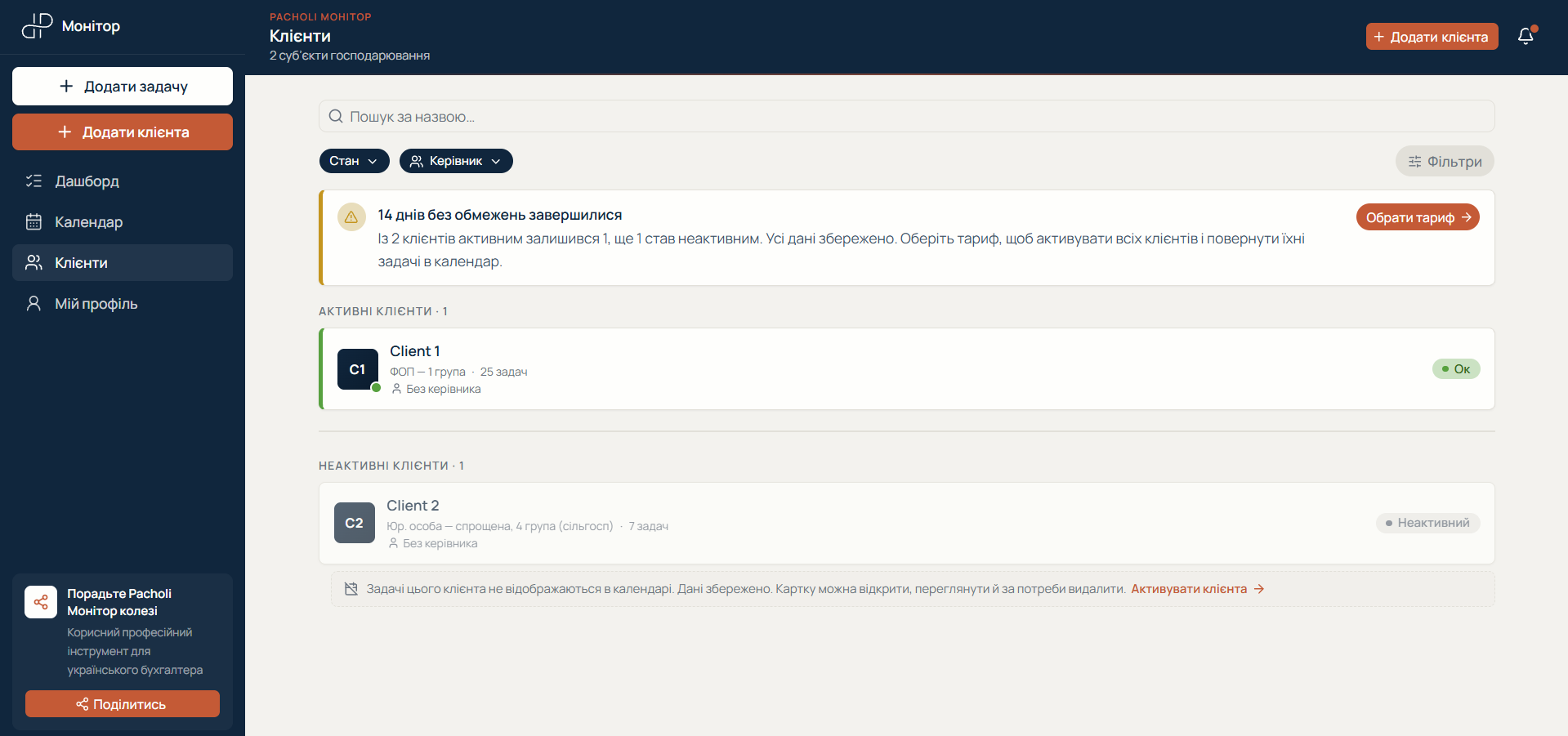
Every plan has every feature, and the price depends on the number of clients. Each new account gets 14 days without a client limit, starting from the second client added.
Subscription billing for the accounting app in 20 days
Paid tariffs went live on Aug. 5, 2026, 20 days after the release. From that day, Pacholi Monitor ran as a subscription SaaS, priced by the number of clients an accountant serves.
Payment provider: Monobank acquiring, chosen by the client on June 25 for its commission and API, and because Pacholi already banks with Monobank
Plans: priced by number of clients, with limits enforced in the app. Clients beyond the plan stay saved and become view-only.
Promo codes: partner reports in the admin panel, used for the launch offer and for bloggers
Payment methods: cards, plus Apple Pay and Google Pay through Monobank's page
Deferred to Phase 2: annual plans, prorated upgrades, and automatic payment retries. Monobank could not handle prorating, annual plans, or retries, so the team kept this logic on Pacholi's own backend to add later.
Testing: 15 of 15 production test cases and 50 of 50 billing tickets closed by Aug. 7
How the Pacholi Monitor engagement runs
Full-stack
developer
Project manager,
BA, UI, QA
QA
engineer
Delivery and
account managers
The full-stack developer worked full time through release and billing. The project manager, who also covered business analysis, UI, and QA, worked part time, and the QA engineer joined from the beta. The delivery and account managers were on demand.
Each milestone closed with a dated report: June 11, June 20, July 16, Aug. 7, and Sept. 17. Change requests came with options and a price, and the founder chose on the call.
Since Aug. 11, the work runs in estimated batches: the founder collects tasks, the team estimates them, and a few days of development follow. By Sept. 17, the team had finished 13 Phase 2 tasks. The Team tariff and document upload are next.
Pacholi Monitor results after launch
500+
Registered users, October 2026, 3 months after release
8%
Of registered users on a paid plan, October 2026
11
People in the founder's accounting firm run their client deadlines in the app
20 days
To paid tariffs: July 16 release, Aug. 5 billing
Liudmyla's team used the table view to plan their August holidays: they looked for the weeks with the fewest deadlines across all clients and finished work early to free those weeks.
Questions about building a tax deadline app like Pacholi Monitor
Can you build from a specification I wrote myself?
Yes. Pacholi's founder wrote hers with Claude over a few weeks. We read it, returned questions and options, and cut it to a first release that fit her date.
How long does a first release take?
Pacholi Monitor took 9 weeks from kick-off to production and 23 working days to handover for client testing. Subscription billing, which made it a paying SaaS, followed 20 days after release.
Why a progressive web app instead of native apps?
One codebase installs on iOS and Android from the browser, with push notifications on iOS 16.4 and later, and releases do not wait for app store review. The owner's sign-in was designed around the iOS rule that keeps the browser and installed app cookies apart.
How do tax rules stay correct when the law changes?
Rules live in templates managed in the admin panel, each with a link to its legal basis. When a client's profile changes, the app regenerates future tasks only.
Can the business owner see the accountant's other clients?
No. The owner connects to their own company with a code from the accountant and gets view-only access to that company's tasks.
Which payment providers can you integrate in Ukraine?
Pacholi Monitor bills its SaaS subscriptions through Monobank acquiring, with cards, Apple Pay, and Google Pay. The client compared Monobank with WayForPay and LiqPay before choosing.
What happens after the first release?
Pacholi moved to estimated batches: the founder collects tasks, we estimate them, and development runs for a few days at a time.
We'll read it and come back with questions and a first-release plan for your SaaS or app that you can launch on your date.
 Liudmyla Shtohryna