
Most proptech founders building with AI in 2026 face the same choice: keep building the whole product solo, or bring in engineers before the parts that matter break. That choice affects more than your timeline. It decides whether the product survives contact with a second homeowners association (HOA), a property management system (PMS) integration, or an audit.
Here's what that looks like in practice. A founder spends a weekend with an AI coding tool and ships a working resident portal: sign in, a unit list, a maintenance request form, a simple board dashboard.
It looks done. A design partner logs in and likes it.
Then a second HOA joins the same account, and the data model breaks. The demo worked because it assumed one property, one role, one login. Real HOAs never stay that simple.
This guide draws that line for real estate SaaS: what AI already builds well, what you can extend yourself with a little skill, and where real engineering starts. If you're newer to the category, we've written about what proptech actually covers as background.
TL;DR: AI has genuinely collapsed the cost and time of building a generic SaaS shell, including parts of a proptech product that look domain-specific but aren't. What it can't prompt past is real estate's actual complexity: permission models tied to property and HOA structure, legacy PMS and MLS integrations, and compliance-sensitive workflows. Once you hit that wall, an AI-native team can close the remaining gap fast, using the same speed that got you this far.
Why a working demo doesn't mean you're done
AI coding tools are good now, good enough that a founder with some technical comfort, not necessarily an engineer, can ship a working product in days instead of months. That's the starting point for this guide.
The trouble shows up later, in a specific place. A prototype built around one user, one property, one workflow holds up fine in a demo.
Real proptech software runs several access levels against the same property, the same HOA, the same management company, often at once. That gap surfaces once you're past the demo stage.
A second board member logs in and sees data meant for someone else. A second building joins the account and the access model has nowhere to put it. A payment record needs to stay visible to one role and hidden from three others.
Each of those is a modeling problem, tied to how real estate ownership and management actually work. It's the specific wall this guide is about.
The generic SaaS layer AI already builds well
AI tools now build the generic SaaS layer well, worth saying plainly instead of downplaying it.
Authentication, a basic admin panel for creating, editing, and deleting records, a Stripe checkout, a simple dashboard, a landing page with a waitlist form: these are solved problems now. An AI coding assistant produces working versions of all of them, often correctly on the first pass.
We've seen this speed inside our own delivery, not just in theory. For a martech client, our team delivered a working AI-powered MVP in 75 hours for $3,375, about 17% under the original estimate.
The build shipped fast because the scope stayed inside the generic layer: an interface, an integration, a workflow that never touched property-specific permissions or a legacy system.
Most of that speed comes from collapsed handoffs. Design, frontend work, and QA now overlap instead of running one after another, and that overlap is where the time actually gets saved.
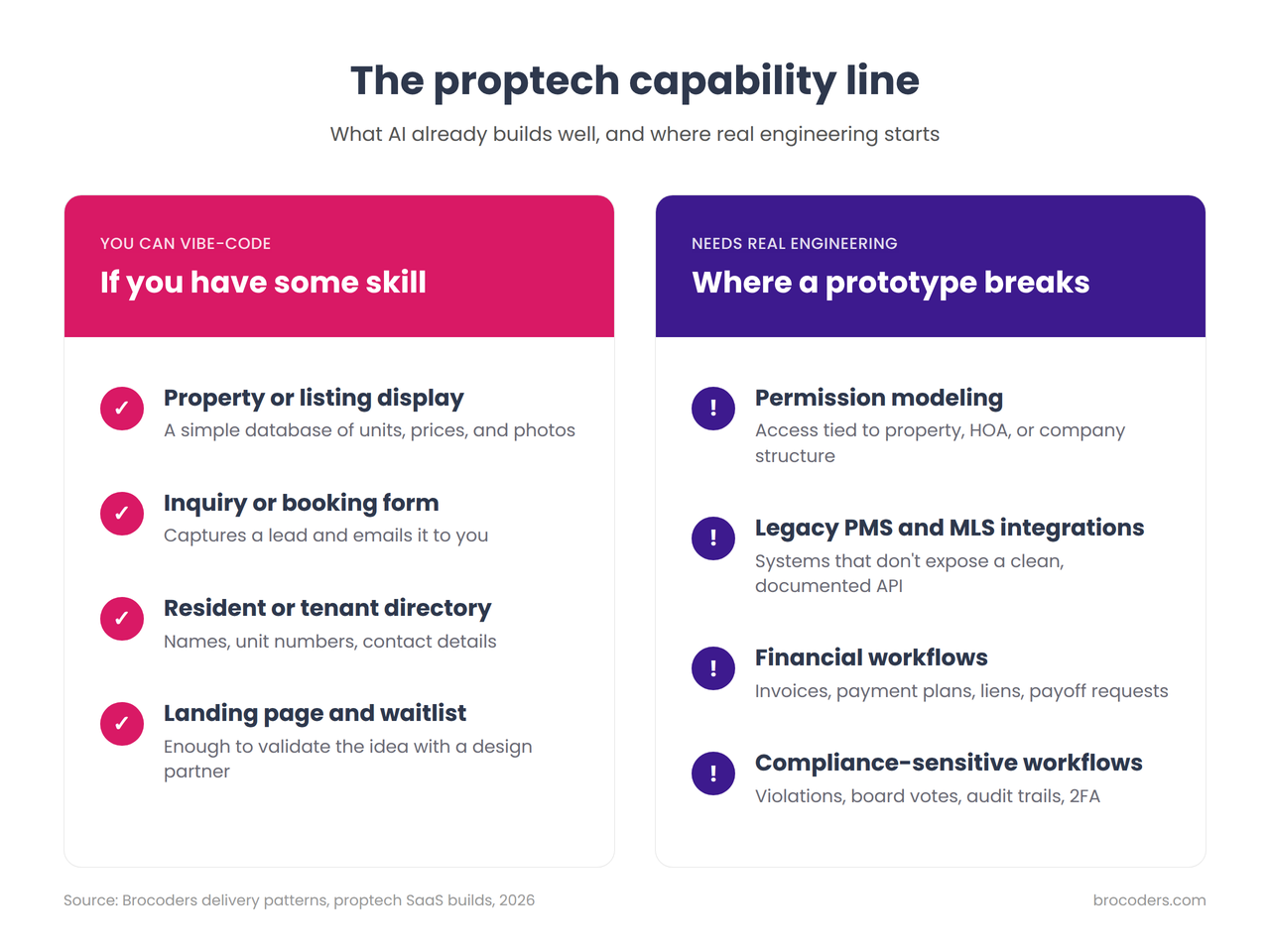
What you can vibe-code in a real estate SaaS, if you have some skill
The generic layer above applies directly to proptech too. If you have some technical comfort, here's what you can realistically build yourself right now.
A property or listing display page, pulling from a simple database of units, prices, and photos. A basic inquiry or booking form that captures a lead and emails it to you.
A resident or tenant directory with names, unit numbers, and contact details. An early landing page to validate the idea with a design partner, before anyone writes a line of production code.
Each of these is a genuinely useful, real piece of a proptech product. None of them need a permission model more complex than logged in versus logged out, and none of them touch a system you don't control.
Build them. They'll save time later, and they're the right way to test whether your idea has a design partner willing to use it.
What you clearly can't, and why
Four things reliably break a vibe-coded proptech prototype. Each one is specific and nameable, and each one is a normal day's work for a team that builds around it on purpose.
Permission modeling tied to real-world structure. A generic app has users and roles. Proptech software has users, roles, properties, HOAs or management companies, and the specific relationships between all four.
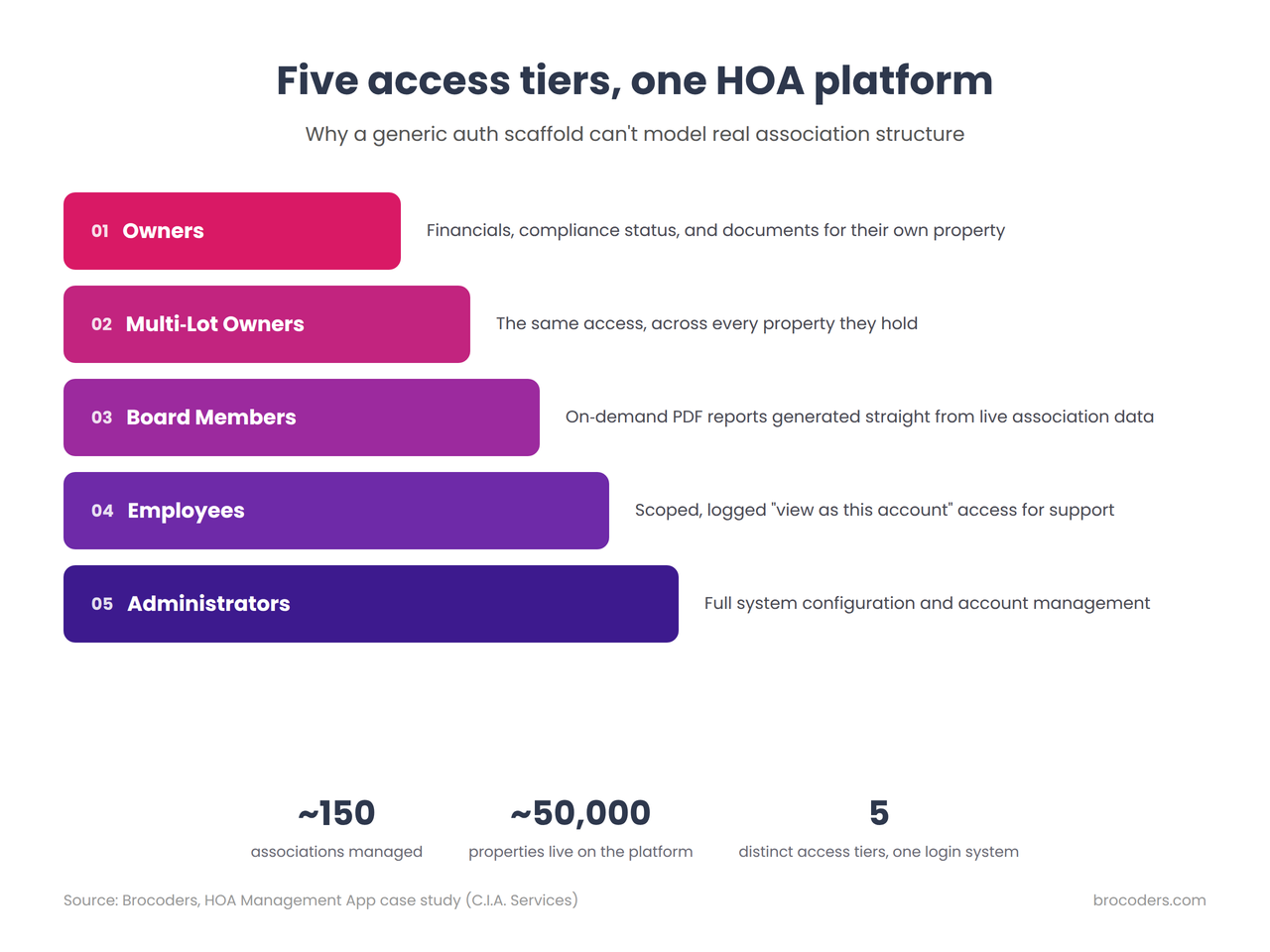
When we built the HOA Management App for C.I.A. Services, we shipped five distinct access tiers: Owners, Multi-Lot Owners, Board Members, Employees, and Administrators, live across roughly 150 associations and 50,000 properties.
The registration flow alone shows why this is an architecture problem, not a form-building one. A resident enters a community code, an account number, and a PIN, and the system checks all three against live association records before granting any access at all. A generic sign-up form just creates an account and hopes the person is who they say they are.
Support staff need a way in too, to see the app the way a specific owner sees it when something goes wrong. We built that as a scoped, logged "view as this account" mode, not a shared admin login every employee reuses. Unlogged impersonation is a security hole waiting to happen.
A generic auth scaffold assumes one user, one role. This one assumes a single user can hold different roles across different properties inside the same account, and that's the part a weekend build rarely gets right on the first pass. We've written more about designing multi-tenant SaaS architecture if you want the technical detail.
Integrations with systems that don't have clean APIs. Most real estate businesses already run on a property management system, sometimes an MLS or CRM alongside it. Few of these expose a modern, documented API.
On the HOA platform, that meant reading and writing across two separate backends at once: a legacy Windows-based property management system on one side, the association's own public website on the other, neither one aware the other existed. Getting one account, one balance, and one document library out of two disconnected sources, without creating duplicate or conflicting records, is a data-modeling problem before it's an integration problem.
Scoping around that usually doesn't require the old system's source code. User-level access to the existing platform is normally enough to map the flows and start planning the rebuild.
Financial workflows that touch a real balance. Open invoices, payment plans, liens, and payoff requests all have to reconcile against an actual account balance, not just render a number on a screen.
Get the state transitions wrong here, a payment plan that doesn't update a lien status, a payoff request that doesn't lock the balance while it's pending, and a resident gets told they owe money they've already paid, or a payoff closes on a stale number. Those are real consequences for a real household, not a display glitch.
Compliance-sensitive workflows. Violation notices, architectural review requests, board votes, and financial documents all carry real consequences if the wrong person sees or edits them. A mistake here costs someone money, or puts an association out of compliance with its own bylaws.
Board members also need on-demand reports generated straight from live data, current the moment they're opened rather than a static export somebody has to remember to update. Any account holding financial and personal data at this scale needs two-factor authentication and an audit trail of who accessed or changed what.
None of this rigor is unique to proptech. On a separate multi-tenant SaaS build, we set up hard data isolation at the database and API layer so one customer's workspace cannot return another's records even by accident, plus an audit log and a logged impersonation mode for support, the same pattern as the HOA platform's registration and access model. It's what an architecture-led team builds in by default, whatever the product is.
There's also a cost to treating your own time as free. The AI-powered MVP mentioned earlier worked out to roughly $45 an hour of delivered work (75 hours for $3,375).
A founder rebuilding the same kind of permission logic through trial and error, without knowing the shape of the problem yet, can easily burn more hours than that, plus weeks of AI subscription and token costs paid out along the way.
Add the founder's own time at any reasonable rate to those credits, and the total can land higher than paying an experienced team working from a proven architecture and a working boilerplate to do it right the first time.
This isn't only Brocoders' read on the problem. Netta Ademola-Paavoseppä, Global Director of AI Products at Vastuu Group, put it directly to our co-founder Rodion Salnik in a recent conversation about AI adoption:
There's a new group of people who have no background in specs or architecture and are now building things anyway. They're vibe coding. They don't know what they're building, so they don't know what they're exposing.
How the gap gets closed, fast
Closing this gap starts with scoping. Scoping doesn't require handing over the old system's source code in most cases.
User-level access to what already exists is usually enough to map the permission model, the integrations, and the workflows that need to survive the move.
From there, architects and engineers own the structure while AI accelerates the implementation underneath them, the same combination behind the 75-hour MVP above.
Three examples show what that looks like at different scales. CondoGenie, a Canadian condo management platform for residents, boards, and property managers, has been a client relationship since its inception.
Lake, a vacation rental platform, hit a scaling wall on its old stack and came back with 80 times more connected properties and a 210% spike in site activity within 3 months of the rebuild. A codebase we took over through ShineUp moved to a new AWS environment in 2 to 3 weeks, on a fixed price, with no rebuild required.
Team augmentation is another alternative to a full build. For AreaButler, a German proptech startup building location analysis software, we embedded engineers directly into their existing team instead of running a separate build.
Once you've hit the wall this guide describes, the next step is scoping an MVP build sized to what's actually left to solve.
A two-minute self-check before you build more
Run these four questions against your own product before you write another line of code.
Does more than one type of user need different access to the same property or account? Does the product need to talk to a system you don't control, like a PMS, an MLS, or a payments processor with strict rules?
Could a mistake in who sees what cost someone money, or put you out of compliance with a regulation or an HOA's own bylaws? Does the workflow involve enforcing a rule at scale, like booking limits, amenity availability, or approval sequences, across many properties at once?
One or two "yes" answers means you're still safely in DIY territory, and you should keep building. Three or four means you've reached the wall this guide describes, and it's worth scoping the rest with people who build this for a living.
Brocoders builds AI-native custom software for proptech and real estate teams, from the generic layer up through the permission models, integrations, and compliance workflows above. If you've hit the wall this guide describes, we're glad to talk through what closing it would actually look like for your product.
Frequently Asked Questions
Yes, for a real part of the product. AI tools now handle the generic SaaS layer well: authentication, a basic dashboard, a checkout flow, a landing page. The parts specific to real estate are where a solo AI build typically runs into trouble: permission models tied to property or HOA structure, legacy system integrations, and compliance-sensitive workflows.
A property or listing display, a simple inquiry or booking form, a basic resident or tenant directory, and an early landing page to validate the idea with a design partner. None of these need a permission model more complex than logged in versus logged out.
Because proptech software needs access tied to a specific property, HOA, or management company, not just a user role. A generic AI-built auth system assumes one user, one role. Real estate software needs one user able to hold different roles across different properties inside the same account, a different and harder problem.
Usually not. User-level access to the current platform is typically enough to map the existing flows, the permission structure, and the integrations, and to start scoping a rebuild around them.
Fast enough that speed, not cost, is the stronger argument for bringing one in. One recent AI-powered MVP for a martech client shipped in 75 hours for $3,375. Lake, a vacation rental platform, went from hitting a scaling wall to 80 times more connected properties within 3 months of its rebuild.
A development company brings existing patterns for the domain-specific parts (permission modeling, PMS and MLS integrations, compliance workflows) that would otherwise be new territory for an in-house team building its first proptech product. If you want to compare options directly, we've written about real estate software development companies.
Often, yes. A meaningful share of the founders we talk to already have a shipped, in-production platform and want the next stage architected on top of it, rather than a from-scratch rebuild. Scoping that work usually starts the same way a rebuild does: mapping what exists before deciding what to add.