
By Yulya Glamazdina, Brocoders. Published 25 May 2026. Updated Oct. 16, 2026. Vendor facts rechecked against Clutch and each company's own site on Oct. 9, 2026.
The PropTech market is worth $44.59 billion in 2026 and is forecast to reach $104.57 billion by 2034, and the real estate software segment inside it is $14.44 billion this year. Most of that money goes to companies buying or building software, and most lists of "top real estate software development companies" are compiled the same way: Google, Clutch, a quick portfolio scan, and paste. The result is 10 companies that all claim real estate experience, none of which have shipped anything close to what you're building.
Brocoders wrote this list and builds real estate software, so we left ourselves out of the scoring and the ranking. Our dated record sits in the About the author box under How this list was made.
Real estate software is specific. HOA platforms, condo management portals, property valuation engines, rental marketplaces, MLS-connected listing sites, and commercial CRMs each have distinct compliance requirements, user workflows, and data models. A real estate software development company that built a listing page two years ago is not the same as one that has shipped multi-tenant HOA management software.
This list was compiled differently. We looked for companies with verifiable, named case studies in property management, HOA software, condo platforms, commercial real estate tools, or rental technology. "Real estate experience" backed only by a category tag on a website didn't make the cut.
How this list was made
Brocoders wrote this page, and we sell real estate software development ourselves, so you know who built the shortlist. We ran every company through the Real Estate Software Proof Test below, reading its website, its published case studies (named client, number, URL that opens) and its Clutch profile by hand, not other listicles. No vendor paid to be listed. Last check: 9 October 2026.
Brocoders is not among the 10 companies on this list.
About the author: Brocoders. Not scored or ranked in this guide. Checked Oct. 16, 2026.
Brocoders is a software development company founded in 2014 in Tallinn, Estonia, with 87 engineers (about 60% senior) and 85+ projects delivered. It builds and modernizes property software: HOA and condo platforms, resident portals, and rental marketplaces. Clutch rating: 5.0 across 38 reviews. Published real estate cases:
- CondoGenie: a condo and HOA management platform first written in 2009. Brocoders replatformed it from 2018, migrated nine years of data while the business stayed live, and still runs it: over 550 associations and over 80,000 registered users (admin panel, October 2026). Dated in-place upgrades since: Rails (August 2025), Playwright test suite (2025), Stripe API (February 2026).
- C.I.A. Services (Houston and San Antonio, Texas): a PWA for owners, board members and staff, built on a third-party property management API, July 2022 to June 2025.
- AreaButler (Germany): team augmentation since 2022 for a location-analysis SaaS used by brokers and appraisers, including AI-generated location descriptions and onOffice CRM integration.
Outside real estate but relevant to anyone rebuilding a live platform: Lake, a vacation-rental marketplace. Brocoders rebuilt its WordPress monolith and had it in production in 3 months (2025). Connected properties grew from about 500 to 40,000, an 80x increase.
Where we are not the fit: a mortgage or investment-lending build, or a Fortune 500 procurement needing 30+ engineers on day one. Full scope is on our proptech industry page, and more cases are in the real estate software case studies.
The test has 4 checks. You can use them in any first call with a company.
1. Named client or product. Can they point to a specific company, app, or platform, and not just "a property management company"? Anonymous case studies are better than nothing. Named ones tell you whether the experience is real and repeatable.
2. A problem that matches yours. Does the case study describe a property management challenge you actually recognize? Multi-unit compliance, HOA board communication, tenant payment workflows, MLS or IDX feeds, amenity booking: the closer the match, the faster the ramp-up.
3. A client quote about the outcome. Generic praise ("great team, delivered on time") is easy to manufacture. A client explaining what changed in their operations is harder to fake and more useful to you.
4. A published URL you can click. If you can read the case study right now, it's real. If the company says "we did something similar" but can't show you a page, treat that as a yellow flag.
Every company on this list cleared all 4 checks, with one noted exception in the Inoxoft entry below. The comparison table also records whether each company has published a live-product modernization case: a platform that stayed in use while it was migrated or rebuilt. That is the proof most buyers with an existing system ask for first, and most vendors do not have it.
Quick comparison: 10 real estate software development companies
| Company | Founded | HQ | Team | Clutch rating (reviews) | Best for | Verified real estate case | Live-product modernization case |
|---|---|---|---|---|---|---|---|
| Ascendix Technologies | 1996 | Dallas, TX | 150+ (50 - 249) | 4.9 (15) | Commercial real estate CRM and Salesforce platforms | Colliers International product development | None published |
| Django Stars | 2008 | Wilmington, DE; engineering in Europe | 100+ (50 - 249) | 4.8 (61) | Valuation engines, marketplaces, compliance-heavy platforms | Scoperty (35M+ properties, ING Ventures) | None published |
| Inoxoft | 2014 | Philadelphia, PA; engineering in Lviv | 230 (50 - 249) | 5.0 (74) | Tenant portals, amenity management, full-lifecycle builds | Property management platform, US company with 20+ years (unnamed) | None published |
| Taazaa | 2007 | Hudson, USA | 400+ (250 - 999) | 5.0 (28) | Property management legacy modernization, US clients | Tropicana Properties (40 complexes, El Paso TX) | Tropicana: live .NET 2 to .NET 8 migration, corrections cut from 60 to 15 to 20 a month |
| Goji Labs | 2014 | Los Angeles, CA | 70+ (250 - 999) | 5.0 (91) | Early-stage marketplace and product strategy | Gitcha real estate marketplace | None published |
| Simform | 2010 | Orlando, FL; engineering in Ahmedabad, India | 1,200+ (1,000 - 9,999) | 4.8 (88) | Cloud-scale proptech and real estate investment platforms on Azure | Fractional real estate investment platform (client unnamed): up to 100,000 daily transactions, onboarding 50% shorter | Real estate lending platform (client unnamed): legacy backend refactored and moved to cloud, loan processing 35% faster; downtime not stated |
| Vention | 2002 | New York, NY | 3,000+ (1,000 - 9,999) | 4.9 (103) | Leasing automation, resident experience, long-term proptech teams | EliseAI (AI leasing assistant, about 90% of leasing workload automated) | None published as a case study (legacy migrations for Bowery and TheGuarantors mentioned without numbers) |
| Netguru | 2008 | Poznań, Poland | 400+ (250 - 999) | 4.8 (73) | Agent tooling, design systems, property portals | Keller Williams (Command platform, 100,000+ active users by October 2019) | Keller Williams: agent features merged into Command, 0 legacy UI elements left; downtime not stated |
| Hicron Software | 2006 | Wrocław, Poland | 380+ (250 - 999) | No reviews yet (0) | Commercial real estate back-office tools and access control | iLOQ (US web platform delivered two months ahead of schedule) | iLOQ: Finnish desktop app rebuilt as a web app on the existing .NET/AWS backend; no usage numbers |
| Mind Studios | 2013 | Fairfax, VA; engineering in Dnipro | 50 - 200 (50 - 249) | 4.9 (36) | Real estate marketplaces, MLS integration, landlord apps | AnyCurb (MLS marketplace, 85% likely-to-sell accuracy, third-party verified) | None published |
Order is by the Proof Test, then by depth of named real estate work. Ratings and review counts are as shown on Clutch on 9 October 2026.
1. Ascendix Technologies
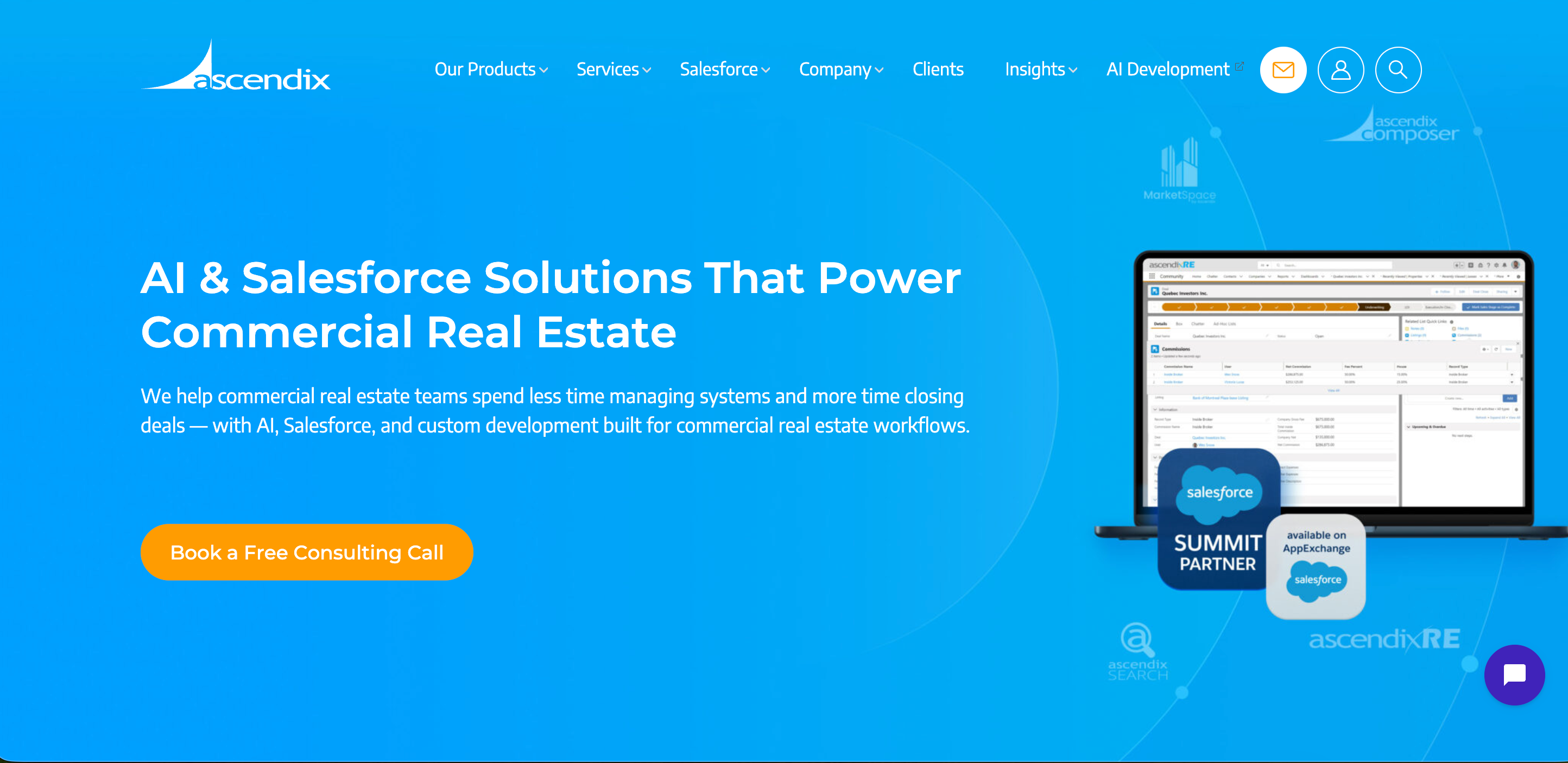
Founded: 1996 | HQ: Dallas, TX (offices in Portugal and Poland) | Team: 150+ (50 - 249) | Clutch: clutch.co/profile/ascendix-technologies, 4.9, 15 reviews | Avg. hourly rate: $50 to $99/hr | Tech stack: Salesforce, .NET, Node.js, React
Overview and company background
Ascendix Technologies has 30 years of real estate technology experience, which makes them one of the longest-tenured companies in this space. They've built their own commercial real estate products: AscendixRE (a CRM for commercial brokers), Composer (brochure generation), and Marketspace (a property listing portal). Long-term technology partner to JLL, one of the world's largest commercial real estate services firms.
Real estate software development approach
Ascendix's strength is CRM-first platforms and Salesforce customization for commercial real estate. They work best with brokerages and enterprise real estate companies that already have Salesforce infrastructure and need it extended, replaced with a proprietary product, or deeply customized for deal pipeline management.
Notable real estate projects and case studies
Colliers International. Real estate product development for one of the world's largest commercial real estate services and investment firms. Full case study: ascendixtech.com/cases/real-estate-product-development-case-study-colliers/
AscendixRE. A proprietary CRM used by thousands of commercial real estate brokers globally to manage deal pipelines, property data, and client relationships.
"Ascendix is very organized and responsive... true consultants who think through processes and have knowledgeable commercial real estate expertise. Not many consulting and software development firms can offer that kind of expertise and industry knowledge."
Clutch reviewer
Technology stack
Salesforce, .NET, Node.js, React. Deep Salesforce customization and CRM integration expertise.
Why choose Ascendix Technologies
If your product lives in commercial real estate and involves Salesforce, AscendixRE extensions, or a property listing portal for brokers, Ascendix has pre-built components and deep domain knowledge that reduces build time. Their 30 years of CRE-specific experience shortens the discovery phase considerably.
Honest weakness
Ascendix is Salesforce-centric. If you're building a residential property management platform, a tenant portal, or a full-stack SaaS with React and Node.js from scratch, their toolset may not match. They also have fewer Clutch reviews (15) than most companies on this list, which limits independent verification of their recent work.
2. Django Stars
Founded: 2008 | HQ: Wilmington, DE (engineering team in Europe) | Team: 100+ (50 - 249) | Clutch: clutch.co/profile/django-stars, 4.8, 61 review | Tech stack: Python, Django, React, Vue.js, Angular, Node.js, PostgreSQL, AWS
Overview and company background
Django Stars has been building Python-based products since 2008. Their real estate software portfolio includes some of the most commercially significant case studies on this list: a German property platform backed by ING Ventures and a Swiss mortgage platform that was later acquired for CHF 107M.
Real estate software development approach
Django Stars builds compliance-first real estate products, covering GDPR, PCI-DSS, and SOC 2 within the architecture from the start. This is relevant if your platform handles tenant financial data, credit checks, or cross-border mortgage workflows. They also scale teams well: the Scoperty engagement started with 1 engineer and grew to 14 over 4 years.
Notable real estate projects and case studies
Scoperty. A German property valuation and search platform listing 35M+ properties across Germany. Backed by ING Ventures and integrated with Sprengnetter and PriceHubble data sources. Django Stars rebuilt the frontend from scratch and built the entire backend, scaling from 1 engineer to a 14-person team over 2018 to 2022.
"It feels as though they are a part of our company, and their people are really engaged in delivering a good solution. They feel fully responsible for our product. They think about the solution, and I think that is really cool for an outside company. They have a stable team. With Django Stars, you're really able to create a Scrum mindset."
Sebastian Frenzel, CPO, Scoperty
Full case study: djangostars.com/case-studies/scoperty/
MoneyPark. A Swiss digital mortgage platform that became the market leader and was acquired by Helvetia Group for CHF 107M.
Molo. A UK digital mortgage lender. Qweeqwee. A property rental and purchase marketplace in Qatar.
All real estate case studies: djangostars.com/case-studies/proptech/
Technology stack
Python, Django, React, Vue.js, Angular, Node.js, JavaScript, PostgreSQL, AWS. Strong DevOps and cloud infrastructure capabilities.
Why choose Django Stars
Django Stars is the right call if you're building a high-complexity marketplace, a property valuation engine, or a platform that will scale to millions of records and needs to handle financial data under European compliance requirements. Their long partnership model (4 years on Scoperty) also suits founders who want a stable team, not a rotating cast of contractors.
Honest weakness
Django Stars' portfolio leans toward fintech-adjacent real estate tech: mortgages, valuations, and investment platforms. If you're building residential property management software, an HOA platform, or a tenant portal for US property managers, their specific experience is limited compared to Taazaa.
3. Inoxoft
Founded: 2014 | HQ: Philadelphia, PA (US office; engineering in Lviv, Ukraine) | Team: 230 (50 - 249) | Clutch: clutch.co/profile/inoxoft, 5.0, 74 reviews | Tech stack: Flutter, Python/Django, Node.js, .NET, React.js, React Native, Golang
Overview and company background
Inoxoft is a 230-person company with ISO 27001 certification and Microsoft Gold Partner status. Their real estate software portfolio includes property management web platforms, amenity booking systems, and digital concierge apps. Tools built by Inoxoft serve 100,000+ users globally.
Real estate software development approach
Inoxoft works across the full development lifecycle: discovery, design, build, and post-launch support. For property management products, they've built both web platforms and cross-platform mobile apps, which matters if your product needs to serve office teams and field staff on different devices.
Notable real estate projects and case studies
Property management platform. Built for a USA-based real estate company with 20+ years in the market. The platform covers buy/sell/rent workflows with a personalized client portal guiding users through each step. Full case study: inoxoft.com/casestudy/property-management-software/
Amenity management app. Built a cross-platform mobile and web solution for a luxury property operator with 70+ buildings. The app automated amenity booking and concierge requests for thousands of residents, replacing manual calls and spreadsheets. Full case study: inoxoft.com/casestudy/custom-software-solution-for-amenity-management-company/
Technology stack
Flutter, Python/Django, Node.js, .NET, React.js, React Native, Golang. ISO 27001 certified. Microsoft Gold Partner.
Why choose Inoxoft
Inoxoft is a strong pick for tenant-facing tools: digital concierge apps, amenity booking portals, and resident management platforms. Their Golang capability handles performance-sensitive backend work, and their 230-person team gives you staffing flexibility for both small MVP builds and larger platform expansions.
Honest weakness
Inoxoft's published case studies don't name clients. There are no named executive quotes on their real estate case study pages. You'll need to ask for references during a discovery call and verify independently through Clutch reviews before committing. This is the one entry on this list that cleared 3 of 4 checks on the Real Estate Software Proof Test.
4. Taazaa
Founded: 2007 | HQ: US-based | Team: 400+ (250 - 999) | Clutch: clutch.co/profile/taazaa, 5.0, 28 reviews | Tech stack: .NET 8, ASP.NET MVC, JavaScript, PostgreSQL, CI/CD on Linux; also React, Vue, Angular, Python, Go, AWS
Overview and company background
Taazaa is a US-based company with named property management clients and published case studies that go deeper than most. They've modernized legacy property management software, built data warehouses for rental SaaS platforms, and helped property managers move from manual correction cycles to stable automated systems.
Real estate software development approach
Taazaa uses an Agile model with 2-week sprint demos. Clients see working software every sprint, which matters for property management teams that can't afford long build cycles with nothing to show. They've done both greenfield builds and legacy modernization, which is a less common combination.
Notable real estate projects and case studies
Tropicana Properties. Tropicana manages 40 apartment complexes in El Paso, TX, including a mix of market-rate and low-income units. Taazaa inherited a broken .NET 2 codebase, migrated it to .NET 8 while the system stayed in use, automated CI/CD on Linux, and reduced tenant account corrections from 60 per month to 15 to 20.
"With the Taazaa team, I can just give them the vision, and they'll figure it out. That's been very refreshing for us."
Iyari Fierro, Technology & Procurement Officer, Tropicana Properties
Full case study: taazaa.com/success-story/tropicana-properties-modernizes-property-management-with-taazaa/
Innago. Taazaa built a data warehouse that contributed to 150% business growth for Innago, a property management SaaS. They also built a no-code support portal that cut Innago's support overhead.
Full Innago case study: taazaa.com/success-story/innago-sees-150-business-growth-with-data-warehouse/
Technology stack
.NET 8, ASP.NET MVC, JavaScript, PostgreSQL, CI/CD pipelines with Linux containerized deployments. Also React, Vue, Angular, Python, Go, and AWS across other engagements.
Why choose Taazaa
Taazaa is the strongest pick on this list if you have an existing property management system that's failing or scaling poorly. They've done exactly this with Tropicana: inheriting broken software, stabilizing it, and modernizing the architecture without taking it offline. That's a specific and rare competency, and it is the only published live-product modernization case among the ranked companies.
Honest weakness
Taazaa has fewer Clutch reviews than most companies on this list (28), which limits the volume of independent feedback available. Their published case studies focus on US property management. If your platform targets European markets or needs GDPR-specific compliance architecture, verify whether their team has that context before signing.
5. Goji Labs
Founded: 2014 | HQ: Los Angeles, CA | Team: 70+ (250 - 999) | Clutch: clutch.co/profile/goji-labs, 5.0, 84 reviews | Tech stack: Ruby on Rails, Node.js, React, Next.js, Redis, AWS
Overview and company background
Goji Labs is a product strategy and development company that combines UX research, product discovery, and custom engineering. For real estate software founders who are still defining their product, Goji Labs offers a different starting point than a pure engineering shop.
Real estate software development approach
Goji Labs runs discovery interviews with buyers, sellers, and agents before writing a line of code. For real estate platforms, this matters: the workflows a seller expects differ significantly from what an agent expects, and building both into one product without that research tends to produce cluttered UIs and expensive rework.
Notable real estate projects and case studies
Gitcha. A real estate marketplace connecting buyers, sellers, and agents. Goji Labs conducted user research with all 3 audiences, designed the platform architecture, and built the full product. After launch, transactions closed faster and agent engagement improved.
"Goji Labs built a platform that reflects how people actually want to buy and sell property. It's clear, fast, and makes the process less stressful."
Gitcha Team
Full case study: gojilabs.com/case-studies/gitcha-real-estate-marketplace-platform/
Pocket. A second published real estate platform case study. Full case study: gojilabs.com/case-studies/pocket-real-estate-platform/
Technology stack
Ruby on Rails, Node.js, React, Next.js, Redis, AWS. Full-stack capability across web, mobile, and product design.
Why choose Goji Labs
Goji Labs is the right fit for early-stage real estate software founders who need a product team, not just engineers. If your main risk is building the wrong product, their discovery-first approach reduces that risk before you've spent your full budget. With 84 Clutch reviews, they also have the largest independent review base on this list.
Honest weakness
Goji Labs has 70+ people, which is smaller than several companies on this list. If you need to scale your engineering team rapidly to 10+ people within 3 months, that capacity may not be available. The Gitcha client quote is also attributed to "Gitcha Team" with no named individual, which is weaker social proof than the named executive testimonials from Django Stars and Taazaa.
6. Simform

Founded: 2010 | HQ: Orlando, FL (engineering in Ahmedabad, India) | Team: 1,200+ (1,000 - 9,999) | Clutch: clutch.co/profile/simform, 4.8, 88 reviews | Tech stack: .NET, Node.js, Angular, Flutter, Azure, Databricks, Snowflake
Overview and company background
Simform is a 1,200+ person engineering company founded in 2010, with a Microsoft Azure Expert MSP status that fewer than 105 companies hold worldwide. Its real estate work centres on cloud-scale platforms: a fractional investment marketplace, a real estate lending platform, and white-label resident apps for multifamily operators.
Real estate software development approach
Simform leads with cloud architecture and data engineering. For real estate products, that means building for transaction spikes, automated KYC and payment flows, and ML features such as price prediction from the start. Its scale suits platforms that expect high traffic and need a large team that can grow quickly.
Notable real estate projects and case studies
Fractional real estate investment platform. Simform built a marketplace where investors buy shares of rental properties from $10, with primary and secondary trading, automated KYC/AML checks, bank linking and ML-based property price prediction. The platform handles up to 100,000 daily transactions and 10,000+ concurrent users, and cut onboarding time by 50% and new-user drop-off by 30%.
"Their work ethic is outstanding."
Mike Johnson, Director of Growth Systems & Data, Realbricks (Clutch review)
Full case study: simform.com/case-studies/fractional-real-estate-investment-platform-for-investors/
Real estate lending platform. Simform refactored the backend of a marketplace lender for real-estate-backed loans, automated loan approvals and payments, and moved the platform to scalable cloud infrastructure. Loan processing became 35% faster, the platform handled 4,000+ loans at peak, and release cycles dropped under 7 days. Full case study: simform.com/real-estate-lender-cuts-loan-processing-with-platform-overhaul/
Technology stack
.NET, Node.js, Angular, Flutter, Azure, Microsoft Fabric, Power Platform, Databricks, Snowflake. CMMI Level 3. Microsoft Azure Expert MSP, Databricks Consulting Partner, Snowflake Select Tier partner, AWS and Google Cloud partner.
Why choose Simform
Simform is a strong pick for real estate investment and lending platforms that must handle heavy transaction volume on Azure. The fractional investment case shows it can deliver trading, compliance checks and ML pricing in one product at 100,000 daily transactions.
Honest weakness
Simform's real estate case studies don't name their clients or include client quotes, so the only named real estate feedback comes from Clutch reviews. Real estate is also not among the industries Clutch lists as a focus for Simform, and some Clutch reviews mention missed deadlines when requirements were not defined upfront.
7. Vention
Founded: 2002 | HQ: New York, NY (offices in Europe, including London, Berlin, Warsaw and Vilnius) | Team: 3,000+ (1,000 - 9,999) | Clutch: clutch.co/profile/vention-0, 4.9, 103 reviews | Tech stack: Java/Spring Boot, Python/Django, Node.js, .NET, React, Angular, React Native, AWS
Overview and company background
Vention has more than 20 years in custom software and 3,000+ engineers. Its proptech portfolio includes EliseAI, Carson Living, BuildingLink and Convene, with partnerships that often run 4 to 10 years. ISO 27001-certified delivery.
Real estate software development approach
Vention works as an embedded extension of the client's engineering team, typically starting small and growing with the product. BuildingLink grew from 2 engineers to a larger dedicated team over 10 years. Their real estate integrations cover MLS/IDX, property management systems, Stripe, Salesforce and smart-building hardware such as ButterflyMX.
Notable real estate projects and case studies
EliseAI. Vention built AI-powered automatic replies for 24/7 lead nurturing, integrations with property management platforms, and a new QA framework for this AI leasing assistant over a 4-year engagement. About 90% of the leasing workload was automated and conversions rose 125%.
Full case study: ventionteams.com/our-work/eliseai
Carson Living. A 24/7 resident services platform for buildings without a doorman, covering maintenance, payments, deliveries, keyless locks and live cameras. Vention has worked on it for 5+ years with a 14-person team; the platform serves 900+ residential buildings.
"We treat them as an integral part of our organization."
Guy Blachman, CEO, Carson Living
Full case study: ventionteams.com/our-work/carson-living
Convene. A booking platform with Stripe payments, Salesforce automation and native apps for landlords, tenants and visitors, built by a 25-person team over 4 years. Convene raised $250M+ in funding during the engagement. Full case study: ventionteams.com/our-work/convene
All real estate work: ventionteams.com/solutions/real-estate
Technology stack
Java/Spring Boot, Python/Django, Node.js/Nest.js, .NET, PHP/Laravel, React, Angular, Vue, Swift, Kotlin, React Native, PostgreSQL, MongoDB, Docker, Kubernetes, Terraform. ISO 27001. AWS, Google Cloud, Microsoft and Salesforce partner.
Why choose Vention
Vention is the right call for funded proptech companies that need a long-term team that grows with the product. EliseAI, Carson Living, Convene and BuildingLink are all multi-year engagements, and the EliseAI case shows measurable leasing automation at scale.
Honest weakness
Most of Vention's real estate results are self-reported, and several case studies report team size and duration rather than business outcomes; Carson Living has no business metrics. The $50,000 minimum project size on Clutch also rules out small MVP builds.
8. Netguru

Founded: 2008 | HQ: Poznań, Poland | Team: 400+ (250 - 999) | Clutch: clutch.co/profile/netguru, 4.8, 73 reviews | Tech stack: React, Next.js, Node.js, Python, Ruby on Rails, React Native, Flutter, AWS
Overview and company background
Netguru has been building digital products since 2008 and is a Certified B Corporation with 400+ people. Its real estate portfolio includes Keller Williams, the largest US real estate franchise by agent count, and Otodom, one of Poland's largest property portals.
Real estate software development approach
Netguru combines product design and engineering in one team. For real estate, that means design systems, UX research and A/B-tested flows alongside the build itself. They scale teams heavily when needed: the Keller Williams engagement grew to 50+ Netguru people by 2019.
Notable real estate projects and case studies
Keller Williams. Netguru built a design system and supported 5 teams working on Command, KW's all-in-one platform for agents, including Kelle, an AI assistant for agents, and the move of contacts, referrals and sales pipeline features from desktop to mobile. The design system reached 100% adoption with 0 legacy UI elements left, and Command had 100,000+ active users by October 2019.
"Netguru has been the best agency we've worked with so far."
Adi Pavlovic, Director of Innovation, Keller Williams
Full case study: netguru.com/clients/keller-williams-digital-transformation
Otodom. Product design for the Polish property marketplace, including saved-search email notifications and 4 A/B-tested registration flows. Subscriptions to saved-search notifications rose 116% and email-to-reply conversion rose 21%. Full case study: netguru.com/clients/otodom-product-design
Home Made. A lettings platform for a London agency, built from scratch with Salesforce CRM integration and shipped 13 weeks from first meeting to release. Full case study: netguru.com/clients/home-made-case-study
All real estate case studies: netguru.com/our-clients/real-estate
Technology stack
React, Next.js, Vue, Angular, Node.js, Python, Ruby on Rails, Java, Go, GraphQL, Swift, Kotlin, React Native, Flutter. AWS, GCP, Azure, Kubernetes, Terraform. Certified B Corporation. Microsoft and AWS partner.
Why choose Netguru
Netguru is a strong fit for brokerages and property portals where design quality and agent adoption decide success. The Keller Williams work shows they can deliver a design system and mobile tooling across several teams of a 100,000-user platform.
Honest weakness
Netguru's minimum project size on Clutch is $50,000 at $50 to $99/hr, which is steep for early-stage proptech. Real estate is only 10% of its Clutch focus, and several of its real estate case pages (Home Made, DAMAC) give no outcome numbers.
9. Hicron Software
Founded: 2006 | HQ: Wrocław, Poland (offices in Poznań, Warsaw, Zürich, Augsburg, Málaga and Sydney) | Team: 380+ (250 - 999) [verify] | Clutch: clutch.co/profile/hicron-software, no reviews yet | Tech stack: .NET, C#, Java, Angular, React, Node.js, SAP, Azure, AWS
Overview and company background
Hicron was founded in Wrocław in 2006 as an ERP provider and is an SAP Gold Partner with 3,000+ delivered software projects. Its real estate work focuses on back-office tools for commercial property operators: tenant billing, subcontractor management, tax depreciation and digital access control.
Real estate software development approach
Hicron replaces spreadsheets and manual processes with custom web applications, usually alongside the client's existing ERP or backend. That fits commercial and logistics real estate operators with complex cost allocation and enterprise systems already in place, more than consumer-facing proptech.
Notable real estate projects and case studies
iLOQ. Hicron rebuilt iLOQ's desktop access management app, made for the Finnish market, as a web platform for the US market, keeping iLOQ's existing .NET/AWS backend. It was delivered two months ahead of the early-2025 schedule and showcased at a Las Vegas conference in April 2025.
"Hicron Software proved to be a trusted partner with unmatched technical expertise, delivering a scalable and user-friendly web application that was pivotal to our successful U.S. market expansion."
Mikko Hyvärinen, Director of Software Portfolio, iLOQ
Full case study: hicronsoftware.com/case-studies/modern-web-application-to-enter-us-market/
Tenant billing for 24 logistics parks. A .NET application that splits shared costs such as utilities and road lighting across tenants for an unnamed logistics park operator. Monthly fee calculation dropped from 30 days to 5. Full case study: hicronsoftware.com/case-studies/simple-billing-for-thousands-of-tenants-with-one-application/
Subcontractor portal. A self-serve onboarding portal for an unnamed commercial real estate firm, cutting administrative workload by 60%. Full case study: hicronsoftware.com/case-studies/subcontractors-management-tool/
Technology stack
.NET, C#, Java, Angular, React, Node.js, TypeScript, SAP/ABAP, Azure, AWS. SAP Gold Partner. ISO 27001 and TISAX are reported by third-party profiles [verify].
Why choose Hicron Software
Hicron is the right call for commercial and logistics real estate operators that need back-office automation tied into SAP or other enterprise systems. The logistics park billing case shows a measurable cut in monthly processing time, from 30 days to 5.
Honest weakness
Hicron has no Clutch reviews despite its size, so there is no independent client feedback to check. Two of its three real estate case studies don't name the client, and the company's core expertise is SAP and automotive rather than real estate.
10. Mind Studios
Founded: 2013 | HQ: Fairfax, VA (engineering in Dnipro, Ukraine) | Team: 50 - 200 (50 - 249) | Clutch: clutch.co/profile/mind-studios, 4.9, 36 reviews | Tech stack: Ruby on Rails, Vue.js, PostgreSQL, Redis, Sidekiq, AWS, native iOS and Android
Overview and company background
Mind Studios has built web and mobile products since 2013, with offices in Fairfax, Dnipro, Vienna and Dubai. Its real estate portfolio covers MLS-integrated marketplaces, property management apps and landlord platforms in the US, Saudi Arabia and South Africa. The company reports that 70% of clients stay with them for 3+ years.
Real estate software development approach
Mind Studios focuses on MVPs and first product versions for real estate founders, with native mobile apps built alongside the web platform. They handle market-specific requirements such as MLS feeds in the US and Hijri calendar and Arabic UX in the Middle East.
Notable real estate projects and case studies
AnyCurb. A US marketplace for buyers, sellers and agents with real-time MLS and off-market listings, maps, video property reviews, mobile apps and a likely-to-sell prediction algorithm that scores 300+ metrics per home. The algorithm reached 85% accuracy, verified by a third party, and Mind Studios reports that AnyCurb was acquired in 2021.
"They've done an amazing job. The platform has received great feedback and the process of working together has been very smooth."
Danyal Ali, CEO, AnyCurb
Full case study: themindstudios.com/portfolio/anycurb/
Mulki. A mobile-first property management platform for Saudi Arabia with tenant and lease management, real-time finance tracking, and AI contract scanning that follows government-approved lease formats. The MVP launched in September 2022. Full case study: themindstudios.com/portfolio/mulki/
Rentorr. A platform for landlords, tenants and contractors in South Africa, with tenant fraud checks through a bank API, rent payments and maintenance jobs. Full case study: themindstudios.com/portfolio/rentorr/
Technology stack
Ruby on Rails, Vue.js, Bootstrap, PostgreSQL, Redis, Sidekiq, AWS, native iOS and Android, ML for document scanning.
Why choose Mind Studios
Mind Studios fits founders building a real estate marketplace or landlord app that needs MLS integration and native mobile from day one. AnyCurb shows they can ship a predictive feature with a verified accuracy figure, at $25 to $49/hr on Clutch.
Honest weakness
Mind Studios' real estate cases are mostly MVPs and new builds from 2016 to 2021, and AnyCurb's 85% accuracy is the only result with a number. The AnyCurb acquisition appears only on Mind Studios' own site, and there is no published case of modernizing a live, at-scale real estate product.
What a real estate software development company builds
The query "real estate software" covers eight different products, and a company deep in one is often untested in another. Use this map to ask the right vendor the right question.
Property management and HOA platforms
Multi-tenant systems for property managers, condo boards and homeowner associations: owner and resident records, dues and assessments, violation letters, ACC applications, board portals, vendor management. Scale is measured in doors and associations, and the hard part is multi-role access and audit trails. On this list: Taazaa (Tropicana), Inoxoft.
Tenant and resident portals
Self-service apps for residents: payments, maintenance requests, documents, amenity booking, announcements. Usually a web app plus a mobile or PWA front end on top of an existing property management system's API, so integration quality decides the project. On this list: Inoxoft (amenity app for a 70-building operator).
MLS and IDX integrations and listing platforms
Search and listing sites fed by Multiple Listing Service data through IDX or RESO Web API feeds, with geocoding, saved searches and lead capture. Compliance with each MLS's display rules is part of the build. On this list: Mind Studios (AnyCurb), Django Stars (Scoperty, 35M+ properties from third-party data sources).
Marketplaces for sales, rentals and vacation stays
Two-sided platforms connecting buyers, sellers, landlords, tenants or hosts, with messaging, scheduling, payments and dispute flows. Growth depends on supply integrations (channel managers, PMS partnerships). On this list: Goji Labs (Gitcha), Django Stars (Qweeqwee).
Commercial real estate (CRE) CRM and brokerage tools
Deal pipelines, stacking plans, lease abstracts, comps and brochure generation for brokers and asset managers, often on top of Salesforce or Dynamics. On this list: Ascendix (AscendixRE, Colliers, JLL).
Valuation, AVM and investment platforms
Automated valuation models, mortgage and lending workflows, fractional investment and syndication platforms. These carry financial regulation (lending licences, KYC, PCI DSS) on top of real estate data. On this list: Django Stars (Scoperty, MoneyPark, Molo), Simform (lending platform, fractional investment platform).
Analytics, data warehouses and reporting
Portfolio dashboards, occupancy and rent-roll analytics, data warehouses that feed BI tools. The value is in reconciling data from PMS, accounting and CRM systems that were never designed to talk. On this list: Taazaa (Innago data warehouse, 150% business growth).
AI features for real estate products
Document extraction from leases and applications, AI leasing assistants, listing-description generation, retrieval assistants over property records, image and VIN-style scanning. The question to ask is how the model is grounded in your data and how answers are checked. On this list: Vention (EliseAI).
Top proptech software development companies: how this list differs from our proptech list
This page is written for operators: property managers, HOA and condo boards, brokerages, lenders and marketplaces buying custom software for their own business. Our companion list, top proptech software development companies, is written for proptech founders building a product to sell, and it weights vendors on multi-tenant SaaS architecture, usage-based billing and AI product work rather than on operator case studies. Several companies appear on both; the order and the proof differ because the buyer differs.
How to choose the right real estate software development company
Apply the Real Estate Software Proof Test from the top of this article. Here's how it translates into specific questions for any discovery call.
Ask for a case study that matches your product type. If you're building an HOA platform, ask: "Have you built HOA management software before? Can I see the case study?" If they say "we've done real estate," push further. That category is too broad to be useful to you. The section above tells you which of the eight product types to name.
Ask who the client was. Named clients you can verify on LinkedIn are a stronger signal than anonymous ones. A company that has delivered real estate software at scale will be able to name at least one.
Ask what went wrong. Any company that's delivered real products has stories about scope creep, integration problems, or a feature that had to be rebuilt. If everything "went perfectly," they're either filtering or inexperienced. A straight answer tells you more than a polished pitch.
Ask about the team model. Property management software has long maintenance tails. HOA platforms add features for years. A dedicated team model (one stable team, focused on your product) suits this better than a project-based model where the squad disperses after launch.
Ask whether they have kept a live system running while changing it. If you already have software with paying users, the only proof that counts is a case where the vendor migrated or rebuilt a platform without taking it down. Ask for the client, the dates, what was kept and what was replaced, and one number from before and after. The comparison table above records who has published one.
Ask about regulatory context. Real estate software touches more regulation than most buyers expect. In the US, Fair Housing rules apply to any screening, advertising or AI ranking of applicants; CCPA and the state privacy laws that followed it govern resident data; GLBA applies to lending and mortgage flows; PCI DSS applies the moment rent or dues are paid through your platform. In the EU, GDPR governs every tenant and owner record, and SOC 2 or ISO 27001 is what enterprise clients will ask you for. Ask the vendor which of these they have built for, on which project, and how it was audited. A vague answer here is a real signal.
What does real estate software development cost?
Cost ranges vary by scope, team location, and complexity of integrations.
| Scope | Typical range | Typical timeline | What's included |
|---|---|---|---|
| MVP (core workflows, 1 user type) | $40,000 to $90,000 | 3 to 5 months | Discovery, design, core build, QA, launch |
| Tenant or resident portal with mobile app | $50,000 to $120,000 | 4 to 7 months | Portal on an existing PMS API, payments, maintenance requests, PWA or native app |
| Standard platform (2 to 3 user types, integrations) | $90,000 to $200,000 | 6 to 9 months | Full user flows, payment integration, notifications, admin panel |
| AI valuation engine or document pipeline | $80,000 to $250,000 | 4 to 8 months | Data pipeline, model integration, grounding and review workflow, evaluation set |
| Complex multi-tenant SaaS | $200,000 to $500,000+ | 9 to 14 months | Multi-tenant architecture, compliance layer, API integrations, mobile app |
Regional rate benchmarks: US/Western European agencies typically charge $80 to $150/hr. Eastern European agencies (Ukraine, Poland, Estonia) charge $35 to $80/hr. The rate difference on a 6-month build translates to $60,000 to $120,000 in budget. The trade-off is timezone overlap: expect 4 to 6 hours of daily overlap with a European team versus full-day overlap with a US team. Maintenance after launch usually runs 15 to 20% of the build cost per year.
Finding the right partner
Every company on this list cleared the Real Estate Software Proof Test. All have published, linkable case studies. All have Clutch profiles with real reviews.
Which one fits depends on your product. For commercial real estate CRM, Ascendix. For high-load marketplace or valuation platforms, Django Stars. For US property management legacy modernization, Taazaa. For early-stage product discovery and marketplace builds, Goji Labs. For tenant portals and amenity apps, Inoxoft. For cloud-scale proptech and investment platforms on Azure, Simform. For leasing automation and resident experience, Vention. For agent tooling and property portals, Netguru. For commercial real estate back-office tools and access control, Hicron Software. For marketplaces, MLS integration and landlord apps, Mind Studios.
Brocoders wrote this guide and is not ranked in it. If you're building an HOA management platform, condo portal, or property management SaaS, the dated record is in the About the author box under How this list was made, and our proptech industry page has the full scope.
Frequently Asked Questions
A real estate software development company designs and builds custom software for property-related businesses: HOA management platforms, tenant portals, rental marketplaces, MLS-connected listing sites, commercial real estate CRMs, property valuation tools, and amenity booking apps. The difference from a general software firm is domain experience. A real estate software company has already learned the workflows: multi-unit lease structures, HOA governance models, owner vs. tenant access permissions, compliance requirements for payment processing. That prior learning reduces discovery time and the cost of misunderstood requirements.
Proptech software development is building software products for the property industry, from property management and leasing to valuation, transactions and building operations. Buyers use "proptech" for a product sold to many real estate businesses and "real estate software" for a system built for one. The engineering overlaps; the architecture does not, because a proptech product has to be multi-tenant and billable from day one.
A focused MVP covering core workflows for 1 user type (residents, property managers, or HOA boards) typically costs $40,000 to $90,000 with an Eastern European team and $80,000 to $180,000 with a US-based team. Full platforms with multi-tenant architecture, payment processing, resident portals, and mobile apps generally run $150,000 to $400,000. The biggest variables are the number of integrations, compliance requirements, and timeline pressure. Discovery that's skipped at the start usually shows up as cost overruns in month 3.
A focused MVP takes 3 to 5 months with an experienced team. Full platforms with multiple user types, payment processing, a document management system, and a mobile app take 6 to 12 months. Discovery, third-party API integrations (payment gateways, MLS feeds, property data providers), and regulatory compliance are the most common sources of timeline extension. A team that has built similar software before will scope the integrations accurately. A team that hasn't will underestimate them.
Buy if a product like Buildium, AppFolio, Yardi or Vantaca covers 80% of your workflow and you can live with its data model; the licence is cheaper than any build. Build if your process is the business (a management company with its own compliance flow, a brokerage with its own deal pipeline), if you sell the software to others, or if the off-the-shelf tool's API will not give you the integrations you need. Many operators do both: a licensed PMS at the core and a custom portal or integration layer built around it, which is what the resident portal cases on this list are.
Start with the 4-check framework at the top of this article: named client, matching problem, client outcome quote, and a published URL. After that, ask three questions in any discovery call: Can you show me a case study that matches my product type? What goes wrong on a build like mine, and how do you handle it? What does your team model look like after launch? The answer to the last question matters most for real estate software, which has long maintenance tails and keeps adding features for years.
Usually, yes, and it is cheaper and safer than a rewrite when the system still has paying users. The pattern is an independent audit first, then fixing the modules where errors cost money (billing, reconciliation, integrations), then migrating the platform piece by piece while it stays live, often with the strangler fig pattern. Ask any vendor for a case where they did this, with dates and one number from before and after. On this list, Taazaa's Tropicana migration and Brocoders' CondoGenie work are published examples.
The stacks on this list cluster around React or Next.js on the front end, Node.js, NestJS, Python/Django, .NET or Ruby on Rails on the back end, PostgreSQL, and AWS or Azure. Salesforce dominates commercial real estate CRM work. Mobile is React Native or Flutter. The stack matters less than whether the vendor has integrated the systems you depend on: your PMS, MLS or IDX feed, payment processor and accounting system.
The practical question is timezone overlap and communication structure, not geography. A US-based team gives you full-day overlap and easier reference checks. An Eastern European team typically provides 4 to 6 hours of daily overlap with US time zones at significantly lower rates. The difference on a 6-month build can be $60,000 to $120,000. Most real estate founders we work with choose offshore for the budget and compensate with structured daily communication: a morning sync, async updates in Slack, and weekly demos. Poor communication discipline on both sides breaks offshore engagements far more often than the timezone does.
For a product you will sell to many property businesses, pick a company that has shipped multi-tenant SaaS and can show a dated MVP with a number, then check it against our proptech software development companies list, which is written for that buyer. Goji Labs fits founders who still need product discovery; Django Stars fits data-heavy or regulated products; Brocoders (unranked here) fits HOA, condo and marketplace MVPs with a fixed engagement floor of around $80,000.