
Last updated: October 2026. Reviewed by Brocoders' marketing and delivery team, based on published case studies and direct source verification.
A property management company running a failing legacy system needs a partner who has already stabilized one without taking it offline, not a list of agencies claiming broad "real estate" experience. Every "top proptech software development companies" list promises to help with that search.
We checked. Most search results for this phrase follow the same shape: an agency writes the ranking, puts itself first, and never notes that the author and the top pick are the same company. None state a reason a neutral evaluator would agree with the order.
We scored every company against 6 signals, and we list who did not clear the bar and why. The 6 that cleared it appear in alphabetical order, not ranked, because 6 different proptech niches share no single best.
Brocoders wrote this guide and builds proptech software, so we left ourselves out of the scoring and the list. Our dated record sits in the About the author box under How we compiled this list.
TL;DR: 15 companies claim to build proptech software in most rankings for this search. We could verify named clients, real outcomes, and a specific proptech niche match for 6 of them. This page shows the scoring, the exclusions, and where each of the 6 actually fits: commercial real estate CRM, valuation engines, tenant and amenity apps, MLS platforms, legacy property management modernization, or early-stage marketplaces.
How we compiled this list
We call it the PropTech Depth Test. 6 signals, each one built to separate a vendor with real domain depth from a vendor that added "proptech" to a homepage.
| Signal | What we checked | Weight |
|---|---|---|
| Named client or product | A real company name, product name, or live URL, not "a US-based client" | 20% |
| Problem-type match | HOA governance, CRE brokerage, valuation, tenant management, or marketplace, matched to your specific build | 20% |
| Operational-change quote | A named person describing what changed, not "great communication" | 15% |
| Published, readable proof | A case study URL you can open today | 15% |
| Post-launch continuity | Evidence the team stayed on after handoff | 15% |
| Data and integration depth | Real API or data-source integration, or AI-assisted functionality, not a generic CRUD app with real estate branding | 15% |
We started from the 15 companies on the most recent competing ranking, plus every agency we could find with a published proptech case study. We checked reviews between August 27 and September 4, 2026, and read all 6 case studies in full.
13 companies evaluated. 6 passed. The inclusion bar was clearing at least 5 of the 6 signals above. Several well-known names came close and missed on one signal specifically: a self-hosted portfolio page instead of a third-party-verifiable case study. One example, checked directly: Biz4Group's "Homer AI" property management project is described only on Biz4Group's own site, with no named client company and no independently checkable outcome. That doesn't mean the work isn't real. It means it doesn't clear this page's bar, and we'd rather tell you that than pad the list to 15. Brocoders is not among the 13 companies scored.
A note on the "Best for" line in every profile below: that's our editorial read of fit, not something the vendor confirmed. Use it as a starting filter, not a final answer.
About the author: Brocoders. Not scored or ranked in this guide. Checked Oct. 16, 2026.
Brocoders is a software development company founded in 2014 in Tallinn, Estonia, with 87 engineers (about 60% senior) and 85+ projects delivered. It builds and modernizes property software: HOA and condo platforms, short-stay rental infrastructure, and AI features inside proptech products. Clutch rating: 5.0 across 38 reviews. Published proptech cases:
- CondoGenie: a condo and HOA management platform first written in 2009. Over 550 associations and over 80,000 registered users (admin panel, October 2026), modernized and run by Brocoders since 2018.
- Lake: a vacation-rental marketplace. Brocoders rebuilt its WordPress monolith and had it in production in 3 months (2025). Connected properties grew from about 500 to 40,000, an 80x increase. Lake's founder cites a 210% spike in site activity.
- C.I.A. Services (Houston and San Antonio, Texas): a PWA for owners, board members and staff, built on a third-party property management API, July 2022 to June 2025.
- AreaButler (Germany): team augmentation for a proptech SaaS since 2022, including AI-generated location descriptions for brokers.
Where we are not the fit: a mortgage or investment-lending build, or a team of 30+ engineers on day one. Full scope is on our proptech industry page, and more cases are in the proptech case studies.
Quick comparison
| Company | Clutch rating | Reviews | Hourly rate | Min. project | Founded | Best for |
|---|---|---|---|---|---|---|
| Ascendix Technologies | 4.9/5.0 | 15 | $50 to $99 | Not published | 1996 | CRE brokerages on Salesforce |
| Django Stars | 4.9/5.0 | 60 | $50 to $99 | $50,000+ | 2008 | Compliance-heavy valuation engines |
| Goji Labs | 4.8/5.0 | 84 | $100 to $149 | $50,000+ | 2014 | Early-stage marketplace validation |
| Inoxoft | 5.0/5.0 | 74 | $25 to $49 | $10,000+ | 2014 | Tenant and amenity apps |
| MEV | Not yet rated | 0 | $45 to $85 | $10,000+ | 2006 | RESO-certified MLS platform modernization |
| Taazaa | 4.9/5.0 | 28 | $50 to $99 | $10,000+ | 2007 | US legacy property management modernization |
Rates and minimums for every company were compiled from Clutch profiles and case study pages as of Q3 2026; confirm current figures directly before shortlisting (see why trust this page).
1. Ascendix Technologies
Overview: Ascendix Technologies is a commercial real estate technology specialist with a 4.9/5.0 Clutch rating across 15 verified reviews, founded in 1996 in Dallas, Texas. Ascendix builds its own CRE products, AscendixRE (a CRM for commercial brokers), Composer, and Marketspace, alongside client work, and has stayed a long-term Salesforce-ecosystem partner to JLL, one of the largest commercial real estate services firms in the world.
Core focus:
- Salesforce customization for commercial real estate brokerages
- Proprietary CRM and property listing platforms
- Deal pipeline management and CRE data migration
Real project example: Ascendix built a real estate product development platform for Colliers International, one of the largest commercial real estate services and investment firms in the world.
"Ascendix is very organized and responsive. True consultants who think through processes and have knowledgeable commercial real estate expertise. Not many consulting and software development firms can offer that kind of expertise and industry knowledge." Attributed to: a Clutch reviewer
Strengths:
- 30 years of CRE-specific technology work, longer than any other company on this list
- AscendixRE runs live for thousands of commercial brokers globally, proof beyond a single case study
Weaknesses / considerations: Built specifically for commercial real estate and Salesforce; a residential, HOA, or tenant-portal build doesn't match their domain instinct. 15 Clutch reviews is the lowest count on this list.
Key stats:
- Clutch reviews: 15 verified, 4.9/5.0
- Hourly rate: $50 to $99
- Founded: 1996
- Headquarters: Dallas, Texas
- Distinction: the only company here with 3 decades of CRE-specific product and client history.
2. Django Stars
Overview: Django Stars is a Python-focused development company founded in 2008, holding a 4.9/5.0 Clutch rating across 60 verified reviews. Its proptech portfolio includes a German property valuation platform backed by a major venture fund and a Swiss mortgage platform later acquired for CHF 107M.
Core focus:
- Property valuation and search platforms at high data volume
- GDPR- and PCI-DSS-compliant proptech and fintech-adjacent architecture
- Long-term, scaling engagements from a single engineer to a full team
Real project examples:
- Scoperty (Germany): a property valuation and search platform listing 35M+ properties, integrated with multiple external data sources and backed by ING Ventures. Django Stars rebuilt the frontend and backend, scaling the team from 1 engineer in 2018 to 14 by 2022.
"It feels as though they are a part of our company, and their people are really engaged in delivering a good solution. They feel fully responsible for our product." Attributed to: Sebastian Frenzel, CPO, Scoperty
- MoneyPark (Switzerland): a digital mortgage platform that became the market leader in its segment while Django Stars was the development partner, later acquired by Helvetia Group for CHF 107M.
Strengths:
- Compliance architecture (GDPR, PCI-DSS) built in from the start on financially regulated proptech products
- A 4-year engagement that scaled from 1 to 14 engineers on a single product, real evidence of long-term continuity
Weaknesses / considerations: Portfolio leans fintech-adjacent: valuation engines, mortgages, and investment platforms, with a European, commercially oriented client base. A team looking for HOA, tenant, or amenity-specific experience will find a closer domain match elsewhere on this list.
Key stats:
- Clutch reviews: 60 verified, 4.9/5.0
- Hourly rate: $50 to $99
- Founded: 2008
- Headquarters: Wilmington, Delaware (engineering in Europe)
- Distinction: the largest single commercial outcome on this list, a CHF 107M acquisition.
3. Goji Labs
Overview: Goji Labs is a product-strategy-first development company founded in 2014 in Los Angeles, holding a 4.8/5.0 Clutch rating across 84 verified reviews. Rather than starting from a fixed spec, Goji Labs runs buyer, seller, and agent interviews before writing code, the right fit for a founder still validating what to build.
Core focus:
- Product discovery and UX research for multi-sided marketplaces
- Full-stack development following the research phase
- Real estate platforms serving distinct user types in one product
Real project example: Goji Labs built Gitcha, a three-sided real estate marketplace connecting buyers, sellers, and agents, running research with all 3 audiences before designing the architecture. Transactions closed faster and agent engagement improved after launch.
"Goji Labs built a platform that reflects how people actually want to buy and sell property. It's clear, fast, and makes the process less stressful." Attributed to: the Gitcha team
Strengths:
- 84 verified Clutch reviews, the most independent feedback volume of any company here
- A documented discovery process that runs research across every user type before the build starts, reducing the risk of building the wrong product
Weaknesses / considerations: At roughly 70 people, staffing up to 10+ engineers within a few months isn't a given the way it is with a 200+ person agency. The Gitcha quote is attributed to "Gitcha team," not a named individual, weaker social proof than the named-executive quotes elsewhere on this list.
Key stats:
- Clutch reviews: 84 verified, 4.8/5.0
- Hourly rate: $100 to $149
- Founded: 2014
- Headquarters: Los Angeles, California
- Distinction: the only company here built around product discovery first, code second.
4. Inoxoft
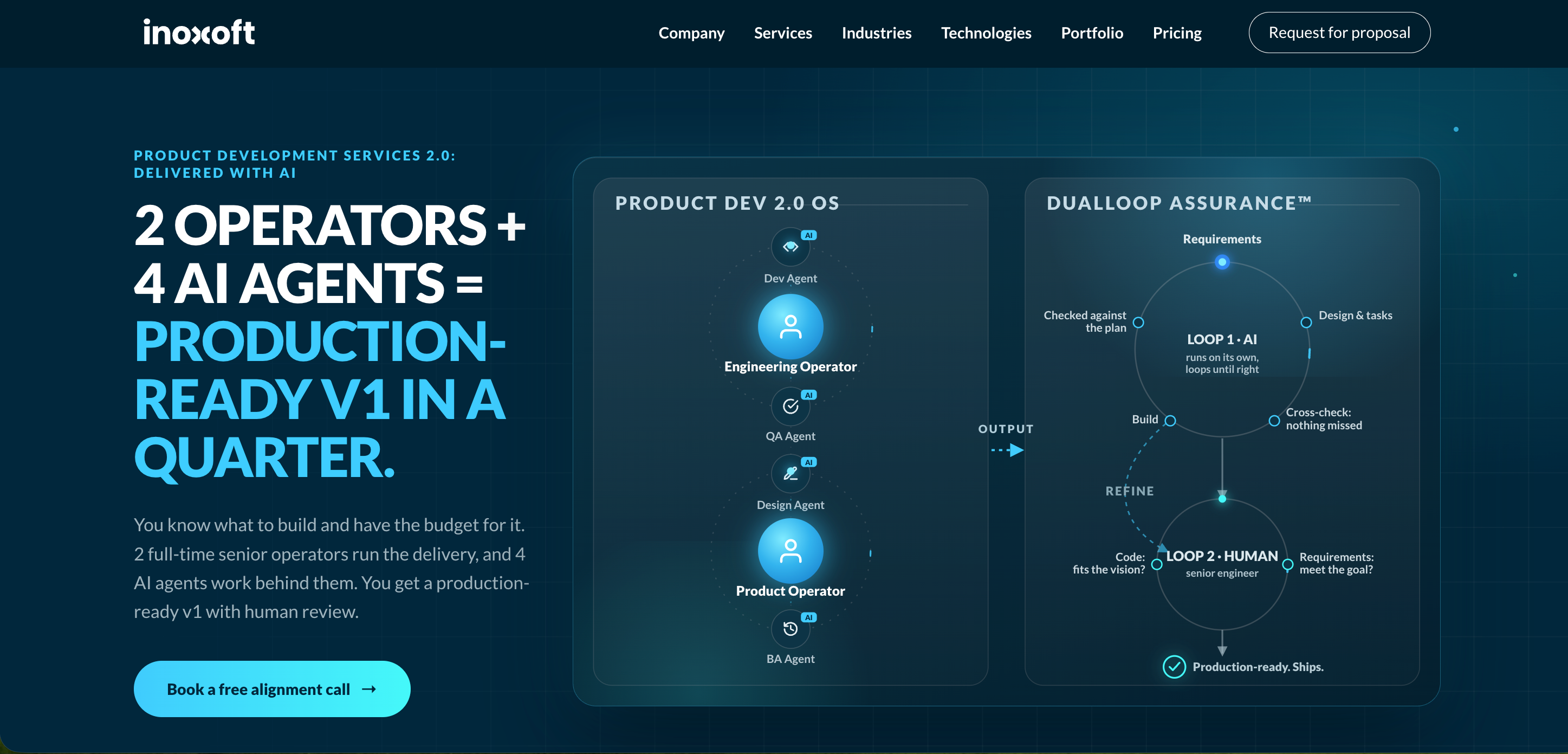
Overview: Inoxoft is a 230-person, ISO 27001-certified company founded in 2014, holding a 5.0/5.0 Clutch rating across 74 verified reviews. Its proptech portfolio covers property management, amenity booking, and digital concierge apps serving 100,000+ users globally.
Core focus:
- Tenant-facing digital concierge and amenity booking apps
- Property management platforms with web and mobile parity
- Full lifecycle delivery, discovery through post-launch support
Real project examples:
- A luxury property operator managing 70+ buildings, for whom Inoxoft built a cross-platform amenity booking system that replaced manual calls and spreadsheets for thousands of residents.
- A US real estate company with 20+ years in the market, for whom Inoxoft built a full buy, sell, and rent property management platform with a client portal guiding users through each step.
Strengths:
- 230 people means faster staffing to a larger team than most companies on this list
- ISO 27001 certification and Microsoft Gold Partner status add formal, checkable security documentation
Weaknesses / considerations: Neither published proptech case study names the client company or an executive by name, this is the one PropTech Depth Test signal Inoxoft misses. Ask for a named reference directly on a discovery call before relying on the published case studies alone.
Key stats:
- Clutch reviews: 74 verified, 5.0/5.0
- Hourly rate: $25 to $49
- Founded: 2014
- Headquarters: Philadelphia, Pennsylvania (US office)
- Distinction: highest average rating on this list, paired with the fastest staffing capacity.
5. MEV
Overview: Founded in 2006, MEV is a US-based custom software development company that holds a RESO Data Dictionary 2.0 certification earned on a client's live MLS platform. They build the data infrastructure behind MLS (Multiple Listing Service) platforms and work with MLS organizations, proptech companies, and brokerages.
Core focus:
- RESO- and OData-compliant MLS platforms and Web API architecture
- RETS legacy migration and IDX listing-data integration
- Multi-tenant proptech SaaS and full platform modernization
Real project examples: MEV has partnered with Hawaii Information Service (HIS) since 2018 to modernize its MLS platform. HIS is a real estate data provider that has served Kauai and Hawaii since 1984, and its platform holds 600,000+ properties across 300+ data fields. MEV rebuilt the search engine and built a RESO- and OData-compliant Web API, earning HIS a RESO Data Dictionary 2.0 certification, the industry standard for listing-data interoperability.
"MEV has a deep desire to understand what a platform does, what functionality it delivers, and how it creates value for customers. That allows MEV to develop technology solutions that not only solve complex challenges, but also build a platform that is scalable and extensible. As we’ve grown to 400 hotels, our system’s performance is keeping pace, and our integrations meet the demands of our customers.." Attributed to: Mike Medsker, Co-Founder and President, Focal Revenue Hospitality Revenue Software Development
Strengths:
- A 7-year MLS partnership, still active in 2026, evidence of a long-term engagement that continues well beyond launch
- A full platform rebuilt and cut over with zero downtime and no data loss, while the legacy system stayed live for users throughout
- Weaknesses / considerations: MEV's proptech depth is concentrated in MLS and listing-data infrastructure, so a valuation engine or a consumer marketplace will find a closer match elsewhere on this list. Real estate is one of several verticals MEV serves, alongside healthcare and life sciences.
Key stats:
- Clutch reviews:* not yet rated (profile live)
- Hourly rate: $45 to $85
- Founded: 2006
- Headquarters: San Diego, California
- Distinction: the only RESO Data Dictionary 2.0-certified MLS platform builder on this list.
6. Taazaa
Overview: Taazaa is a US-based company founded in 2007, holding a 4.9/5.0 Clutch rating across 28 verified reviews. It's the only company on this list with a documented history of inheriting broken, legacy property management code and stabilizing it without taking the system offline.
Core focus:
- Legacy .NET modernization for property management systems
- Data warehouse builds for rental SaaS platforms
- 2-week sprint demos with visible progress every cycle
Real project examples:
- Tropicana Properties (El Paso, Texas): Taazaa inherited a failed .NET 2 codebase managing 40 apartment complexes, migrated it to .NET 8, and cut tenant account corrections from 60 a month to 15 to 20, a 70% reduction.
"With the Taazaa team, I can just give them the vision, and they'll figure it out. That's been very refreshing for us." Attributed to: Iyari Fierro, Technology and Procurement Officer, Tropicana Properties
- Innago, a property management SaaS platform, saw 150% business growth after Taazaa built a data warehouse and a no-code support portal that cut support overhead.
Strengths:
- The only company here with a named client story about stabilizing a failing legacy system without downtime
- A documented, specific outcome (60 corrections a month down to 15 to 20) rather than a vague efficiency claim
Weaknesses / considerations: Published work is US-focused; a European build needing GDPR-specific architecture needs its own verification of that team's compliance context. 28 Clutch reviews is on the lower end of this list's range.
Key stats:
- Clutch reviews: 28 verified, 4.9/5.0
- Hourly rate: $50 to $99
- Founded: 2007
- Headquarters: United States
- Distinction: the only verified legacy-modernization specialist for property management on this list.
How to evaluate a proptech vendor at every stage
Most of what goes wrong in a proptech vendor selection happens before the contract, not after.
The RFP. Name your specific sub-niche, HOA governance, CRE brokerage, valuation, tenant management, or marketplace, up front. A vendor whose follow-up questions get sharper, not vaguer, is showing real domain instinct.
The discovery call. Ask what went wrong on a past proptech project and how they handled it. Every agency with real delivery history has a story. A polished non-answer is the signal to watch for.
The reference check. A written testimonial isn't enough. Ask for a live call with a named client about post-launch support and how scope changes were handled mid-project.
The contract terms. Ask what the team model looks like after launch, retainer, hourly, or a new contract, before you sign. Proptech platforms have long maintenance tails: 73% of proptech tools have to connect to a buyer's existing customer or property system, and that integration work rarely ends at launch.
The 6 criteria that actually matter
These are the PropTech Depth Test signals from the methodology section, restated as what to actually look for on a vendor's site or in a call.
- A name you can check. If a case study doesn't name the client or the product, you can't verify it independently. Ask for the name directly if it's missing.
- Your specific sub-niche, not "real estate." HOA governance and commercial brokerage tooling are different problems that happen to share an industry label. Ask for a case study in your exact category.
- A quote about what changed operationally, not a quote about communication. "Delivered on time" is easy to collect. "Corrections dropped from 60 a month to 15" is not.
- A URL you can open today. No case study link isn't automatically disqualifying, but it shifts the burden of proof onto the discovery call.
- Evidence the team stayed past launch. Proptech platforms need ongoing data-feed and compliance upkeep. A team that only ever hands off and leaves is a structural mismatch for this category.
- Real integration or AI-assisted work, not a generic app with real estate branding. Ask specifically what the product connects to and how.
How to choose
Run these 4 questions against your shortlist before a discovery call:
- Does their strongest case study match your specific proptech sub-niche, not just the broader industry?
- Can they name a client and a person you could actually call?
- Did they stay engaged after launch on at least one published project, or does their model end at handoff?
- Is their team size and rate range a realistic match for your budget and timeline, not just their most impressive logo?
What proptech software development costs
| Scope | Typical range | What's included |
|---|---|---|
| MVP, core workflows, 1 user type | $40,000 to $90,000 | Discovery, design, core build, QA, launch |
| Standard platform, 2 to 3 user types, integrations | $90,000 to $200,000 | Full user flows, payments, notifications, admin panel |
| Complex multi-tenant SaaS | $200,000+ | Multi-tenant architecture, compliance layer, APIs, mobile |
Rate benchmarks vary by region: US and Western European agencies typically charge $80 to $150 an hour; Eastern European and Baltic agencies (Ukraine, Poland, Estonia) charge $35 to $80 an hour, a gap that can mean $60,000 to $120,000 on a 6-month build. The trade-off is timezone overlap, expect 4 to 6 shared working hours with a European team versus a full day with a US-based one. A morning sync and weekly sprint demos close most of that gap in practice.
Why trust this page
Brocoders compiled this page and is not scored or ranked on it. The author box under How we compiled this list says what we build, with dates. For every company, we verified: the Clutch profile and review count as of early September 2026, at least 1 published case study with a named client or product, and any direct quote used.
What we did not independently verify: self-reported headcounts and internal metrics that aren't tied to a named, checkable outcome. Rates and minimum project sizes were compiled from Clutch and case study pages roughly 1 quarter before publish.
13 companies were evaluated. 7 were excluded for not clearing at least 5 of the 6 PropTech Depth Test signals, most commonly for relying on a self-hosted portfolio page instead of a third-party-verifiable case study. Review counts, rates, and team sizes change over time. Verify current data directly on each company's Clutch profile and website before shortlisting.
Conclusion
The company that fits your build depends on which proptech problem you actually have, not which name shows up first in a search. An HOA platform and a CRE valuation engine share an industry label and almost nothing else, data model, compliance requirements, or user workflow.
Match your sub-niche to the comparison table above, then run the how-to-choose questions against your shortlist before the first call. Not ready to shortlist yet? Our 2026 proptech trends roundup covers the category shifts worth watching first.
Brocoders wrote this guide and is not ranked in it. If your build is HOA or condo governance, short-stay rental infrastructure, or an early-stage proptech product, the dated record is in the About the author box, and our proptech industry page has the full scope.
Frequently Asked Questions
Not much in practice, most agencies use the terms interchangeably. "Proptech" leans slightly broader, covering AI-assisted tools and data platforms alongside classic HOA or listing systems. If a vendor's portfolio only covers listing websites, ask directly whether they've built your specific sub-niche. For the broader vendor landscape outside this proptech-specific scoring, see our real estate software development companies list.
An MVP with 1 user type runs $40,000 to $90,000. A standard platform with integrations runs $90,000 to $200,000. A complex multi-tenant SaaS platform starts at $200,000. See the cost breakdown above for what's included.
We scored 14 companies against 6 signals: named client, sub-niche match, an operational-change quote, a readable case study, post-launch continuity, and integration depth. 6 cleared at least 5 of the 6 and made this list. Full detail is in the methodology section.
Ask for a case study in your exact sub-niche, not "real estate" broadly. Ask what went wrong on a past project. Ask for a live reference call, not just a written testimonial. Ask what the team model looks like after launch.
Not necessarily. Ascendix Technologies has 15 Clutch reviews and a 30-year relationship with JLL. Goji Labs runs research before writing code specifically because headcount doesn't fix a product-market-fit problem. Size buys staffing speed, not domain depth.
It depends on whether the list discloses that and applies the same standard to itself as to everyone else. Most rankings in this category don't. This page discloses Brocoders' inclusion in the first paragraph and scores it against the same 6 signals as every other entry, with no claimed number-1 spot.
It depends on scope. Brocoders rebuilt Lake's rental platform backend in 3 months. Taazaa's Tropicana Properties legacy modernization ran longer, since it involved migrating a failing codebase without downtime. Ask any vendor for a timeline specific to your scope, not an industry average.