
AI agents are no longer just executing instructions, they're increasingly making the judgment calls that used to require a human expert on the other end of a phone call. That shift is fueling what analysts now call "service as software," a model where AI doesn't just support a service business, it becomes the delivery mechanism for the service itself.
TL;DR: Service as software (sometimes shortened to SaS) means AI delivers the outcome a service used to deliver, not just a tool that helps a person deliver it. The work behind any service splits into intelligence (rules-based, verifiable) and judgment (taste and experience). Intelligence work converts first. Brocoders has already built both sides of that split for real clients, an AI panel encoding advisory judgment and an AI assistant encoding technical support intelligence, and this guide breaks down what it takes to do the same with an existing service.
What is service as software
Service as software is a model where an AI agent delivers the finished outcome of a service directly, instead of a tool that helps a person produce that outcome. Traditional software hands a person a better instrument to do their job. Service as software does the job and hands over the result.
A March 2026 essay from Sequoia Capital partner Julien Bek, which went on to draw more than 3 million views on X according to Fortune's coverage, put the same idea in market terms in the original piece: the next trillion-dollar company won't sell a tool, it will sell the outcome the tool used to help a human produce. Bek's own line: "If you sell the tool, you're in a race against the model. But if you sell the work, every improvement in the model makes your service faster, cheaper, and harder to compete with."
Foundation Capital, the venture capital firm, puts a number on the scale of the shift, estimating AI's push into the services market represents a $4.6 trillion opportunity, close to the combined size of global salaries in sales, marketing, engineering, and IT services that could move to software-delivered outcomes over the next several years.
For a business built around a service, advisory work, technical support, consulting, or any function currently priced by the hour, the useful question is which part of that work is close enough to a checklist to hand to an AI agent, and which part still needs a person's judgment call.
How it differs from software as a service (SaaS)
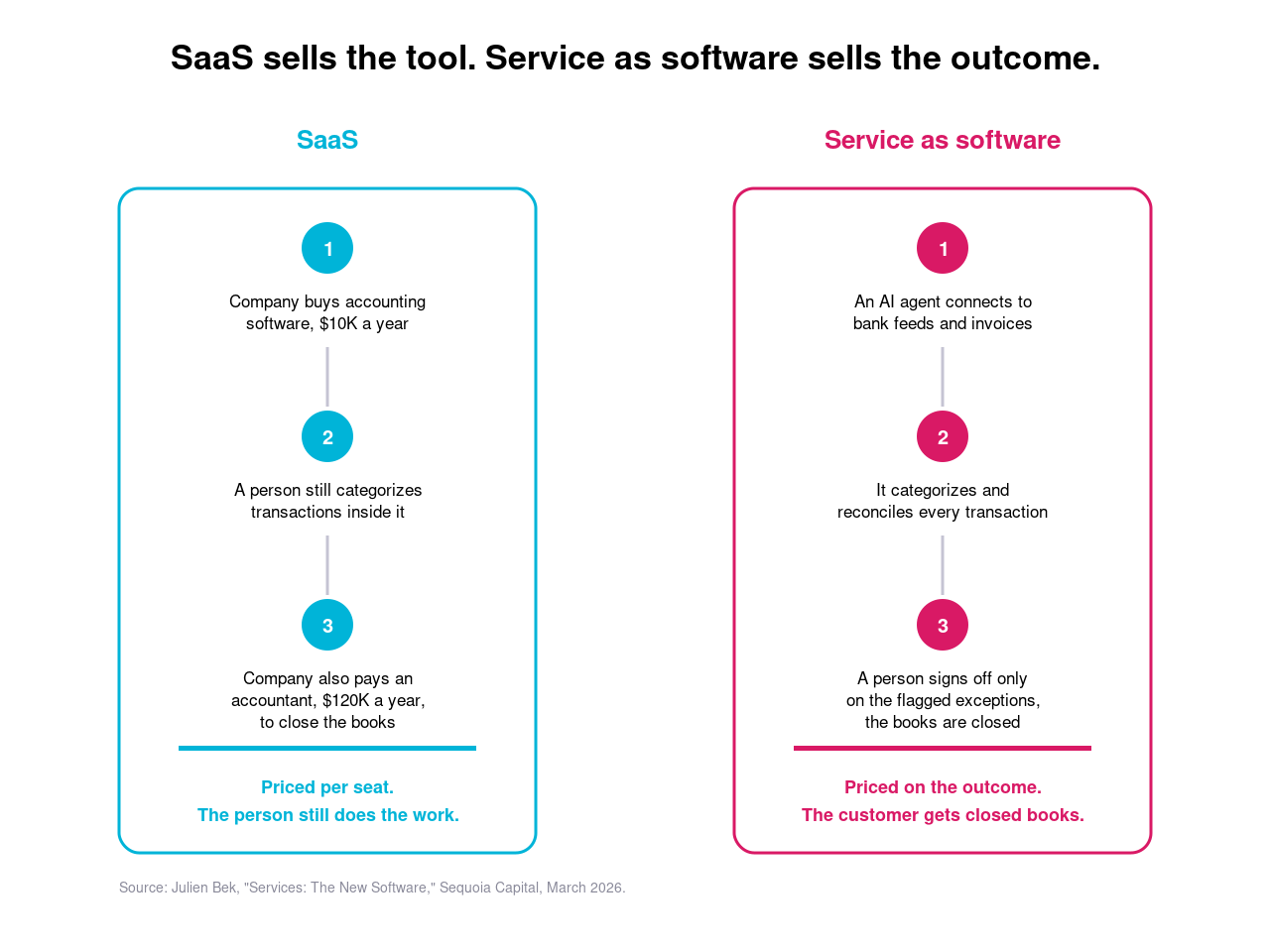
Traditional SaaS sells a tool. A support team buys a helpdesk platform and still staffs people to answer tickets. A firm buys accounting software and still pays an accountant to close the books. The software makes the person faster. The person still does the work and still gets billed for their time.
Service as software sells the finished work instead of the tool used to produce it. Bek's example is direct: a company might spend $10,000 a year on accounting software and $120,000 a year on an accountant to close the books. In the service as software version, an AI agent connects directly to the company's bank feeds, invoices, and prior statements, categorizes every transaction, reconciles the accounts against the source documents, and flags only the exceptions that need a person's sign-off. Nobody logs in to do the categorizing by hand. The customer doesn't buy a better ledger. They get closed books.
That distinction matters for pricing too. SaaS is priced per seat or per feature. Service as software is priced closer to what the outcome is worth, which is why Foundation Capital frames it as an outcome-based shift rather than a tooling upgrade.
The two things every service is made of
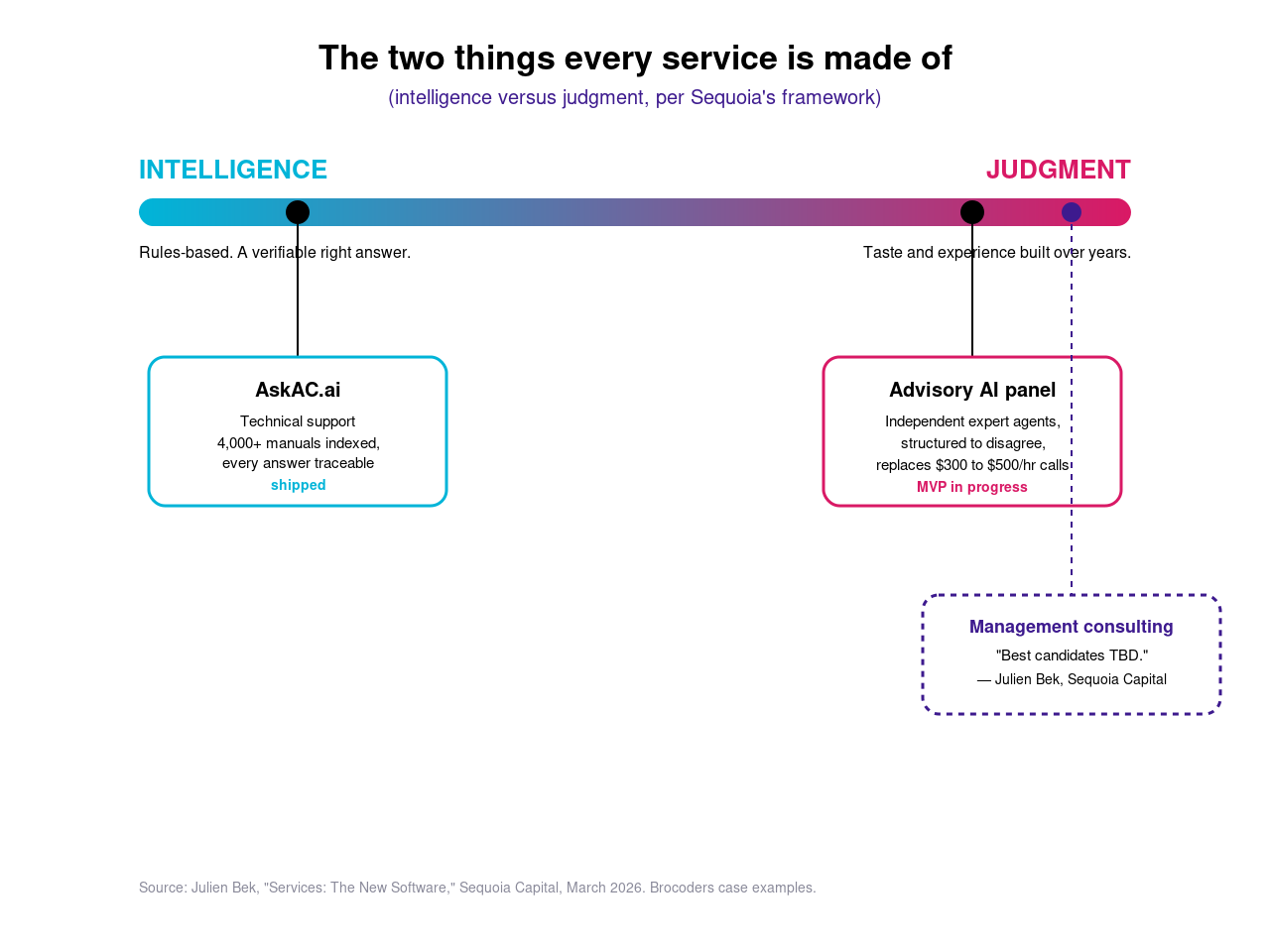
Bek's essay splits the work behind any service into two categories. Intelligence is rules-based work with a verifiable right answer, writing code, medical coding, standard-line insurance claims. Judgment is taste and experience built over years, deciding what to build next, which feature matters, when to ship. His argument: AI has crossed the threshold to handle most intelligence work on its own. Judgment still needs a human, for now, and "the higher the intelligence ratio in any field, the sooner autopilots will win."
Rodion Salnik, co-founder of Brocoders, has described the same split from the delivery side, built from real client conversations rather than market theory: "What's missing in a lot of software is the consultant side. If a company can say to their client, tell us what you want to know, and we'll make sure you get that out of the product, that's an extra layer most software doesn't have."
That's the practical test for any service business looking at this shift. Not "will AI replace what we do," but "which part of what we do is a verifiable answer, and which part is the judgment a client is actually paying for."
What this looks like once it's built
Writing about management consulting, Bek calls it "a huge market but the work is mostly judgement," then adds: "best candidates TBD." That's not a small gap. Advisory work, the kind billed at $300 to $500 or more an hour, sits at the center of what most professional services firms sell.
Brocoders built one candidate. For a client whose business ran on hourly advisory calls, the team built a structured panel of independent AI experts, each assigned distinct expertise and a distinct point of view, deliberately architected to disagree rather than converge, moderated by an AI facilitator that runs multi-round discussions and tracks a live readiness score the client can act on. It's an early, direct attempt at the exact question Bek left open: what an autopilot for judgment-heavy advisory actually looks like, once someone builds it rather than theorizes about it.
The second example sits on the other side of Bek's framework, intelligence work rather than judgment work. CompressorWorld's technical support team fielded the same category of question all day: which compressor fits this specification, what's the replacement part number, what does this fault code mean. The answers already existed, buried across more than 4,000 product manuals and spec sheets that nobody had time to search by hand. Brocoders built AskAC.ai, an AI assistant embedded directly in the company's e-commerce experience, every answer traceable back to its source document, running continuously with no hallucinated responses. That's Bek's intelligence category almost exactly as described, a well-defined right answer, work the company had already staffed and budgeted for, now delivered by software instead of a person reading a PDF.
Neither client's business disappeared. Both changed what a customer has to do to get the answer.
What companies actually charge for
The principle is easy to state. What's harder to find is what these companies actually put on an invoice once they're live. A look at seven companies already selling service as software shows the unit of charge varies a lot, and so does how openly each one publishes it.
| Company | Sector | What they charge for | Pricing structure |
|---|---|---|---|
| Sierra | Customer service AI agents | Per successful resolution, "success" defined per contract | No public rate card. Third-party estimates put annual contracts around $150,000+, with setup fees of $50,000 to $200,000 on top |
| Decagon | AI customer support | Per conversation by default, or per resolution | Reported per-resolution rate near $0.50, plus a flat $50,000 a year platform fee regardless of which model is chosen |
| Ada | AI customer support | Per resolution | No published rates, enterprise sales only, reported to start in the tens of thousands per year |
| Crosby | AI-native law firm, contract review | Per document reviewed | Fixed fee per document, $250 to $1,000 depending on complexity, typically around $400 |
| WithCoverage | AI-enabled insurance brokerage | The policy itself, not a commission on premium | Flat fee that explicitly removes the commission-on-premium incentive traditional brokers run on |
| Rillet | AI-powered accounting and ERP | Platform access, still a subscription | Median $28,300 a year, despite automating 93% of manual journal entries |
| Anterior | AI prior authorization for health plans | Not publicly disclosed | Claims roughly 90% of administrative work automated and 74% faster processing, but no public pricing model |
Two patterns stand out. Most companies that talk about outcome-based pricing don't actually publish a rate, Sierra, Decagon, and Ada all sell the idea of paying for results, then route every real number through an enterprise sales call. Crosby and WithCoverage are the exceptions, both post a genuinely transparent flat fee tied to a specific unit of work, a document or a policy. And the shift isn't universal even among AI-native products: Rillet automates most of the manual accounting work and still charges the way traditional SaaS always has, a flat annual subscription, not a price per closed book.
For a business evaluating its own service, that split matters more than the theory. A flat fee per unit (a document, a resolved ticket, a closed account) is simple to explain to a buyer and simple to build toward. A fully custom, sales-negotiated number is harder to reach as an early mover and usually means the category is still new enough that nobody has agreed on how to measure the outcome yet.
How to evaluate your own service
Three questions, in order, for a business leader looking at their own service through this lens.
Which parts are intelligence, and which are judgment. Map the actual workflow, not the job title. A technical support role often turns out to be mostly intelligence (documented answers, verifiable facts). An advisory role often splits, research and benchmarking are intelligence, the recommendation itself is judgment.
Is this already outsourced, or fully in-house. Bek's playbook is specific here: if a task is already outsourced, the budget line already exists, the buyer already accepts external delivery, and swapping the vendor is a much smaller decision than eliminating a role. Start there.
What would the client actually pay for the outcome alone. If the honest answer is close to what they pay today for the hours behind it, the conversion is viable. If the value is entirely in the relationship or the judgment call, that part stays human for now, and the software should support it rather than replace it.
Brocoders is an AI-native software development company that builds AI product development for teams turning an existing service into something a client can use without booking a person's time, including the two builds described above.
Frequently Asked Questions
Service as software (SaS) is a model where AI delivers the finished outcome a service used to deliver, rather than a tool that helps a person deliver it. Instead of selling accounting software, a service as software product closes the books directly.
SaaS sells a tool and the customer still does the work and pays for the time behind it. Service as software sells the completed work itself, priced closer to the value of the outcome than to a per-seat license.
The intelligence parts, work with a verifiable right answer, like documented technical support or standardized data processing. Judgment work, the kind built on years of taste and experience, converts more slowly and often stays human-led with AI support underneath it.
Not based on what's shipped so far. In both examples in this guide, the business kept running. What changed was how the customer accesses the outcome, on demand instead of on a person's calendar.
With the outsourced, intelligence-heavy part of the work first. It has an existing budget line, a buyer already used to external delivery, and a clear way to measure whether the AI version is actually as good as the human one.