
Type "what is conversational commerce" into Google and every top result comes from a company selling you a chat platform. That's not a coincidence. The keyword carries a $90 CPC despite being purely informational, which means vendors are paying hard to shape the definition before you've even formed an opinion.
So here's the plain version, with no platform to sell.
Conversational commerce is buying, selling, and getting support through conversation, chat, messaging apps, voice, live chat, instead of through menus, search bars, and static product pages. A customer asks a question or states an intent in natural language, and the interaction moves toward a purchase, a resolved issue, or an answer, without them clicking through a category tree.
That definition hasn't really changed since Sephora put a styling bot on Messenger and H&M built a quiz-based bot to recommend outfits. What's changed is what sits behind the conversation. And most of what's ranking for this term in 2026 hasn't caught up.
TL;DR
Conversational commerce means buying, selling, and support happening through chat, messaging, or voice instead of static pages. The version most articles still describe is scripted bots answering from a fixed script. The version actually shipping in 2026 is agentic AI that retrieves real information, cites where an answer came from, and can complete an action. Here in Brocoders, we've built both halves of that shift, including AskCW.ai, a technical assistant that answers from 4,090 indexed manuals with zero hallucinated answers.
What conversational commerce actually means
Conversational commerce covers any commerce interaction, buying, support, discovery, that happens through a conversational interface rather than a traditional web flow. That includes AI chatbots on a website, branded messaging on WhatsApp or Instagram DM, voice assistants, and live chat staffed by real agents.
It's a category of interaction that spans several tools. A Bloomreach analysis makes this point well: a chatbot is a tool, conversational commerce is the broader strategy of using conversation as a sales and support channel across a customer's whole journey. You can run conversational commerce through five different tools and still be doing the same underlying thing: replacing a form or a menu with a conversation.
Estimates on market size vary by research firm. Fin.ai puts the 2026 market at roughly $10 to $14 billion, with projections toward $40 billion by the mid-2030s. Other estimates cited in BigCommerce's 2026 guide put current market size closer to $30 billion, reaching $43.7 billion by 2028. The gap between those numbers says more about how loosely "conversational commerce" gets defined across research firms than it does about the actual size of the category. What every estimate agrees on is direction: growth, not decline.
The old game: why most 2026 content is still describing 2018 technology
For most of the last decade, conversational commerce meant a scripted decision tree wearing a chat interface. You typed a question, the bot matched it against a set of pre-written intents, and it returned a pre-written answer or routed you to a human. Sephora's Messenger bot, H&M's style quiz, Vodafone's TOBi handling routine account questions, all real, all useful, and all built on the same foundation: a fixed script with branching logic.
That was the game for years. It worked well enough for narrow, predictable questions. It broke the moment a customer asked something the script hadn't anticipated, which is most of the time a real customer says something in their own words.
Nearly every article ranking for "what is conversational commerce" right now is still describing that game. They swap in the word "AI" and recycle the same four examples (Sephora, H&M, Vodafone, Nike or Burberry on WeChat), then add a market-size stat and a demo CTA. Read five of these articles back to back and you'll notice they're describing the same 2018-era interaction pattern with 2026 branding.
The new game: agentic, source-grounded AI
The real shift in 2026 isn't that chatbots got friendlier. It's that the underlying system changed from a fixed script to something that retrieves real information and reasons about it before answering.
Two things separate this from the old game. First, grounding: instead of matching your question against a pre-written intent, the system searches an actual knowledge base, product manuals, order history, a policy document, and builds its answer from what it finds there. Second, source citation: a well-built system can point to exactly where an answer came from, which means it can also tell you when it doesn't know something instead of guessing confidently and getting it wrong.
Put those two things together and you get what the industry has started calling agentic commerce: a system that doesn't just answer, it reasons through a request and can complete an action, checking order status, processing a return, qualifying a lead for a sales handoff, without a human touching every step.
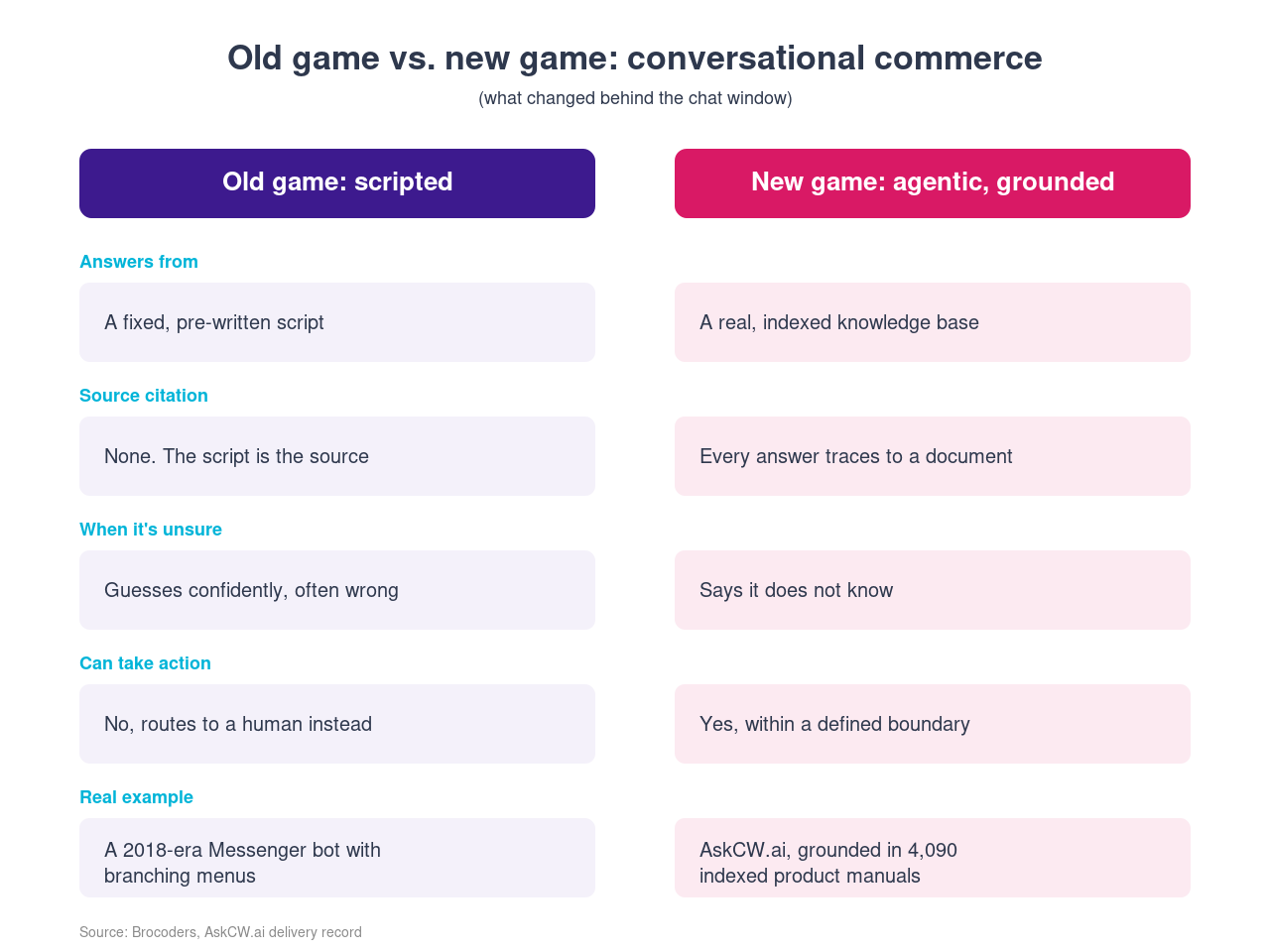
This is also where the honest caveat belongs. "Agentic" gets used loosely. A system that can act autonomously still needs a hard boundary on what it's allowed to do without a human in the loop. The businesses getting this right in 2026 aren't the ones giving AI unlimited authority. They're the ones that grounded the AI in real data first, then extended what it's trusted to do from there.
Industry estimates on cost put AI-handled interactions at roughly $0.50 to $0.70 each, against $6 to $8 for a human agent handling the same interaction, a figure repeated across several 2026 conversational commerce guides though not tied to a single primary study. Treat it as directional. The real reason the shift matters isn't the cost line, it's that a grounded system can finally be trusted with questions that used to require a human, because it can show its work.
What this looks like when it's built right
Definitions are easy. Grounded systems are harder to build than they sound, which is exactly why so few of the ranking articles show one.
Here in Brocoders, we built AskCW.ai for CompressorWorld, an industrial e-commerce business selling and servicing compressors. Their customers were asking detailed technical questions, spec comparisons, compatibility checks, troubleshooting steps, that a script could never cover. We indexed 4,090 product manuals and spec sheets and built the assistant to answer strictly from that library, with every answer traceable back to its source document. No hallucinated specs. If the assistant doesn't have a grounded answer, it says so instead of guessing. The result is a support layer that runs on the e-commerce site itself, handling routine technical questions around the clock and converting more of that research traffic into quote requests instead of losing it to a competitor with a faster answer.
We built a second, related system for an automotive AI client: a conversational engine purpose-built for vehicle research, translating complex vehicle history and specification data into plain language a car buyer can actually use, embedded directly in the shopping experience rather than bolted on as a separate widget.
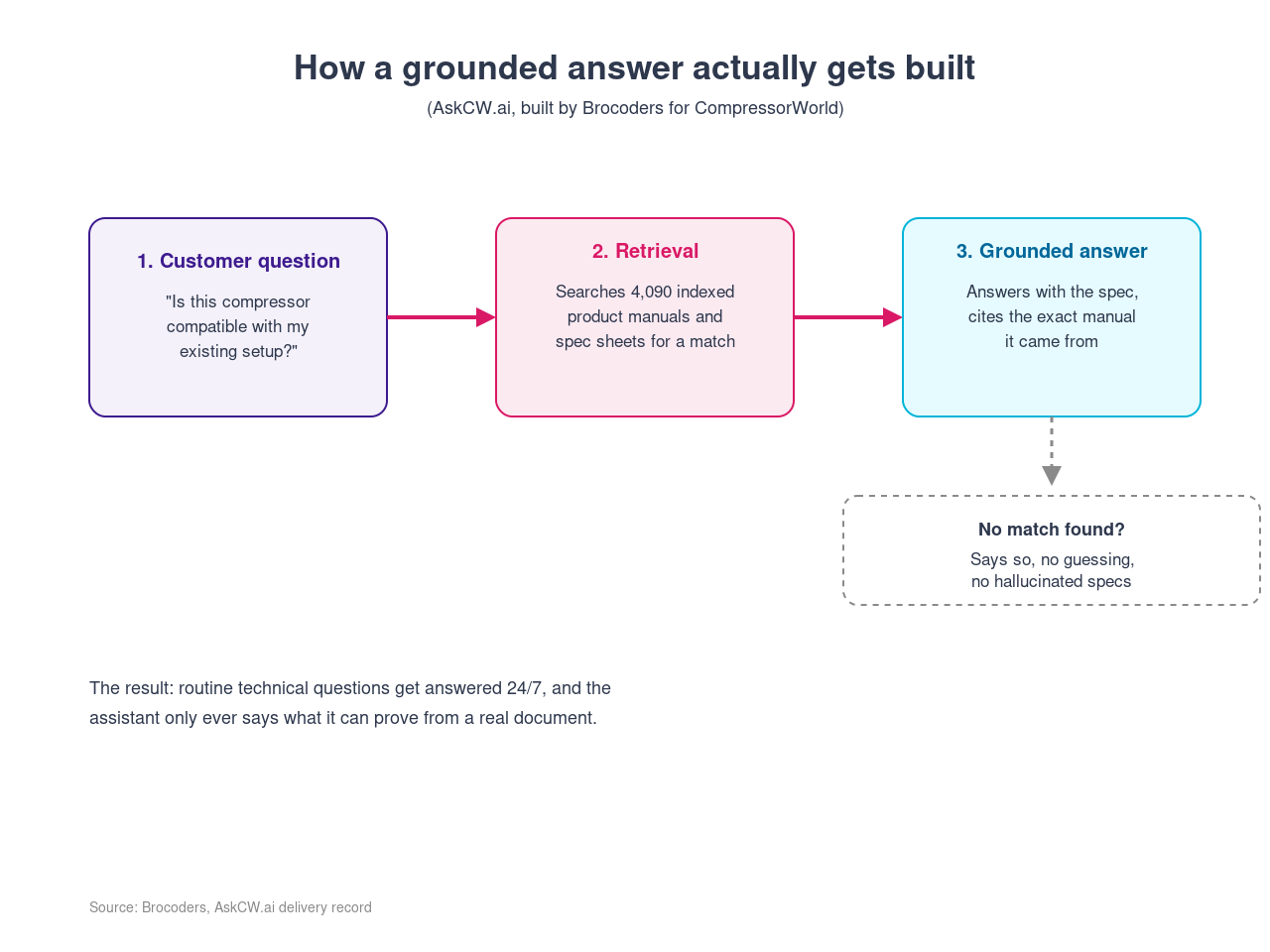
Neither of these is a chatbot with a friendlier prompt. Both are grounded in a real, indexed body of information, and both are honest about what they don't know. That's the difference the definition articles skip.
How to tell an old-game pitch from a new-game one
If you're evaluating a conversational commerce vendor, or scoping a build with your own team, three questions cut through most of the marketing language fast.
Does it cite its source for each answer, or does it just answer? A grounded system can point to the document, order record, or policy it pulled from. A scripted one can only point back to its own script.
Can you see what it's allowed to do autonomously? A well-built system has a defined, auditable boundary, what it can answer versus what it hands off. If a vendor can't describe that boundary clearly, the boundary probably doesn't exist yet.
Does it fail gracefully? Ask it something outside its knowledge base. A grounded system says it doesn't know. A scripted or ungrounded one bluffs, which is exactly the failure mode that erodes customer trust fastest.
Where this goes next
Conversational commerce isn't a new category in 2026. What's new is which version of it a business actually ships. The old game still gets built every day, and it still has a place for narrow, predictable questions. The new game, grounded, source-traceable, honest about its limits, is what turns a chat widget into something customers actually trust with a real decision.
That's the same principle behind how we build AI-native products more broadly here in Brocoders: senior architects own the structure, AI accelerates the work, and the output stays inspectable rather than magic. If you're past the definition and into scoping an actual build, how a conversational AI layer gets added to an existing product without a rebuild walks through the engineering in detail. If you're comparing partners for the build itself, our AI product development work covers exactly this kind of grounded, agentic system, and a look at who's building conversational AI in 2026 is a reasonable next stop before you shortlist anyone.
Frequently Asked Questions
No. A chatbot is one tool inside conversational commerce, which also includes messaging apps like WhatsApp, voice assistants, and live chat. The bigger distinction in 2026 isn't which tool you use, it's whether the system behind it is grounded in real data or running on a fixed script.
Conversational marketing focuses on the top of the funnel: qualifying leads and starting conversations before a purchase decision. Conversational commerce spans the whole journey, discovery, purchase, and post-purchase support, and often includes completing the transaction itself inside the conversation.
It's a system that goes beyond answering questions to reasoning through a request and completing an action, checking an order, processing a return, qualifying a handoff, within defined limits. The key word is "defined." A responsible agentic system has a clear, auditable boundary on what it can do without a human.
Retail examples get the most attention, but the pattern shows up wherever customers ask detailed, specific questions before buying: industrial equipment (AskCW.ai answers technical compressor questions from 4,090 indexed manuals), automotive research, insurance, and B2B SaaS support are all live use cases, not just retail chat.
Not necessarily. The cost driver isn't the chat interface, it's the grounding work: indexing your actual product data, manuals, or policies so the system has something real to answer from. A narrow, well-grounded assistant on one specific use case costs far less than a broad, ungrounded one that tries to answer everything.
Check whether it cites sources per answer, whether its autonomous actions are clearly bounded, and whether it says "I don't know" when it should. A system that always sounds confident is the one to be most careful with.