One requirements document became a ServiceTitan-class HVAC platform in 6 days and $1,609 of AI spend
A complete, running field service platform, generated by our AI-native pipeline here in Brocoders. No human wrote the CRUD, the pages, the migrations, or the tests
One requirements document went in. A running FSM platform came out: 82 database models, 343 API endpoints, 88 screens, ~454 automated tests. The generation cost $1,609 in AI spend across 369 model calls over ~5.5 days, versus 6 to 12 months and six figures for a comparable custom build.
The platform
One requirements document went in. A complete, running FSM platform came out. No human wrote the CRUD, the pages, the migrations, or the tests.
The fastest way to judge a claim like that is to look at the thing. So here is the platform itself, role by role. The generated system ships with 4 working logins: admin, dispatcher, technician, and customer. Each one gets its own version of the product, scoped by permissions, and each one covers a complete working day.
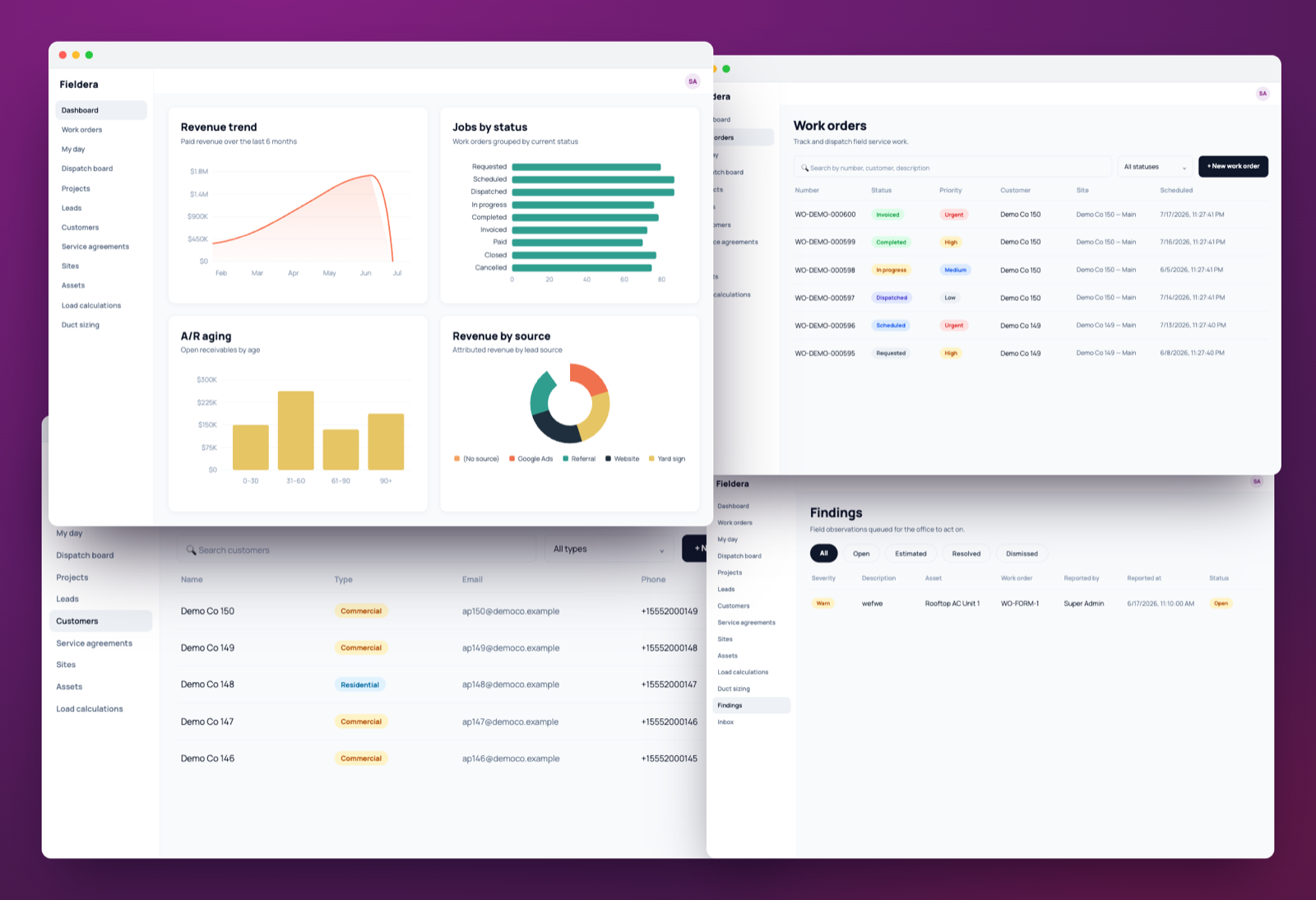
Admin
The owner's view of the whole operation: revenue trend, jobs by status, A/R aging, and revenue by lead source on the dashboard, plus full lists for work orders, customers, and field findings flagged for the office to act on.
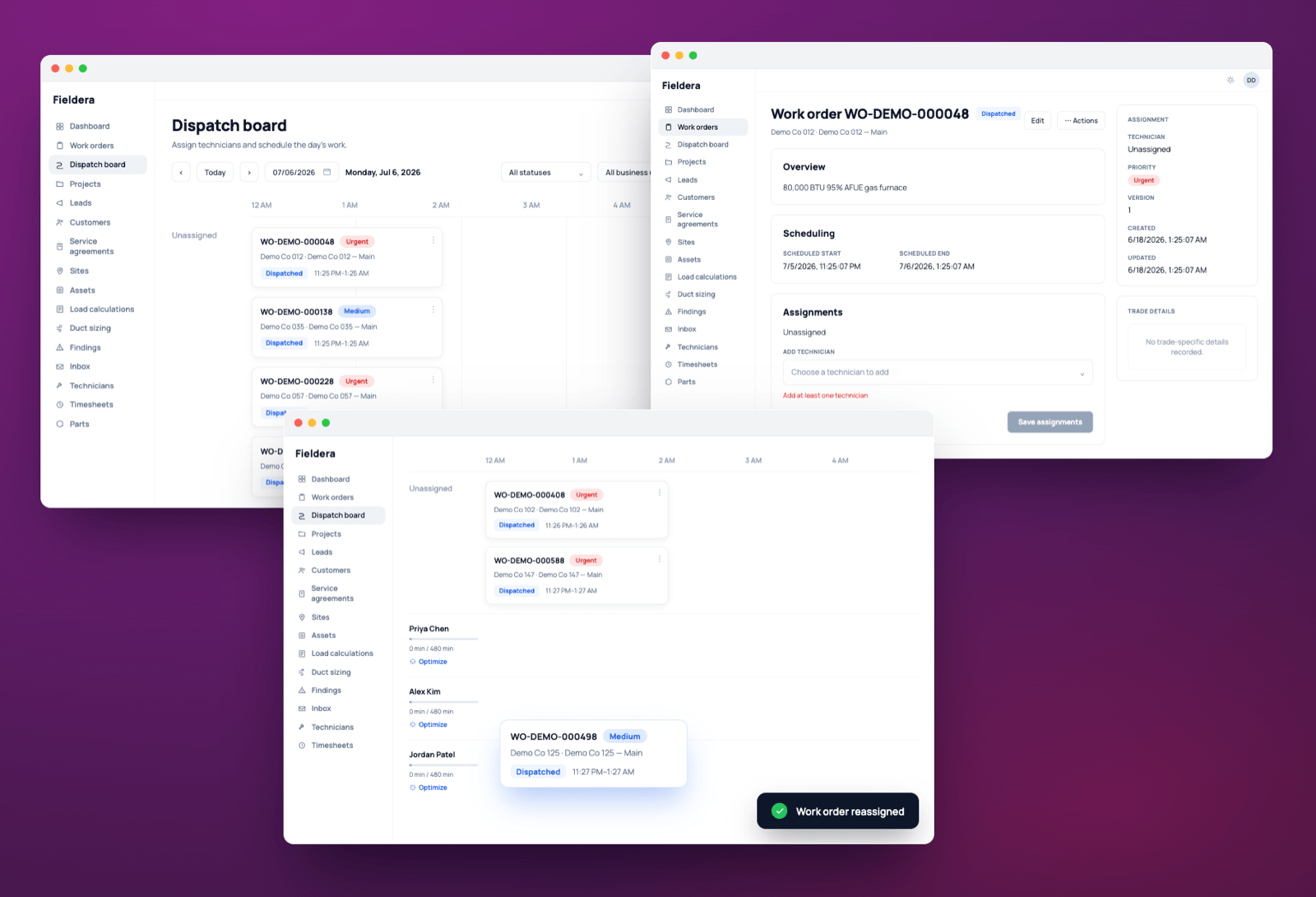
Dispatcher
The daily surface a dispatcher lives in: an hour-by-hour board of every technician's schedule, an unassigned queue by priority, route optimization per technician, and instant reassignment with confirmation.
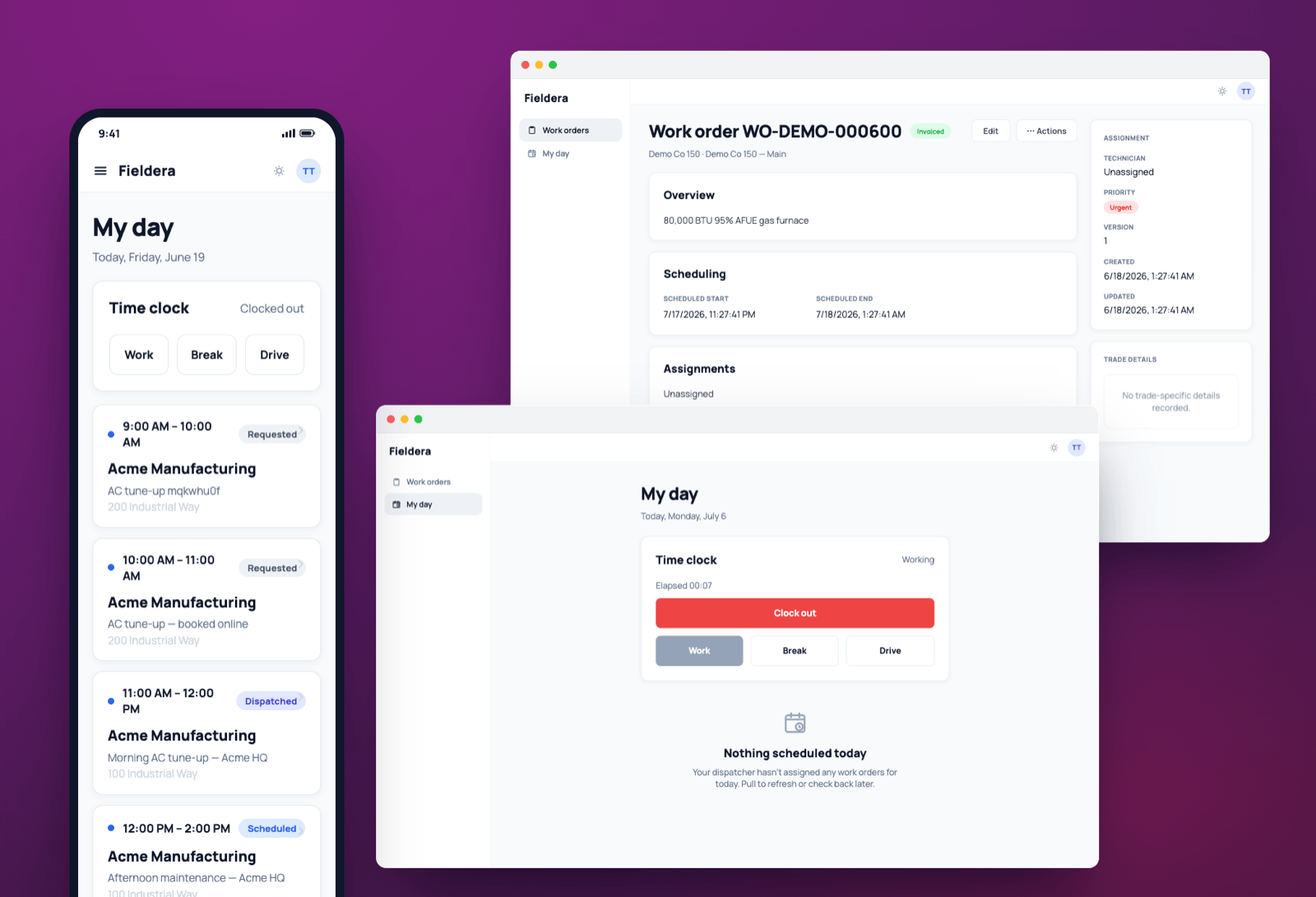
Technician
A field-ready "My day" view on phone and desktop: a time clock for work, break, and drive states, the day's scheduled jobs, and full work order detail down to trade-specific fields and assignment history.
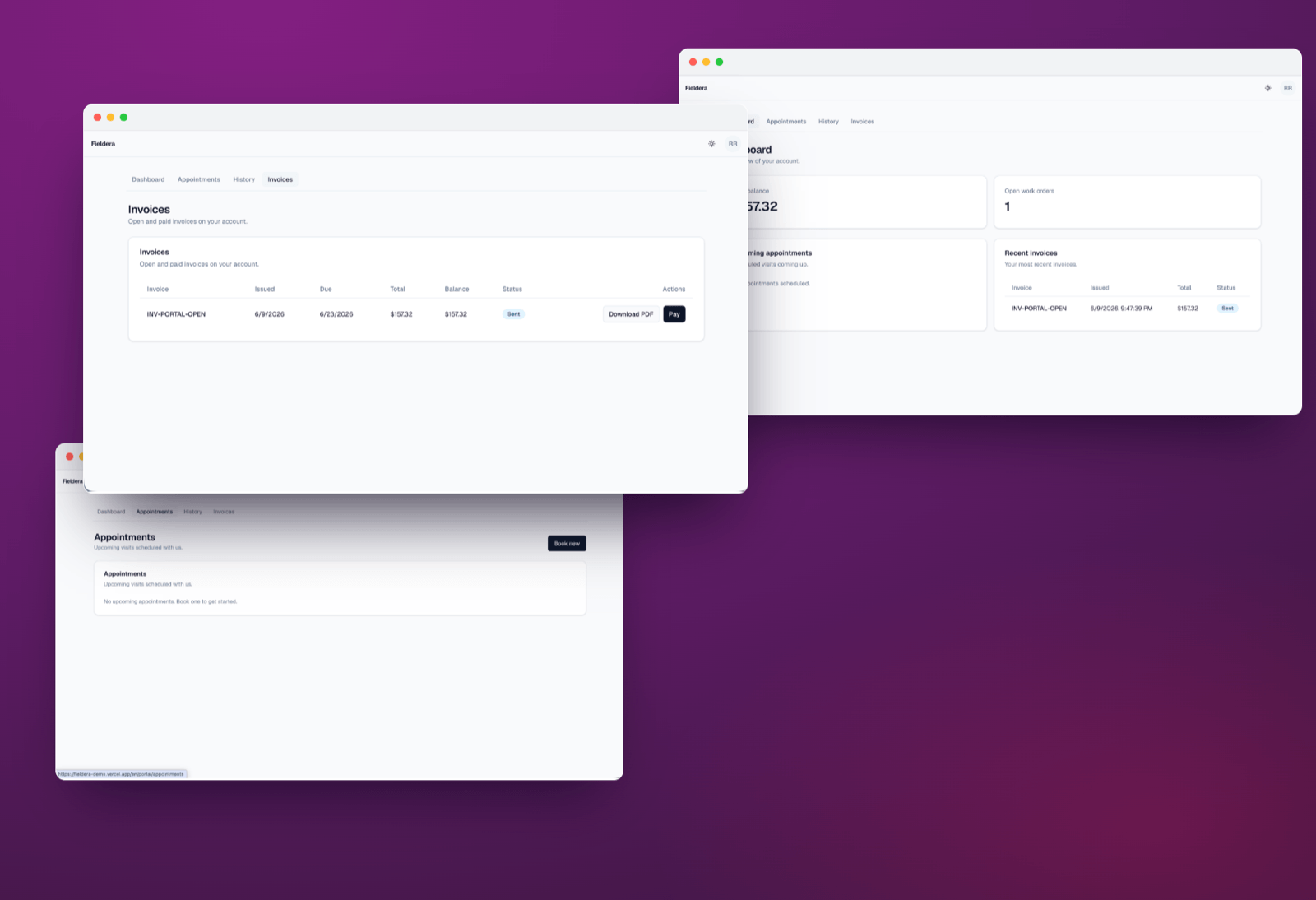
Customer
A self-serve portal for the client: account balance and open work orders at a glance, upcoming appointments, and an invoice history with online payment and PDF download.
This is a working system with dispatch, invoicing, payroll, inventory, refrigerant compliance, load calculations, and marketing attribution. The scale of what shipped is engineering evidence, and each line below is work a development team normally does by hand:
This is the surface area a development team would spend months designing, writing, and testing by hand.
Why we ran this experiment
Operators of field service businesses are handed two options: rent generic per-seat SaaS you never own, or commission a custom build that takes months and six figures. Here in Brocoders we wanted to test whether that tradeoff still holds, so the Fieldera team ran an internal experiment: one requirements document, one AI-native generation run, and every artifact kept for inspection.
The AI spend is the generation step, and a real deployment adds review, hardening, data migration, and support. Even so, the step that used to cost months now fits on a corporate card.
What separates this from vibecoding
"I vibecoded an app" stories are everywhere. Trust comes from the seams, so here are ours: the questions the system asked, the plan it built, and the checks it ran on itself.
Discovery, not dictation
The system generated 10 clarifying questions from the spec: 5 blockers and 5 nice-to-haves, each explaining why it matters before asking. It is the same paper trail a good business analyst leaves.
Every answer was locked back into the requirements as a decision before a line of code existed.
Planning like a tech lead
The locked requirements decomposed into 23 epics and 96 user stories, phased MVP → Phase 2 → Phase 3. 82 of 96 stories declared explicit dependencies on earlier stories. A real ordered backlog, with payroll waiting on invoices and dispatch waiting on work orders and technicians.
Build one story at a time, check your own work
25 QA and verifier passes and 10 automated repair passes fired during execution. 95 of 96 stories completed. The output is a conventional git history, roughly 82 commits, about one per story, readable feature by feature.
The honest limits
What this changes
Custom-fit software is now the faster and cheaper option. The baseline for this surface area was months and six figures, or per-seat SaaS you never own. This run cost $1,609 in AI spend across 369 model calls in ~5.5 days of generation. With usage-based pricing, growth stays affordable: every new hire costs the same to run.
The build-cost floor for vertical operations software just moved. An MVP scope that used to justify a seed round's worth of engineering is now a generation run plus fit work. Scope your MVP against what generation covers, and spend the human budget on the parts that differentiate you.
FAQ
Yes. This build produced a running platform with 82 database models, 343 API endpoints, 88 screens, and about 454 automated tests, all generated from one requirements document. The repo is countable and inspectable.
The generation cost $1,609 in AI spend across 369 model calls.
About 5.5 days of wall-clock generation. A fitted client deployment runs 4 to 5 weeks, because workflow mapping, integrations, and training are where the value is.
It is a standard NestJS and Next.js monorepo with about 454 tests and a conventional git history of roughly 82 commits, about one per story. Any developer can clone it and read the product being built feature by feature.
The field app is a PWA today, a deliberate PWA-now, native-later decision.
The pipeline asked 10 clarifying discovery questions before building, planned a dependency-ordered backlog of 23 epics and 96 stories, and ran 25 QA and verifier passes plus 10 automated repair passes during execution. Vibecoding skips all three.
Fieldera is taking design partners
Bring your operation's requirements and we will show you what a fitted deployment looks like in 4 to 5 weeks. Write to talk@fieldera.ai.
Want to see how an AI does this without the wheels coming off? The orchestrator deep-dive is coming next.