The CoreHealth challenge
Build a full-featured product on a tight schedule
In England, 1 in 10 people wait over three weeks to see a general practitioner.
CoreHealth company (name was changed according to NDA) recognized this issue long ago. Since 2006, they’ve been on a mission to make healthcare more accessible. From phone to video consultations, they’ve built services that bring care closer to patients. They also provide doctors and video consultations for insurers, pharmacies and other health platforms.
A major client asked CoreHealth to bring back video consultations and funded a new version of their doctor consultation platform. The budget had to be spent within 6 weeks. The developer who built the old platform had moved on, and the code never reached Brocoders. CoreHealth needed the new version built from its own documents, connected with multiple third-party tools, and delivered as a full-featured product. With the deadline set, CoreHealth reached out to Brocoders on June 1, 2023.
CoreHealth at a glance
- Client
- CoreHealth (name changed under NDA), a UK telemedicine provider since 2006
- Product
- A telehealth platform: booking, browser video consultations, clinical notes, signed PDF prescriptions, sick notes and referral letters, card payments
- Product type
- Multi-tenant telehealth platform: 3 solutions on one codebase, for patients, pharmacies and custody
- Situation in June 2023
- The developer who built version 1 had moved on, and the old code never reached Brocoders
- Engagement
- July 2023 to present. Working product in 6 weeks, MVP in October 2023, custody solution from November 2023, pharmacy solution April to June 2024, change requests since 2025
- Scale
- 129 custody locations with accounts by April 2026
- Stack
- React 18, TypeScript, NestJS 9 on Node.js, PostgreSQL, AWS, Stripe, Vonage OpenTok, Mailgun
- Team
- 5 to 6 people in 2023
- Services
- Project takeover of a product without its code, custom product development, multi-tenant SaaS development
Obstacles on the CoreHealth project
Tight deadline
We had six weeks to deliver a working product, with no room for delay.
No access to the old code
The old platform dated from 2019, its developer had moved on, and the code was never handed over.
Limited budget
With constrained funding from their client, CoreHealth needed a cost-effective solution built fast.
6 weeks
Product delivered
3 solutions
For remote GP consultations
129 locations
For custody consultations
July 2023
Discovery
August 2023
UI/UX design
September 2023
Development and a recorded demo
October 2023
MVP delivery
November 2023
Custody solution
April to June 2024
Pharmacy solution
2025 to 2026
Change requests
April 2026
129 custody locations
The CoreHealth solution
Brocoders built a working doctor consultation platform in 6 weeks, from the start of design on Aug. 3 to a recorded demo on Sept. 15, 2023. CoreHealth presented it to a prospective client at a conference, and the response was exactly what they’d hoped for: the client liked it.
That initial success opened the door to more. What began as a basic MVP grew into three solutions: one for general doctor consultations, one for pharmacies, and another one designed specifically for custody.
All three run on one React and NestJS codebase. Each client company on the platform has a type, patient, pharmacy or custody, and that type sets payment, documents and emails, with no separate codepath per solution. After the MVP, Brocoders added the custody flow and the pharmacy solution to the same codebase in 2023 and 2024, and has handled CoreHealth’s change requests since 2025.
Solution 1: Doctor consultation platform
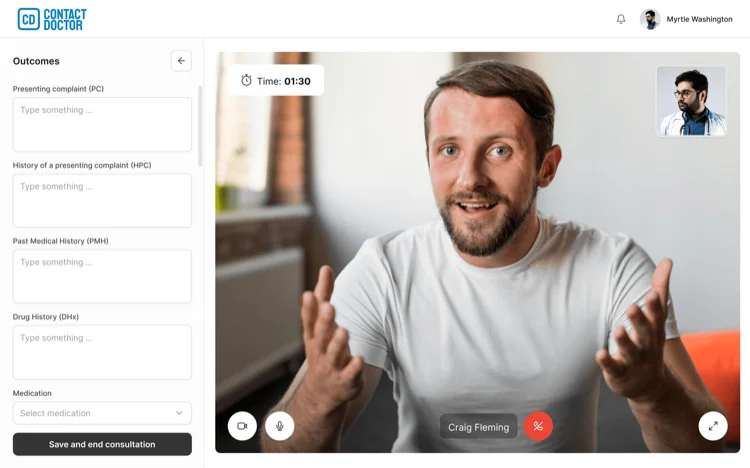
The platform lets users book consultations online, browse and choose doctors by specialty, and select time slots that fit their schedule. It also supports real-time video consultations and secure data handling for both patients and healthcare providers.
Patients book a 15-minute video or phone consultation, pick a slot from the doctor’s calendar and pay by card through Stripe, with promo codes. The video room runs in the browser on Vonage OpenTok, with no app to install, and opens 5 minutes before the start, only after payment clears. During the call, the doctor fills in the notes form beside the video, with ICD or SNOMED coding. After it, the doctor issues a prescription, sick note or referral letter as a PDF with the doctor’s digital signature.
Solution 2: SaaS for pharmacies
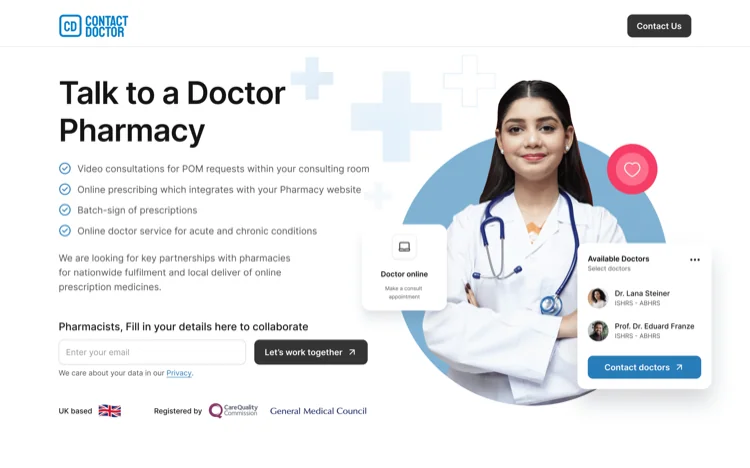
Between April and June 2024, we built the solution for pharmacies that want to offer online prescription services. Users can consult with licensed doctors through video calls, and, if approved, receive a prescription after the consultation. Once complete, the prescription is sent directly to the pharmacy, allowing patients to purchase their medicine immediately.
Pharmacies sign up and get approved by CoreHealth’s admin, then buy consultation packages, such as 10 consultations, with a counter of how many are left. One pharmacy company can run more than one branch, and its staff see the prescriptions issued to their customers, with no paper handover.
Solution 3: Doctor consultation platform for custody
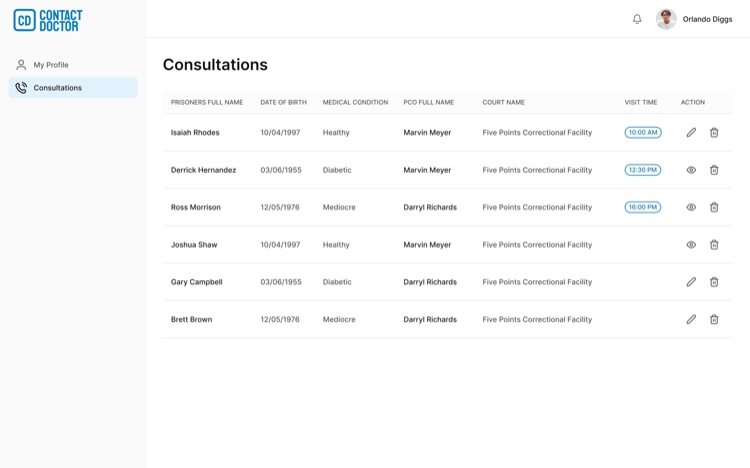
Finally, we built a secure telehealth solution for custody, on PIN-locked tablets. Custody staff book a doctor on behalf of a detainee, add the officer’s name and a clinical early warning score, and the doctor sees the patient through the tablet’s camera. During the call, the patient’s side stays locked, and the same PIN opens it again. Custody bookings have no payment step.
April 2026: 17 more custody locations. Brocoders set up accounts for 17 more custody locations, which brought the total to 129.
The process: how Brocoders built CoreHealth’s platform
Brocoders assembled a 5-member team for the project
We started the project with a team of five: 1 front-end developer and 1 back-end developer full-time, 1 QA engineer, 1 UI/UX designer on demand, and a project manager who also worked as the business analyst. A delivery manager oversaw the project. This team size was ideal for the project scope. When QA tasks became lighter, we shifted the engineer to part-time to help reduce costs for the client.

Discovery

UI/UX design

development

Discovery

UI/UX design

development
Part-time PM and business analyst
On-demand UI/UX designer
On-demand developers and QA engineer
Full-time front-end developer
Full-time back-end developer
Part-time QA engineer
On-demand UI/UX designer
Part-time PM and business analyst
Once the team was in place, we kicked off with the discovery phase.
Step 1. Discovery
Our team reviewed CoreHealth’s documents, screenshots and hand drawings of the current system to identify technical and logical gaps across all user flows. We applied feature-based decomposition to break the platform down into functional modules. It helped the client understand what functionality they would get when the system goes live.
Discovery ran from July 17 to Aug. 11, 2023. As a result of the discovery phase, we provided the artefacts and the documentation ready for further project stages:
- Q&A documentation: 19 questions, answered by CoreHealth’s CEO
- User story documentation: 42 user stories
- Project estimation and roadmap, with a 15% buffer on medium-risk tasks and 30% on high-risk ones
- Low-fidelity prototype
- UI/UX design
Step 2. Design
In the design phase, we focused on the platform’s visual structure. Using the early artefacts from discovery, we created a low-fidelity prototype to map key user flows and gather client feedback. Based on that input, we refined the UI/UX design to make the interface clear and ready for development.
Step 3. Development
Considering the client’s timeline constraints and limited budget, we recommended using a JavaScript-based stack. For the frontend, we suggested ReactJS, and NodeJS for the backend.
It allowed us to quickly develop a high-performing application without compromising on quality. This stack was the most efficient choice for the project. It's also technically well-suited for a platform that needs to connect with many external systems.
Development ran in 4 sprints, from Aug. 14 to the recorded demo on Sept. 15, 2023, on React 18 with TypeScript, NestJS 9 and PostgreSQL on AWS. The team built its own booking calendar after weighing Calendly and TidyCal, because a third-party scheduler meant one more integration before the demo date. It started the video integration early, to learn what it could do. The estimate had rated video high-risk. To hold the demo date, it postponed 8 features, among them password recovery, reviews and doctor self-registration. It connected Stripe for payments, Vonage OpenTok for video and Mailgun for email.
Key CoreHealth project outcomes
Fast delivery
A working product in just 6 weeks, from the start of design to the recorded demo, and the full MVP in October 2023.
3 solutions
The basic MVP expanded into three solutions on one codebase: one for general consultations, one for pharmacies, and one for custody.
129 custody locations
Custody staff at 129 locations can book a doctor for a detainee on the same platform.
Result for CoreHealth
Brocoders helped CoreHealth build a platform that keeps doctors as productive as possible. That was the brief from CoreHealth’s CEO: a platform that keeps its doctors as busy as they can be.
Before
After

Old code from 2019, its developer gone

New React and NestJS codebase, built from CoreHealth's documents
Tight deadlines
Working product in 6 weeks, MVP in October 2023
A video service its developer could no longer support
Stripe, Vonage OpenTok and Mailgun connected
There was no historic data to migrate. Not built by Brocoders: CoreHealth’s telephony for phone consultations, and doctor pay, which CoreHealth handles off-platform by invoice.
CoreHealth technology stack







- Frontend: React 18, TypeScript, Vite, Tailwind CSS, React Query, React Hook Form (more on React)
- Backend: NestJS 9 on Node.js, TypeORM, PostgreSQL
- Infrastructure: AWS (EC2, S3, CloudFront, Route 53, CodeDeploy, CDK), Docker
- Services: Stripe for payments, Vonage OpenTok for video, Mailgun for email
- Documents: the server renders prescriptions, sick notes and referral letters as PDFs with html-pdf-node
FAQ: taking over a telehealth platform after the developer has moved on
It can. Brocoders built CoreHealth's version 2.0 from the client's documents, screenshots and flows, because the old code never arrived. There was no historic data to bring across. When code does exist, our project takeover work starts with an audit of it.
CoreHealth's working product took 6 weeks from the start of design to a recorded demo (Aug. 3 to Sept. 15, 2023), after nearly 4 weeks of discovery. Payments, signed PDF documents and the landing page followed, and the MVP was complete in October. More on our MVP development work.
It uses Vonage OpenTok. The backend creates each session and issues the join token, and the patient and the doctor meet in a browser video room.
CoreHealth's does, on one codebase. A type on each client company sets payment, documents and emails, so pharmacies and custody staff work in the same system as patients. More on our SaaS development work.
It doesn't. There's no NHS login, NHS number lookup, Electronic Prescription Service link or pharmacy system API. The doctor issues a signed PDF prescription, and the pharmacy's staff see it on the platform. A signed prescription is what the pharmacy accepts.
Brocoders didn't build CoreHealth's telephony, which carries phone consultations, or its doctor pay, which runs off-platform by invoice. The web app, the backend, the AWS hosting and the payment, video and email services are Brocoders' work.
Brocoders has handled CoreHealth's change requests since 2025 and still has work scheduled on the account in October 2026.
Send us what you have: the repository and hosting access if they exist, or documents and screenshots if they don't. With code, we start with a fixed-price software audit: 5 business days for $5,000 (Essential) or 10 business days for $9,900 (Standard). Without code, we start the way CoreHealth did, with a discovery that ends in user stories, a prototype and an estimate.
More takeover and healthcare builds like CoreHealth
- Project takeover case studies
Products we took over from another team and shipped
- HeyPractice
A learning platform audited, then rebuilt in 5 months
- Traders Alloy
A CI/CD pipeline after a previous vendor couldn't get one running
- Geriana
A caregiving marketplace connecting families with caregivers
- HealthTech case studies
Telehealth and care platforms we built


Need a similar solution?
We can help you build custom telemedicine software that connects patients to healthcare providers in real-time, making quality care just a click away.
Book a free consultation