
AI has found its way into recommendation and matching engines, and while it holds real potential to sharpen retrieval and reasoning, most of what's published about it in 2026 substitutes a big number for an actual architecture. You'd be hard pressed to find a vendor blog on the topic that doesn't lead with a conversion percentage: a guide from Masterofcode promises a jump from 3% to 45% conversion, with no study linked, no baseline defined, and no company named. That's the pattern across most 2026 content on recommendation and matching engine development, a big number, an LLM, and nothing you can check.
On the other side of that hype sit two 2026 research papers, and neither has been cited by a single vendor blog we found while researching this piece. Read together, RecoChain and RRCM describe recommendation and matching engines evolving toward hybrid retrieval, ranking, and reasoning systems, where the LLM's job is picking what evidence to use rather than replacing the system that ranks it. It's clear the architecture underneath a recommendation engine matters more than the acronym sitting on top of it, and we build this way at Brocoders, across products that were never labeled "recommendation engines" until now.
TL;DR: Most 2026 vendor content on AI recommendation engines sells "add an LLM agent" plus unsourced conversion lifts. The stronger 2026 research says LLMs work best as an evidence-selection layer inside a measurable 4-layer architecture (data, retrieval, ranking, feedback), not as a replacement for it. We call this the 4-Layer Match Stack, and we already build it, in a live shopping platform and in a furniture-matching MVP we're scoping right now.
The industry norm: recommendation engines are becoming AI agents
Search "AI recommendation engine development" in 2026 and the pattern repeats across almost every result. RBMSoft, Gloriumtech, Devox, Softweb, and a dozen others describe the same shift: bolt an LLM onto your product catalog, call it agentic, and watch conversion climb.
The percentages vary wildly from source to source, which is itself the tell. Nobody discloses a baseline, a data set, or a methodology. The claim exists to sell a build, not to describe one.
Underneath the hype sits a real and useful shift that a 2026 practitioner's guide to recommender algorithms documents plainly: classic collaborative filtering and matrix factorization are getting layered with LLM-based reasoning. That part is true. What isn't true, or at least isn't supported by the current research, is that the LLM becomes the recommendation engine. It becomes one component inside a system that still has to retrieve candidates, rank them, and measure whether the ranking is any good.
We went looking for the research behind the marketing claims. We found two papers instead, both from 2026, and neither shows up anywhere in the content currently ranking for this topic.
What the 2026 research actually shows
The first paper, RecoChain, describes a unified generative retrieval and ranking framework: one Transformer-based pipeline that generates candidate items and ranks them in the same pass, closing the usual gap between candidate generation and final ranking quality. That sounds like the LLM taking over. It isn't. RecoChain is still trained and evaluated against classic top-k ranking quality, the same metric recommendation teams have used for a decade. Generative retrieval changed how candidates get proposed. It didn't remove the scoreboard.
The second paper, RRCM, frames LLM-based recommendation as a retrieval-and-reasoning problem over collaborative behavior and item metadata. The LLM's job in RRCM is deciding when to pull in more evidence, a policy that gets optimized against the final ranking reward, not against how convincing the LLM's own output sounds. In plain terms: the model doesn't recommend. It decides what the recommender needs to look at next.
A third, independent source backs the same direction without citing either paper. Rauf Aliev's "Recommender Algorithms in 2026: A Practitioner's Guide" teaches the same layered story: neighborhood models and matrix factorization as the baseline, deep learning architectures built on top, and LLMs used as semantic feature extractors and RAG components rather than as standalone recommenders. Three separate sources, none of them selling anything, land on the same architecture.
That's the gap nobody in the current search results is filling.
The tilt: LLMs pick the evidence, they don't replace the ranker
Recommendation and matching engines in 2026 are becoming retrieval-plus-ranking-plus-reasoning systems. The LLM's role is picking what evidence a deterministic ranker should see. The ranker still makes the call, and you can still measure whether it's making a good one.
That single distinction changes how you evaluate any vendor pitch. Stop asking whether a system uses AI. Ask which layer the AI sits in, and whether the layer underneath it is still measurable. If a vendor can't answer that question, the pitch is the product.
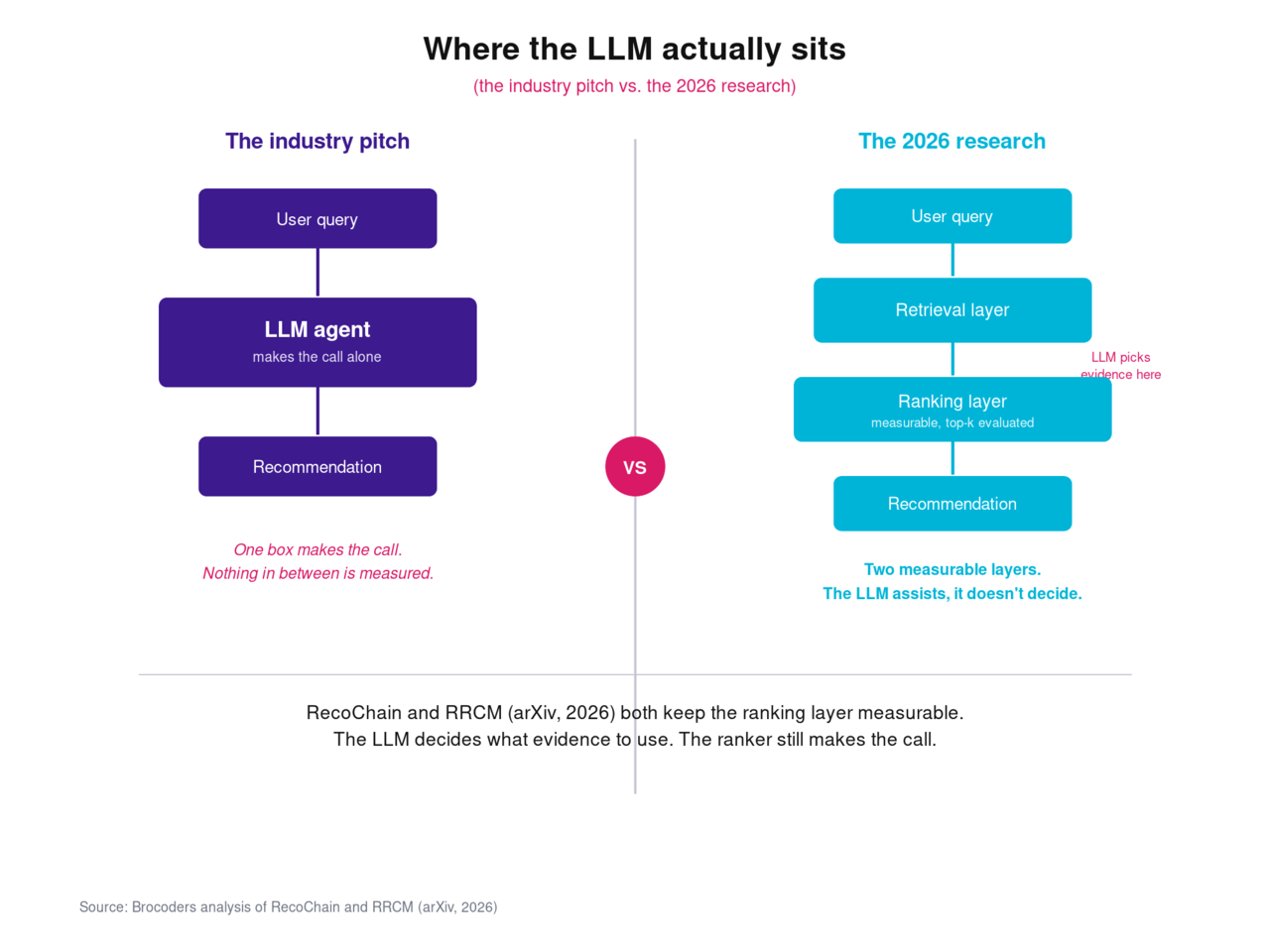
We've built systems this way for two years without naming the pattern. Naming it now is the point of this piece.
The 4-Layer Match Stack
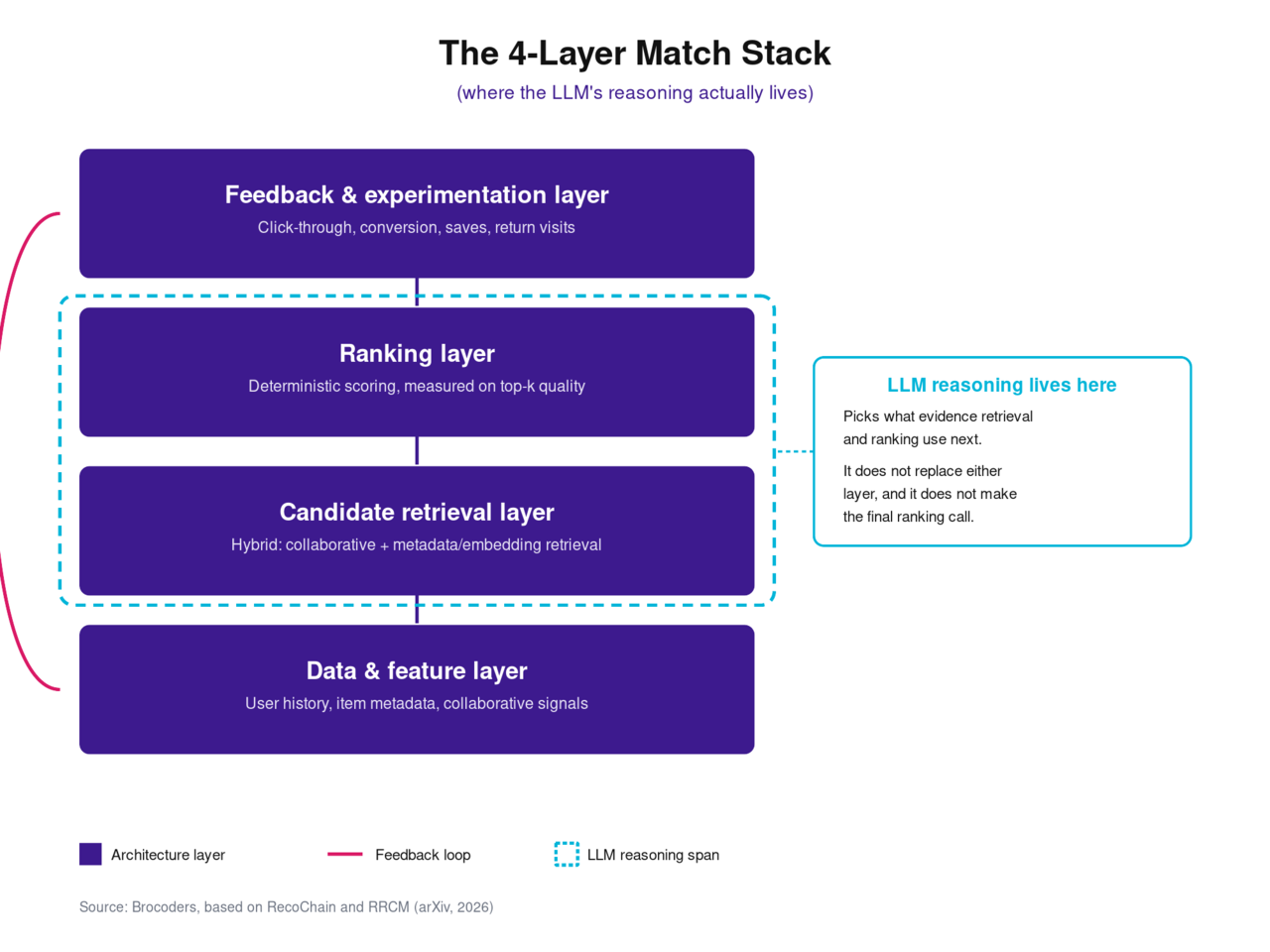
A defensible recommendation or matching engine in 2026 has four layers, the same structure RecoChain assumes, whether you build it yourself or buy it from a vendor.
Data and feature layer. User history, item metadata, and collaborative signals. Both RecoChain and RRCM assume this layer is strong before anything generative gets layered on top. Skip it and every layer above it inherits the gap.
Candidate retrieval layer. A hybrid generator, typically collaborative retrieval plus metadata or embedding retrieval, that narrows millions of items down to a workable shortlist. This is where vector search (pgvector, or a managed equivalent) usually lives.
Ranking layer. A deterministic model that scores and orders the shortlist, with explicit offline and online evaluation. Top-k ranking quality is still the metric that matters, generative or not.
Feedback and experimentation layer. The loop that tells you whether the ranking is actually working: click-through, conversion, saves, return visits, fed back into the data layer.
The LLM's reasoning capability runs through the retrieval and ranking layers, not beside them as a fifth layer. It helps construct context, understand metadata, and decide what evidence to retrieve next. It doesn't sit above the stack making the final call, and it shouldn't, because a stack you can't measure is a stack you can't improve.
What this looks like in production
We built an AI-powered personalized shopping platform's recommendation and semantic search layer on exactly this pattern, before we had a name for it (client name withheld at their request). Onboarding, in-session behavior, and account data feed a recommendation engine that surfaces trending, contextual, and complementary products for each shopper, first-time or returning. Alongside it, we built AI-powered semantic search that reads shopper intent and natural language instead of matching keywords, paired with dynamic filters that adjust to search context and product attributes in real time. The founder's own read on it was simple: once shoppers started sticking around, finding things they liked, and coming back, the team knew the AI was working. Underneath that experience sits the same shape: a data layer that learns preferences continuously, a retrieval layer doing semantic and behavioral matching, and a ranking layer that decides what actually surfaces.
Build priorities if you're starting from zero
If you're scoping a recommendation or matching engine from scratch, RecoChain and RRCM point to the same order every time.
- Build the event and profile data pipeline first. Both papers assume strong user history and metadata inputs; without them, retrieval and ranking have nothing good to work with.
- Build a hybrid candidate generator next, combining collaborative retrieval with metadata or embedding retrieval, rather than betting on one method alone.
- Build the ranking layer with explicit offline and online evaluation before you touch the reasoning layer. You need a scoreboard before you can tell if anything is improving it.
- Add controlled LLM usage last, for context construction and retrieval decisions, not as a replacement for the ranker.
Curato's own MVP 1 scope follows this order almost by instinct: catalog and preference data first, similarity retrieval second, a curated ranked output third, with semantic search and richer discovery layered on in MVP 2 through 5.
What not to claim (and why most vendor pages do)
The research, in both RecoChain and RRCM, is explicit about where the evidence stops. Avoid claiming ROI lifts, conversion gains, latency thresholds, or accuracy improvements unless you have your own benchmark data or a source that reports them directly. Avoid claiming that traditional recommendation engines are dead. That line shows up constantly in marketing content, while the actual research shows evolution toward hybrid and unified systems, not replacement.
Stating what you can't prove is a trust signal, not a weakness. It's also one hype-heavy competitor content can't copy without abandoning its own sales pitch.
Build vs buy: where the cost actually goes
A custom recommendation or matching engine build runs roughly $70,000 to $400,000 or more upfront, with 10 to 15% annual maintenance on top (Azati; Veld Systems); smaller, focused builds often land closer to $50,000 to $150,000. SaaS alternatives like Rebuy, Nosto, or Amazon Personalize start around $25 a month and scale toward $1,000 or more depending on catalog size and traffic, according to DMI.
The real question isn't which number is smaller. When you buy a SaaS recommendation layer, the behavioral data training it typically stays with the vendor, a cost that rarely shows up in the price comparison but matters enormously if that data is part of your product's moat, per Digital Applied. And roughly 80% of the effort in most AI recommendation projects goes into data preparation, not model training, regardless of whether you build or buy, according to the same analysis.
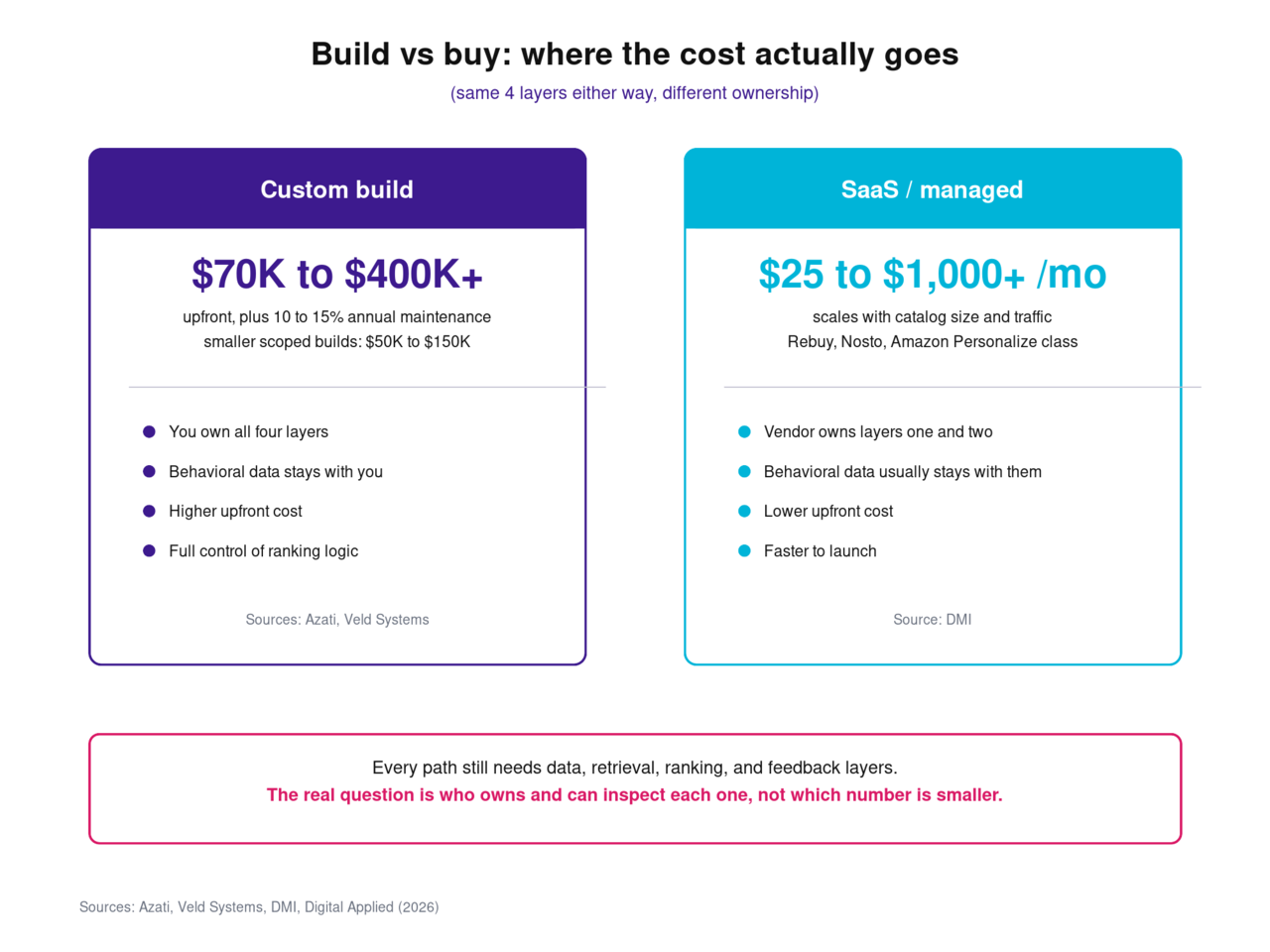
That reframes the decision. Every path needs the same four layers. Buying a SaaS tool means renting layers one and two from someone else, data ownership included. Building means owning all four, at a higher upfront cost. Neither choice removes the architecture; it only changes who holds it.
Where this leaves you
Recommendation and matching engines aren't becoming AI agents that replace ranking systems. They're becoming retrieval-plus-ranking-plus-reasoning systems, and the research backing that shift is sitting in two 2026 papers that almost nobody selling these builds has read.
We've built this architecture inside a live shopping platform, and we're scoping it right now for a furniture-matching MVP that maps onto the same four layers before a single line of generative code gets written. If you're specifying a recommendation or matching engine and want the data and ranking layers built right before anyone talks about agents, that's the conversation to have with our AI development team.
Frequently Asked Questions
A recommendation engine ranks items for a single user based on preferences and behavior (what to show this shopper). A matching engine pairs two sides of a marketplace against each other (which buyer fits which seller, or which designer fits which client). Both run on the same underlying stack: data, retrieval, ranking, and feedback.
Custom builds run roughly $70,000 to $400,000 or more, smaller scoped builds often $50,000 to $150,000, plus 10 to 15% annual maintenance (Azati; Veld Systems). SaaS alternatives start near $25 a month and scale with catalog size and traffic (DMI).
Depends on whether the behavioral data training the system is part of your competitive advantage. Buying rents the retrieval and ranking layers, data included, from the vendor. Building costs more upfront and gives you ownership of every layer, per Digital Applied.
Varies with data readiness and scope. An MVP validating just the core recommendation loop, before semantic search or richer discovery layers, commonly runs 8 to 12 weeks; the full 4-layer stack with production-grade ranking and feedback loops takes longer.
RAG sits inside the retrieval layer: it pulls relevant context (product descriptions, past behavior, metadata) for the ranking model or the reasoning layer to use, the same evidence-selection role the 2026 research assigns to LLMs generally.