
Every comparison in this category scores these tools on how well they hold a conversation. Fluency, tone, how human the replies feel.
That's the wrong test if you sell anything technical. We in Brocoders build these assistants, including AskCW.ai for an industrial compressor distributor, and the question that decides whether one works is duller than fluency: can it read the manual?
Because for a catalog of technical products, the answer a buyer wants is almost never in the product record. It's on page 14 of an installation PDF, in a compatibility table, or in a compliance note nobody has ever converted into a web page. An assistant that indexes only your catalog will nail "what's the flow rate" and fall over on "will this model run a food-grade line at 175 PSI." The second question is the one that decides the sale.
And when it falls over, it usually doesn't say so. It generates something plausible. A wrong spec, stated confidently, in front of a buyer who came to you because they trusted your catalog.
One more thing worth knowing before you read on. We pulled the search data for this keyword, and roughly half of US search demand for "ai shopping assistant" is consumers looking for Amazon's Rufus or Walmart's Sparky. So if you're a merchant, most of what ranks for this term was written for somebody else. This list covers assistants you install on your own store.
Disclosure: Brocoders compiled this list, and Bridge is our product. We've scored it against the same six criteria as everything else, given it an honest limitation, and it isn't at the top. We evaluated 24 tools and 10 passed.
TL;DR: Most AI shopping assistant comparisons score tools on how well they talk. What decides whether one works on your store is what it can read, whether every answer cites its source, and what it does when it doesn't know. Score any tool on those six signals before you look at a pricing page.
Research methodology
Data collected July 2026. We started with 24 tools and kept 10.
Scoring weights:
| Evaluation factor | Weight | What we measured |
|---|---|---|
| Ingestion depth | 30% | Which of your buyer's reference documents it can read: PDF manuals, installation guides, datasheets, compatibility charts, compliance sheets, tables, scanned pages. Includes published parser list, volume tolerance, tagging burden |
| Answer provenance | 20% | Whether every answer links to the source document it came from |
| Decision scope | 15% | How far it takes a buyer: discovery, configuration, compatibility, availability, quote |
| Action layer | 15% | Whether it can query live systems and execute actions, or only respond |
| Data perimeter | 10% | Self-hosting, VPC deployment, compliance posture |
| Failure behavior | 10% | What it does when the answer isn't in its data |
Ingestion depth carries the heaviest weight deliberately. For a technical catalog every other capability sits downstream of what the assistant can read.
Inclusion criteria. A merchant has to be able to install it on their own store. It needs a public product page documenting what data it ingests. And it needs either verifiable third-party reviews or a named published client.
What we excluded, and why. Amazon Rufus, Walmart Sparky, and Perplexity Shopping are consumer assistants owned by the marketplace, so you can't put them on your site. We name them because they drive a large share of this keyword's traffic and the confusion is worth clearing up. Gorgias handles order tracking and returns well, which is post-purchase support rather than product discovery. Zowie detects buying intent and automates post-purchase flows without doing spec matching. Vellum builds an assistant for the store operator, a different product wearing the same label.
Editorial note. "Best for" is our reading, not vendor-verified. Brocoders compiled this list and Bridge is a Brocoders product.
All 10 assistants compared
| Tool | Reads your documents? | Rating | Pricing from | Deployment | Best for |
|---|---|---|---|---|---|
| Zoovu | Catalog plus limited docs | Minimal public review presence, 3.8/5 (19 reviews) | Enterprise, on request | Vendor cloud | Enterprise manufacturers with configurable catalogs |
| Threekit | Catalog plus limited docs [Source] | 4.4/5 (65 reviews) | Enterprise, on request | Vendor cloud | Manufacturers selling made-to-order products through dealers |
| Bridge (Brocoders) | Documents native | No public review profile | Setup fee plus usage | Managed cloud, your VPC, or on-premise | Distributors and manufacturers with large document libraries and compliance review |
| Alhena AI | Documents native | 4.9/5 (35 reviews) | Free tier, then $239/mo | Vendor cloud | DTC and mid-market stores wanting discovery and support in one tool |
| Rebuy | Catalog only (Source) | 4.7/5 (741 reviews) | Usage-based (Source) | Shopify app | Shopify merchants focused on merchandising and AOV |
| Nobi | Catalog and web content | no public profile | $25/month base (Source) | Vendor cloud | Mid-market stores replacing site search and chat together |
| Tidio (Lyro) | Catalog and web content | 4.6/5 (1,948 reviews) | Free tier, Lyro paid add-on | Vendor cloud | SMB stores where support volume is the bigger problem |
| Constructor | Catalog and behavioral data | Enterprise, limited public reviews | Enterprise, on request | Vendor cloud | Large retailers tuning discovery at scale |
| Algolia | Catalog only, documents are DIY | 4.5/5 (453 reviews) | Free tier, then usage-based | Vendor cloud, API-first | Teams with engineers who want to build the layer themselves |
| Klevu (Athos Commerce) | Catalog only | 3.5/5 (3 reviews) | On request | Vendor cloud | Fashion and FMCG catalogs with high SKU counts |
The Provenance Test
Six signals. The first one is a gate: fail it and the other five stop mattering for a technical catalog.
1. Ingestion depth. What can it actually read? Some tools index your product records and nothing else. Others parse the documents your buyers genuinely need: PDF manuals, installation instructions, datasheets, compatibility charts, wiring diagrams, certification sheets, parts diagrams, service bulletins.
Five things to check here, and vendors rarely publish all five:
- File types parsed natively. PDF, DOCX, XLSX, TXT, XML feeds, SQL, scanned images. Ask for the list. "Trained on your content" and a named parser list are different claims.
- Tables, diagrams, and scanned pages. Spec data lives in tables and images. Plenty of tools extract body text and silently drop the table the answer was in.
- Volume tolerance. What happens at 100 documents? At 4,000? Retrieval quality decays as the corpus grows unless the retrieval layer was built for it.
- Tagging burden. Does it index as-is, or does somebody on your team tag every document first? Manual tagging is the hidden cost that kills these projects around month three.
- Refresh path. When a manual gets revised, does the index update on its own?
2. Answer provenance. Does every answer link back to the document it came from? Without that you can't debug a wrong answer, and you can't prove a right one to a buyer who pushes back.
3. Failure behavior. What happens when the answer isn't in the data? Saying "I don't have that documented" is a design decision, and most tools haven't made it. This is the least-examined signal in the category and it's the one that protects your catalog's credibility.
4. Decision scope. Discovery, then configuration, then compatibility, then availability, then quote. Most tools stop at step one and call it guided selling.
5. Action layer. Can it check live stock, build a quote, book a slot? Reading needs an index. Acting needs integrations, and those are separate projects with separate timelines.
6. Data perimeter. Where do your catalog data and customer conversations live, and can the whole thing run inside your own cloud? If procurement or legal reviews your vendors, this decides whether the tool is buyable at all before anyone looks at features.
The 10 AI shopping assistants
Group 1: document-grounded assistants for technical catalogs
1. Zoovu: conversational product advisors at enterprise scale
| Reads documents? | Rating | Pricing | Min. commitment | Deployment | Founded | HQ |
|---|---|---|---|---|---|---|
| Catalog plus limited docs | Minimal public review presence | On request | Annual, enterprise | Vendor cloud | 2007 | Boston, USA |
Sources: Zoovu guided selling assistant, G2 profile, Capterra profile
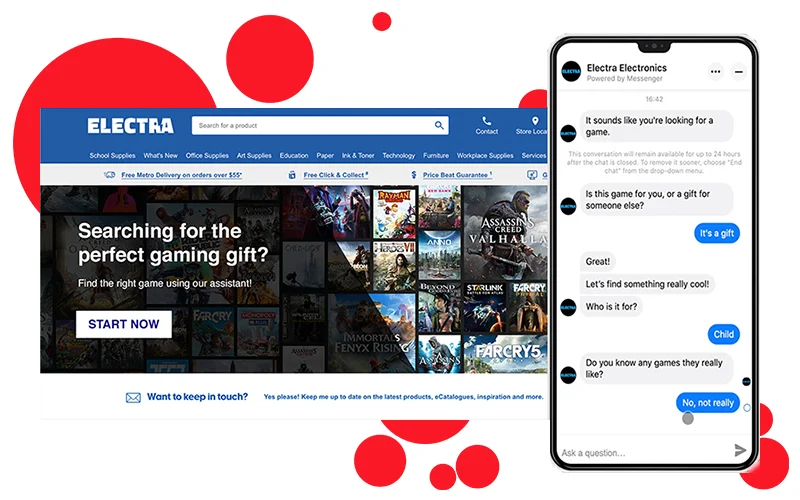
Zoovu builds structured product advisors that walk a buyer through need-based questions and map answers onto product attributes. More than 3,500 brands use it, including Amazon, P&G, Whirlpool, and Microsoft. Its semantic layer is built to turn technical specs into language a non-expert buyer follows, which is genuinely hard and genuinely useful.
The Provenance Test: ingestion, strong on structured attribute data, document parsing is not published in detail [Source]. Provenance, not documented publicly. Failure behavior, undocumented. Decision scope, discovery through configuration. Action layer, integrates with commerce platforms. Data perimeter, vendor cloud.
Limitations: Zoovu keeps a thin presence on review platforms, so independent verification is hard to come by. Advisors are configured rather than trained, which means a person builds the question logic and maintains it as the catalog changes. Enterprise pricing and annual contracts put it out of range for most mid-market stores.
Best for: enterprise manufacturers with configurable catalogs and a team to own advisor logic.
2. Threekit: guided selling for made-to-order manufacturing
| Reads documents? | Rating | Pricing | Min. commitment | Deployment | Founded | HQ |
|---|---|---|---|---|---|---|
| Catalog plus limited docs [Source] | 4.4/5 (65 reviews) | On request | Annual, enterprise | Vendor cloud | 2005 | Chicago, USA |
Sources: Threekit on B2B buying assistants, G2 profile
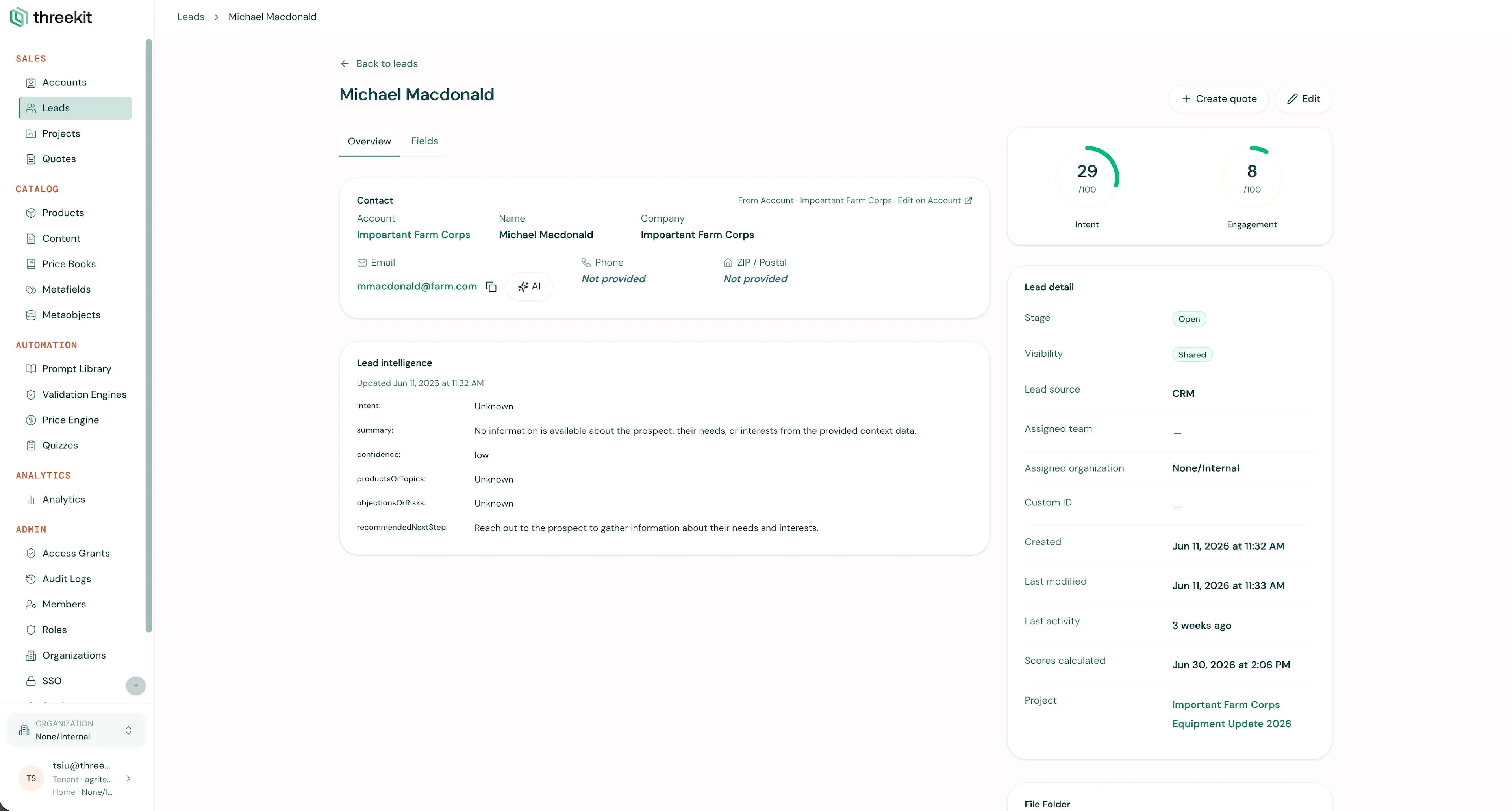
Threekit is an AI sales agent for manufacturers whose products are too configurable for a standard cart. It trains on the manufacturer's catalog, business rules, and product data, then runs structured discovery and routes configured opportunities to the right dealer or channel partner by geography, product family, or account type. That dealer-routing piece is unusual and it matters if you sell through a channel.
The Provenance Test: ingestion, catalog and business rules, document parsing unclear [Source]. Provenance, undocumented. Failure behavior, undocumented. Decision scope, discovery through configuration and quote, the deepest on this list. Action layer, dealer routing and CPQ integration. Data perimeter, vendor cloud.
Limitations: built around configuration logic and business rules, so it needs your product rules formalized before it can help. Enterprise contracts only. If your problem is unstructured documentation rather than configuration complexity, the fit is weaker than the category label suggests.
Best for: manufacturers selling configurable or made-to-order products through dealers and distributors.
3. Bridge (Brocoders): document-grounded assistants you can self-host
| Reads documents? | Rating | Pricing | Min. commitment | Deployment | Founded | HQ |
|---|---|---|---|---|---|---|
| Documents native | No public review profile | Setup fee plus usage | Paid engagement, no free tier | Managed cloud, your VPC, or on-premise | 2015 (Brocoders) | Tallinn, Estonia |
Sources: Brocoders AI development case studies, AI development and integration services
Bridge is our own platform for deploying AI agents grounded in a company's documents. Native parsers handle unstructured files (PDF, DOCX, TXT) and structured sources (XML feeds, SQL), and a hybrid retrieval layer combines semantic and keyword search so specific part numbers and model codes still match exactly. Every answer carries a link to the document it came from.
The proof is AskCW.ai, built for Compressor World, an industrial compressor distributor in Massachusetts. It answers engineers' spec and compliance questions from 4,090 indexed manuals, spec sheets, and FAQ documents, each answer citing its source. When the answer isn't in the corpus, it says so rather than generating one. The stack is NestJS, Next.js, PostgreSQL, LlamaIndex, and OpenAI, and we've written up how we approach LLM application architecture and MCP-based agents separately.
The Provenance Test: ingestion, native parsers for PDF, DOCX, TXT, XML, SQL, no manual tagging. Provenance, source link on every answer. Failure behavior, states when the answer isn't documented. Decision scope, discovery through spec matching, availability, and quote. Action layer, read and write via Model Context Protocol, with human approval available on critical actions. Data perimeter, deploys inside your own AWS, Azure, or GCP environment, or on-premise.
Limitations: Bridge is a platform delivered as a build, so there's no app-store install and no free tier. Setup is a paid engagement with a defined timeline, which rules it out entirely if you want to test something this afternoon. It also has no public review profile, so you're relying on named client work rather than aggregated reviews. Being our own product, we're the biased party here and you should weigh our claims accordingly.
Best for: distributors and manufacturers with large document libraries, technical buyers, and a procurement team that asks where the data lives. Typical engagements start in the low tens of thousands.
Group 2: conversion assistants for DTC and mid-market
4. Alhena AI: ecommerce concierge with real document support
| Reads documents? | Rating | Pricing | Min. commitment | Deployment | Founded | HQ |
|---|---|---|---|---|---|---|
| Documents native | 4.9/5 (35 reviews) | Free tier, then $239, $599, $1,199/mo | Monthly | Vendor cloud | 2022 | USA |
Sources: Alhena data sources documentation, G2 profile, Alhena on B2B guided selling
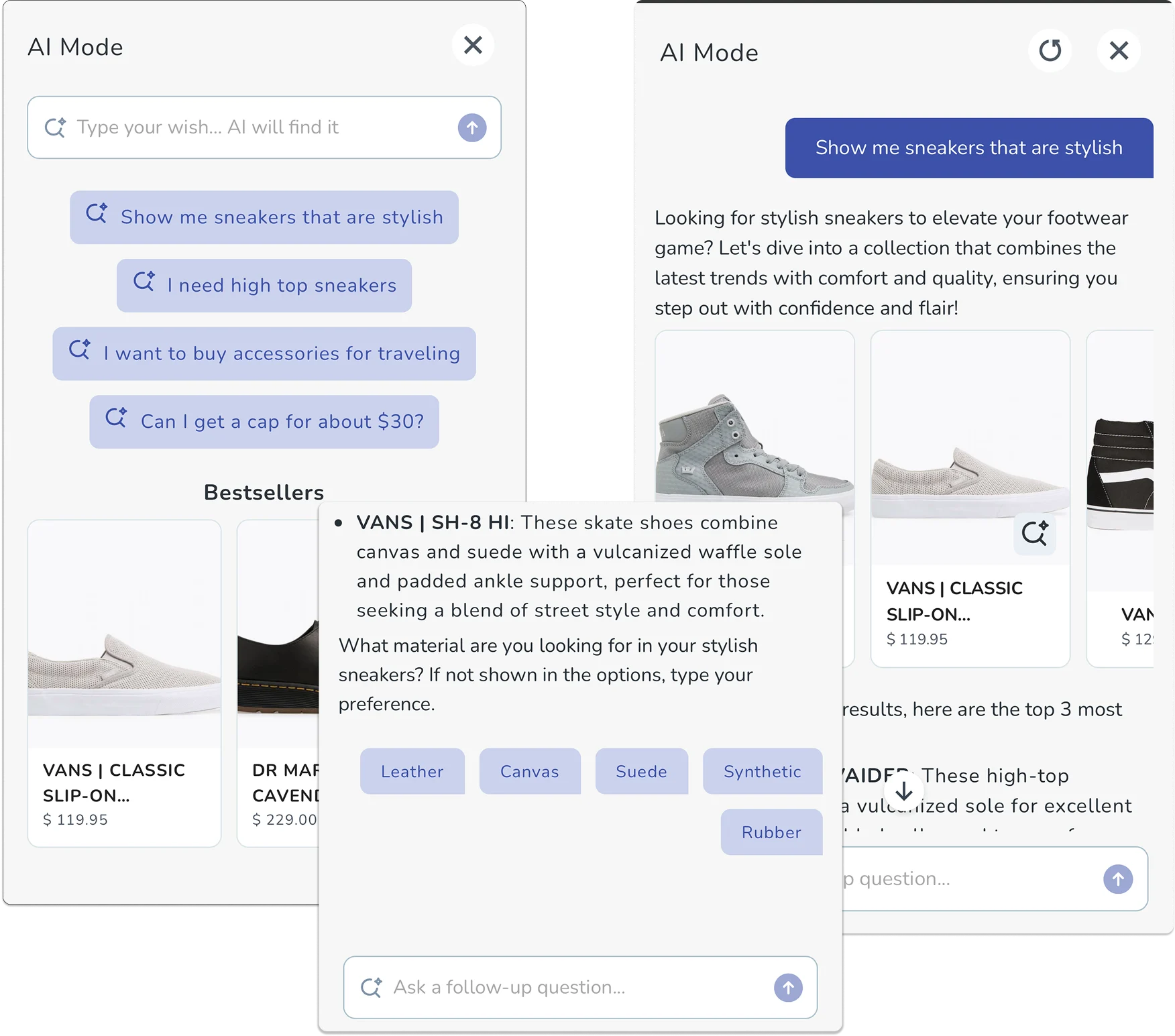
Alhena is the strongest ingestion story outside the enterprise tier, and its documentation is the most honest in the category about what it parses. Published sources include PDF via pdfminer, CSV via pandas, JSON-LD and Schema.org structured data, images, Google Drive folders, Confluence, Notion, Slack, and helpdesk ticket imports from Zendesk, Freshdesk, and Gorgias. It also connects to ERP or CPQ systems and layers guided selling on top using a product knowledge graph holding valid attribute combinations.
Credit where it's due: Alhena's own writing concedes that "AI shopping assistant" covers at least four distinct jobs and most tools are strong in one or two. That's a more candid framing than the rest of the category manages.
The Provenance Test: ingestion, broad published parser list including PDF. Provenance, grounded answers, per-answer source linking [Source]. Failure behavior, undocumented. Decision scope, discovery through comparison and cart action, guided selling on the enterprise tier. Action layer, ERP and CPQ connections. Data perimeter, vendor cloud.
Limitations: PDF extraction runs through pdfminer, which pulls text well and handles tables and scanned pages far less reliably. If your specs live in tables or scans, test that specifically before committing. Deployment is vendor cloud only, so self-hosting is off the table for procurement teams that require it. The free tier caps at 25 conversations a month, which is a demo rather than a pilot.
Best for: DTC and mid-market stores that want discovery and support in one tool and have documentation in text-based files.
5. Rebuy: merchandising and personalization for Shopify
| Reads documents? | Rating | Pricing | Min. commitment | Deployment | Founded | HQ |
|---|---|---|---|---|---|---|
| Catalog only (Source) | 4.7/5 (741 reviews) | Usage-based (Source) | Monthly | Shopify app | 2017 | USA |
Sources: Rebuy Shopify App Store listing, Rebuy pricing page
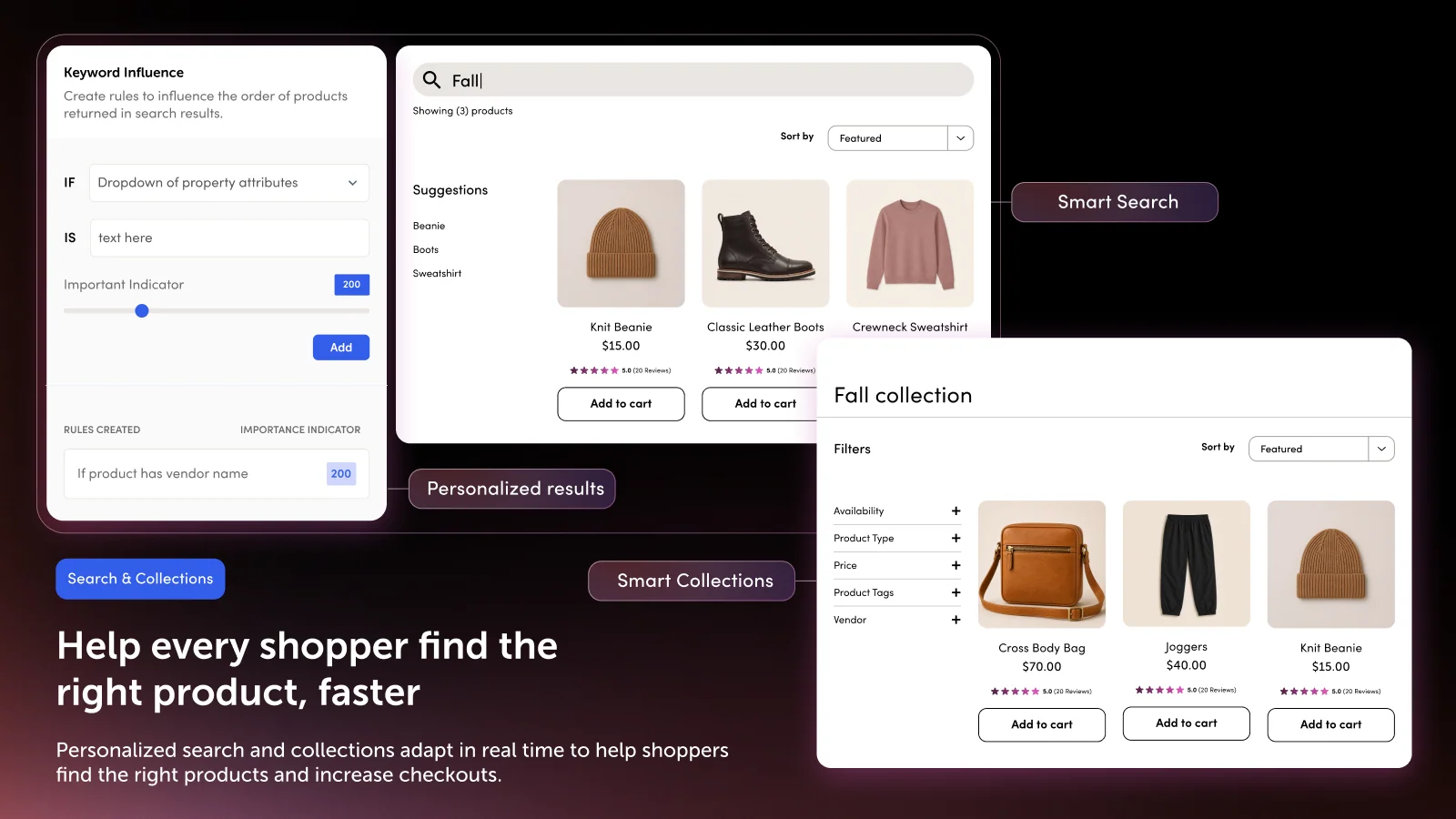
Rebuy sits in the merchandising and personalization lane: product recommendations, cart upsells, and post-purchase offers driven by behavioral data. It's well established with Shopify merchants and it does that job properly.
The Provenance Test: ingestion, catalog and behavioral data, no document parsing. Provenance, not applicable to recommendation logic. Failure behavior, not applicable. Decision scope, recommendation and cart action. Action layer, native Shopify actions. Data perimeter, vendor cloud.
Limitations: Rebuy answers "what else might you want" rather than "will this work for my application," so it can't touch technical pre-purchase questions. Shopify only. Pricing scales with order volume, which gets expensive as you grow.
Best for: Shopify merchants whose gap is average order value rather than pre-purchase technical questions.
6. Nobi: site search and shopping chat in one platform
| Reads documents? | Rating | Pricing | Min. commitment | Deployment | Founded | HQ |
|---|---|---|---|---|---|---|
| Catalog and web content | no public profile | $25/month base (Source) | Monthly, usage-based, no long-term contract (Source) | Vendor cloud | 2023 | N/A |
Sources: Nobi on ecommerce AI assistants, Nobi on Athos Commerce alternatives
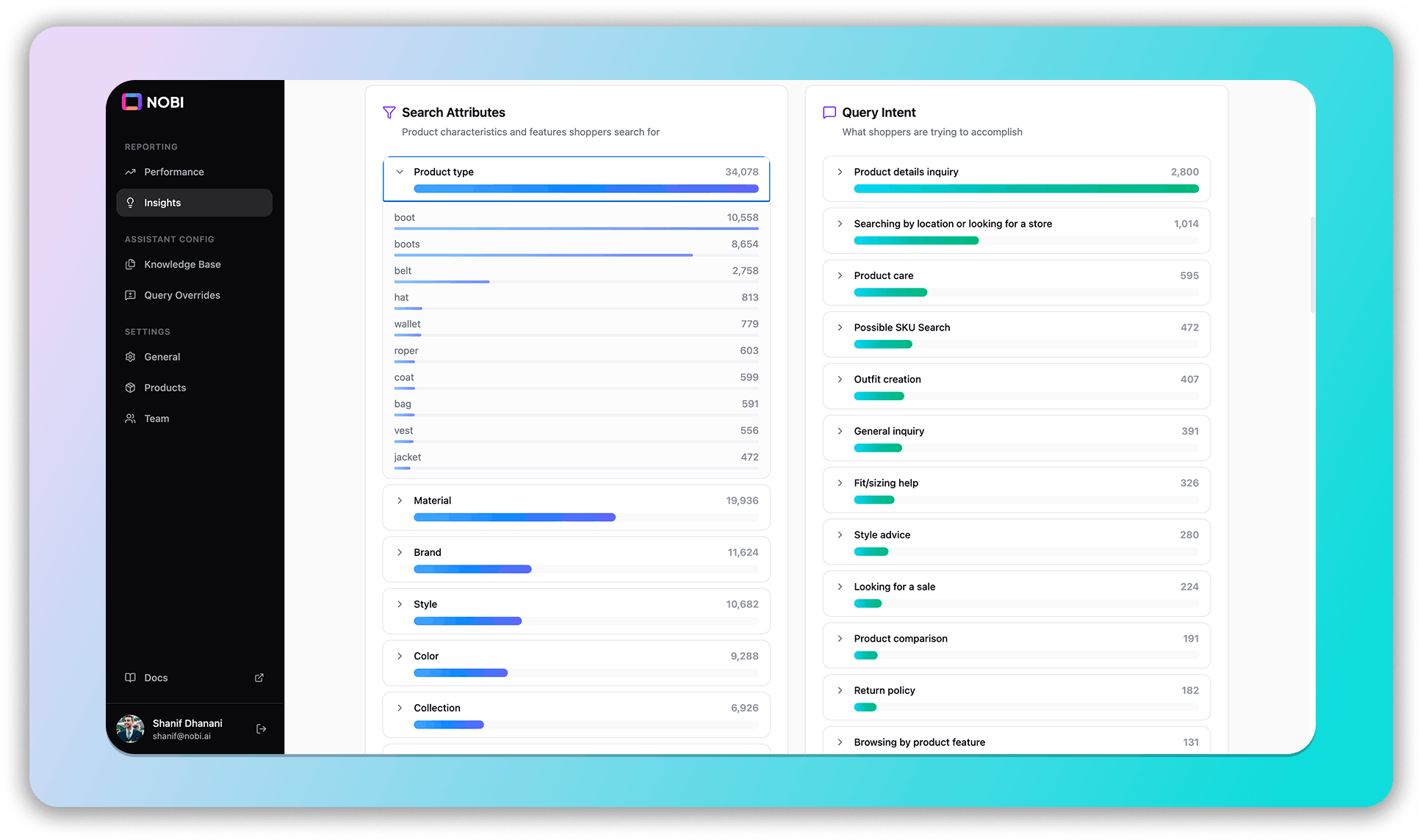
Nobi combines site search and shopping-assistant chat, which removes the usual problem of running two tools that disagree about your catalog. For a mid-market store replacing an ageing search vendor, consolidating both is a reasonable reason to shortlist it.
The Provenance Test: ingestion, catalog and site content, document parsing not published [Source]. Provenance, undocumented. Failure behavior, undocumented. Decision scope, search and product discovery. Action layer, catalog actions. Data perimeter, vendor cloud.
Limitations: Nobi publishes little verifiable third-party review data, so due diligence takes longer. We could not find a published parser list, so treat any document-reading claim as unverified until you see it work on your own files.
Best for: mid-market stores replacing site search and chat at the same time.
7. Tidio (Lyro): conversational AI for SMB support
| Reads documents? | Rating | Pricing | Min. commitment | Deployment | Founded | HQ |
|---|---|---|---|---|---|---|
| Catalog and web content | 4.6/5 (1,948 reviews) | Free tier, Lyro paid add-on | Monthly | Vendor cloud | 2013 | Szczecin, Poland |
Sources: Lyro data sources documentation, Tidio on AI shopping assistants
Tidio's Lyro is a support-first agent that also guides customers toward products inside chat. Setup is quick and the free tier is a real one, which explains its popularity with smaller stores.
The Provenance Test: ingestion, website scraping, manual Q&A pairs, CSV import on the Plus plan, and Zendesk help center articles. No PDF manual parsing. Provenance, undocumented. Failure behavior, undocumented. Decision scope, support answers and light product guidance. Action layer, Lyro Actions for order lookups. Data perimeter, vendor cloud.
Limitations: the published data sources are web pages, Q&A pairs, CSVs, and help center articles, so your PDF manuals stay unreadable unless somebody converts them by hand. File import sits behind the Plus plan. Lyro is priced as an add-on, so the headline free tier understates real cost.
Best for: SMB stores where support volume is the bigger problem and product questions are simple.
Group 3: search and discovery infrastructure
8. Constructor: discovery ranking for large retailers
| Reads documents? | Rating | Pricing | Min. commitment | Deployment | Founded | HQ |
|---|---|---|---|---|---|---|
| Catalog and behavioral data | Enterprise, limited public reviews | On request | Annual, enterprise | Vendor cloud | 2015 | San Francisco, USA |
Sources: Constructor AI shopping agent
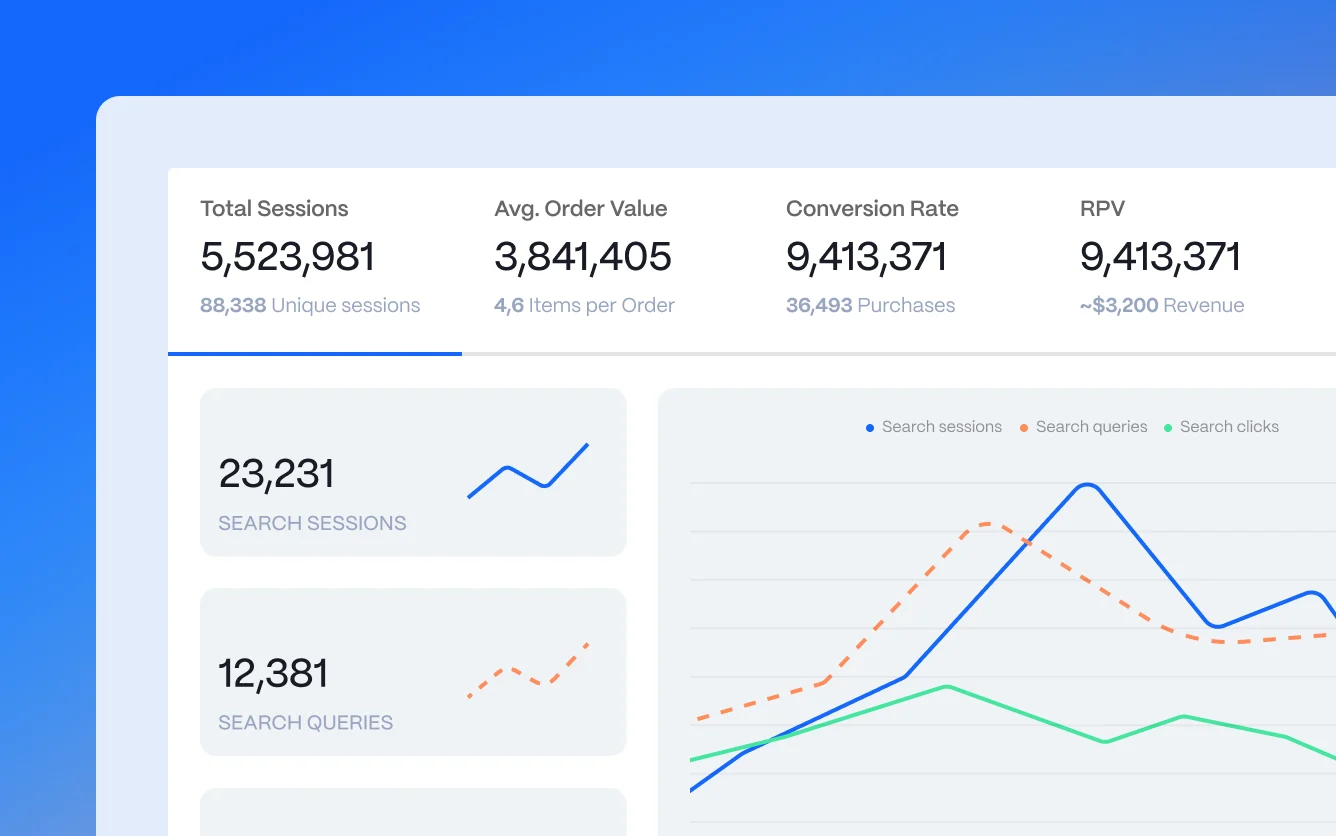
Constructor layers an AI shopping agent on top of search and browse, tuned against behavioral signals so results improve with traffic. At high SKU counts and high traffic that feedback loop is a real advantage.
The Provenance Test: ingestion, catalog and behavioral data. Provenance, not applicable to ranking logic. Failure behavior, returns results rather than declining. Decision scope, search and discovery. Action layer, catalog actions. Data perimeter, vendor cloud.
Limitations: the model needs traffic volume to perform, so smaller stores see less benefit. Enterprise contracts and implementation timelines. It ranks and retrieves products rather than answering questions from documentation, so a spec question grounded in a manual falls outside what it's built to do.
Best for: large retailers with high SKU counts and enough traffic to train the ranking model.
9. Algolia: search infrastructure for teams with engineers
| Reads documents? | Rating | Pricing | Min. commitment | Deployment | Founded | HQ |
|---|---|---|---|---|---|---|
| Catalog only, documents are DIY | 4.5/5 (453 reviews) | Free tier, then usage-based | Monthly | Vendor cloud, API-first | 2012 | San Francisco, USA |
Sources: Algolia vs Klevu comparison, G2 comparison data
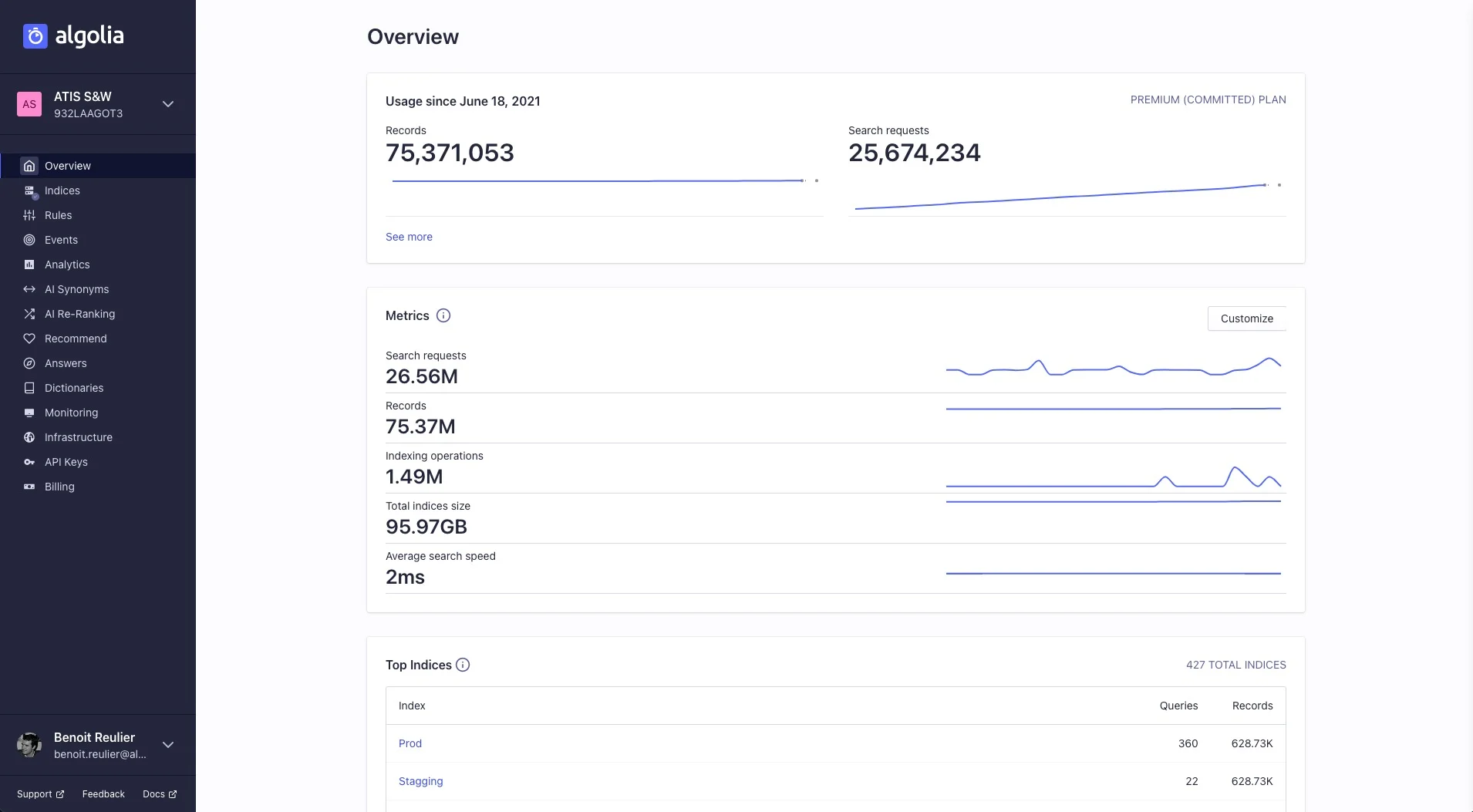
Algolia is search infrastructure with an AI discovery layer on top, and it's the most flexible option here for a team with developers. You index JSON records and control ranking precisely.
The Provenance Test: ingestion, structured JSON records you supply. Document text can be indexed, but you build the extraction pipeline yourself. Provenance, whatever you build. Failure behavior, whatever you build. Decision scope, search and retrieval. Action layer, API-driven, built by your team. Data perimeter, vendor cloud with regional options.
Limitations: the flexibility is the cost. Algolia gives you primitives, and turning them into a document-grounded assistant means building parsing, chunking, retrieval, and citation yourself, which is a multi-month engineering project. Without in-house engineers it's the wrong shape of tool.
Best for: teams with engineering capacity who want to own the assistant layer rather than buy it.
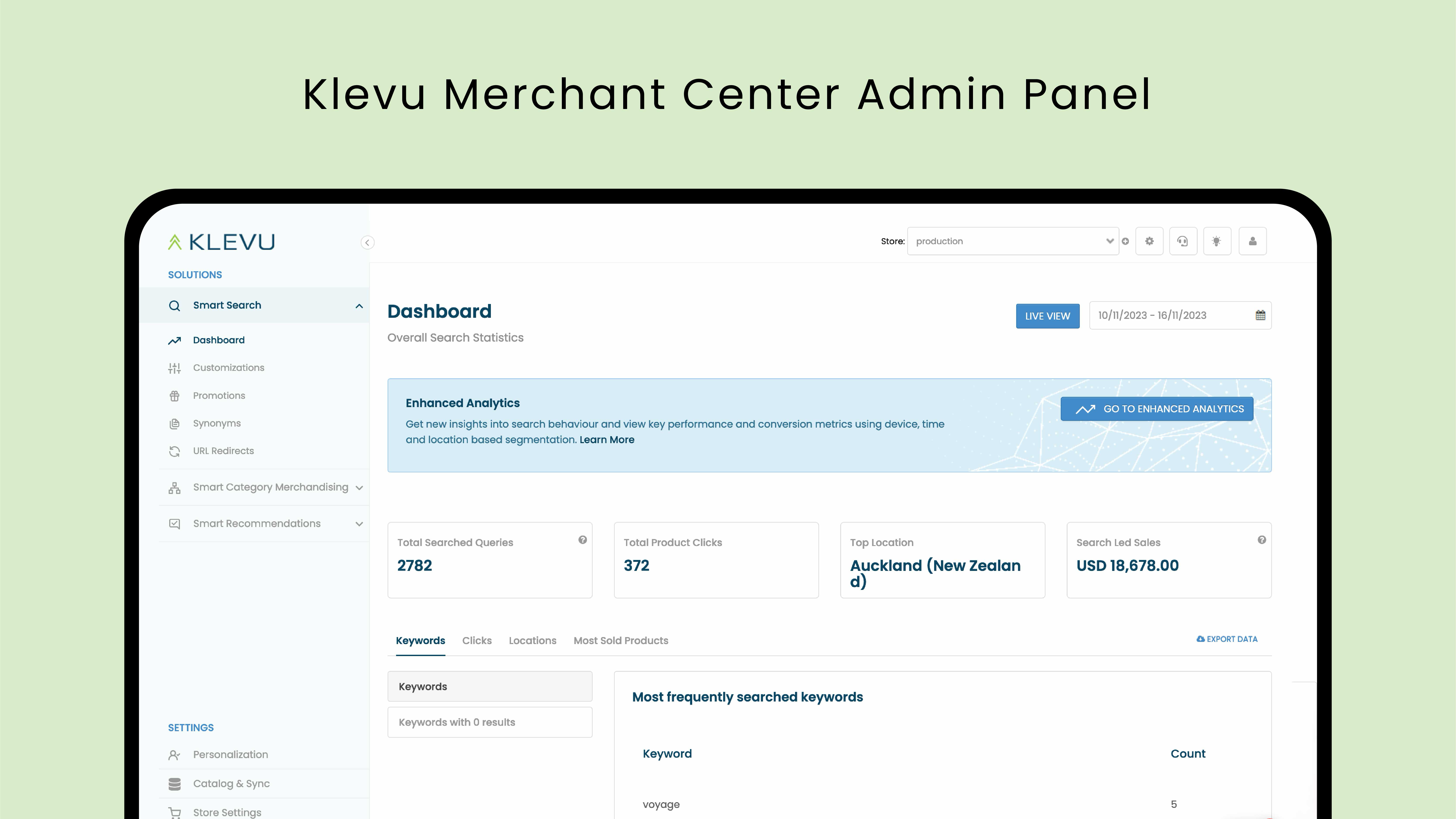
10. Klevu (now Athos Commerce): search and discovery for high-SKU retail
| Reads documents? | Rating | Pricing | Min. commitment | Deployment | Founded | HQ |
|---|---|---|---|---|---|---|
| Catalog only | 3.5/5 (3 reviews) | On request | Annual | Vendor cloud | 2013 | Helsinki, Finland |
Sources: Klevu indexing API documentation, Klevu catalog browser support, G2 comparison
Klevu built semantic search for merchandisers rather than developers, with genuine NLP behind it, and it sits between Algolia's developer tooling and Constructor's enterprise tier. Note that Searchspring and Klevu now operate as Athos Commerce, so check which entity you're contracting with.
The Provenance Test: ingestion, product catalog data and attributes via indexing APIs. No document parsing. Provenance, not applicable. Failure behavior, returns search results. Decision scope, search and discovery. Action layer, catalog actions. Data perimeter, vendor cloud.
Limitations: the product is strongest in fashion and FMCG, where buying decisions turn on attributes rather than documentation, and weakest on technical catalogs for the same reason. The Athos Commerce merger adds roadmap uncertainty worth asking about directly. Catalog indexing only, so manuals stay outside the index.
Best for: fashion and FMCG catalogs with high SKU counts and attribute-driven buying.
How to evaluate at every stage
Stage 1, building the shortlist. Most buyers start from a listicle, including this one. Better starting point: pull the last 50 pre-purchase questions your team answered by phone or email, then ask of each tool whether it could have answered that specific question. The list writes itself and it's yours rather than ours.
Stage 2, the demo. Vendors demo on vendor data. Bring 10 of your own hardest questions, and include one whose answer genuinely isn't in your documentation. What the tool does with that eleventh question tells you more than the other ten combined.
Stage 3, checking the ingestion claim. Ask for the parser list in writing. "Trained on your content" covers everything from a full document pipeline to a website crawler. Ask specifically about tables and scanned pages, because that's where spec data hides.
Stage 4, auditing an answer. Ask the tool where an answer came from. If it can't show you the source document, you have no way to debug a wrong answer in production and no way to defend a right one when a buyer disputes it.
Stage 5, scoping the action layer. Separate reading from doing. Checking stock, reserving inventory, and generating a quote are three integrations with three timelines, and vendors quote them as one line item.
Stage 6, procurement and legal. Raise data residency in week one. Tools that can't deploy inside your own cloud die in legal review after you've spent six weeks falling in love with them, and that's a self-inflicted wound.
How to choose
Four questions, in this order:
- Where do your buyers' answers live? If they're in your product records, most tools on this list work. If they're in manuals, datasheets, and compatibility tables, only the top of the ingestion column is worth your time.
- What happens when it's wrong? For a technical catalog, a confidently wrong spec costs you more than a missed upsell. Weight provenance and failure behavior accordingly.
- Does it need to act, or just answer? Answering needs an index. Checking stock and quoting need integrations, and those change the budget and the timeline.
- Who has to approve the data arrangement? If legal or procurement gets a vote, sort by deployment options before you look at features.
What it costs in 2026
Three tiers, and the gap between them is wide.
App-store tools: free entry tiers, then roughly $200 to $1,200 a month. Alhena's published tiers run $239, $599, and $1,199, with a free tier capped at 25 conversations. Tidio and Rebuy sit in similar territory with usage-based scaling. Setup is days.
Enterprise platforms: Zoovu, Threekit, Constructor, and Klevu price on request, annually, typically in five to six figures a year with implementation on top. Expect a quarter or more before it's live.
Platform builds: a setup fee plus usage, where usage is closer to direct API cost than a per-seat markup. Bridge works this way. Higher upfront cost than an app, lower recurring cost than enterprise licensing, and you own the deployment. It only pays off if your document corpus is large enough to justify the build.
One cost nobody quotes: document preparation. If a tool needs manual tagging, budget for the person doing it, every month, forever.
Conclusion
Score any tool on the six signals before you look at a pricing page, and weight the first one hardest. What the assistant can read sets the ceiling on every answer it will ever give your buyers.
If your answers live in a few hundred web pages, plenty of options on this list will serve you well and cost very little. If they live in thousands of manuals and spec sheets, and a wrong answer costs you a customer's trust, you're shopping in a much smaller part of this market. That's the part we work in, and you can see how we approach it in our AI development case studies or by looking at what we build for SaaS and product teams.
Why trust this page
Produced by Brocoders, an AI-native software development company in Tallinn, Estonia. AI-native development means AI embedded at every layer of delivery, with senior architects owning the architecture. We build document-grounded assistants on our own Bridge platform, including AskCW.ai for Compressor World, and we sell AI development and integration services, so read our Bridge entry with that in mind.
Verified per tool: public product page, documented data sources and file types where published, G2 or Capterra profile where one exists, published pricing where available.
Not verified: vendor performance claims, unpublished customer metrics, and any review count or founding detail marked [NEEDS SOURCE] above. Where a vendor publishes no parser list, we say so rather than assuming.
Review data, pricing tiers, and feature sets change over time. Verify current data directly on each vendor's G2 profile and website before shortlisting.
Frequently Asked Questions
Site search retrieves products matching a query. An assistant answers a question, which may involve reading documentation, comparing options, and checking compatibility before it recommends anything. The practical test: ask "which model handles 50 CFM at 175 PSI for food-grade use." Search returns products with those words nearby. An assistant reads the spec sheet and answers.
We evaluated 24 tools against six weighted criteria in July 2026 and kept 10. Ingestion depth carried the most weight at 30%, because for technical catalogs everything else depends on what the assistant can read. We verified against vendor documentation, G2 and Capterra profiles, and published pricing pages rather than other listicles. Brocoders compiled the list and Bridge is our product, disclosed at the top.
App-store tools start free and run roughly $200 to $1,200 a month. Enterprise platforms price on request, generally five to six figures a year plus implementation. Platform builds charge a setup fee plus usage. The number that catches people out is document preparation, so ask whether manual tagging is required before you compare monthly fees.
Only if it parses those files. Ask for the published parser list, and ask specifically about tables and scanned pages, since spec data usually lives in tables that text extractors drop. Alhena publishes PDF support via pdfminer. Bridge parses PDF, DOCX, TXT, XML, and SQL natively. Tidio's Lyro reads web pages, Q&A pairs, CSVs, and help center articles, so PDFs need converting first.
It depends entirely on a design decision the vendor made, and most don't document it. The two behaviors are declining to answer, or generating a plausible-sounding response from adjacent data. For technical products the second one damages buyer trust in your whole catalog, so test it deliberately during the demo with a question you know has no documented answer.
A few options deploy inside your own AWS, Azure, or GCP environment, or on-premise, which keeps catalog and conversation data inside your perimeter. Bridge supports this. Most tools on this list are vendor cloud only, sometimes with regional hosting choices. If procurement or legal reviews vendors, confirm the deployment model before evaluating features, because this is where shortlists collapse late.
Comparing tools on how well they converse. Fluency is table stakes and every vendor demos well. What separates them is what they can read, whether answers cite sources, and how they behave when the data runs out. Score those three first.