
The problem with most conversational AI shortlists
The global conversational AI market is projected to grow past $50 billion by the end of the decade, and most of that spend is going toward systems that answer confidently and incorrectly. A chatbot that hallucinates a return policy or a voice agent that mishears an account number does more damage than no automation at all. The companies worth hiring in 2026 pair language understanding with production discipline: intent handling that survives edge cases, retrieval grounded in your own documents, integration with the back end systems that actually complete a task, and analytics that show where the bot is still guessing.
We compiled this list of 10 conversational AI development companies to help you separate the ones with real production work from the ones with a good demo. Brocoders, our own team, is on this list. We build conversational AI as part of our AI product development work, including a technical assistant for an e-commerce compressor retailer that answers from 4,000 indexed manuals with every answer traceable to a source. We disclose that upfront and hold ourselves to the same evaluation framework as everyone else below, weaknesses included.
The Production Discipline Test: how we evaluated every company on this list
Most comparisons of conversational AI vendors rank by client logos or funding raised. Neither tells you whether the bot will hallucinate a policy to your customer next Tuesday. We built the Production Discipline Test around five signals that separate a working conversational AI system from an impressive demo.
Retrieval grounding. Does the system answer from your actual documents, product data, or knowledge base, with a traceable source for every claim, or does it lean on the model's general training and hope it lands close enough?
Failure handling. What happens when the user asks something the bot cannot answer? Good systems escalate cleanly to a human or a fallback flow. Weak systems either loop the user or, worse, answer anyway.
Back end integration. Can the conversational layer actually complete a task, check an order status, reschedule an appointment, pull a real account balance, or does it stop at answering questions?
Multimodal and channel coverage. Does the vendor handle voice, chat, and structured input (like an uploaded photo or a VIN scan) in one system, or does each channel need a separate build?
Post-launch visibility. Can you see where the bot is failing after launch? Analytics that surface unanswered questions and low-confidence responses are what let a team actually improve the system instead of guessing.
Score a vendor against these five signals during your first call. A partner who cannot explain their retrieval architecture in plain language on that call will not build one that holds up under production traffic.
Quick comparison table
| Company | Headquarters | Founded | Model | Best for |
|---|---|---|---|---|
| Brocoders | Tallinn, Estonia | 2011 | Custom development | AI-native product teams building a conversational layer into a SaaS or e-commerce platform |
| Master of Code Global | Redwood City, USA | 2004 | Custom development | Enterprise brands needing an established chatbot partner with 1,000+ delivered projects |
| BotsCrew | San Francisco, USA | 2016 | Custom development | Companies wanting a custom AI agent built without adopting a large platform |
| PolyAI | London, UK and New York, USA | 2017 | Platform + custom voice agents | Enterprises replacing phone-line IVR with a conversational voice agent |
| Yellow.ai | San Mateo, USA | 2016 | Enterprise platform | Brands running high-volume, multi-channel customer and employee conversations |
| Cognigy | Düsseldorf, Germany | 2016 | Enterprise platform | Large enterprises needing strict governance and SAP or telecom integrations |
| Kore.ai | Orlando, USA | 2013 | Enterprise platform | Banking, healthcare, and retail enterprises with complex multi-turn conversation needs |
| Ada | Toronto, Canada | 2016 | AI customer service platform | Support teams that want an AI agent handling ticket volume with minimal engineering lift |
| Deepgram | San Francisco, USA | 2015 | Voice AI infrastructure | Developer teams building their own voice product on top of speech-to-text and text-to-speech APIs |
| Markovate | Princeton, USA | 2016 | Custom development | Mid-market companies wanting custom voice and workflow automation on a moderate budget |
Brocoders
Overview: Brocoders is an Estonia-based, AI-native software development company that has shipped 70 products since 2011, and holds a 5.0/5.0 Clutch rating across 30 verified reviews. The team builds conversational AI as one part of a broader AI product development practice, working alongside SaaS platform builds and MVP development rather than treating chatbots as a standalone service line.
Core focus:
- Custom conversational AI agents embedded into existing e-commerce, SaaS, and internal platforms
- Retrieval-augmented generation delivered through Bridge, Brocoders' own AI-agent platform, grounded in the client's product manuals, documentation, or knowledge base
- End-to-end delivery: architecture, integration with back end systems, and ongoing iteration after launch
- Delivered through an AI-augmented team of senior architects who own the architecture while AI accelerates the build
Real project examples:
- Compressor World (USA): Brocoders built AskAC.ai on Bridge, a technical assistant embedded into Compressor World's e-commerce experience that answers industrial compressor questions from 4,000 indexed product manuals and spec sheets, with every answer traceable to a source and no hallucinations. The system offloads routine support requests and converts researchers into quote requests.
- An automotive research platform (US, name withheld): Brocoders replaced the client's static VIN reports with a single Bridge-powered conversational interface that supports session memory, voice input, and image-based VIN scanning, surfacing vehicle history summaries, recall lookups, and depreciation data as the platform's primary acquisition funnel.
Strengths:
- Traceable retrieval architecture: Bridge grounds every response in the client's own data and cites its source, the same mechanism behind the AskAC.ai assistant, instead of generating from general model knowledge
- Multimodal input handled natively through Bridge, shown in the automotive research platform's voice and image-based VIN scanning built into the same conversational flow
- AI-augmented delivery model keeps senior architects on the design decisions while AI accelerates implementation, rather than routing the build through a junior offshore team
Weaknesses / considerations: Brocoders has not yet published a dedicated conversational AI case study page with results metrics for AskAC.ai or the automotive research platform, so buyers evaluating purely on public benchmark data will need to request those details directly rather than finding them on the site.
Key stats:
- Founded: 2011
- Headquarters: Tallinn, Estonia
- Clutch reviews: 30 verified
- Average rating: 5.0/5.0
- Team composition: approximately 60% senior engineers
- Distinction: the only company on this list building conversational AI as part of a broader AI-native product practice rather than as a standalone chatbot service.
Fit for conversational AI projects: Best for founders and product teams who need a conversational layer built into an existing platform, with the same senior team handling the surrounding product work. Companies that specifically want an off-the-shelf enterprise platform with a vendor support desk should look at Kore.ai or Cognigy instead.
Master of Code Global
Overview: Master of Code Global has operated since 2004 and holds a 4.7/5.0 Clutch rating across 35 verified reviews, making it one of the most established chatbot and conversational AI specialists on this list. The company has delivered over 1,000 projects for brands including Burberry, Tom Ford, T-Mobile, and Dr. Oetker.
Core focus:
- Custom chatbot and conversational AI development across retail, telecom, and hospitality
- Generative AI integration into existing customer service and marketing workflows
- Voice and chat channel builds for large consumer brands
Real project examples:
- Boost.ai partnership work: Master of Code has contributed conversational AI implementations for enterprise brands seeking to automate customer service at scale, drawing on 20 years of chatbot delivery experience across retail and consumer sectors.
Strengths:
- 20 years of continuous chatbot delivery, longer than any other custom development shop on this list
- Established relationships with recognizable consumer brands including Burberry, Tom Ford, and T-Mobile
- 1,000+ delivered projects gives the team pattern-matched experience across industries
Weaknesses / considerations: Detailed public case studies with specific before-and-after metrics are harder to find than the client list itself, which makes it more difficult to verify outcome claims without a direct conversation with the sales team.
Key stats:
- Founded: 2004
- Headquarters: Redwood City, USA
- Clutch reviews: 35 verified
- Average rating: 4.7/5.0
- Projects delivered: 1,000+
- Distinction: the longest continuously operating custom chatbot development shop on this list.
BotsCrew
Overview: BotsCrew, founded in 2016 and headquartered in San Francisco, holds a 4.8/5.0 Clutch rating across 39 verified reviews and has been ranked among Clutch's top chatbot development companies for nine years running. The team builds custom AI agents using GPT-4o, Llama 3, and retrieval-augmented generation without requiring clients to adopt a large enterprise platform.
Core focus:
- Custom AI agent and chatbot development, built without a proprietary platform lock-in
- RAG and NLP implementations for support automation and internal tools
- Production clients across retail, automotive, and nonprofit sectors
Real project examples:
- Honda and Adidas: BotsCrew has delivered production conversational AI systems for major consumer brands, applying custom NLP pipelines rather than a templated platform response.
- American Red Cross: the team built a conversational AI implementation supporting a nonprofit's public-facing engagement, demonstrating the same technical approach applied outside a purely commercial use case.
Strengths:
- Nine consecutive years ranked among Clutch's top chatbot companies, a rare consistency signal in a fast-moving category
- Platform-independent builds mean clients are not locked into a vendor's proprietary infrastructure
- Client roster spans consumer, automotive, and nonprofit sectors, showing range beyond one industry vertical
Weaknesses / considerations: As a fully custom development shop without a packaged platform, ongoing maintenance and iteration after launch depend on continuing the engagement with BotsCrew's team rather than a self-service admin panel.
Key stats:
- Founded: 2016
- Headquarters: San Francisco, USA
- Clutch reviews: 39 verified
- Average rating: 4.8/5.0
- Distinction: ranked a top chatbot development company by Clutch for nine consecutive years.
PolyAI
Overview: PolyAI was founded in London in 2017 by researchers from Cambridge's Machine Intelligence Lab and now operates from London and New York. The company's enterprise voice AI platform handles phone, chat, and SMS conversations for clients including FedEx, Marriott, and Caesars Entertainment.
Core focus:
- Enterprise voice AI that replaces or augments phone-line IVR systems
- Complex, multi-turn conversation handling with intent recognition and topic changes
- Deep integration with CRM and payment systems for real-time task completion
Real project examples:
- Marriott and Caesars Entertainment: PolyAI voice agents handle account management, reservations, and billing inquiries for large hospitality operators, taking calls out of a traditional phone queue.
- FedEx: the platform manages order tracking and support inquiries through a conversational voice interface integrated with FedEx's back end systems.
Strengths:
- Founding team's background in academic dialogue research shows in the platform's handling of topic changes mid conversation
- Deep integrations with payment processors and CRMs let the voice agent complete transactions, not just answer questions
- Enterprise client roster spanning logistics, hospitality, and travel demonstrates cross-industry reliability
Weaknesses / considerations: PolyAI's Clutch profile shows the company's headcount and location but had not accumulated public client reviews at the time of research, so buyers should request reference calls directly rather than relying on third-party review volume.
Key stats:
- Founded: 2017
- Headquarters: London, UK, and New York, USA
- Notable clients: FedEx, Marriott, Caesars Entertainment, PG&E
- Distinction: the enterprise voice AI specialist with the deepest academic dialogue-research pedigree on this list.
Yellow.ai
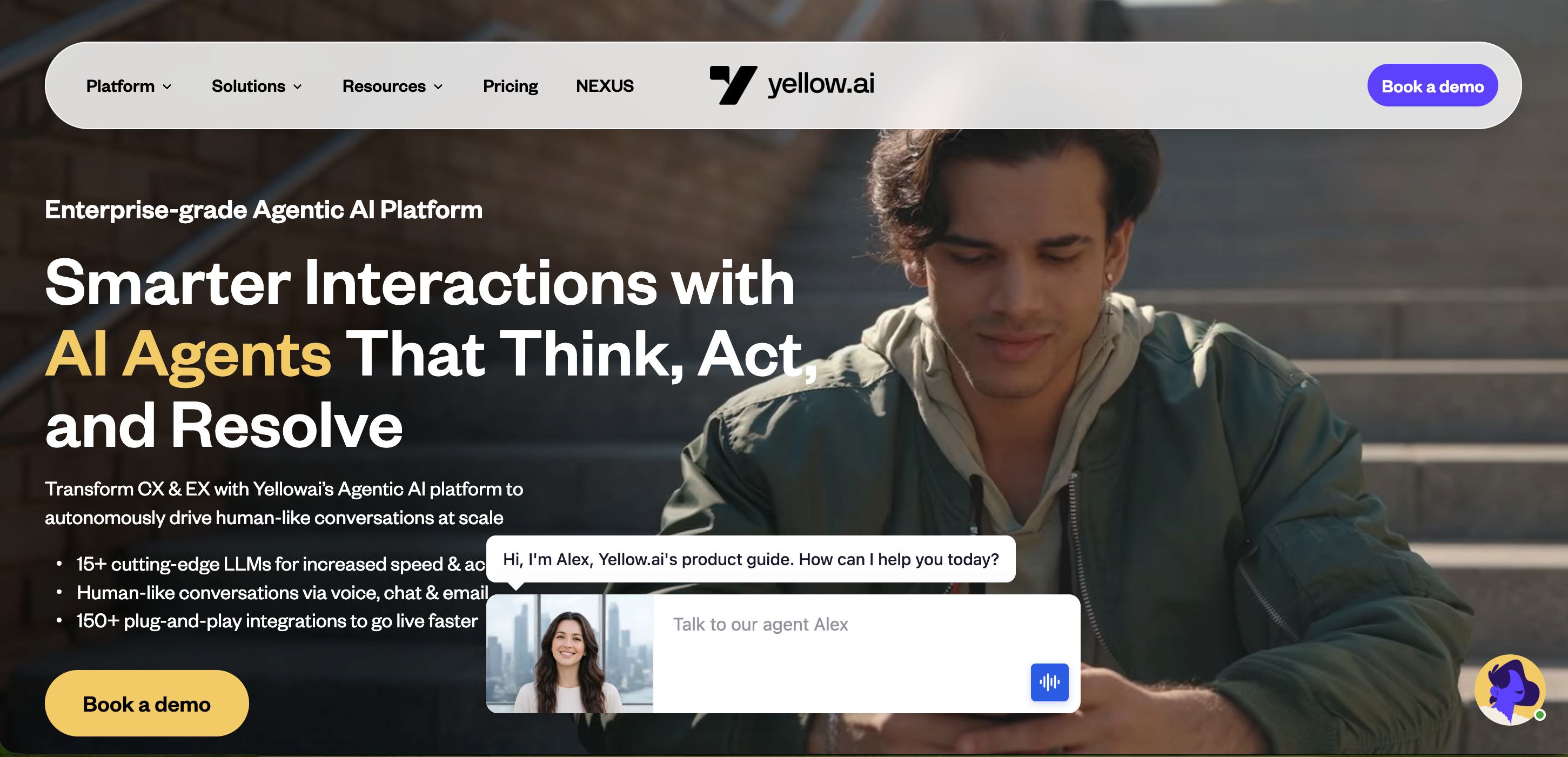
Overview: Yellow.ai was founded in 2016 in Bangalore and is now headquartered in San Mateo, California. The platform holds a 4.4/5.0 G2 rating across 106 reviews and is positioned as a Gartner Magic Quadrant Leader for enterprise conversational AI, offering 150+ pre-built integrations and support for 100+ languages.
Core focus:
- Multi-channel enterprise conversational AI covering customer and employee interactions
- Agentic AI automation with wide language coverage for global brands
- Pre-built integrations designed to shorten deployment timelines
Real project examples:
- Enterprise deployments across telecom, banking, and retail sectors use Yellow.ai's agentic automation to handle high-volume, multi-language customer conversations without a separate build per market.
Strengths:
- 100+ language support makes this a strong fit for brands operating across many regional markets simultaneously
- 150+ pre-built integrations reduce the custom engineering work needed before launch
- Gartner Magic Quadrant Leader recognition provides third-party validation for enterprise buyers who need it for procurement
Weaknesses / considerations: As a platform-first solution, deep customization beyond the pre-built integration library requires working within Yellow.ai's own configuration framework rather than an open custom build.
Key stats:
- Founded: 2016
- Headquarters: San Mateo, USA
- G2 rating: 4.4/5.0 (106 reviews)
- Integrations: 150+
- Distinction: the platform with the widest language coverage on this list, built for global multi-market brands.
Cognigy
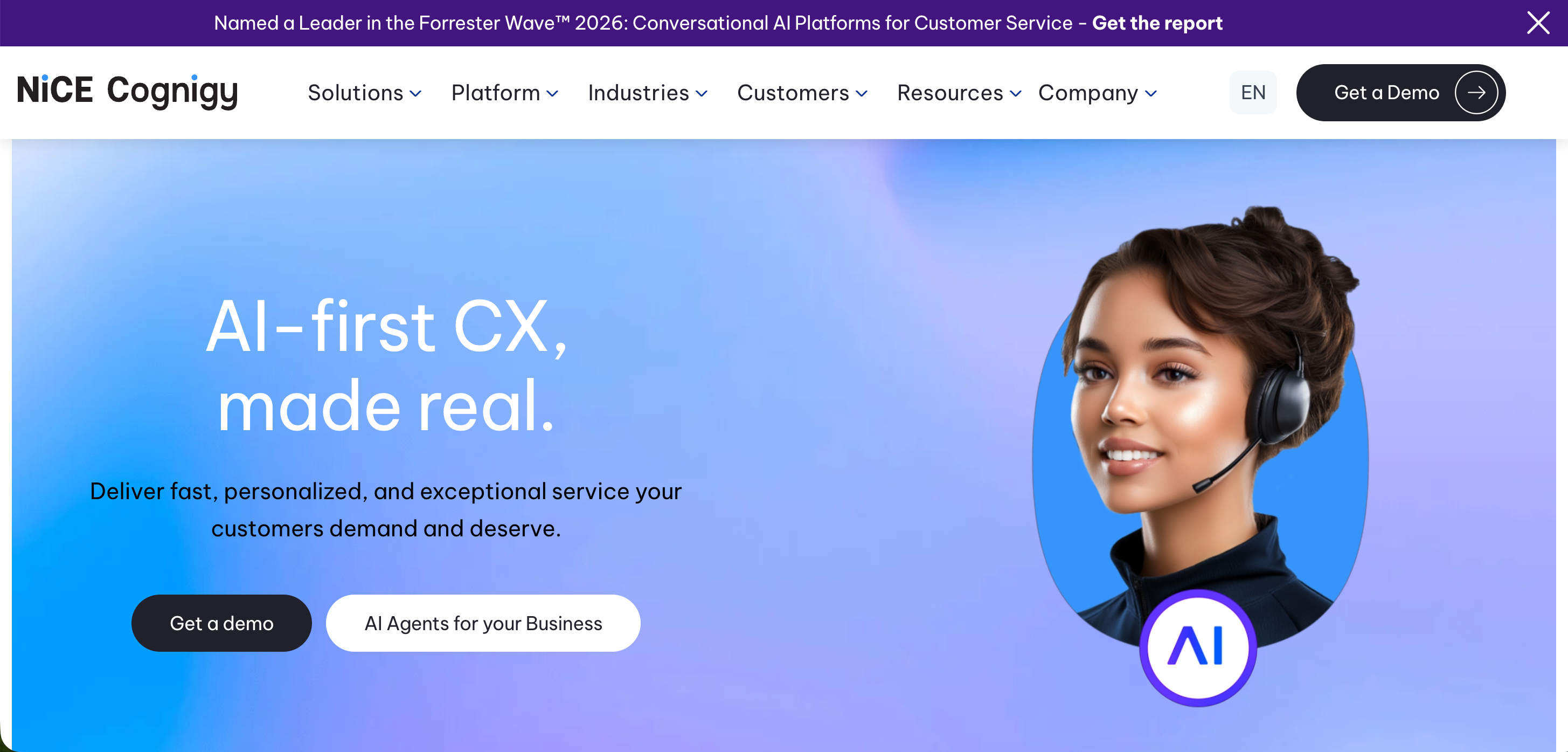
Overview: Cognigy, founded in 2016 in Düsseldorf, Germany, and now part of NiCE, holds a 4.5/5.0 G2 rating and is positioned for large enterprises that need a highly configurable, governance-heavy conversational AI platform.
Core focus:
- Enterprise-grade bot platform with strong governance and data residency controls
- Deep SAP and telecom system integrations
- Configurable conversation logic for complex, regulated industries
Real project examples:
- Enterprise telecom and financial services clients use Cognigy's platform to manage regulated customer interactions where data residency and audit trails are non-negotiable requirements.
Strengths:
- Strong data residency controls make this a natural fit for European enterprises under GDPR or similar regulatory regimes
- Deep SAP integration capability is uncommon among conversational AI platforms
- NiCE acquisition adds enterprise contact center infrastructure behind the conversational layer
Weaknesses / considerations: The platform's configurability and governance features come with a steeper implementation curve than lighter-weight chatbot tools, which pushes typical engagements toward larger enterprise budgets rather than mid-market projects.
Key stats:
- Founded: 2016
- Headquarters: Düsseldorf, Germany
- G2 rating: 4.5/5.0
- Distinction: the platform with the deepest SAP integration and data residency controls on this list.
Kore.ai
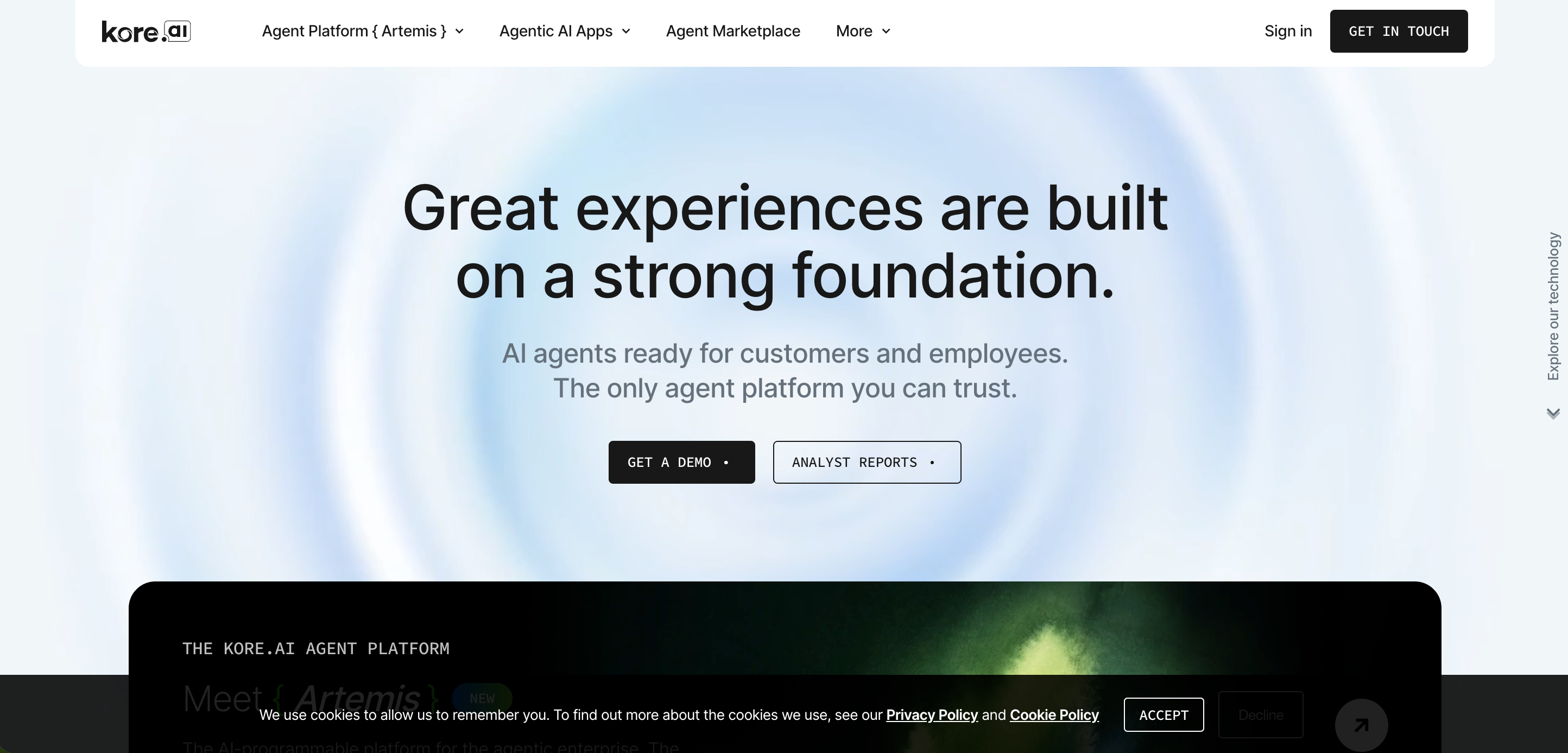
Overview: Kore.ai, founded in 2013 and originally headquartered in Orlando, Florida, established a strategic headquarters in the San Francisco Bay Area in 2026. The platform holds a 4.6/5.0 G2 rating across 466 reviews, the highest review volume of any platform on this list, and is used by large enterprises in banking, healthcare, and retail.
Core focus:
- Enterprise conversational AI covering customer service, IT support, and employee experience automation
- Complex, multi-turn conversation handling with a flexible integration framework
- Agentic AI applications built on the Kore.ai Agent Platform
Real project examples:
- Banking and healthcare enterprises rely on Kore.ai to automate multi-turn customer service and IT support interactions where a single conversation may span several systems of record.
Strengths:
- 466 verified G2 reviews is the largest public review base on this list, giving buyers the most third-party data to evaluate against
- Coverage spans customer-facing and internal employee-facing automation in a single platform
- Recent AllianceBernstein growth investment signals continued platform investment through 2026 and beyond
Weaknesses / considerations: The platform's breadth across customer service, IT support, and employee experience means new customers often need a structured onboarding phase to scope which modules actually apply to their use case, rather than a narrow single-purpose deployment.
Key stats:
- Founded: 2013
- Headquarters: Orlando, USA (strategic HQ added in San Francisco Bay Area, 2026)
- G2 rating: 4.6/5.0 (466 reviews)
- Distinction: the highest review volume of any conversational AI platform on this list.
Ada
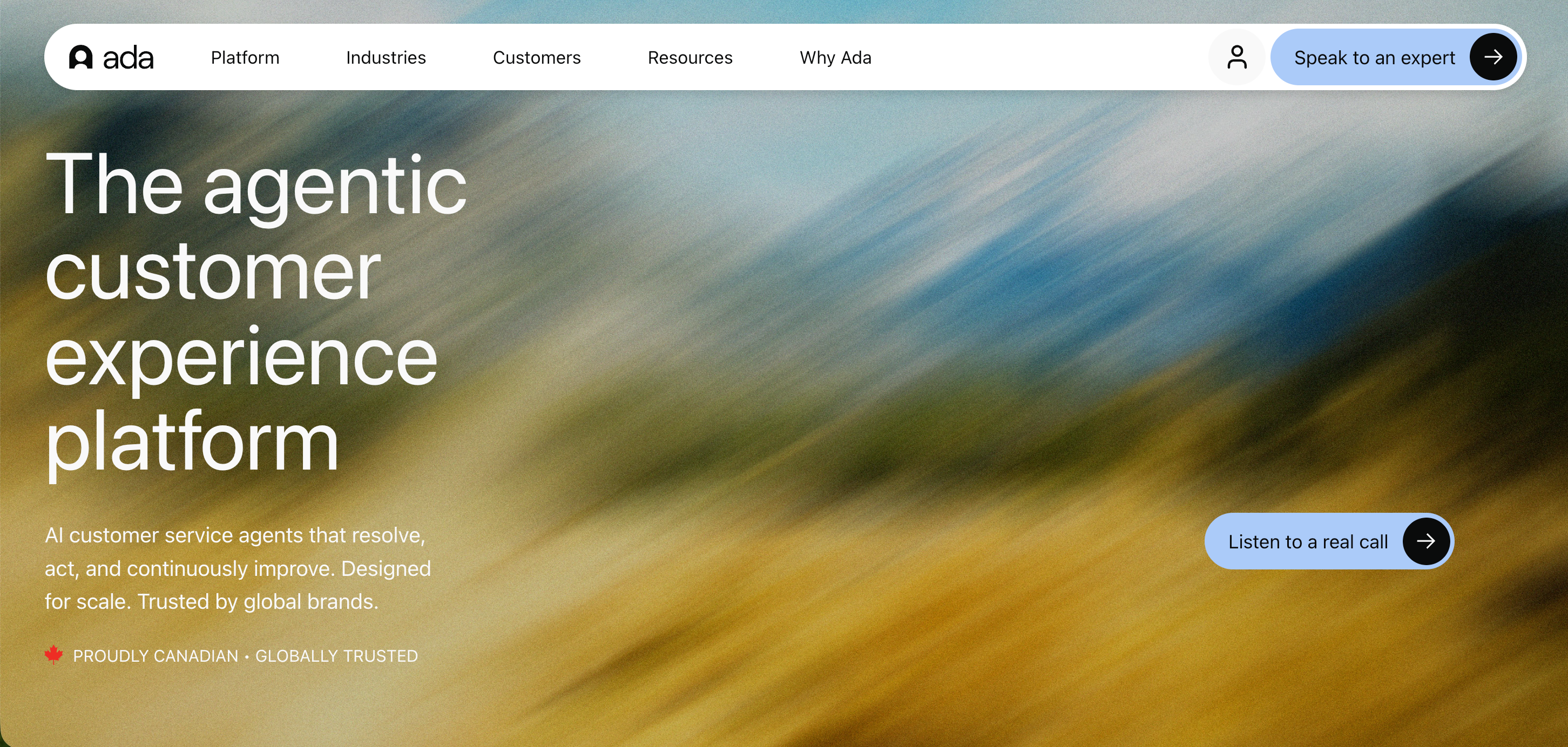
Overview: Ada, founded in 2016 and headquartered in Toronto, holds a 4.6/5.0 G2 rating across 169 reviews, with users scoring the platform 9.4 out of 10 on quality of support. The company operates as an AI platform purpose-built for text-based customer support automation.
Core focus:
- AI customer support agents for text-based ticket deflection and resolution
- Self-service configuration designed for support teams without dedicated engineering resources
- Integration with existing helpdesk and CRM tools
Real project examples:
- Support-heavy consumer brands use Ada to automate first-response ticket handling, escalating only the interactions that genuinely need a human agent.
Strengths:
- 9.4/10 quality-of-support score from users is one of the strongest satisfaction signals on this list
- Designed for support teams to configure directly, reducing dependency on engineering resources for ongoing changes
- $200 million in funding and a $1.2 billion valuation reflect sustained investor confidence in the platform's staying power
Weaknesses / considerations: Ada is optimized specifically for text-based customer support, so companies needing voice automation or a conversational layer embedded into a product experience beyond the support ticket will need a different platform or a custom build.
Key stats:
- Founded: 2016
- Headquarters: Toronto, Canada
- G2 rating: 4.6/5.0 (169 reviews)
- Funding: $200 million raised
- Distinction: the highest user-rated quality of support score on this list.
Deepgram
Overview: Deepgram, founded in 2015 and headquartered in San Francisco, builds research-driven voice AI infrastructure and is positioned as a leading platform for developers building speech-to-text, text-to-speech, and full speech-to-speech products.
Core focus:
- Speech-to-text (STT), text-to-speech (TTS), and speech-to-speech (STS) APIs for developer teams
- Infrastructure layer rather than a finished chatbot or agent product
- Designed for teams that want to build their own conversational product on top of accurate voice transcription
Real project examples:
- Voice-first product teams across contact centers and consumer apps use Deepgram's APIs as the transcription and synthesis layer beneath their own conversational logic.
Strengths:
- Research-driven approach to speech models gives Deepgram a reputation for transcription accuracy in noisy, real-world audio conditions
- API-first design integrates into an existing custom build rather than requiring a full platform migration
- Full speech-to-speech capability lets developers build voice agents without stitching together separate STT and TTS vendors
Weaknesses / considerations: As infrastructure rather than a finished product, Deepgram requires an in-house or partner engineering team to build the actual conversational logic and application layer on top of the APIs.
Key stats:
- Founded: 2015
- Headquarters: San Francisco, USA
- Distinction: the voice AI infrastructure layer of choice for developer teams building a custom conversational product from scratch.
Markovate
Overview: Markovate is a custom development firm serving mid-market companies with voice AI and workflow automation projects, positioned as an accessible entry point for businesses that need conversational AI without an enterprise platform budget.
Core focus:
- Custom voice AI and chatbot builds for mid-market budgets
- Workflow automation paired with conversational interfaces
- Industry applications spanning healthcare, real estate, and retail
Real project examples:
- Mid-market service businesses use Markovate's custom builds to automate appointment scheduling and lead qualification through a conversational front end integrated with existing CRM tools.
Strengths:
- Positioned for mid-market budgets that enterprise platforms like Kore.ai or Cognigy typically price out
- Pairs conversational AI with broader workflow automation rather than treating the chatbot as an isolated feature
- Industry-specific templates shorten the path from kickoff to a working pilot
Weaknesses / considerations: As a smaller custom shop without the scale of the enterprise platforms on this list, Markovate has a thinner public track record of documented case studies with verified outcome metrics.
Key stats:
- Headquarters: Princeton, USA
- Founded: 2016
- Distinction: the mid-market entry point for custom conversational AI on this list, priced below the enterprise platforms.
How to choose a conversational AI development partner
Apply the Production Discipline Test from earlier as a set of questions on your first sales call, not just a framework you read once. Here is how to turn each signal into a diagnostic question.
Ask about retrieval grounding directly. "Walk me through what happens when a user asks a question your system has never seen before." A partner who describes a retrieval pipeline pulling from your actual documents, with a traceable source per answer, understands the hallucination problem. A partner who talks only about model choice or prompt engineering does not.
Ask what the failure path looks like. "Show me what the user sees when the bot cannot answer confidently." Vague answers here predict a bot that either loops frustrated users or, worse, guesses and answers wrong.
Ask which back end systems the conversation actually touches. A conversational layer that only answers questions is a search bar with extra steps. Ask whether the vendor has integrated with a CRM, payment processor, or scheduling system in a past project, and ask for the specific system name.
Ask how you will see the bot's blind spots after launch. "What does your analytics dashboard show me in week two?" If the answer does not include unanswered questions or low-confidence responses, you will be flying blind on where the system needs iteration.
Match the engagement model to your actual need. If you need a conversational layer built into an existing product, a custom development team like Brocoders, Master of Code Global, or BotsCrew fits better than a platform. If you need to stand up multi-channel automation quickly across a large enterprise with existing infrastructure, a platform like Kore.ai, Cognigy, or Yellow.ai gets you there faster. If you are building the product yourself and need the voice layer, Deepgram's infrastructure approach avoids platform lock-in entirely.
What conversational AI development costs in 2026
| Project tier | Typical scope | Estimated cost range |
|---|---|---|
| Simple | Single-channel FAQ bot with basic retrieval from a defined document set | $15,000 to $40,000 |
| Standard | Multi-channel conversational agent with CRM integration and task completion | $40,000 to $120,000 |
| Complex | Multimodal conversational AI (voice, chat, image input) integrated across multiple back end systems, with ongoing iteration | $120,000 to $350,000+ |
Custom development shops typically bill hourly rates between $30 and $150 depending on region and seniority mix, while enterprise platforms like Kore.ai, Cognigy, and Yellow.ai price on subscription or usage-based tiers layered on top of implementation fees. Budget for ongoing iteration after launch, not just the initial build. The teams that treat analytics and retraining as part of the engagement, rather than a one-time delivery, are the ones whose conversational AI still performs well six months after launch.
Conclusion
The conversational AI companies on this list split into two real categories: platforms that get you to a working multi-channel deployment faster, and custom development teams that build a system tailored to your specific product and data. Neither is universally better. An enterprise standing up support automation across 20 markets needs Kore.ai's or Yellow.ai's integration library more than it needs a bespoke build. A product team embedding a conversational layer into an existing SaaS platform, the way Brocoders did for Compressor World's technical assistant and an automotive research platform's vehicle research tool, both built on Bridge, needs a team that can own the architecture end to end.
Whichever path fits your project, run every finalist through the Production Discipline Test from this article before you sign anything: ask about retrieval grounding, failure handling, back end integration, multimodal coverage, and post-launch visibility on the first call. If you are building a conversational layer into an existing product and want a team that treats it as part of the broader engineering work rather than a bolted-on chatbot, our AI product development team at Brocoders can walk you through how we approached these Bridge-powered builds, weaknesses included.
Frequently Asked Questions
A platform like Kore.ai, Cognigy, or Yellow.ai gives you pre-built infrastructure, integrations, and a configuration interface, in exchange for working within that platform's framework and ongoing subscription costs. A custom development company like Brocoders, Master of Code Global, or BotsCrew builds a conversational system tailored to your specific product and data, with more flexibility but a longer initial build and dependency on the development team for future changes.
A simple, single-channel bot with defined retrieval sources typically takes 6 to 10 weeks. A standard multi-channel agent with back end integration runs 3 to 5 months. Complex multimodal systems, like a voice-and-image conversational assistant integrated across multiple systems, can take 5 to 9 months depending on integration complexity.
It depends entirely on the integration depth. A bot connected only to a document retrieval system can answer questions but cannot check an order status or reschedule an appointment. A bot integrated with your CRM, payment processor, or scheduling system can complete those tasks directly in the conversation. Ask any vendor for a specific example of a task their system completed, not just a question it answered.
Ask them to explain their retrieval architecture in plain language and ask for a traceable-source example, where a real answer links back to the specific document or data point it came from. Brocoders' AskAC.ai assistant, built on Bridge, answers from 4,000 indexed manuals with every answer traceable to its source. If a vendor cannot describe an equivalent mechanism, treat hallucination risk as unmanaged.
RAG is a technique where the AI system retrieves relevant information from your own documents or database before generating a response, rather than relying solely on the model's general training data. It matters because it grounds answers in facts you control and makes each answer traceable to a source, which is what prevents the model from confidently making up an answer.
It depends on where your customers already engage. Support-heavy businesses handling written tickets are usually better served by a text-focused platform like Ada. Businesses replacing a phone line, like hospitality or logistics companies, need a voice specialist like PolyAI. Companies wanting one conversational layer across both channels should look at a custom build (Brocoders, BotsCrew) or a multi-channel platform (Yellow.ai, Kore.ai).
Ongoing maintenance and iteration typically run 15% to 25% of the initial build cost annually, covering retraining on new documents, monitoring unanswered questions, and adjusting the conversation flow as your product changes. Vendors who quote a fixed build price with no mention of post-launch iteration are underpricing what it actually takes to keep the system accurate.