
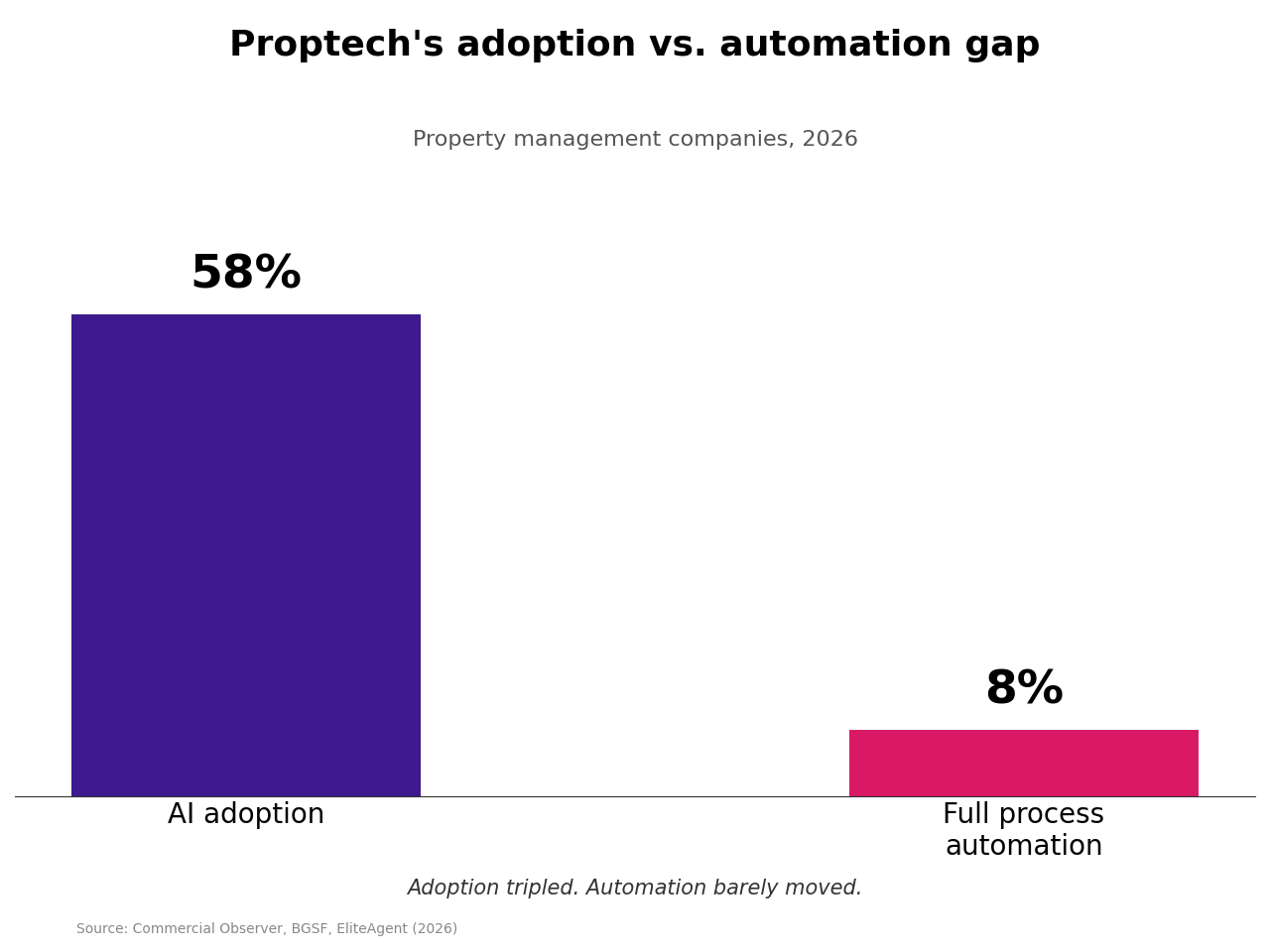
Every proptech trends roundup this year opens with the same number. AI adoption among property management companies jumped from 20% to 58% in a single year. It gets cited as proof the industry turned a corner.
The number that doesn't make the headline: only 8% of those companies have fully automated a single process. Adoption tripled. Automation barely moved.
That gap is the actual story of proptech in 2026.
TL;DR
58% of property management companies have adopted AI, but only 8% have fully automated a single process. The gap comes from change management, legacy system integration, and unclear ROI targets, not the technology itself. The proptech trends worth acting on in 2026 are the ones that close that gap: structured data, honest rollout planning, and software built to connect with what operators already run.
The stat everyone's citing (and the one nobody is)
Ninety two percent of commercial real estate firms have now piloted AI in some form, up from a low single digit percentage three years ago. Every proptech vendor blog treats this as the headline number for 2026.
Pilots are cheap, though. A pilot means someone on the team tried a chatbot, tested a document summarizer, or ran a demo of an AI leasing assistant. It doesn't mean the tool made it into daily operations.
Only 5% of firms that piloted AI say they've achieved all their AI goals. In property management specifically, where adoption hit 58%, just 8% report a fully automated process anywhere in the business.
Will Mitchell, CEO of construction workflow platform Rabbet, said AI is currently overhyped in proptech, and that several companies are using it as a marketing story rather than delivering measurable ROI. He expects a reckoning this year, as 2021 era valuations collide with AI growth promises that never showed up in the numbers, pushing some companies toward acquisition or running out of cash.
Adoption is a press release metric. Automation is an operations metric. 2026 is the year that gap becomes hard to ignore.
Why adoption stalls after the pilot
If the blocker isn't the technology, what is it?
76% of proptech leaders name change management and training as the primary adoption barrier. Integration challenges and budget constraints trail far behind, both around 25%. The tool works in the demo. It stalls when the team that has to use it every day never got trained on it, never trusted it, or wasn't consulted before it showed up in their workflow.
The second blocker is quieter but just as real: data. 73% of proptech tools need to connect to systems the operator already runs, whether that's property management platforms, accounting software, or legacy databases that have been running for a decade. When that integration is done badly, data leaks through missing information in 49% of cases and legacy system limitations in another 28%.
Take a property management company that adopts an AI leasing assistant. It reads listings, answers prospect questions, schedules tours, and works well in isolation. Then it needs to pull unit availability from a property management system installed in 2014, and the integration breaks every time a field gets renamed. Six months later, the leasing team is back to manually checking availability before every tour, and the AI tool sits unused.
The AI tool gets blamed for a failure that belongs to an integration nobody stress tested.
The survives the pilot test
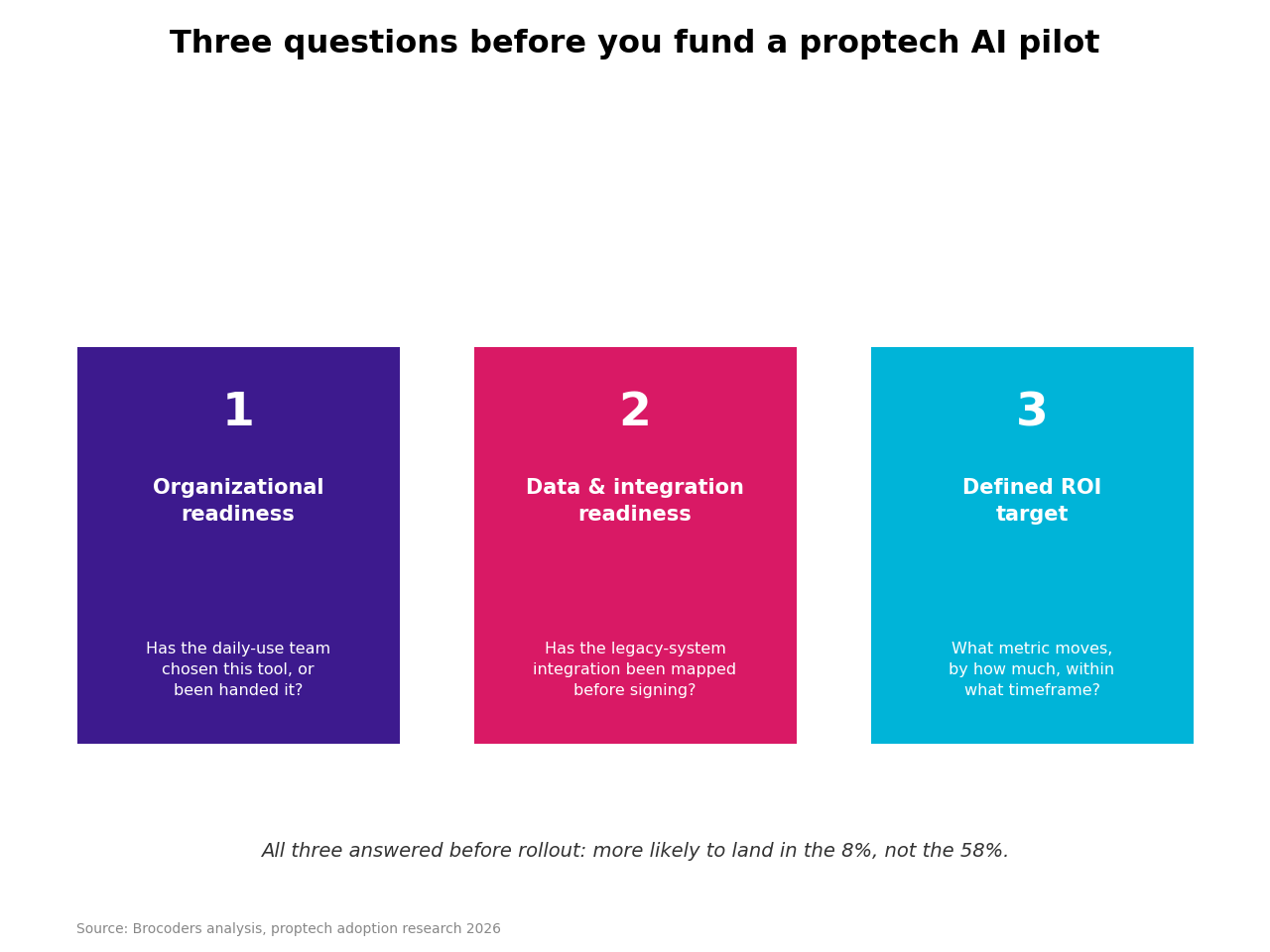
There's a way to tell, before you spend the budget, whether a proptech AI initiative will survive past the pilot or join the fifty points of adoption that never became automation.
First, organizational readiness: has the team that will use this tool daily been part of choosing it, or is it being handed to them? The 76% change management stat says this is the single biggest predictor of whether a pilot sticks. Second, data and integration readiness: does the tool need to talk to a legacy system, and has anyone mapped what that integration actually requires before signing the contract? Most proptech disappointments trace back to this question being skipped. Third, a defined ROI target set before rollout, not after: what specific metric moves, and by how much, within what timeframe. "We adopted AI" isn't an outcome. A lower cancellation rate or fewer manual document review hours per week is.
When a pilot needs a production team, our proptech software development team takes it from prototype to live platform.
A proptech initiative that can answer all three questions before it starts is far more likely to land inside the 8% than inside the 58%.
What this means for 2026
Two examples show where the gap costs real money.
56% of property managers report facing application fraud in the past year, and 65% of those managers faced more than one type. Yet 78% still rely on manual document verification. The technology to catch fraudulent applications automatically exists. The adoption-automation gap means most operators are still checking documents by eye while fraud rates climb.
71% of residents say they'd value bundled services like utilities or insurance coordinated through their property manager. Only 22% of managers currently offer them. The blocker is the same data and integration gap: bundling services means connecting billing, resident, and vendor systems that were never built to talk to each other.
Neither headline says "AI," but both point at the same 2026 trend. Structured data and legacy integration decide whether a proptech investment ends up inside the 8% or gets counted, and forgotten, inside the 58%.
The same gap shows up at the top of the market
The adoption-automation gap isn't limited to property management software. PwC and the Urban Land Institute's Emerging Trends in Real Estate Europe 2026 survey, based on more than 1,270 senior European property professionals, found AI or machine learning use across real estate activities jumped from 51% in 2025 to 75% in 2026. Ninety four percent of respondents call adapting and integrating new technology essential for long-term success. Leasing and marketing lead deployment plans at 90%, followed by property management at 87% and asset management at 86%.
The same survey cites a MIT report from August 2025 that found 95% of generative AI pilots at companies across the US failed to generate any profit. A Morgan Stanley estimate cited alongside it puts 37% of US REIT job roles as candidates for automation, roles that, for now, mostly still sit with people.
The pattern holds whether the question is asked of a property manager running 50,000 units or an investment committee sitting on institutional capital. Adoption keeps climbing. Full implementation is the part that keeps lagging behind.
Where a build partner actually helps
Most proptech vendors selling AI features have an obvious incentive to keep the conversation at "we adopted it." We don't sell a proptech platform. Here in Brocoders, we build the systems that determine whether a tool survives contact with an operator's actual, decade-old stack, and proptech and real estate is one of the areas we build in.
That's the exact problem C.I.A. Services brought us: a 30-year-old HOA management company running around 150 associations and 50,000 properties, where owners couldn't get basic account information without calling staff. We built a hybrid web app that pulls live data from their existing property management system and their public site, without asking them to rip out infrastructure that already worked. That's integration readiness, not a feature demo.
CondoGenie is the other side of the same problem: a proptech founder building a condominium management platform from scratch, where the product had to be designed around structured data from day one instead of patched on top of a system that fights it.
If your team is weighing a proptech trend for 2026 and asking whether to buy a point tool or build software that fits your actual operation, that's the real question behind every adoption stat in this article.
Sources: Commercial Observer, "Is AI in Proptech Overhyped?", January 2026; MRI Software, "PropTech trends for 2026"; BGSF, "Struggling With PropTech Adoption?"; EliteAgent, "Proptech Pulse 2026"; PwC and Urban Land Institute, "Emerging Trends in Real Estate Europe 2026: Facing Reality," including MIT (August 2025) and Morgan Stanley figures cited within it.
Frequently Asked Questions
Proptech is technology built specifically for the real estate and property management industry, covering everything from leasing and maintenance software to AI leasing assistants, digital twins, and resident-facing apps. The term spans off-the-shelf platforms and custom-built systems.
The adoption numbers say yes, in the sense that matters. AI adoption in property management reached 58% in 2026, but only 8% of companies have fully automated a single process with it. The technology works; the gap is in rollout, training, and integration, not the underlying tools.
Two reasons dominate. 76% of proptech leaders cite change management and training as the top adoption barrier, ahead of integration or budget. Close behind is data: 73% of proptech tools need to connect with legacy systems, and that integration frequently breaks or leaks data when it's rushed.
Less about which AI feature to add, more about whether an initiative can survive contact with a decade-old system and an untrained team. The trends worth acting on are structured data, honest integration planning, and defined ROI targets set before rollout.
Investment continues to grow year over year, with AI, digital transaction platforms, and sustainability tech drawing the largest share of new funding, though public figures vary by source and quarter.
It depends on how much the tool needs to integrate with systems already in use. An off-the-shelf point solution works well in isolation. Once a tool needs to pull live data from a legacy property management system or connect billing, resident, and vendor data, a custom build usually closes the adoption-automation gap that off-the-shelf tools tend to fall into.