
We keep hearing a version of the same question from commercial real estate brokerages this year: buy a pre-built platform for tenant sourcing, build an AI agent from scratch, or combine a few data sources and automation tools into something in between.
CRE teams running active AI pilots jumped from under 5% in 2023 to 92% in 2025, according to one industry analysis of Gartner and MIT NANDA research. Proptech investors moved just as fast: total proptech VC hit $16.7 billion in 2025, up 68% year over year, with AI-native companies pulling in $4.5 billion of that.
What's rarer is a broker who's already sketched the architecture before calling anyone. We've seen it firsthand: a brokerage naming the platforms it was weighing, naming the automation tools it would glue them with, and landing on hybrid as its own answer before we said a word.
That instinct is usually right, and usually missing one detail that changes what the build needs to look like. Here's the honest version of that answer.
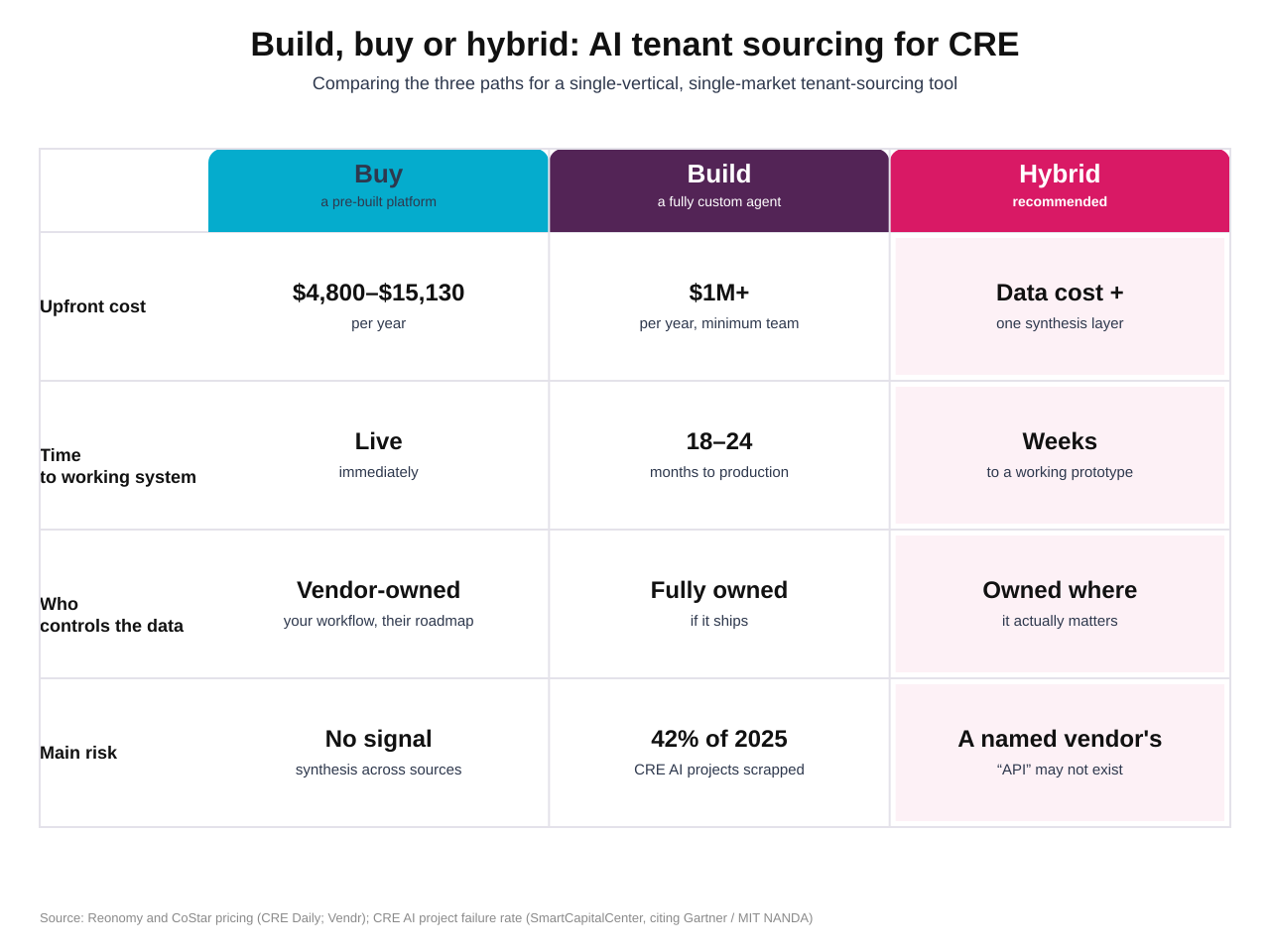
TL;DR: Buying gets you speed but not fit. Building gets you fit, but most custom CRE AI projects never reach production. Hybrid is the right call for a single-vertical, single-market tenant sourcing tool, as long as you know that one of the two data platforms people usually name in that plan, CoStar, doesn't offer the kind of API access the plan assumes.
What is AI tenant sourcing for CRE?
Tenant sourcing is the work of finding companies likely to lease or buy commercial space before they start actively looking. Brokers have always done this through cold calls, referral networks, and driving territory to spot moving trucks and for-lease signs.
AI tenant sourcing automates the finding part. Software watches public and semi-public signals such as layoffs, funding rounds, lease expirations, new business registrations, mergers, and bankruptcy filings, then flags the companies most likely to move, often weeks before a listing goes public.
A single signal rarely means much by itself. A funding round could mean a company is about to expand, or it could mean nothing changes for another two years.
The "AI" in AI tenant sourcing usually means the scoring layer that combines several weak signals into one number, the part that used to take a research team days to piece together by hand.
AI tenant sourcing works upstream of a CRM and a listing platform. A CRM tracks relationships a broker already has, and a listing platform like LoopNet shows space that's already on the market.
AI tenant sourcing exists to surface the deal before either one would show it. The rest of this piece covers how to get one built, bought, or both.
Buy: what a pre-built platform gets you, and where it stops
Buying is the fastest path to something working. Reonomy prices its core subscription at $4,800 a year, or $400 a month, per user, with both a real-time API and bulk data feeds for larger pulls, per a 2025 review of its pricing and access model. It covers over 50 million US properties, traces ownership through LLC layers back to the real owner, and ships a built-in likely-to-sell score based on debt and sales history.
CoStar sits at the other end of the price range. The average CoStar contract runs about $15,130 a year, ranging from roughly $3,000 to $23,000 depending on the package, per transaction data compiled by Vendr. For that money you get the deepest comps and market analytics dataset in the industry.
NextAutomation's 2026 buyer's landscape separates "point tools and data" (CompStak, Placer.ai) from "vertical AI SaaS" and "systems of record," because no single purchased product spans all three categories.
Buying gets you one strong signal, not the synthesis a tenant-sourcing agent needs from watching layoffs, funding rounds, lease expirations, new business registrations, mergers, and bankruptcy filings together. For more on vendors beyond tenant sourcing specifically, see our roundup of real estate software development companies.
Build: why most custom CRE AI never reaches production
The instinct to build makes sense once you've seen what buying leaves out, but the failure rate on that path is worth sitting with first.
The same 2026 analysis cited above found that the share of CRE firms scrapping most of their AI initiatives rose from 17% in 2024 to 42% in 2025, and put a real number on the gap between a working prototype and a production system: 18 to 24 months, plus a minimum three-person team running upward of $1 million a year once you account for the maintenance a "finished" AI agent actually needs.
Institutional scale doesn't erase this friction. Josh Panknin of Columbia University told Commercial Observer that real estate companies "are not technology development companies," and that fragmented data is what makes in-house AI hard to scale, in a piece covering Blackstone and Brookfield-backed AI initiatives with far larger budgets than most brokerages will ever have. If firms with billion-dollar capital partners hit the data-fragmentation wall, a mid-size brokerage building the same thing from a blank page should expect to hit it sooner.
Hybrid: the honest answer
For a single-vertical, single-market tenant-sourcing tool, hybrid is the right call.
Buying alone locks you into someone else's roadmap for a workflow that's specifically yours. As our own AI-native development work puts it: you own your stack instead of renting space on someone else's. A generic CRE intelligence product will always be a compromise here, because your edge sits exactly where a horizontal platform never looks.
Building alone assumes the year and the seven-figure budget the previous section just laid out. Few brokerages have either, and few need to.
Hybrid means renting the data you can't reasonably replicate (ownership records, distress signals, comps) and building the layer that's actually yours: signal ingestion, scoring logic, and a workflow that puts an alert in front of a broker before the listing goes public. AI-native development makes that middle layer materially cheaper to build than it was two years ago, which is the real reason hybrid now beats a pure custom build even for smaller teams.
The nuance most build vs buy advice skips
Here's the detail that changes the plan. CoStar and Reonomy get named together constantly, as if they're a matched pair of API-accessible data sources. They aren't.
An independent audit of CoStar's developer access gave it a grade of F: no public or self-serve API exists for CoStar Suite, COMPS, Market Analytics, or LoopNet. Access is portal-only, the terms of use prohibit automated extraction, and CoStar has pursued federal lawsuits under the Computer Fraud and Abuse Act against companies that tried programmatic access anyway. Reonomy, by contrast, sells a real, documented API.
The fix is pointing the hybrid stack correctly: Reonomy's API for ownership and distress data, public and government feeds for the rest (business registrations, deed records, building permits, WARN notices, bankruptcy filings), and CoStar treated as a manual verification step rather than an integration point. One indie developer who built a cheaper CRE data alternative summed up the underlying mistake well: leaning on an enterprise platform for a narrow, first-pass research task feels like using a Bloomberg Terminal just to check one ticker.
Gaps like this are common, not a sign of sloppy research. AI tools make it genuinely easy to sketch a working architecture in an afternoon. What they rarely flag is which vendor's terms of service will get you sued for using it the way you planned to. Pairing that early research with senior technical review before you spend a dollar is how you catch a gap like this before it costs you a rebuild.
What actually goes into a tenant movement score
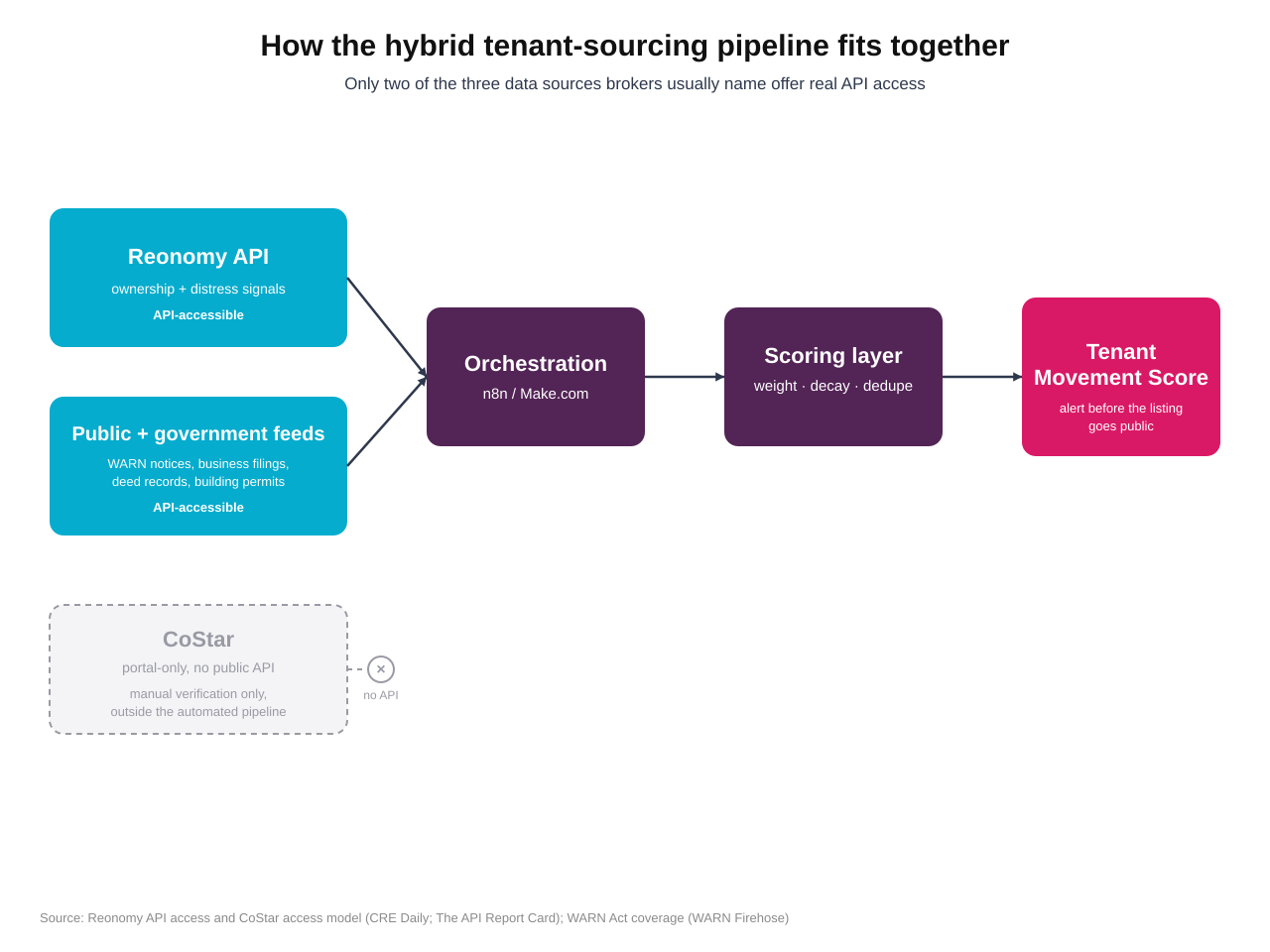
Turning six raw signal types into one usable score is an engineering problem, not a data problem. Each signal needs a weight, since a bankruptcy filing predicts a move with more certainty than a single funding round. Older signals need to decay, because a lease expiring in 14 months matters differently than one that expired last quarter with no action taken. Every source needs deduplication too, since the same company can show up under three slightly different names across a WARN notice, a business registration, and a news mention.
None of this means reinventing the wheel on every input. WARN Firehose already normalizes layoff notices across all 50 states into one clean feed, with a free tier and a $49-a-month paid API, a real, buildable starting point for just one of the six signal types.
We've built this kind of synthesis before, though not in CRE yet. Our work on AreaButler, a German proptech platform, pulled AI-generated property analysis from a CRM, a real estate data platform, and OpenAI into one broker-facing output. For scale, our rebuild of Lake's vacation rental platform connected 40 to 50 property management systems, taking it from about 500 to 40,000 properties (an 80x jump) in three months. It's the same integration work a CRE tenant-sourcing tool needs, aimed at a different signal set, and both projects sit inside our broader proptech and real estate work.
Where to start without overcommitting
A short, paid feasibility pass tells you whether your plan holds up, at a fraction of a full build's cost, and checks exactly which of your named data sources actually offer the access you're assuming before that becomes a signed contract.
That step also keeps the parts of your own research that are right (usually more of them than a vendor pitch will admit) while fixing the one or two assumptions that would otherwise cost real money to discover later. If you're weighing this same build-buy-hybrid decision for a proptech or real estate workflow beyond tenant sourcing, the same math applies, worth running before you write the first line of code or sign the first vendor contract.
Frequently Asked Questions (FAQ)
It means using software to watch signals like layoffs, funding rounds, lease expirations, new business registrations, mergers, and bankruptcy filings, then score which companies are most likely to move before a listing goes public. It works upstream of a CRM or a listing platform, surfacing the deal earlier rather than replacing either tool.
No. CoStar has no public or self-serve API for its core products (CoStar Suite, COMPS, Market Analytics, LoopNet). Access is portal-only, automated extraction is barred by its terms of use, and the company has pursued CFAA lawsuits against firms that tried anyway.
Yes. Reonomy sells a documented API and bulk data feeds as part of its standard $4,800-a-year subscription. CoStar's roughly $15,130-a-year average buys portal access only, with no programmatic integration path.
The most useful signals are layoffs, often visible through WARN Act notices, funding rounds, upcoming lease expirations, new business registrations, mergers and acquisitions, and bankruptcy filings. No single signal is reliable alone; the value comes from weighting and combining several.
Buying alone is cheapest upfront (roughly $4,800 to $15,000 a year per data source) but won't synthesize signals into one score. A full custom build commonly runs 18 to 24 months and $1 million or more a year in team cost. Hybrid, renting what you can't replicate and building only the synthesis layer, sits well below either extreme.
Typically: an API-accessible data source like Reonomy for ownership and distress signals, public or government feeds for filings and registrations, an automation tool like n8n or Make.com to orchestrate the pulls, and a scoring layer that weights, deduplicates, and decays the combined signals into one usable alert.
A working prototype can come together in weeks. Getting it to a production-grade system, handling edge cases, maintenance, and real data volume, commonly takes 18 to 24 months from scratch, exactly the gap a short feasibility pass catches before you commit.