
Six separate public feeds already broadcast when a commercial tenant is getting ready to move, and almost no brokerage reads more than one or two of them at once.
WARN Firehose alone normalizes more than 86,000 layoff notices covering over 14 million workers across all 50 states into one feed, and that is only one of six signal types worth watching.
Enterprise B2B intent data platforms like Bombora and 6sense already charge $25,000 to over $300,000 a year, per Autobound's 2026 provider comparison, to turn scattered buying signals into one score for software sales teams. Nobody sells the commercial real estate version.
Our companion piece on build, buy, or hybrid tenant sourcing already made the case for hybrid. It's clear the raw material for early warning already sits in public records. Brokers need a real method, not a feature checkbox, to turn six scattered feeds into one score worth acting on before a competitor gets there first.
TL;DR: Six public signals, layoffs, funding rounds, lease expirations, new business registrations, M&A activity, and bankruptcy filings, can predict a tenant move, but no single vendor tracks all six together. Building the synthesis layer means sourcing each signal honestly, weighting and decaying them over time, and deduplicating company identities across sources that never agree on a name.
The two problems hybrid quietly hides
Say you have already accepted the answer our last piece walked through: buying alone locks you into someone else's roadmap, building alone takes 18 to 24 months and a team you probably do not have, and hybrid is the right call for a single-market prospecting tool.
Hybrid still hides two specific engineering problems, and neither one is optional.
The first is scoring. Six signal types, layoffs, funding rounds, lease expirations, new business registrations, M&A activity, and bankruptcy filings, do not carry equal weight, and they do not stay equally relevant forever. Treat them all the same and you drown in noise.
The second is deduplication. The same tenant shows up under three different names across three different sources, a WARN notice, a state business registration, and a news mention, and a system that cannot tell those three records are one company is not a system worth using.
Get either one wrong and the cost is real. Miss a signal and a competing broker gets the listing first. Chase a false alarm and you burn a cold call on a landlord relationship you were trying to build. Both problems already have proven, named solutions, borrowed from fields that solved them before commercial real estate needed to.
Where each of the six signals actually lives
No existing vendor tracks all six signal types together. Here is what is actually real for each one, what it costs, and where it stops.
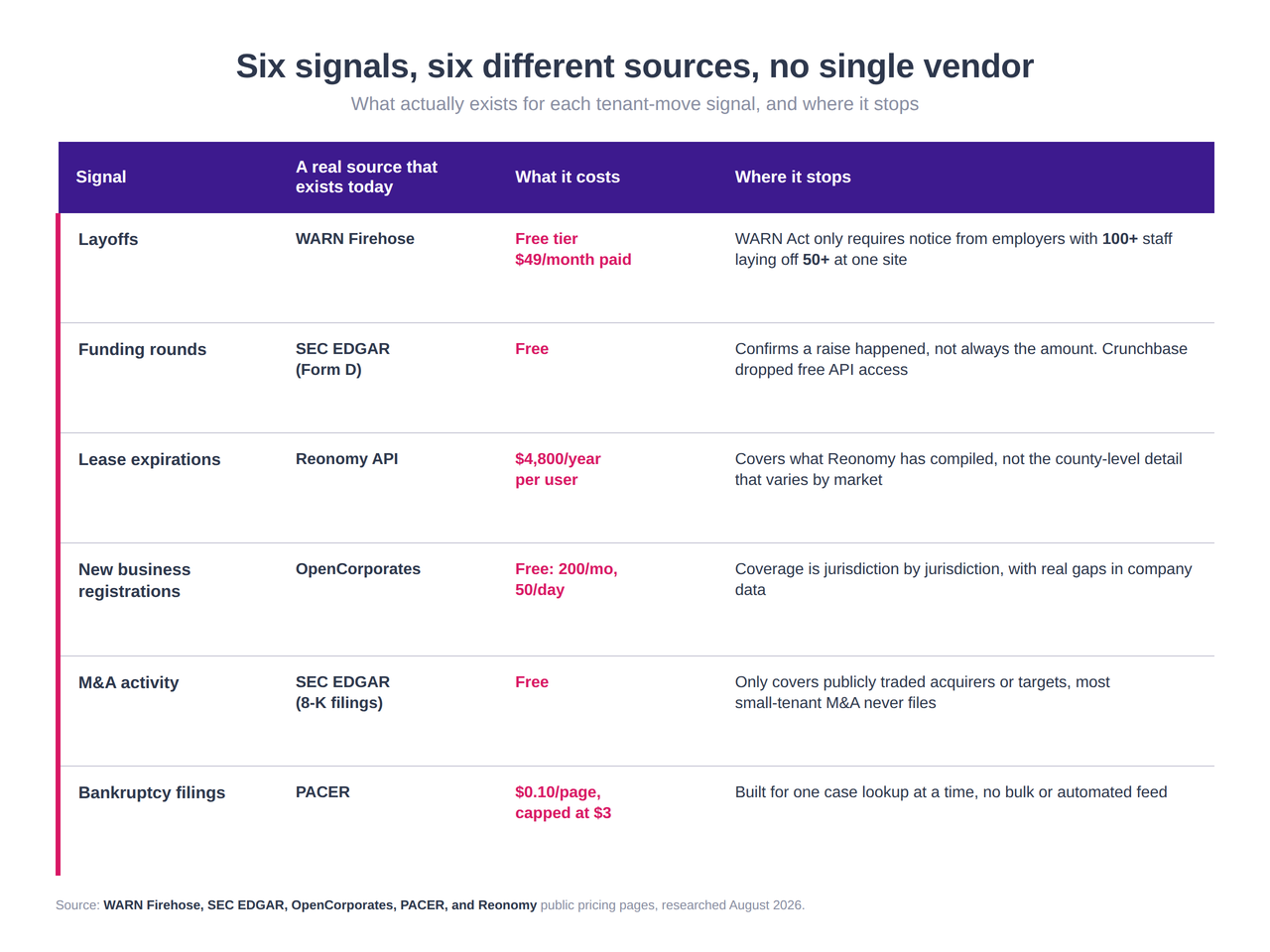
| Signal | A real source that exists today | What it costs or requires | Where it stops |
|---|---|---|---|
| Layoffs | WARN Firehose, normalized WARN Act notices across all 50 states | Free tier (25 calls a day), $49 a month paid API | The WARN Act only requires notice from employers with 100 or more employees, laying off 50 or more workers at one site, with 60 days' notice. Most small and mid-size tenants fall outside it entirely. |
| Funding rounds | SEC EDGAR, free, official, real-time Form D filings | Free, no API key required | Form D confirms a raise happened, not always how much. Crunchbase used to fill that gap for free; it shut down free API access, and a self-serve plan or a custom license is now the only way in. |
| Lease expirations | Reonomy's real-time API and bulk feeds | $4,800 a year or $400 a month per user | Covers what Reonomy has itself compiled. It does not include the county-level detail that varies from one market to the next. |
| New business registrations | State Secretary of State registries, or OpenCorporates as an aggregator | Free tier default: 200 requests a month, 50 a day | Coverage is jurisdiction by jurisdiction. OpenCorporates says outright that it knows about more jurisdictions than it has full company data for. |
| M&A activity | SEC EDGAR 8-K filings | Free | Only covers publicly traded acquirers or targets. Most small-tenant M&A never touches an SEC filing. |
| Bankruptcy filings | PACER, the federal court records system | $0.10 a page, capped at $3 a document, plus a $30 search fee per name | Built for looking up one case at a time, not for an automated feed watching many companies at once. |
Several of these sources are administered county by county or state by state rather than nationally, so what is easy to pull in one market can be genuinely hard in another. That is worth planning for before you assume a system built for one region will drop into the next without changes.
None of the point-source platforms fill this gap either. NextAutomation's comparison of Cherre and CompStak confirms it directly: Cherre unifies property data, CompStak crowdsources lease comps, and neither one is built to watch layoffs, funding, M&A, or bankruptcy at all. Generic B2B intent platforms like Bombora and 6sense already solve a version of the scoring problem, just never for commercial real estate, and at enterprise pricing that assumes a SaaS sales team's budget, not a single-market brokerage's.
Scoring: weighting and decay
The naive version of a tenant movement score treats every signal as equally important and permanently valid. A bankruptcy filing from three years ago counts the same as a layoff notice from last week. That version is mostly noise.
The fix has two parts, and both are established practice in adjacent fields, just never applied to commercial real estate in public writing.
Weight by predictive strength first. A bankruptcy filing is a stronger tell than a single funding round, and a lease expiration paired with a hiring freeze is stronger than either signal alone.
Decay by age second. Mature B2B intent-data practice recommends weighting signals from the last 7 to 14 days most heavily, and applying decay to anything older than 30 days, warning that stale signal "creates false confidence that is worse than no data at all," according to Autobound's provider comparison. That same guidance recommends layering weak signals together instead of trusting any one alone: a single funding round means little by itself, but a funding round plus a hiring spike plus a new lease inquiry is a real pattern.
Borrow both numbers directly. A 7 to 14 day window for full weight and a 30-day decay curve is a reasonable starting point for a first version, and it is far better than either ignoring age entirely or guessing at a schedule from scratch.
Deduplicating company identities
A WARN notice lists "Acme Logistics LLC." A state business registration lists "Acme Logistics, Inc." A funding announcement mentions only "Acme." Three records, one company, and a system that treats them as three separate leads is not a system worth using.
This is a solved problem, and it has a name: entity resolution, or probabilistic record linkage.
Splink, an open-source library built by the UK Ministry of Justice's analytical team, links a million records in under two minutes on a laptop and scales past 100 million records on larger infrastructure. It uses the Fellegi-Sunter method, an unsupervised statistical approach that scores how likely two records describe the same entity, without needing a labeled training set to start.
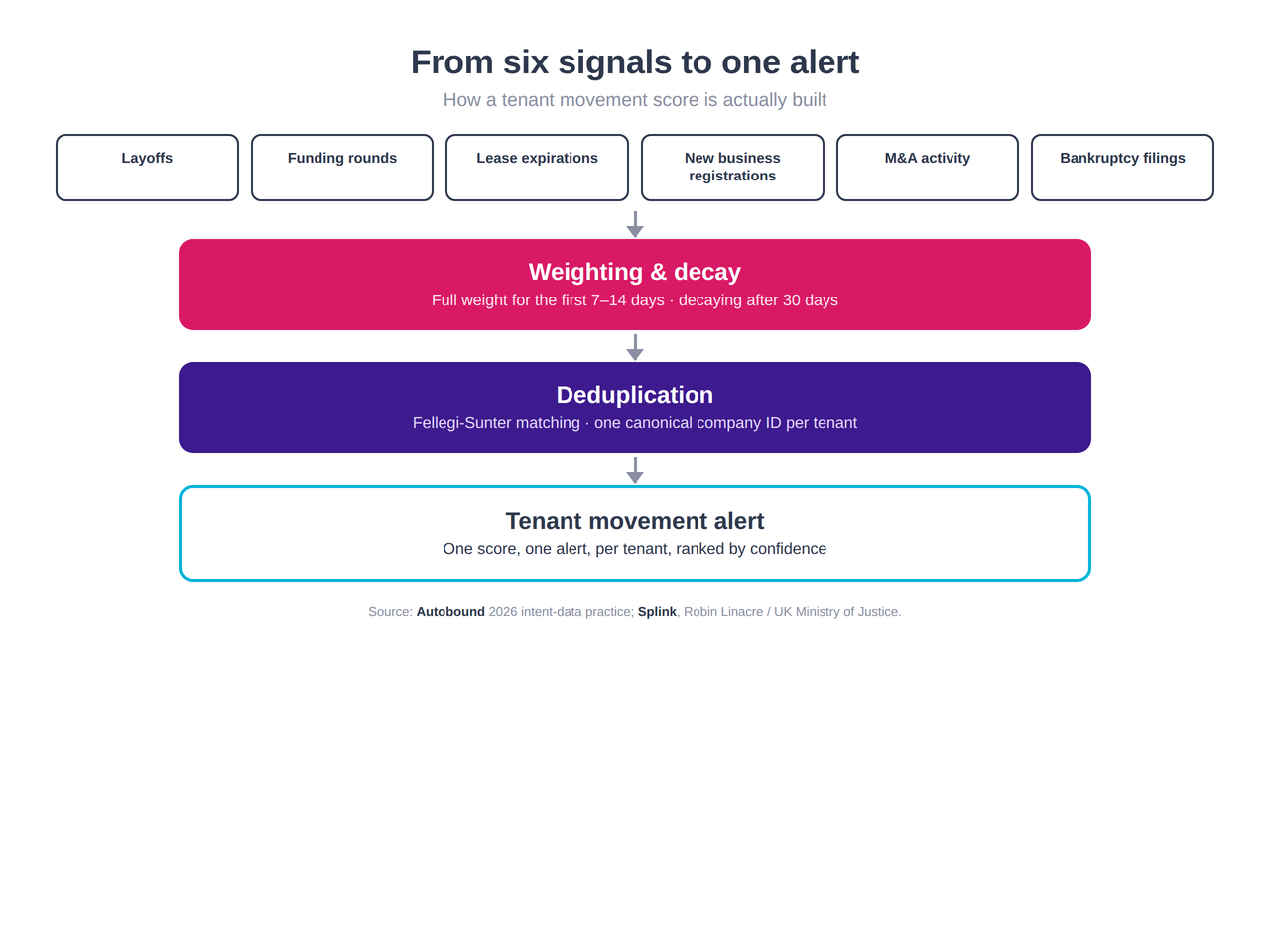
The practical version for a tenant movement score does not need to be perfect. It needs a consistent confidence bar: normalize company names and addresses the same way every time, check for a shared domain, phone number, or registered address across records, and only merge two records automatically once the match score clears a set threshold. Anything below that threshold goes to a human for a quick check rather than an automatic merge, which is a far cheaper mistake to make than silently combining two different companies into one false alert.
Proof this is buildable
It would be easy to assume a system like this has to be invented from scratch: a custom scoring model, a custom deduplication engine, a custom integration layer, all built with no precedent to lean on.
None of that is true. Every piece already works, proven at real scale, just never assembled for this specific job. Splink resolves entities across 100 million or more records today. Decay and signal-layering logic is standard, working practice in adjacent sales-intelligence tooling right now.
That is exactly the kind of work we have already built, just not for commercial real estate yet. Our AreaButler case study pulled AI-generated property analysis from a CRM, a real estate data platform, and OpenAI into one broker-facing output, the same "many inputs, one clean answer" shape a tenant movement score needs. Our rebuild of Lake's vacation rental platform connected 40 to 50 property management systems, taking it from about 500 to 40,000 properties, an 80x jump, in three months, proof we can build and maintain an integration layer at real volume. Both sit inside our broader proptech and real estate work. We have not shipped a CRE-specific tenant movement score yet. The underlying capability is proven.
The business case for owning this layer
The economics favor owning the synthesis layer rather than just subscribing to more point tools.
Buying data alone adds up fast without ever solving the actual problem. Reonomy runs $4,800 a year per user for ownership and lease data. Enterprise intent platforms built for a different industry entirely run $25,000 to over $300,000 a year, per Autobound. Neither one, alone or together, does the synthesis work described above.
Missing a real signal has a real cost attached. Commercial leasing commissions commonly run 3% to 6% of the total lease value, according to a summary of standard leasing commission structures. A competing broker who spots a tenant's move a month earlier is a broker who gets the introductory call first.
A system with too many false positives has a cost too, just a quieter one. Every wasted outreach to a landlord based on a signal that turned out to be nothing spends down the trust that makes the next, real conversation possible. In a relationship-driven business, that cost compounds over years, not weeks.
What we would build
The signal data itself is worth renting. Reonomy, WARN Firehose, and SEC EDGAR already exist, are already priced, and would take real time to replicate for no real benefit.
The synthesis layer is different. Sourcing, scoring, decay, deduplication, and alerting are the parts nobody sells, because they depend on judgment calls specific to how a single market actually behaves. That layer is the part worth owning outright rather than renting.
Our own framing on this, from how we think about SaaS lock-in generally, applies directly here: you are not a tenant on someone else's platform, you own your stack. A rented data source can raise its price or change its terms. A synthesis layer you built and understand cannot be taken away from you. That is the layer our AI-native development work is built to deliver, tuned to your specific market rather than a generic national dataset.
A starter scoring framework
Most brokerages doing this today check each source manually, one at a time, on no fixed schedule. That works until volume grows past what one person can track by hand.
Here is a simple starting point you can copy without hiring anyone yet.
First, assign each signal a rough reliability tier:
- High: bankruptcy filings, business dissolution or M&A activity
- Medium: layoffs (WARN-covered), lease expirations inside 12 months
- Lower alone, strong in combination: funding rounds, new business registrations
Second, apply a simple decay rule: full weight for the first 14 days, a fading weight through day 30, and treat anything older as background context rather than an active signal.
Third, run every match through a short deduplication check before it becomes an alert: normalize the company name and address, check for a shared domain or registered address across sources, and hold anything below a clear confidence bar for a human glance instead of auto-merging it.
That framework will not catch everything a fully built system would. It is enough to test whether the six signals you can access today actually predict anything worth acting on in your specific market, before you commit real budget to a build. A short, paid feasibility pass is the lower-risk next step if that test looks promising, and the same logic applies to any proptech or real estate workflow built on scattered public signals, not just tenant sourcing specifically.
Sources: WARN Firehose; US Department of Labor, WARN Act; SEC EDGAR APIs; OpenCorporates API; PACER pricing; NextAutomation, Cherre vs. CompStak; Splink, Robin Linacre; Autobound, 2026 intent data provider comparison; Leasing commission structures.
Frequently Asked Questions (FAQ)
Layoffs, funding rounds, lease expirations, new business registrations, mergers and acquisitions, and bankruptcy filings. No single signal is reliable by itself. The value comes from weighting several of them together and watching how they change over time.
Weight each signal by how strongly it actually predicts a move, a bankruptcy filing counts for more than a single funding round, and decay older signals so they matter less over time. Mature intent-data practice recommends full weight for signals inside 7 to 14 days, decaying anything past 30 days, and combining weak signals together rather than trusting any single one alone.
Through entity resolution, also called probabilistic record linkage. Tools like Splink use statistical matching to score how likely two records describe the same company, without needing a labeled training set, and can process a million records in under two minutes.
No. It only requires notice from employers with 100 or more employees laying off 50 or more workers at a single site, with 60 days' notice. Most small and mid-size tenants, often the ones a single-market broker cares about most, fall outside that threshold entirely.
Not one that covers all six signal types together. Point-source platforms like Reonomy, CoStar, Cherre, and CompStak each do one piece well, ownership records, comps, or unified property data, but none of them track corporate events like layoffs or bankruptcy filings at all.
It ranges widely. WARN Firehose starts free and runs $49 a month at its paid tier. SEC EDGAR is completely free. Reonomy runs $4,800 a year per user. OpenCorporates defaults to 200 free requests a month. PACER charges $0.10 a page, capped at $3 a document. None of these prices include the synthesis work of turning six separate feeds into one usable score.