
Last updated: June 2026. Written by Rodion Salnik, co-founder of Brocoders.
For most of my career, the advice for a team that needed to move faster was simple: add engineers. Need more output, rent more developers. We in Brocoders sold that model for years, and for years it worked.
Then AI changed what one engineer can do in a day, and the old math stopped adding up. The companies doing the most interesting work in 2026 quietly switched to a different way of buying engineering. It has a name now: forward deployed engineering. And I think it marks the end of staff augmentation as the default.
TL;DR: Staff augmentation priced software by the developer-hour because, for decades, more hands meant more output. AI broke that link, so the best AI companies switched to forward deployed engineering: small embedded teams that own a business outcome instead of filling seats. Use the Outcome Test, three questions about risk, billing, and ownership, to decide which model your next build actually needs.
The model everyone still defaults to
Staff augmentation is the model most software buyers still reach for first. You hire vetted engineers by the hour, they plug into your team, attend your standups, use your stack, and report to your leads. You manage them like employees, just without the long-term commitment.
It was a sensible answer to a real problem. Hiring full-time is slow, and sometimes you only need three React developers for nine months. We ran exactly these engagements: we augmented AreaButler's team in Germany with remote engineers, and we scaled a Canadian payroll company's team with React developers to renovate their legacy product. Good work, happy clients.
The model rests on one assumption: that output scales with headcount. More seats, more code, more progress. For a long time that assumption held, which is why staff augmentation typically costs 20 to 40 percent more per resource than full project outsourcing (DesignRush). Buyers paid the premium because keeping control of the work felt worth it.
What AI did to the headcount math
That assumption is the part AI broke. A single engineer who is fluent with Cursor, Claude, or Copilot now ships what used to take a small group (Right Tail). The link between headcount and output got much weaker, and in some cases it inverted.
Here in Brocoders we put a number on it internally. A traditional team of 10 can be matched, and often beaten, by an AI-augmented team of 4 with the right architecture around it. The four-person team is faster to coordinate, cheaper to run, and easier to hold accountable, because there are fewer hands between the problem and the result.
So when you buy developer-hours in 2026, you are paying for a unit that no longer maps cleanly to value. Two teams can bill the same hours and deliver wildly different results, depending on how well they use AI and how well a senior architect steers it. Hours became a poor proxy for the thing you actually want, which is a working result.
The model the best AI companies quietly switched to
Forward deployed engineering is the model that fits the new math. A forward deployed engineer is a builder who embeds directly with a customer, learns the business problem in depth, and writes software inside the customer's real environment until the problem is solved. The unit of value is the outcome, not the timesheet.
Palantir invented the approach and got mocked for fifteen years, with critics calling it expensive consulting dressed up as software. The mockery aged badly. Palantir delivered roughly 640 percent total shareholder return over the three years through 2025, and the rest of the industry started copying the playbook (Databricks). Anthropic signed a 1.5 billion dollar forward deployed staffing venture with Deloitte. OpenAI made the same bet at twice the size with a 10 billion dollar alliance with Bain (PYMNTS).
The hiring data tells the same story. Forward deployed engineer postings on Indeed grew from 643 in April 2025 to 5,330 in April 2026, a 729 percent increase in a single year (Christian & Timbers). Senior forward deployed engineers now command 215,000 to 310,000 dollars in base pay in the US, with total comp at frontier labs regularly clearing 500,000 (PYMNTS).
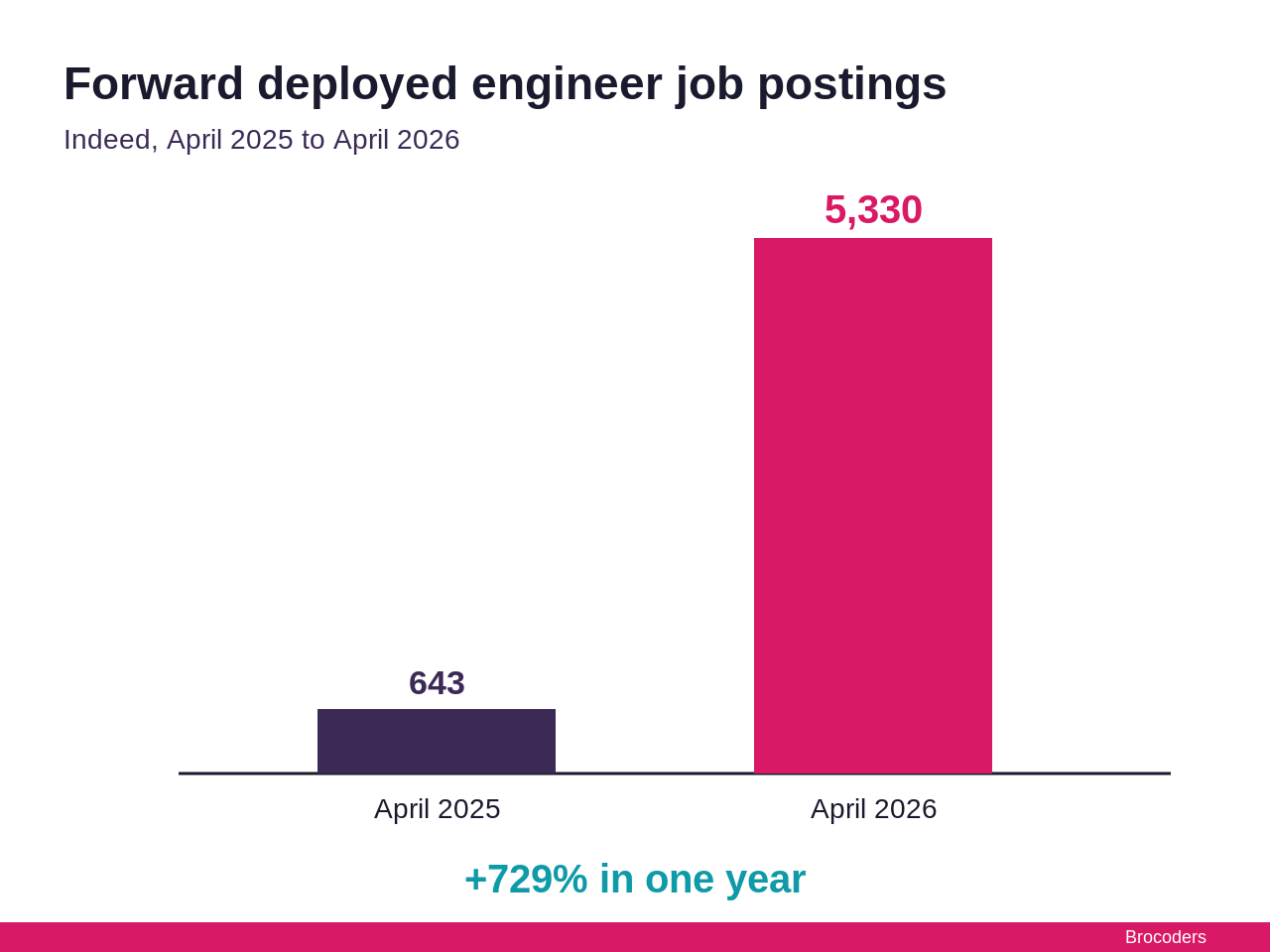
Most of this coverage frames forward deployed engineering as a new job to hire for. I read it differently. It is a signal about how serious software buyers now want to buy: results delivered by a small embedded team, not seats rented by the hour.
The Outcome Test: seats vs outcomes
When a client asks me which model they need, I give them three questions. I call it the Outcome Test, and it cuts through the sales language fast.
First, who carries the risk if the result is late or wrong? In staff augmentation, you do. The engineers did their hours; steering the work was your job. In forward deployed engineering, the team carries it, because they signed up for a result, not a schedule.
Second, what are you billed for? If the invoice counts hours and seats, you bought capacity. If it ties to a defined outcome or milestone, you bought a result.
Third, who owns the problem end to end? If the answer is "my internal lead has to translate the business problem into tasks and hand them down," you are running augmentation. If the answer is "the team learns my business and figures out the how," you are running the forward deployed model.
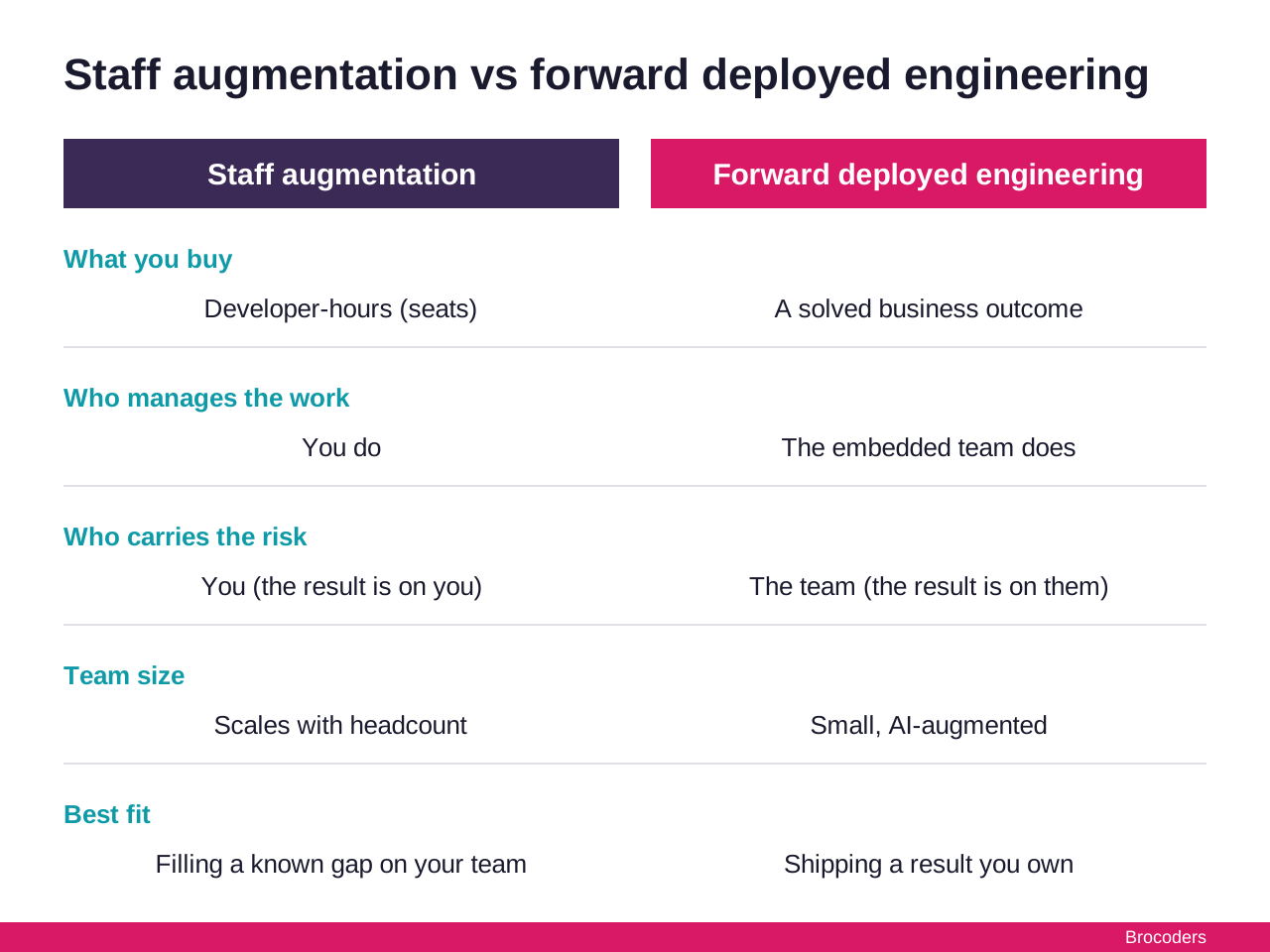
The test is useful because it ignores what a vendor calls itself. Plenty of "dedicated teams" are really seat rentals with a nicer label. The three questions show you what you are actually buying.
What owning the outcome looks like
Owning the outcome shows up in the results, so here are three from our own work, each a small team that took a problem and returned a finished thing.
A vacation rental platform called Lake had a monolithic backend that could not scale past a few thousand connected properties. We rebuilt the architecture in three months. Connected properties grew 80 times, from around 500 to 40,000, and website activity spiked 210 percent. The deliverable was not a pile of hours, it was a platform that could finally grow.
CoreHealth needed the first version of a doctor consultation platform under a hard deadline. We delivered the full telehealth platform in six weeks. Revenue Boosters, an amusement operator, needed a route management product for the collectors servicing its coin-operated machines. We built the complete SaaS, web dashboard and mobile apps included, from scratch in three and a half months. Their owner described the result as "a complete masterpiece."
None of those engagements were sold by the seat. They were sold as outcomes, delivered by small teams using AI under senior architectural supervision. That is forward deployed engineering in practice, whatever label sits on the contract.
When staff augmentation still makes sense
I am not writing staff augmentation off entirely. It still fits a few situations well, and pretending otherwise would be dishonest.
If you have a strong in-house engineering team and a clear plan, and you genuinely just need two more hands inside your process for a defined stretch, augmentation is clean and fast. If you need to keep daily control of technical direction for reasons of compliance, IP, or internal politics, augmentation gives you that control by design. And if the gap is small and well understood, the management overhead is low enough that the model pays off.
The trouble starts when companies use augmentation for work that is really an outcome in disguise. You hand over a vague problem, rent four developers, and then spend your own senior people managing them toward a result you are still responsible for. That is when you are paying a premium for hours and absorbing the risk yourself.
How we build this way
We rebuilt our own delivery around this model. We call it AI-powered development: engineers write code with AI, senior architects own the structure, security, and long-term maintainability, and AI also runs large parts of project management, QA, and continuous integration. The result is a small team that moves quickly and stays accountable for what it ships.
Our own product, Fieldera, is the clearest proof we can show. We built a production-ready field operations platform faster and leaner than a traditional team could have, using the same approach we bring to client work. When a prospective client asks what they will get from us, that is the answer: a team that takes the problem and gives back the result.
If you are deciding how to staff your next build, run it through the Outcome Test first. If what you need is a result you can own rather than seats you have to manage, let's talk about how we'd build it.
This outcome-driven model proves especially effective in SaaS development, enabling small, high-impact teams to deliver scalable solutions faster than traditional approaches. Discover how the Brocoders team provides SaaS development services that drive real business outcomes.
Frequently Asked Questions
Forward deployed engineering is a delivery model where a small team of engineers embeds with a customer, learns the business problem directly, and builds software inside the customer's real environment until the problem is solved. The team is paid for the outcome rather than for hours worked.
A staff-augmentation engineer joins your team and works on tasks you assign, under your management, billed by the hour. A forward deployed engineer owns a business problem end to end, decides how to solve it, and is accountable for the result. One sells capacity, the other sells an outcome.
Yes, in specific cases. If you have a capable in-house team and need extra hands for a defined gap, or you need daily control of technical direction for compliance reasons, augmentation works well. It becomes a poor fit when you hand over a vague problem and end up managing the result yourself.
Because AI weakened the link between headcount and output. A single AI-fluent engineer now ships what used to take a small group, so paying per developer-hour buys a unit that no longer maps to value. Companies want results delivered by small accountable teams instead.
On paper an outcome-based engagement can look more expensive per project, but you are buying a finished result with the delivery risk carried by the team. Staff augmentation already runs 20 to 40 percent higher per resource than project outsourcing, and you absorb the management overhead and the risk on top of that.
Often, yes. A team of four using AI well, with a senior architect owning the structure, can match or beat a traditional team of ten. Fewer people means faster coordination, lower cost, and clearer accountability for the outcome.
A dedicated team makes sense when you have long-running, evolving product work that needs deep, continuous context. The Outcome Test still applies: if that team owns results and carries the risk, you are running the forward deployed model with a long-term commitment attached.