
Most "top API development company" lists rank vendors on team size, founding year, and a Clutch star count. None of those numbers predict what actually breaks an integration: what happens on day 200, when a third-party API changes its schema, your traffic triples, and a rate limit you never read about starts dropping requests.
API work fails quietly. A login flow that works in the demo can buckle under production load. A Strava sync that passes QA can hit a 100-requests-per-15-minutes ceiling the moment your user base grows. The vendors who avoid these problems are not the biggest names in the directory. They are the teams that handle the edges: rate limits, schema drift, duplicate records, versioning, and the long tail of maintenance after launch.
This list ranks 9 custom API development companies on those edges, using a framework we call the API Resilience Test. Full disclosure: Brocoders is on this list, at number one. We build custom APIs and integrations, including a Strava, Garmin, Google Fit, Oura Ring, and Amazon Halo integration for a US fitness equipment manufacturer. We apply the same five-signal test to ourselves that we apply to every other company here, honest weakness included.
The API Resilience Test: five signals that predict integration success
A great API development company is judged on what it does after the happy path. These five signals separate teams that ship durable integrations from teams that ship demos.
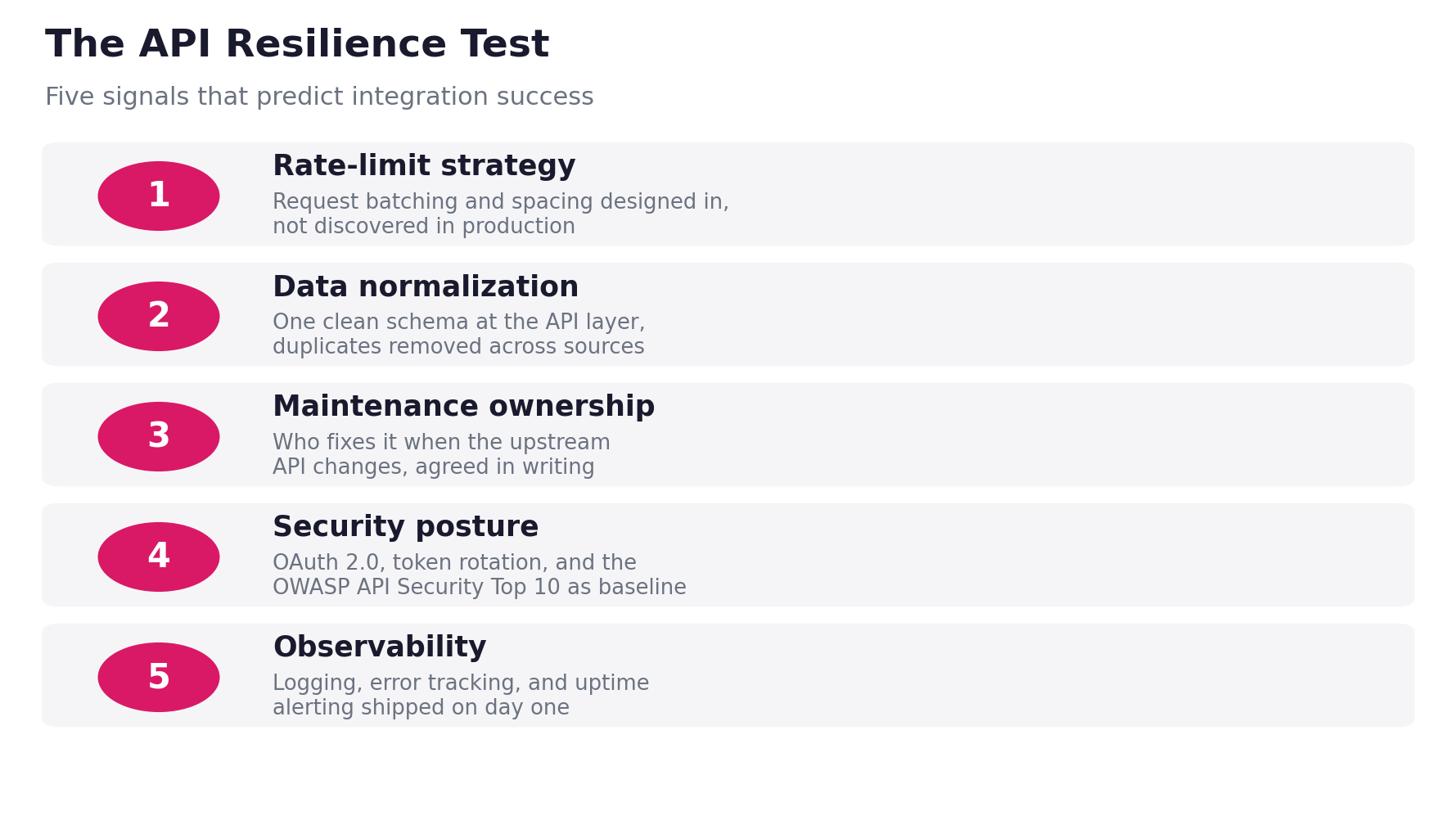
1. Rate-limit and throttling strategy. Every third-party API enforces request limits. Strava allows 100 requests per 15 minutes and 1,000 per day by default. A resilient team designs request batching, spacing, and caching from the start, instead of discovering the ceiling in production. What good looks like: the vendor asks about your expected request volume in the first technical call.
2. Data normalization and deduplication. When you pull data from five sources, you get five schemas and a flood of duplicate records. The best teams normalize at the API layer so your application code stays clean regardless of the source. What good looks like: a documented mapping layer and a deduplication strategy, not ad-hoc field matching.
3. Versioning and maintenance ownership. When a vendor updates their API, someone has to absorb the change. A resilient partner owns versioning, deprecation handling, and ongoing maintenance. What good looks like: a written answer to "who fixes it when the upstream API breaks," agreed before the contract is signed.
4. Security and compliance posture. API endpoints are attack surface. OAuth 2.0, token rotation, encryption, and rate limiting are baseline. For regulated data, SOC 2, HIPAA, or GDPR alignment is non-negotiable. What good looks like: the vendor references the OWASP API Security Top 10 without being prompted.
5. Observability and monitoring. You cannot fix what you cannot see. Resilient teams ship logging, error tracking, and uptime monitoring as part of the build, not as an afterthought. What good looks like: monitoring and alerting are line items in the proposal, not a future phase.
Score each company against these five signals during evaluation. A vendor that scores high on all five will cost more upfront and far less over three years. A vendor that scores high only on price will reverse that math.
Quick comparison: top 9 API development companies
| Company | Location | Hourly rate | Min. project | Clutch rating | Best for |
|---|---|---|---|---|---|
| Brocoders | Tallinn, Estonia | $25–49 | $25,000+ | 5.0 (30 reviews) | SaaS founders adding wearable, payment, or third-party integrations |
| Simform | Orlando, FL, USA | $25–49 | $25,000+ | 4.8 | Cloud-native, serverless API architecture on AWS |
| Intellias | Lviv, Ukraine | $50–99 | $50,000+ | 4.9 | Large enterprises in automotive, fintech, and telecom |
| ScienceSoft | McKinney, TX, USA | $50–99 | $50,000+ | 4.8 | Full-lifecycle API support in healthcare and finance |
| Velvetech | Chicago, IL, USA | $50–99 | $25,000+ | 4.9 | Connecting legacy systems to modern SaaS |
| Apriorit | Wilmington, DE, USA | $50–99 | $50,000+ | 4.8 | Security-sensitive, system-level integrations |
| Capital Numbers | Kolkata, India | $25–49 | $10,000+ | 4.8 | Cost-effective custom API development for SMBs |
| OpenXcell | Ahmedabad, India | $25–49 | $25,000+ | 4.9 | Well-documented APIs for web and mobile apps |
| ELEKS | Tallinn, Estonia | $50–99 | $50,000+ | 4.9 | Enterprise modernization and data engineering |
Rates reflect standard Clutch brackets and shift with project scope and team seniority. Treat them as planning ranges, not quotes.
1. Brocoders
| Founded | 2011 |
| Location | Tallinn, Estonia |
| Team size | 87 specialists |
| Hourly rate | $25–49 |
| Min. project | $25,000+ |
| Clutch | 5.0 (30 reviews) |
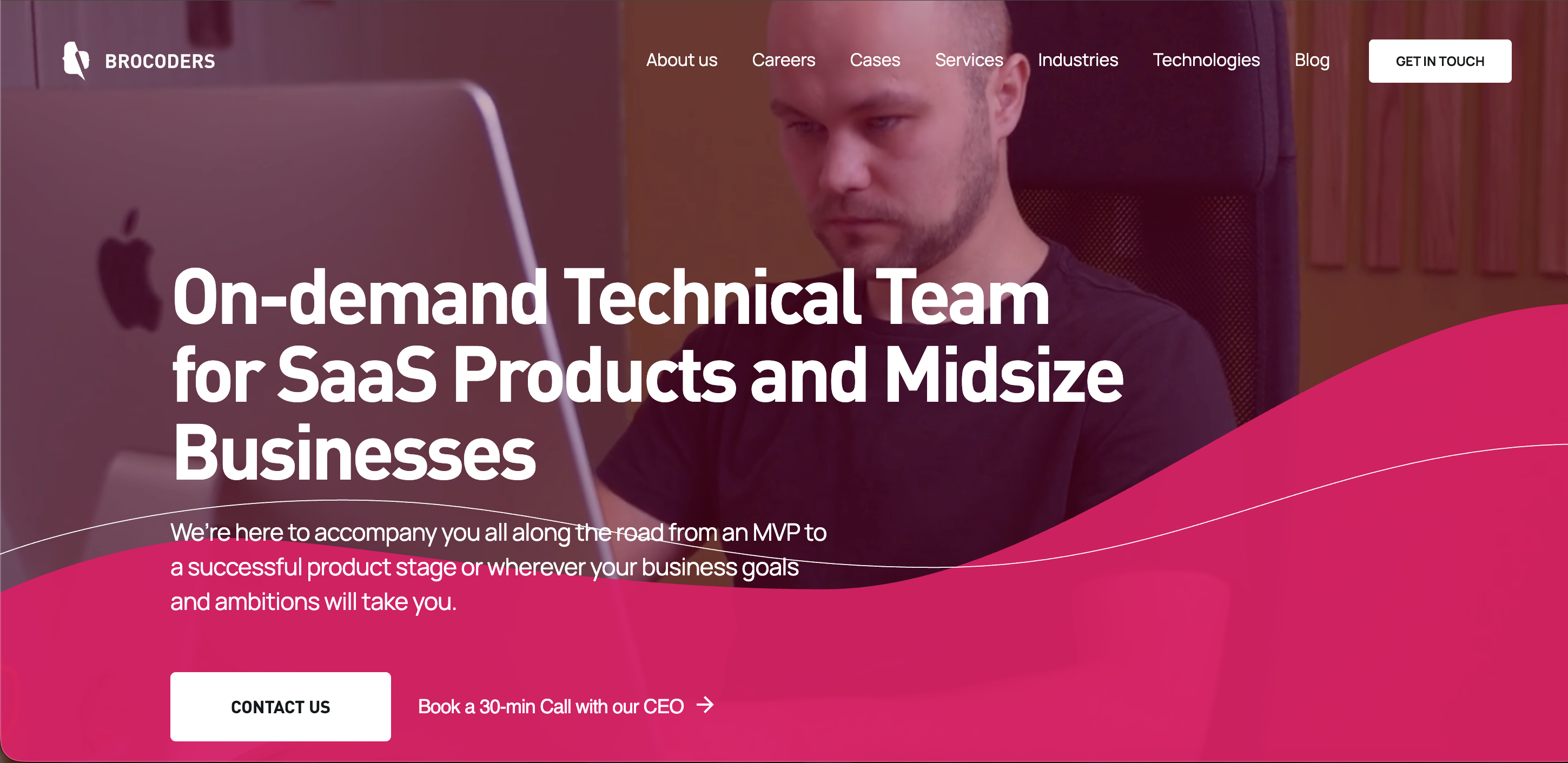
Overview. Brocoders is a custom software development company that builds web and mobile products, MVPs, and provides SaaS development services, with a backend practice centered on Node.js. The company has shipped 85 projects over more than a decade and holds a 5.0 rating across 30 Clutch reviews. API and third-party integration work runs through most of its case studies, from wearable device data to payment and CRM connectivity.
API development approach. Brocoders treats integrations as a separate, testable module rather than code scattered through the application. On a fitness platform project, the team built data exchange with external services in an isolated module, which simplified testing and let two teams work in parallel without stepping on each other. The approach starts with examining the target APIs, mapping data for synchronization, and eliminating duplication before a line of integration code ships.
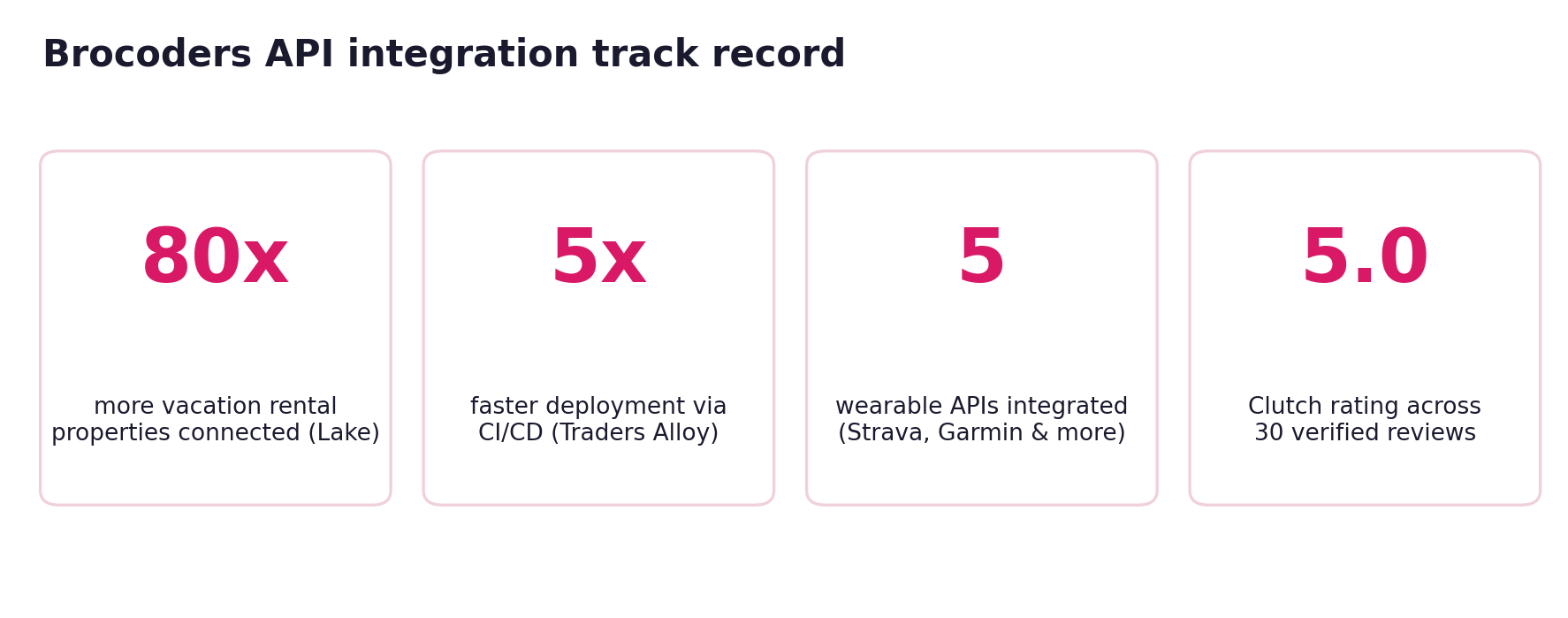
Notable projects. For a US fitness equipment manufacturer that has built products since 1989, Brocoders integrated Strava, Garmin, and Google Fit, then expanded to Oura Ring and Amazon Halo based on user demand. When the user base grew and Strava's rate limits began dropping requests, the team solved it by spacing requests out: increasing frequency while lowering the number sent at any one moment. They also handled Strava's oversized data packets, caused by charts drawn on top of downloaded images, by restructuring the assembly. For Lake, a vacation rental platform, Brocoders rebuilt a monolithic backend into microservices and connected 80 times more properties. For the fintech startup Traders Alloy, the DevOps team replaced manual deployment with an automated CI/CD pipeline that runs 5 times faster.
Technology stack. Node.js, React.js, React Native, Gatsby.js, with microservices architecture and AWS deployment.
Why choose Brocoders. The fitness case is a working example of all five resilience signals: rate-limit strategy, a dedicated integration module, ongoing expansion and maintenance, and QA across multiple iterations before each production release. The client, a Senior Director of Development Experience, said on Clutch: "They worked very closely together with our team and were involved in our planning processes." For founders adding their first complex integrations, that planning involvement is the difference between a sync that holds and one that silently fails.
Honest weakness. Brocoders is a mid-sized team of 87, not a 1,000-person enterprise vendor. For a Fortune 500 program that needs hundreds of engineers staffed across parallel workstreams or deep regulated-industry certifications like CMMI Level 5, a larger firm will be a better structural fit.
2. Simform
| Founded | 2010 |
| Location | Orlando, FL, USA |
| Team size | 1,000+ |
| Hourly rate | $25–49 |
| Min. project | $25,000+ |
| Clutch | 4.8 |
Overview. Simform is a digital product engineering company with a strong cloud-native and DevOps practice. As an AWS Advanced Partner, the team specializes in building scalable, serverless APIs using AWS Lambda and API Gateway.
API development approach. Simform leans into microservices and serverless patterns, designing APIs that scale horizontally under load. The AWS depth means infrastructure-aware API design, where throttling and autoscaling are handled at the platform layer.
Notable projects. Simform works with tech-forward companies building cloud-native applications, with portfolio work spanning media, healthcare, and logistics platforms that require scalable backend services.
Technology stack. AWS Lambda, API Gateway, Node.js, .NET, and microservices architecture.
Why choose Simform. For teams committed to AWS that want serverless API architecture built by a certified partner, Simform's cloud specialization is a clear advantage.
Honest weakness. The AWS-centric approach is a strength until you need a different cloud. Teams on Azure or Google Cloud, or those wanting a cloud-agnostic build, will find the recommendations consistently pulled toward AWS.
3. Intellias
| Founded | 2002 |
| Location | Lviv, Ukraine |
| Team size | 3,200+ |
| Hourly rate | $50–99 |
| Min. project | $50,000+ |
| Clutch | 4.9 |
Overview. Intellias is a technology partner for Fortune 500 companies, with deep domain expertise in automotive, fintech, and telecom. Its API integration work focuses on connecting multiple disparate platforms into a single reliable network.
API development approach. Intellias orchestrates large-scale digital ecosystems, the kind where dozens of internal and external systems have to interoperate. The work is precise and process-heavy, suited to complex enterprise environments.
Notable projects. Intellias has delivered platform engineering for global automotive and mobility companies, along with fintech systems that handle high transaction volumes.
Technology stack. Broad coverage across Java, .NET, cloud platforms, and enterprise integration tooling.
Why choose Intellias. For a large enterprise in a regulated, complex industry that needs a partner with deep domain knowledge and the scale to orchestrate big platforms, Intellias is a strong fit.
Honest weakness. The enterprise focus and 3,200-person scale come with enterprise pricing and process overhead. A startup building a focused MVP will find the engagement model heavier and costlier than the project needs.
4. ScienceSoft
| Founded | 1989 |
| Location | McKinney, TX, USA |
| Team size | 750+ |
| Hourly rate | $50–99 |
| Min. project | $50,000+ |
| Clutch | 4.8 |
Overview. ScienceSoft brings decades of IT experience to API consulting, development, and integration, with a heavy focus on secure APIs for healthcare, finance, and retail.
API development approach. ScienceSoft delivers full-lifecycle support: documentation, testing, monitoring, and long-term maintenance, not just the initial build. That maintenance ownership maps directly onto the third resilience signal.
Notable projects. The firm has built and integrated systems for healthcare providers and financial institutions where compliance and data integrity are mandatory.
Technology stack. .NET, Java, Python, and a wide range of enterprise and cloud platforms.
Why choose ScienceSoft. For businesses that want a partner to own the API across its entire lifecycle, including monitoring and maintenance, ScienceSoft's full-cycle model is a real strength.
Honest weakness. The consulting-led, process-driven style optimizes for thoroughness over speed. Teams that need a fast, iterative MVP may find the engagement more deliberate than they want.
5. Velvetech
| Founded | 2004 |
| Location | Chicago, IL, USA |
| Team size | 200+ |
| Hourly rate | $50–99 |
| Min. project | $25,000+ |
| Clutch | 4.9 |
Overview. Velvetech focuses on modernizing business processes through technology, with a strong suit in API-driven integration. The team is especially skilled at connecting legacy software that cannot be easily replaced to modern SaaS applications.
API development approach. Velvetech specializes in the messy middle: making old systems talk to new ones without business disruption. That requires careful data mapping and an integration layer that absorbs the differences between legacy and modern schemas.
Notable projects. The firm has connected fragmented enterprise systems across insurance, finance, and manufacturing, freeing data trapped in legacy silos.
Technology stack. .NET, Java, and integration middleware, with IoT and telephony experience.
Why choose Velvetech. For mid-sized enterprises that need to integrate legacy systems with modern cloud apps without downtime, Velvetech's modernization focus is well matched.
Honest weakness. The strength in legacy integration means less emphasis on greenfield, cloud-native product builds. A startup with no legacy baggage will not tap the firm's main differentiator.
6. Apriorit
| Founded | 2002 |
| Location | Wilmington, DE, USA |
| Team size | 400+ |
| Hourly rate | $50–99 |
| Min. project | $50,000+ |
| Clutch | 4.8 |
Overview. Apriorit is a software engineering firm with deep specialization in cybersecurity and system-level development. That background makes it a strong choice when security and data integrity are the top priorities.
API development approach. Apriorit builds robust integrations for secure data exchange, with the kind of system-level rigor that comes from a reverse-engineering and driver-development heritage. Security is designed in, not bolted on.
Notable projects. The firm has delivered security-sensitive integrations for technology companies and enterprises handling confidential data.
Technology stack. C++, Python, and low-level system development alongside standard web stacks.
Why choose Apriorit. For projects where security and deep, system-level API integration are the absolute priority, Apriorit's cybersecurity DNA is a genuine differentiator.
Honest weakness. The deep-tech, security-first specialization is overkill for a straightforward CRM or payment integration. For simpler web API work, you would pay for expertise the project does not require.
7. Capital Numbers
| Founded | 2012 |
| Location | Kolkata, India |
| Team size | 750+ |
| Hourly rate | $25–49 |
| Min. project | $10,000+ |
| Clutch | 4.8 |
Overview. Capital Numbers is a highly rated software development company serving a global clientele, known for creating custom, high-performance APIs at competitive pricing.
API development approach. The firm builds custom APIs and handles integration across platforms, with a model designed for cost efficiency without dropping quality. API testing automation is part of the offering.
Notable projects. Capital Numbers serves startups and SMBs across web development, AI API solutions, and integration projects worldwide.
Technology stack. Node.js, React, PHP, .NET, and a broad web and mobile stack.
Why choose Capital Numbers. For startups and SMBs that need cost-effective custom API development and integration, the low minimum project size and competitive rates lower the barrier to entry.
Honest weakness. The high-volume, cost-competitive model can mean less senior attention per project and more variability in who is assigned. For a complex, high-stakes integration, confirm the seniority of your specific team before committing.
8. OpenXcell
| Founded | 2009 |
| Location | Ahmedabad, India |
| Team size | 500+ |
| Hourly rate | $25–49 |
| Min. project | $25,000+ |
| Clutch | 4.9 |
Overview. OpenXcell is a CMMI Level 3 software development company that provides scalable technology solutions, with API services focused on connectivity between web, mobile, and cloud applications.
API development approach. OpenXcell emphasizes well-documented, maintainable, and secure APIs that other developers can integrate easily. Documentation quality is a stated priority, which pays off in long-term maintenance.
Notable projects. The firm has delivered API-backed web and mobile applications across e-commerce, healthcare, and on-demand sectors.
Technology stack. Node.js, React, mobile native stacks, and cloud platforms.
Why choose OpenXcell. For businesses that need well-documented, secure APIs supporting web and mobile apps, the documentation discipline and CMMI process maturity are real advantages.
Honest weakness. As a broad full-service agency, OpenXcell is a generalist rather than an API specialist. Teams wanting a partner whose entire identity is integration depth may prefer a more focused firm.
9. ELEKS
| Founded | 1991 |
| Location | Tallinn, Estonia |
| Team size | 2,000+ |
| Hourly rate | $50–99 |
| Min. project | $50,000+ |
| Clutch | 4.9 |
Overview. ELEKS delivers robust API development with a strong emphasis on data engineering and enterprise software modernization, with a track record serving Fortune 500 clients.
API development approach. ELEKS helps organizations move from legacy systems to API-driven infrastructures, improving interoperability and cloud scalability. The data engineering depth suits APIs that move large volumes.
Notable projects. The firm has handled complex API transformations and platform modernization for large enterprises across finance, logistics, and healthcare.
Technology stack. Java, .NET, Python, and data engineering platforms.
Why choose ELEKS. For enterprises modernizing legacy infrastructure or building data-heavy API systems, ELEKS combines scale with engineering depth.
Honest weakness. Like other enterprise-scale firms here, ELEKS is built for large, complex programs. The pricing and engagement model are a poor fit for an early-stage product that needs a small, fast team.
How to choose an API development company
Run every shortlisted vendor through the API Resilience Test as a set of questions you ask in the sales call. The answers separate marketing from engineering.
Ask about rate limits directly. Say: "Our integration will call [third-party API]. What is its rate limit, and how will you handle it at our expected volume?" A resilient partner already knows the limit or commits to finding it before scoping. A weak one treats it as a problem for later. Brocoders hit exactly this with Strava's 100-requests-per-15-minutes ceiling and solved it by spacing requests, which is the answer you want to hear described.
Ask who owns the data model. Say: "We are pulling from five sources with five schemas. Who normalizes the data, you or us?" The right answer is a documented mapping and deduplication layer at the API level, so your application code stays clean.
Ask who fixes upstream changes. Say: "When [vendor] updates their API and our integration breaks, what happens?" Get the maintenance and versioning answer in writing before signing. This single clause is the biggest long-term cost driver in any integration.
Ask to see the security baseline. Say: "Walk me through your API authentication and how you handle the OWASP API Security Top 10." A team that cannot answer fluently is a team you do not want holding your tokens.
Ask what monitoring ships with the build. Say: "What logging, error tracking, and uptime alerting will be live on day one?" If observability is a future phase, you will be debugging blind when the first production incident hits.
Match scale to stage. A pre-seed founder building an MVP and a Fortune 500 modernizing a platform need different partners. The enterprise firms on this list (Intellias, ELEKS) are built for scale and priced for it. The mid-sized and cost-efficient firms (Brocoders, Capital Numbers, OpenXcell) move faster on focused builds. Pick for your stage, not the most impressive logo.
How much does API development cost in 2026
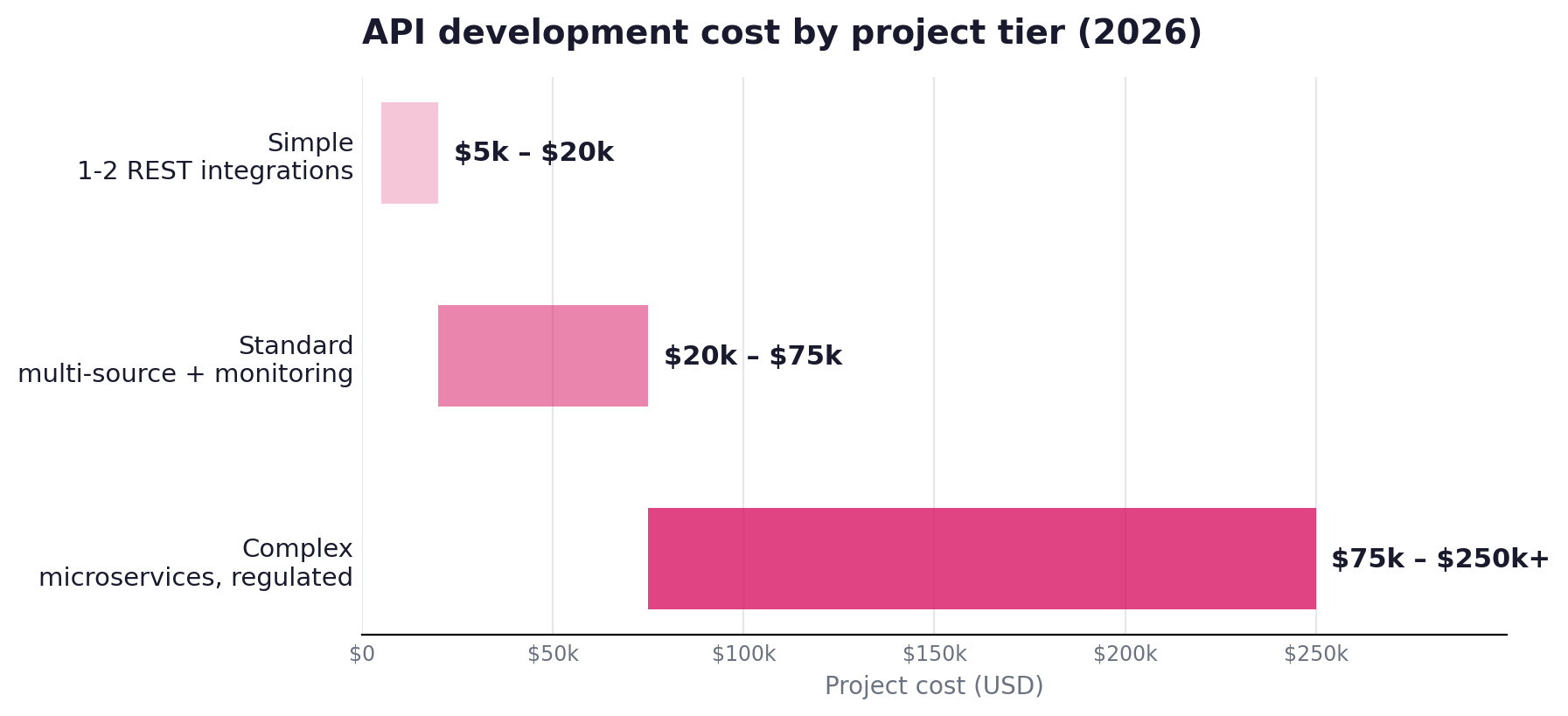
API development pricing depends on integration complexity, the number of endpoints, security requirements, and the seniority of the team. These ranges reflect typical custom development engagements, not platform subscriptions.
| Project tier | Scope | Typical cost |
|---|---|---|
| Simple | One or two REST integrations, standard auth, no custom data model | $5,000–$20,000 |
| Standard | Several integrations, normalized data layer, rate-limit handling, monitoring | $20,000–$75,000 |
| Complex | Many sources, microservices, high throughput, regulated-data compliance | $75,000–$250,000+ |
Regional hourly rates shape the total. Eastern European and Indian firms commonly fall in the $25–49 range, while US-based and large enterprise vendors run $50–99 or higher. A $25–49 team is not automatically cheaper over three years: the deciding factor is how well they handle the five resilience signals, because rework and downtime cost far more than the hourly gap.
The bottom line
The biggest names on a directory are not automatically the best partner for your integration. What predicts success is how a company handles the edges: rate limits, schema drift, duplicate data, versioning, and the maintenance that starts the day after launch. Run every vendor through the API Resilience Test, ask the five diagnostic questions in the sales call, and match the firm's scale to your stage.
Brocoders builds custom APIs and integrations with that resilience built in, from a Strava and Garmin wearable integration that survived production rate limits to a backend rebuild that connected 80 times more properties. If you are planning an integration and want to talk through the five signals against your specific stack, schedule a call with our team. The lasting takeaway: score on resilience, not on logos.
Frequently Asked Questions
An API development company designs, builds, secures, and maintains the application programming interfaces that let software systems exchange data. That includes building custom APIs for your own product, integrating third-party APIs like payment gateways or wearable device data, normalizing data across sources, handling authentication and rate limits, and maintaining the integrations as upstream services change.
API development means building an API, often to expose your own product's data or functions to other systems. API integration means connecting to existing third-party APIs and making them work together inside your application. Most projects involve both. The fitness platform example in this list required integration with Strava, Garmin, and Google Fit, plus development of an internal module to normalize and route that data.
A single standard REST integration with normal authentication can take two to four weeks. A complex, multi-source integration with a custom data model, rate-limit handling, and monitoring can run two to four months. Timelines depend heavily on the quality of the third-party documentation and how many edge cases, like rate limits and oversized payloads, surface during development.
Look beyond team size and star ratings. Evaluate how the company handles rate limits and throttling, whether it normalizes and deduplicates data at the API layer, who owns versioning and maintenance after launch, its security posture against the OWASP API Security Top 10, and whether monitoring ships with the build. Those five signals predict whether the integration holds up in production.
Simple integrations start around $5,000 to $20,000. Standard multi-integration projects run $20,000 to $75,000. Complex enterprise systems exceed $75,000 and can pass $250,000. Hourly rates range from $25–49 for Eastern European and Indian firms to $50–99 or more for US-based and enterprise vendors.
Startups usually benefit from mid-sized or cost-efficient firms that move quickly on focused builds, rather than enterprise vendors priced for large programs. Companies like Brocoders, Capital Numbers, and OpenXcell offer lower minimum project sizes and faster iteration, which suits an MVP or a first complex integration.
The good ones do, and you should require it. Third-party APIs change their schemas, deprecate endpoints, and adjust rate limits without much notice. A partner that owns versioning and maintenance absorbs those changes for you. Full-lifecycle firms like ScienceSoft and Brocoders include maintenance and monitoring rather than treating them as a separate, later phase.
Unified API platforms and iPaaS tools work well when your integrations fit their pre-built connectors and standard data models. A custom development company is the better choice when you need integrations the platforms do not cover, a data model specific to your product, deep control over performance and security, or a build that goes beyond connecting off-the-shelf endpoints.