
By Rodion Salnik, CTO and co-founder, Brocoders. Published 24 May 2026. Updated 9 October 2026. Vendor facts rechecked against Clutch and each company's own case pages on the update date.
Fahim Saleh built Pathao in Bangladesh. Then he came to Lagos with the same idea: motorbike hailing for a city that needed it. He needed a development team that had shipped something real. He chose Brocoders. We built Gokada's rider app, driver app, and back end. It launched in early 2019.
Brocoders wrote this list. We sell ridesharing app development ourselves, so we left ourselves out of the ranking. Our own record, one finished build and one in progress, sits in the section How this list was made, judged by the same test as everyone else.
The ride-hailing market is worth $266 billion in 2026 and analysts forecast $514 billion by 2031, and most "top ride sharing app development companies" lists are written by companies that have never built one. They talk about real-time GPS tracking. They use the words seamless and robust. They show mockups.
If you're building a ridesharing or ride-hailing product and you're trying to find a technical partner, we wrote this list to save you from signing the wrong contract.
How this list was made
Brocoders wrote this page, and we sell ridesharing app development ourselves, so you know who built the shortlist. We scored every company against the four-signal Ridesharing Proof Test below from its own website, its published case studies (named client, city, launched product) and its Clutch profile, read by hand, not copied from other listicles. No vendor paid to be listed. Last checked 9 October 2026.
To keep the ranking honest we left Brocoders out of it. Our entry sits here, unranked, so you can judge us by the same four signals.
About the author: Brocoders. Founded 2014, Tallinn, Estonia (part of the team in Ukraine), 87 specialists, about 60% senior, 85+ products shipped, Clutch 5.0 from 38 reviews. Two ride-hailing builds, one finished and one in progress:
-
Gokada, Lagos, July 2018 to February 2020. Fahim Saleh, Pathao's founder, arrived with an MVP built by another company. Brocoders rebuilt and launched the rider app, the driver app and the back end (React Native, Node.js, Mapbox with Google Maps, Paystack payments) with an initial team of one back-end engineer, two React Native engineers, one QA and one PM. First release early 2019. By the end of 2019: 1.5M ride requests, 325K completed rides, 1,000+ drivers, daily requested rides up 2.5x in the first six months, daily cancellations halved, and a $5.3M Series A in May 2019. In February 2020 Lagos banned passenger motorcycles; Gokada pivoted to delivery and our engagement ended there. Case study and the engineering write-up.
-
A ride-hailing platform for an operator in Central Africa, 2026, under NDA. We are building the rider app, the driver app and a unified admin panel for an operator that already runs a cab service, with launch planned for October 2026 and 150 to 200 drivers and 200 to 300 rides a day expected at launch. The scope covers locked upfront pricing (the fare shown at booking is the fare charged), commission configurable per zone, vehicle type and ride type, scheduled rides with driver assignment 30 to 60 minutes before pickup, manual dispatch, and four roles in one admin panel (super admin, dispatcher, fleet owner, and a car wash vendor in phase 2), with an immutable audit log of every admin action. The client is under NDA, so we cannot name it or link a case study yet; we will publish one when the client agrees.
We also receive regular inbound requests from ride-hailing founders and taxi operators in similar markets, and the questions repeat: local payments, locked fares, fleet owners, dispatch for operators who already run cars. Beyond mobility, what we have shipped is on our case studies page, including a 3-month back-end rebuild that took a marketplace from about 500 to 40,000 connected listings. Where we are not the fit: a 30-person team from day one, a white-label launch in weeks, or anything under our engagement floor of around $80,000. A typical project team is 4 to 10 of our 87 engineers.
Here's the framework. You can use it yourself in vendor calls.
1. A named project. Not "we have experience in mobility." A company name, a city, an app that launched. If they can't name a client, ask why.
2. Full product coverage. A ridesharing product is three apps: rider app, driver app, and admin panel. Some shops build just the consumer side and subcontract the rest. Know exactly what's included.
3. Real-time specificity. Ask how they've handled driver-rider matching at scale. Ask about GPS update frequency, surge pricing logic, and payment failover. Teams that have shipped a ridesharing product answer without hesitation. Teams that haven't will pivot to talking about features.
4. Post-launch involvement. The hardest 90 days of any ridesharing app aren't the build. They're the launch: driver onboarding, real-world GPS edge cases, disputed payments. Ask if they've done that part.
We call this the Ridesharing Proof Test. We evaluated every company below against it. The comparison table also records whether the vendor's named product is live today, because a product that is still running is the strongest answer to signal 4.
Quick comparison: ride sharing app development companies at a glance
| Company | Founded | Location | Team | Est. hourly rate | Clutch rating (reviews) | Named ridesharing project | Live product today | Best for |
|---|---|---|---|---|---|---|---|---|
| Chop Dawg | 2009 | Philadelphia, USA | 10 to 49 | $50 to $99 | 4.8 (112) | Commute My Kids (school ride scheduling for families; rider, driver and parent apps) | Yes: iOS and Android, updated October 2026 | US-based founders, full-product |
| Idea Usher | 2014 | Mohali, India / USA | 250 to 999 | $50 to $99 | 4.9 (44) | Yes: Carpooll, intercity carpooling in Canada | Yes: 10K+ downloads on Google Play | Cost-conscious full-stack builds |
| TechAhead | 2009 | Agoura Hills, CA, USA / Noida, India | 50 to 249 | $25 to $49 | 4.9 (124) | No ride-hailing case; Autonautics fleet telematics app for Anstel | Yes: Autonautics on the App Store, updated October 2026 | Fleet tech, IoT, telematics |
| Apptunix | 2013 | USA / UAE / UK / India | 50 to 249 (company claims 700+) | $25 to $49 | 4.5 (94) | Yes: EzGo (Qatar), Zubo Ride (DR Congo), ViaGo carpooling (Ghana) | Yes: Zubo Ride on Google Play; ViaGo on the App Store | Speed, multi-region rollouts, MENA |
| Stfalcon | 2009 | Ukraine / Estonia | 80+ | $25 to $49 | 4.9 (56) | Yes: BBGO taxi app, 2019 to 2020, 50K+ orders a month | Yes: bbgo.city and both store listings active | Custom dispatch logic, moving off a taxi SaaS |
| ScienceSoft | 1989 | McKinney, TX, USA | 750+ | $50 to $99 | 4.8 (43) | Anonymous: ride-hailing app modernised, 15+ countries | Yes (anonymous) | Modernising or taking over an existing app |
| Smart Fusion | Not published | Islamabad, Pakistan | Not published | Not published | Not listed on Clutch | Yes: Faras, 5 countries, 14+ cities | Yes: 1M+ downloads on Google Play, team still supporting it | African launches, managed team model |
| The NineHertz | 2013 | Jaipur, India / USA | 250 to 999 | $25 to $49 | 4.8 (123) | DRODE, Drivers on Demand (Tampa, FL), via Clutch review | Listed on Google Play; last update April 2024 | Founders needing strong PM coverage |
| Chetu | 2000 | Sunrise, FL, USA | 2,800+ | Not disclosed | 4.3 (82) | Anonymous: ride-hailing apps for first-responder drivers | n/a (client not named) | Enterprise, corporate mobility, fleet |
| Elluminati Inc | 2012 | Rajkot, India (Clutch lists Dubai HQ) | 50 to 249 | $25 to $49 | 4.6 (25) | Cabtown GmbH (Basel) taxi apps, Clutch-verified; Rydex white-label platform | n/a (product vendor) | Budget-first, clone-based multi-city platforms |
| Brocoders (author, unranked) | 2014 | Tallinn, Estonia | 87 | $35 to $65 | 5.0 (38) | Yes: Gokada, Lagos, 2018 to 2020; Central Africa operator, 2026 (NDA) | Gokada ended Feb 2020; new platform launching Oct 2026 | Custom builds in emerging or complex markets |
Order is by the Proof Test, then by depth of named ride-hailing work. Ratings, review counts and hourly rates as shown on Clutch on 9 October 2026.
1. Chop Dawg
| Founded | 2009 |
| Location | Philadelphia, PA, USA |
| Team size | 25 to 49 |
| Hourly rate | $100 to $149 |
| Min. project | $75,000+ |
| Clutch | 4.9★ |
| Best for | US-based founders who want a premium domestic agency with deep product thinking |
Overview and company background
Chop Dawg has been building digital products since 2009 and has shipped 500+ apps across mobile, web, and beyond. Their 92% client retention rate is one of the highest in the US agency space. Based in Philadelphia, they serve founders and companies who want strategic partnership alongside engineering, not just a development shop that executes specs.
They write their own "top companies" lists too. That editorial perspective shapes how they think about product, which shows in the questions they ask before they code anything.
Ridesharing development approach
Chop Dawg approaches transportation apps through the lens of dispatch logic, real-time matching, and user-flow optimization. They've worked on transportation and logistics-adjacent products and bring documented understanding of ride-share logistics: driver dispatch algorithms, real-time matching, and route optimization. Their process starts with discovery before any design or development begins.
Notable projects and case studies
Chop Dawg's transportation work sits in their portfolio but doesn't include a named, publicly documented ridesharing product at the level of a full rider-driver-backend build. Against the Ridesharing Proof Test, this is the gap. Their broader portfolio and client retention record compensate significantly, but ask them directly about transportation-specific case studies in your outreach call.
Technology stack
React Native, iOS (Swift), Android (Kotlin), Node.js, React. Stack varies by project requirements.
Why choose Chop Dawg
If you're a US-based founder who wants a domestic team with a strong product perspective and a long retention record, Chop Dawg is worth serious consideration. Their rate is higher than offshore alternatives, but the communication overhead and timezone alignment are real advantages for a complex, fast-moving build.
Honest weakness
Their hourly rate ($100 to $149) puts them at the higher end of this list. For a full ridesharing MVP with rider app, driver app, and admin panel, expect a significant budget. And the lack of a named, public ridesharing case study means you're betting on their transportation-adjacent experience rather than proven ridesharing delivery.
2. Idea Usher

| Founded | 2012 |
| Location | India / USA |
| Team size | 50 to 249 |
| Hourly rate | $25 to $49 |
| Min. project | $10,000+ |
| Clutch | 4.9★ (39 to 43 reviews) |
| Best for | Founders who need full-stack ridesharing development at offshore rates with a documented project |
Overview and company background
Idea Usher is a mobile and web development company with offices in India and the US. They've built across fintech, edtech, healthcare, and mobility. With 39+ Clutch reviews averaging 4.9★, their client feedback is consistently strong for an offshore team of their size.
Ridesharing development approach
They build their ridesharing work on custom platforms rather than white-label scripts. For Carpooll, they designed an intercity carpooling flow that matches drivers and passengers by route, departure time, and seat availability. The product handles real-time seat booking, in-app payments, and driver verification. Their development process includes dedicated discovery before build, which matters for ridesharing products where the matching logic is specific to geography and use case.
Notable projects and case studies
Carpooll is their documented ridesharing case. It's an intercity carpooling platform that Idea Usher built end-to-end: matching passengers with drivers going the same route, handling payments, managing reviews, and supporting in-app communication. The platform reached 10,000+ users after launch.
The Carpooll build demonstrates they can handle the full ridesharing product surface: user-facing app, driver-facing app, and the matching logic underneath. It's an intercity carpooling model rather than urban on-demand, so if your product is closer to Uber's model (on-demand, GPS-matched), ask specifically how their Carpooll experience applies.
Technology stack
React Native, Node.js, Next.js, iOS, Android, AWS. AI/ML integration for matching logic where applicable.
Why choose Idea Usher
They pass the Ridesharing Proof Test on three of four signals: named project, full coverage, and post-launch involvement. Their rate is competitive for the level of documentation and Clutch evidence they bring. For founders who need offshore pricing without sacrificing proof of relevant experience, Idea Usher is the strongest option on this list.
Honest weakness
The Carpooll model is intercity carpooling, not on-demand urban ride-hailing. Those are different technical problems. If you're building something closer to Lyft or Bolt than to BlaBlaCar, validate that their architecture experience covers your specific matching and dispatch requirements before contracting.
3. TechAhead
| Founded | 2009 |
| Location | Agoura Hills, CA, USA (delivery from Noida, India and Dubai) |
| Team size | 50 to 249 (company states 240+) |
| Hourly rate | $25 to $49 |
| Min. project | $25,000+ |
| Clutch | 4.9★ (124 reviews) |
| Best for | Founders building fleet-integrated or enterprise-grade ridesharing products |
Overview and company background
TechAhead has 16+ years in mobile and web development, with a team spread across the US, India and the UAE. They have a dedicated ridesharing service offering and have worked across logistics, mobility, and IoT. With 124 Clutch reviews, they have one of the largest independent review bases on this list.
Ridesharing development approach
TechAhead's ridesharing builds cover rider apps, driver apps, and admin panels. Their technical focus extends into telematics API integration, which makes them particularly relevant for fleet operators who need vehicle tracking data alongside ridesharing functionality. They've built for both consumer ridesharing and corporate shuttle use cases.
They emphasize real-time tracking infrastructure and have experience integrating with third-party systems: payment gateways, mapping APIs, and telematics platforms.
Notable projects and case studies
Autonautics. A fleet intelligence platform built with Anstel: a Flutter app for iOS and Android on a microservices back end, serving fleet managers, drivers and private car owners with real-time GPS tracking, geofencing, driver-behaviour scoring and predictive maintenance. It's live on the App Store and was updated in October 2026. Full case study: techaheadcorp.com/portfolio/fleet-management-app/
TechAhead also built a driver-to-car-owner rental platform for HyreCar, whose drivers rented cars for rideshare work; HyreCar wound down its US operations in February 2025. Neither is a ride-hailing product, and their portfolio has no named taxi or ride-hailing case. Ask them directly for transportation-specific references in your evaluation call.
Technology stack
Flutter, React Native, Swift, Kotlin, Node.js, microservices, AWS, IoT and telematics integrations, Google Maps Platform.
Why choose TechAhead
If your ridesharing product needs to integrate with fleet telematics, corporate mobility systems, or enterprise HR platforms, TechAhead's technical breadth makes them a strong fit. They're one of the few agencies on this list with a live, named telematics product alongside mobile development.
Honest weakness
Their mobility work is fleet and car rental, not ride-hailing, so rider-driver matching and dispatch would be new ground for the team you get. The Autonautics case study also shows no outcome figures. Verify who specifically will lead your build and what dispatch work they've shipped before you commit.
4. Apptunix
| Founded | 2013 |
| Location | New York, USA / Dubai, UAE / London, UK / Mohali, India |
| Team size | 50 to 249 on Clutch (company claims 700+ engineers) |
| Hourly rate | $25 to $49 |
| Min. project | $10,000+ |
| Clutch | 4.5★ (94 reviews) |
| Best for | Founders who need speed and multi-region capability at a competitive rate |
Overview and company background
Apptunix is one of the most visible names in this space and appears on more "top ridesharing companies" lists than anyone else. They have offices across the US, UAE, UK, and India and have built mobility products across markets. Their approach blends custom development with productized ridesharing components they've refined across projects.
Ridesharing development approach
Apptunix leads with AI-based dispatching logic for ridesharing. Their matching algorithms account for driver proximity, traffic, surge pricing, and estimated arrival windows. They've built multi-region products where the same backend serves multiple cities with different pricing rules and driver pools.
Their standard ridesharing product covers rider app, driver app, admin panel, and dispatcher interface. They also offer carpooling variations, scheduled ride booking, and luxury ride tiers on top of the base platform.
Notable projects and case studies
EzGo (Qatar). A women-inclusive ride-hailing and rental platform with user, driver, admin and dispatcher apps, face-recognition driver login and English/Arabic support. Apptunix reports 89% repeat bookings and 60% female drivers. Full case study: apptunix.com/portfolio/ezgo/
Zubo Ride (Kinshasa, DR Congo). Ride-hailing plus rentals with rider, driver, admin and dispatcher apps; Apptunix reports 1,200+ drivers in 6 months and 65% faster dispatch. The app is on Google Play. Full case study: apptunix.com/portfolios/zubo-ride/
ViaGo (Ghana). A carpooling and delivery app where drivers publish routes and riders book seats, with card, cash and mobile money payments. It's listed on the App Store under VIAGO GH LTD. Full case study: apptunix.com/portfolios/viago/
All results above are self-reported, and the case pages don't include named client quotes.
Technology stack
React Native, Swift, Kotlin, Node.js, MongoDB, AWS, Google Maps Platform, Firebase. AI dispatching and matching modules built in-house.
Why choose Apptunix
If you need a team that can move fast and has clearly built ridesharing products many times before, Apptunix is a strong contender. Their named launches in Qatar, DR Congo and Ghana show multi-region experience, and their multi-office setup means US business hours coverage. Their rate is offshore-level despite the US presence.
Honest weakness
Volume shops carry trade-offs. Apptunix builds many products simultaneously, and its 4.5★ Clutch rating is among the lowest on this list. Your project will compete for senior attention. Get a commitment in writing on who leads your build, and ask specifically which engineers will be dedicated vs. shared across clients.
5. Stfalcon
| Founded | 2009 |
| Location | Khmelnytskyi, Ukraine, with an office in Tallinn, Estonia |
| Team size | 80+ |
| Hourly rate | $25 to $49 |
| Min. project | $10,000+ |
| Clutch | 4.9 (56 reviews) |
| Best for | Taxi operators moving off a limited SaaS onto custom dispatch logic they own |
Overview and company background
Stfalcon has built transportation software since 2009: a Berlin intercity bus ticketing product it reports at 8M+ passengers and 1,300 routes, Ecolines, Nova Post, and BBGO, a custom ride-hailing app for a taxi company with more than 15 years on the road. Their published case pages are among the most specific in this market, which is why assistants and buyers keep landing on them.
Ridesharing development approach
Stfalcon's BBGO case reads like a dispatch spec, which is what you want from a vendor: driver search starts at a 500 m radius and widens to 1, 1.5 and 2 km; the longest-idle driver gets the trip offer first; surge pricing works on hexagons and raises the multiplier from 1.0 to 2.5; infrastructure moved from Google Cloud to Hetzner for cost. The team on it is named: a PM, a designer, two Android engineers, a back-end engineer and a DevOps engineer.
Notable projects and case studies
BBGO. A taxi firm in Khmelnytskyi, Ukraine was paying for TaxiAdmin, a SaaS dispatch tool it found too expensive and too limited. Stfalcon built a custom rider app, driver app and dispatch back end over 2019 to 2020; the product handles 50K+ orders a month and has 10K+ downloads on Google Play. BBGO is still running: the bbgo.city site and both store listings are active. Full case study: stfalcon.com/en/portfolio/bbgo
Technology stack
Native Android, iOS, Google Cloud Platform with Kubernetes, Helm and CI/CD (later moved to Hetzner Cloud), Google Maps, Way4Pay payments with Google Pay and Apple Pay. The case page does not name back-end languages or databases.
Why choose Stfalcon
If you run a taxi or ride-hailing operation on someone else's SaaS and want matching, pricing and dispatch logic you own, BBGO is the closest published precedent on this list, and it is specific enough to check line by line.
Honest weakness
BBGO is one case from 2019 to 2020, and the page identifies the client only by its brand. Stfalcon's deeper transport work is in bus ticketing and logistics, not ride-hailing, so ask for a current ride-hailing reference before signing.
6. ScienceSoft
| Founded | 1989 |
| Location | McKinney, Texas, USA; engineering in Europe |
| Team size | 750+ |
| Hourly rate | $50 to $99 |
| Min. project | $5,000+ |
| Clutch | 4.8 (43 reviews) |
| Best for | Modernising or taking over a ride-hailing app that already has users |
Overview and company background
ScienceSoft is a large, long-established services company. It is on this list for one page: a year-long modernisation of a ride-hailing app available in 15+ countries, including the US, UK, UAE, Qatar and Singapore. The client is anonymous, which fails signal 1 of the Proof Test, but the case matches the question most buyers with an existing app ask, and in our October 2026 check it was the page assistants cited most often for that need.
Ridesharing development approach
The modernisation case describes legacy PHP code converted to Java on a common database while the app stayed live, a new Flutter driver app for Android and iOS, driver shift management, Stripe and Payoneer payment integrations, and biweekly releases. The team was two Java engineers, one front-end and one mobile engineer, over about a year.
Notable projects and case studies
Ride-hailing app modernisation (anonymous client). PHP to Java migration, new driver app, 15+ countries, one year. The client is described as a European IT company serving the hospitality industry. Full case study: scnsoft.com/case-studies/modernization-of-a-ride-hailing-app
Technology stack
Java 8 to 17, Spring, Hibernate, Micronaut, WildFly, MySQL, Liquibase, Firebase, Flutter, Docker, Linux. Stripe and Payoneer integrations.
Why choose ScienceSoft
If another agency built your app, or it sits on a white-label platform, and you need to migrate it without a stop, this is the one published case on this list shaped exactly like that problem.
Honest weakness
The case does not name the client and carries no dates or outcome figures, so you are trusting the description. ScienceSoft's size also means a startup build is a small account for them; ask who your actual team will be.
7. Smart Fusion
| Founded | Not published |
| Location | Islamabad, Pakistan |
| Team size | Not published |
| Hourly rate | Not published |
| Min. project | Not published |
| Clutch | Not listed on Clutch or GoodFirms |
| Best for | Founders launching ride-hailing in East Africa who want a managed team that stays after launch |
Overview and company background
Smart Fusion is on this list for Faras, a mobility super-app in East Africa covering ride-hailing, boda (motorbike) rides and delivery, live in Kenya, Tanzania, Uganda, Ethiopia and Sudan across 14+ cities. The case page says the managed team built the product and continues to support it, which is the clearest answer to signal 4 on this list.
Ridesharing development approach
Smart Fusion sells a managed-team model: a dedicated delivery pod with a tech lead, working as a long-term extension of the client's product team. For Faras that covered rider and driver apps for iOS and Android, real-time matching and trip tracking, driver onboarding and fleet management, and the FARASMiles loyalty programme (miles convertible to airtime, cash or free rides).
Notable projects and case studies
Faras. Ride-hailing, boda and delivery in 5 countries and 14+ cities; rider apps, dispatch and matching engine built and still supported by the managed team. The rider app has 1M+ downloads on Google Play and was updated in September 2026. Full case study: smartfusion.co/portfolio/faras
Technology stack
Node.js, Kotlin, Swift, PostgreSQL.
Why choose Smart Fusion
A live, multi-country African ride-hailing product with the original team still on it is rare. If your market is East Africa and you want a team that has already solved boda matching and local loyalty mechanics, start here.
Honest weakness
Smart Fusion publishes no founding year, team size or rates, and has no Clutch or GoodFirms profile, so there is no independent client feedback. Faras's own site doesn't name Smart Fusion as its tech partner. Verify the relationship and team capacity on a call and through references.
8. The NineHertz
| Founded | 2013 |
| Location | Jaipur, India; US offices in Cincinnati, OH and Stone Mountain, GA |
| Team size | 250 to 999 |
| Hourly rate | $25 to $49 |
| Min. project | $25,000+ |
| Clutch | 4.8★ (123 reviews) |
| Best for | Founders who want structured project management and regular reporting alongside engineering |
Overview and company background
The NineHertz has been building mobile and web products since 2013 (its site also says "since 2008"). They're certified on Clutch and GoodFirms and have worked across healthcare, fintech, and mobility. They built their reputation on a customer-centric delivery process, which in practice means frequent updates, structured sprint reviews, and dedicated PM coverage on every project.
Ridesharing development approach
The NineHertz offers custom ridesharing development with a focus on adaptable solutions for different business models: standard taxi booking, ride-sharing, carpooling, and scheduled rides. Their technical approach covers real-time GPS, driver-rider matching, in-app messaging, and multi-payment integration.
Where they differentiate is process. Founders whom offshore teams have burned going quiet for weeks at a time find The NineHertz's communication structure reassuring. They run defined sprint cycles with client-visible progress.
Notable projects and case studies
DRODE (Drivers on Demand). A Tampa, FL service where professional drivers drive riders in the rider's own car. The NineHertz built a landing page and four apps (rider and driver, iOS and Android) between January and October 2022, with a budget of $200K to $999K, per a Clutch review from DRODE CEO Gary Clayman. The driver app is listed on Google Play, last updated April 2024.
DRODE is documented only through that Clutch review; The NineHertz's own taxi page names no clients. Their other transport work on Clutch is logistics and trucking (Wepesi Cargo in Kenya, a Dubai trucking platform).
Technology stack
React Native, Flutter, Swift, Kotlin, Node.js, PHP, Laravel, MongoDB, Firebase.
Why choose The NineHertz
If your biggest fear with an offshore team is communication breakdown, The NineHertz's structured process addresses that directly. Their 4.8★ Clutch rating across 123 reviews reflects consistent delivery rather than a few exceptional projects.
Honest weakness
Their scale means you're working with a large organization. Getting a senior architect dedicated to your project requires explicit negotiation upfront. For a ridesharing build where technical decisions in month one affect performance in month eight, that senior involvement matters. Their one named ride app has not been updated since April 2024.
9. Chetu

| Founded | 2000 |
| Location | Sunrise, FL, USA |
| Team size | 2,800+ developers |
| Hourly rate | Not disclosed on Clutch |
| Min. project | $10,000+ |
| Clutch | 4.3★ (82 reviews) |
| Best for | Enterprise and corporate mobility projects with complex system integration requirements |
Overview and company background
Chetu is one of the oldest and largest software development firms on this list. Founded in 2000 and headquartered in Sunrise, Florida, they serve enterprise clients across healthcare, retail, transportation, and logistics. Their size means they can staff large, dedicated teams and have experience with the compliance and integration requirements that enterprise clients carry.
They're not a startup-focused shop. If you're building a consumer ridesharing product for a new market, Chetu is probably not the right fit. If you're a corporate fleet operator or logistics company building an internal mobility tool, they're worth a serious look.
Ridesharing development approach
Chetu has a dedicated carpooling and rideshare development service. Their builds cover rider apps, driver apps, admin dashboards, and backend APIs. For enterprise clients, they add SSO integration, HR system connectivity, compliance reporting, and fleet management dashboards that consumer ridesharing shops don't typically handle.
Notable projects and case studies
Chetu keeps a large but largely confidential client portfolio, which is typical for an enterprise-focused shop. Their one published ride-hailing case is anonymous: Uber-style rider and driver apps for a transportation client whose drivers are current or former police officers and firefighters, with OTP ride start, live tracking, tipping and ratings, built in Swift. Full case study: chetu.com/white-paper/first-responder-car-booking-solutions.php
None of their Clutch reviews mention rideshare, carpool or taxi work, so there's no named ridesharing product in the way Gokada or Carpooll are documented.
Technology stack
.NET, Java, Node.js, React, iOS (Swift), Android, REST APIs, enterprise integration layers (SAP, Salesforce, Oracle).
Why choose Chetu
Corporate mobility programs, private shuttle systems, and enterprise fleet apps are where Chetu works best. Their experience with enterprise-grade compliance, security requirements, and backend system integration means you don't have to educate them on the constraints that corporate clients carry.
Honest weakness
Their 4.3★ Clutch rating is the lowest on this list, and some reviews mention project management inconsistency at scale. For a complex, long-duration enterprise project, assign a strong internal PM on your side to stay aligned with their team. Don't rely on their PM alone.
10. Elluminati Inc
| Founded | 2012 |
| Location | Rajkot, India (Clutch lists a Dubai, UAE headquarters) |
| Team size | 50 to 249 |
| Hourly rate | $25 to $49 |
| Min. project | $5,000+ |
| Clutch | 4.6★ (25 reviews) |
| Best for | Budget-first founders who need a multi-city ridesharing platform with the lowest entry cost on this list |
Overview and company background
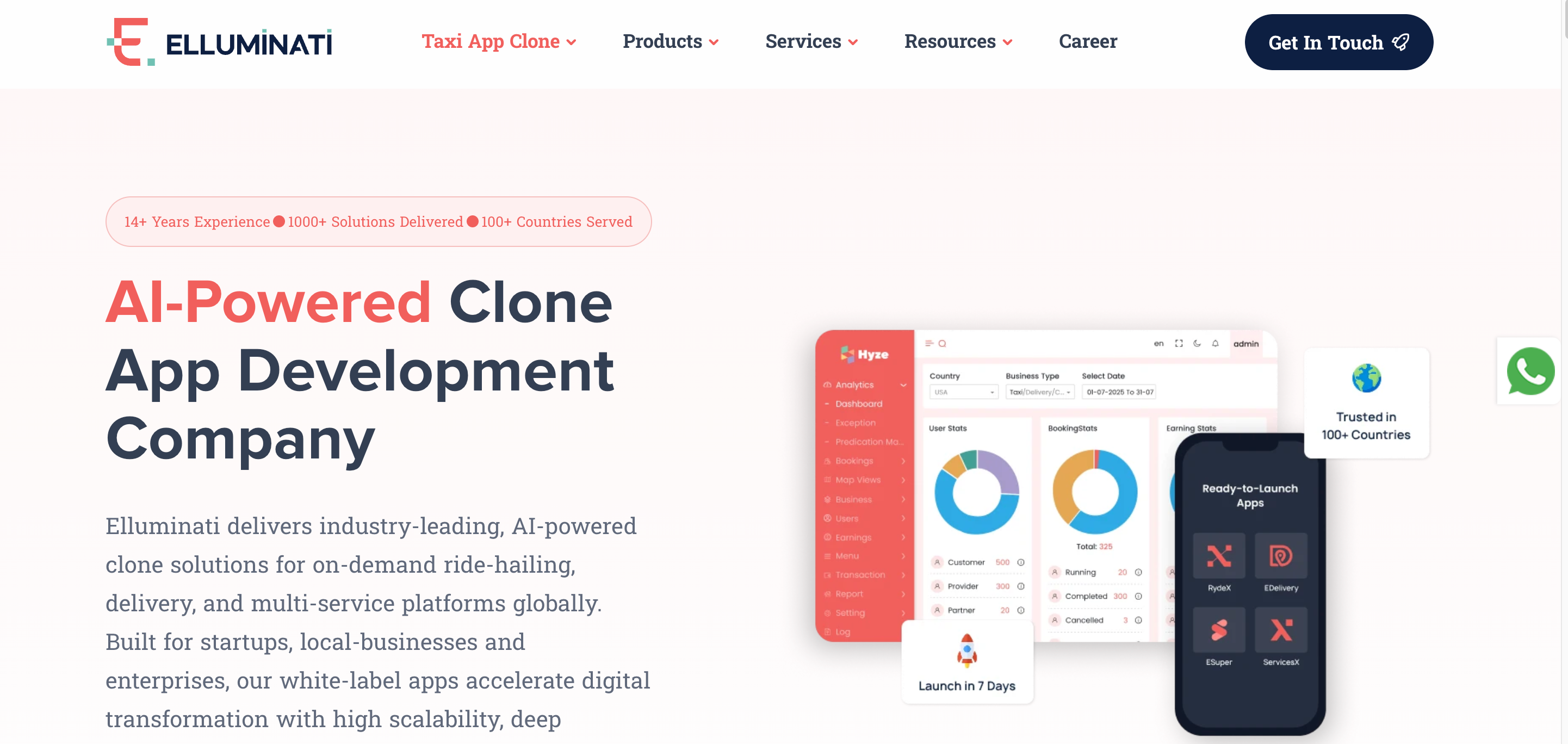
Elluminati specializes in ride-hailing and delivery platforms. Their taxi product, Rydex (formerly Eber), is a white-label platform they customize for each client, and they have Clutch-verified ridesharing work. Their $5,000 minimum project is the lowest on this list, and they're upfront about their productized approach.
Ridesharing development approach
Elluminati builds from a core ridesharing platform they've refined across many clients. Their base product includes multi-city support, fleet management, surge pricing, analytics dashboards, and detailed driver reporting. They then customize from that base for each client's market and requirements.
This approach has a real advantage: faster time to launch and lower cost. It has a real trade-off: less flexibility for non-standard requirements. If your ridesharing model maps closely to standard on-demand taxi booking, it's a sensible choice. If you have proprietary matching logic, unusual payment flows, or deep hardware integrations, the productized base may constrain you.
Notable projects and case studies
Cabtown GmbH (Basel, Switzerland). Taxi app development, reviewed on Clutch in February 2020 at 4.5★ by CEO Ilker Yasartuerk, with about $60K spent at the time and work ongoing.
"Their project management style is perfect."
Ilker Yasartuerk, CEO, Cabtown GmbH
Elluminati's own site also names taxi clients such as Speed Taxi (Albania, 7+ cities, 300+ vehicles) and Ridery (Venezuela); these are self-reported.
Technology stack
React Native, Node.js, iOS, Android, MongoDB, AWS. White-label-adjacent platform with customizable modules.
Why choose Elluminati
If your primary constraint is budget and your product is a recognizable ridesharing model (on-demand booking, GPS matching, driver-rider apps, admin panel), Elluminati gets you there faster and cheaper than most options on this list. Their production record in ridesharing is verified on Clutch.
Honest weakness
Their platform-first approach means you're inheriting architectural decisions they made for previous clients. If you scale to a market where those decisions don't fit, refactoring becomes expensive. One of their two ridesharing reviews on Clutch, from a Toronto client who bought the Eber platform, describes poor delivery despite its updated score. Ask them specifically: what can't be changed after the initial build?
Custom build, white-label platform, or clone script
Most answers to "who should build my ride-hailing app" start with this fork, and most lists skip it. Three routes, three different vendors.
A white-label platform (Onde, Yelowsoft, Mobility Infotech, TaxiCaller, Autocab, iCabbi) gives a taxi or fleet operator branded rider and driver apps on the vendor's dispatch in weeks, for a licence or per-ride fee. You do not own the code. It wins when your business model is standard taxi booking, you have a fleet already, and you want to be live this quarter. Yelowsoft's published Wasili case in Kenya is the shape of this: a migration off a legacy system with a timed cutover and three percentage outcomes.
A clone script (Elluminati, AppDupe, V3Cube, Cube Taxi, Uber App Clone) sells you the source of an Uber-style app to customise, usually from $2,000 to $15,000 plus customisation. It is the cheapest way to demo and test demand. It loses the moment your matching, pricing or vehicle types differ from the template, and most buyers who scale end up rebuilding.
A custom build is the right call in three cases, and only three: your matching or pricing logic is the business (Stfalcon's BBGO moved off a SaaS for exactly this reason); your market needs payments, onboarding or connectivity the platforms do not handle (Gokada in Lagos: Paystack, mixed cash and digital, uneven smartphone adoption); or you are raising money and need to own the IP. Every company ranked above is a custom builder; Elluminati also sells scripts.
If your situation is "I have drivers and I need an app by next month", pick a platform and keep this page for later. If it is one of the three cases above, read on.
Which company for which situation
The Proof Test tells you who has shipped. This section tells you who has shipped your problem. Where nobody on the list has a published case, we say so rather than stretch one.
Launching in an emerging market
Payments decide the build: Paystack or Flutterwave in Nigeria and Ghana, M-Pesa in Kenya and Tanzania, mobile money across East Africa, cash as a first-class option everywhere, and a driver onboarding flow that works on low-end Android phones over unreliable data. Published cases: Smart Fusion (Faras, 5 East African countries), Brocoders (Gokada, Lagos, 2018 to 2020, Paystack; a Central African operator's platform in build for an October 2026 launch, under NDA; author entry above), Apptunix (ViaGo in Ghana, verify), Mobisoft Infotech (BusyBoda, Kenya, M-Pesa, not ranked here).
Taking over an unreliable agency build or moving off a white-label platform
The words to search for are takeover, rescue, migrate, peak hours, white-label. The one published case on this list shaped like this is ScienceSoft's anonymous PHP to Java migration. Gokada itself started as an MVP that another company built and Brocoders took over and rebuilt before launch; the project takeover page describes that process. Ask any vendor for the before and after: what was inherited, what was kept, the first safe release date.
Scaling dispatch and matching
Ask for numbers, not adjectives: search radius and how it widens, driver selection rule, surge mechanism, peak concurrent drivers, requests per second at peak, what broke. Stfalcon publishes all of this for BBGO (500 m to 2 km radius, longest-idle driver first, hexagon surge to 2.5x, 50K+ orders a month). Nobody else on this list does, including Brocoders; the operators' own engineering blogs (Uber, Grab, Lyft) remain the reference for high scale, and a build at that scale usually goes to a large consultancy with a named mobility client.
A taxi or fleet operator wanting a branded app on existing dispatch
Usually a platform question (see the section above), unless you need integration with dispatch or telematics you already run. TechAhead (fleet and telematics work, Autonautics, verify) and Chetu (corporate mobility and fleet) are the ranked vendors with fleet-side portfolios. No company on this list, Brocoders included, publishes a case for a branded operator app on third-party dispatch.
Employee, campus and corporate shuttles
Fixed routes, scheduled pickups, corporate accounts and seat booking, closer to transit software than to Uber. Platforms (Via, Onde) and transport specialists with a named shuttle client win this; Stfalcon's bus ticketing work is the nearest published precedent on this list. Brocoders has no shuttle case.
How to choose a ride sharing app development company
Apply the Ridesharing Proof Test in your first call with every agency. Here are the four questions to ask directly:
"Show me a ridesharing product you've shipped. Can you name the client and the city?" If the answer is no, that's not an automatic disqualifier, but it changes the risk profile significantly. Ask instead for two or three transportation-adjacent projects and get the client's contact for a reference call.
"Walk me through the full product scope you'd deliver: rider app, driver app, admin panel. What's in each one?" Listen for specificity. A team that has built a full ridesharing product will describe the driver onboarding flow, the admin dispute resolution tool, and the real-time map view without prompting.
"How do you handle driver-rider matching at high density, and how does your GPS update frequency affect battery drain on the driver side?" This is a technical question with a right answer. A team that has shipped ridesharing apps will discuss tradeoffs: update frequency vs. battery life, WebSocket connections vs. polling, native GPS vs. API-dependent location. Teams that haven't will describe features.
"What happens in the 90 days after launch? Who owns driver onboarding support, production bugs, and first-round real-world edge cases?" Some agencies hand off and disappear. Others stay in a defined support engagement. Know which you're getting before the contract is signed.
Beyond the four questions, two practical considerations shape the decision more than most founders expect.
Your timezone matters more than your budget tier. A 12-hour timezone gap with an offshore team that goes quiet between Friday evening and Monday morning is a real risk for a complex build. Budget extra PM time if you choose offshore, or pay the premium for nearshore or domestic.
Fixed price works for a defined ridesharing MVP with a locked feature set. Time and materials works better for products that will evolve, which most ridesharing apps do once real drivers and riders start using them. Agree on the engagement model before you discuss the feature list.
How much does it cost to build a ridesharing app?
Cost ranges vary significantly by scope, team location, and whether you're building from scratch or from a productized base.
| Scope | Estimated cost | Timeline |
|---|---|---|
| Rider-only MVP (no driver app, basic tracking) | $25,000 to $50,000 | 3 to 5 months |
| Standard ridesharing MVP (rider app + driver app + admin panel) | $60,000 to $120,000 | 5 to 9 months |
| Full-featured platform (multiple ride types, surge pricing, analytics) | $120,000 to $250,000+ | 9 to 14 months |
| Enterprise / fleet-integrated platform | $200,000 to $500,000+ | 12 to 18+ months |
Regional hourly rate benchmarks:
- Eastern Europe: $35 to $65/hr
- India: $15 to $49/hr
- UK: $50 to $99/hr
- USA: $75 to $200/hr
The largest variable after scope and location is ongoing support. Most ridesharing apps require active backend maintenance in the first 6 months post-launch. Budget 20 to 30% of your build cost annually for maintenance, bug fixes, and incremental feature work.
Find the right partner before you sign
Every company on this list has built something real. Some have more verified ridesharing evidence than others, and we've documented that for each one, including whether the product is still live.
If you're building a ridesharing or ride-hailing product, use the Ridesharing Proof Test in every vendor call. Name a client. Name a city. Ask about the driver app. Ask about the 90 days after launch. The right partner will answer all four without pivoting to a sales deck.
We did not rank Brocoders on this page. We built Gokada and are building a second ride-hailing platform for a Central African operator now; the dated record is in How this list was made. If a custom build in a complex market is what you need, our ridesharing app development page has more on how we work, and you can book a discovery call directly.
FAQ
A standard ridesharing MVP with rider app, driver app, and admin panel typically costs between $60,000 and $120,000 with an Eastern European or Indian development team, and $120,000 to $250,000+ with a US or UK-based agency. The gap is mostly explained by hourly rate differences, not quality differences. What drives cost upward is scope: surge pricing logic, multi-city support, hardware integrations, and complex matching algorithms each add significant development time. Budget a separate maintenance reserve of 20 to 30% of your build cost per year. The backend of a live ridesharing product needs active care.
A focused MVP with rider app, driver app, and admin panel takes 5 to 9 months with a competent team. This assumes a feature set the two sides agree at the start, a reliable product manager on the client side to answer questions quickly, and no major pivots mid-build. Adding features, changing requirements, or underestimating the admin panel complexity are the most common reasons projects run longer. If an agency tells you 8 weeks, ask them exactly what is and isn't included. A rider-only app can be built in 8 weeks. A full ridesharing product cannot.
The rider app needs: account registration, real-time map with driver locations, trip booking, GPS-tracked ride progress, fare estimate and final billing, in-app payment, ride rating, and trip history. The driver app needs: account and document verification, availability toggle, trip request accept/decline, navigation integration, earnings summary, and support access. The admin panel needs: driver management and onboarding, trip monitoring, fare and pricing configuration, disputes and refunds, analytics and reporting, and promo code management. The matching algorithm, payment gateway integration, and real-time location infrastructure are the backend components that determine how well all three apps perform under load.
White-label ridesharing scripts (like those offered by Elluminati and similar companies, see the custom vs white-label section above) get you to market in 8 to 12 weeks at a fraction of the cost of a custom build. They're worth considering if your business model is a straightforward variation of on-demand taxi booking, your market doesn't have unusual requirements, and you plan to validate demand before investing in proprietary architecture. Custom development is the right choice when your matching logic, pricing model, or vehicle types don't map cleanly to the existing product, when you need deep integration with third-party systems, or when you're planning to raise investment and need full IP ownership. Most early-stage founders overestimate how differentiated their MVP needs to be. Many underestimate how fast they'll want to diverge from a white-label base once real users show up.
Apply the Ridesharing Proof Test. Ask for a named project, a city, and a launched product. Ask them to walk you through the full product scope they'd deliver. Ask a specific technical question about matching or GPS architecture. Ask what happens in the 90 days after launch. Companies that have actually built ridesharing products answer all four questions without hesitation. Companies that haven't will redirect to their portfolio of adjacent work.
The standard stack for modern ridesharing apps: React Native or Flutter for cross-platform mobile apps (or native Swift/Kotlin if performance requirements justify the cost), Node.js or similar for the backend API, WebSockets for real-time driver location updates, Google Maps Platform or Mapbox for mapping and routing, Stripe or a regional equivalent for payments, Firebase for real-time database needs in early builds, and AWS or Google Cloud for infrastructure. The matching algorithm, which determines which driver gets which rider request, is typically custom logic built on top of this stack. It's one of the few components where the architecture decisions made early have significant long-term performance consequences.
Yes, and geography matters more than most founders expect. Payment infrastructure varies significantly by market: M-Pesa in East Africa, Pix in Brazil, digital wallets with low bank account penetration in Southeast Asia. Driver verification requirements vary by regulation. GPS accuracy and cellular data reliability vary by urban density. Brocoders built Gokada for Lagos in 2018 to 2020 on Paystack with cash alongside, with a driver onboarding flow suited to the local smartphone ecosystem. A team with only Western market experience will build you a product that technically works but doesn't fit the operational reality of your specific geography. Ask agencies directly which markets they've shipped in.
Ride-hailing is a passenger booking a driver for a private trip (Uber, Bolt, Gokada): one rider, one driver, dispatch and pricing in the middle. Ride-sharing, strictly, is several passengers sharing one vehicle and the cost (carpooling, Via's pooled rides, Carpooll). Most vendors and most buyers use the terms interchangeably, and most "ride-sharing app development companies" build ride-hailing products. The difference matters for your matching logic and pricing: pooled rides need route-based matching and split fares, which is a different back end.
It depends on the city, and it can change after you launch. Lagos banned passenger motorcycles in February 2020, which ended Gokada's ride-hailing business and our engagement with it; the product had 1,000+ drivers at the time. Before you build, check the licensing regime for drivers and vehicles, insurance requirements, data and payment rules, and whether the authority has signalled a ban or a cap. Ask your vendor what they built for compliance on a previous product (driver document verification, trip records for audit, fare caps) and plan the business so one regulation does not end it.
Cash first, then local gateways, then cards. In Nigeria and Ghana that means Paystack or Flutterwave; in Kenya, Tanzania and Uganda, M-Pesa and other mobile money; card acceptance covers a minority of riders in most markets. Driver payouts and commission settlement need the same rails, and a cash trip still has to be recorded and reconciled against the driver's wallet. Gokada ran on Paystack with cash alongside; Faras runs across five East African countries. Ask the vendor which gateways they have integrated and how a failed payment or a cash dispute is handled in the driver app.