
The prototype worked. You showed it to your co-founder first, then to an investor, then to the first handful of people on your waitlist. No one flinched. The screens load, the flow makes sense, and most of it came out of an AI tool in a weekend.
Somebody in the room asked the question you've been asking yourself since: "This is basically done, right?"
That question is the whole problem. A demo answers "does this look right." A product answers "does this hold up when a stranger uses it with real money and real data on a bad Tuesday." Those are different questions, and a vibe-coded prototype was only ever built to answer the first one.
TL;DR: A working demo proves the concept, not the system. Instead of running a generic hardening checklist on a vibe-coded prototype, audit it module by module and give each one a verdict: keep, fix in place, or rebuild. More than 8,000 of the roughly 10,000 startups that tried to ship AI-built apps this way now need rescue engineering at $50,000 to $500,000 each. An early audit is what keeps you out of that group.
Table of Contents |
|---|
| The belief a good demo creates |
| Two different questions |
| Why waiting gets expensive |
| The Keep, Fix, Rebuild audit |
| What we've seen from the inside |
| Where this leaves you |
The belief a good demo creates
Vibe coding earned its name for a reason. You describe what you want, an AI tool generates the code, and by the end of 2025 roughly 41% of all code written globally was AI-generated. Collins Dictionary named "vibe coding" its Word of the Year for exactly this reason. GitHub Copilot alone now writes close to 46% of the average developer's code.
That speed changes what a founder believes about their own prototype. If it took a weekend and it works, the natural read is that finishing it is just a matter of adding a few more features. We hear a version of this from founders constantly: the demo landed, the room was excited, and now the question feels like when to launch.
Two different questions
A team of researchers who study AI-assisted development recently named the actual mechanism behind this: the flow-debt trade-off. The fast, low-effort generation that makes vibe coding feel productive is mechanically the same thing that produces the debt. It's baked into the process itself, present from the first prompt.
Every prompt optimizes for the prompt in front of it, not for the shape of the whole system. There's no plan behind it, and nothing enforcing one across prompts. The result looks coherent because the AI is good at making individual screens look right. It's usually less coherent underneath, because no single prompt ever had visibility into the whole data model, the permission logic, or what happens when two people hit the same action at once.
That's why the surface is misleading. A vibe-coded app with serious problems looks identical to a healthy one, because the parts that are broken (access control, webhook validation, tenant isolation) live in a layer you never see and rarely test by clicking around.
Why waiting gets expensive
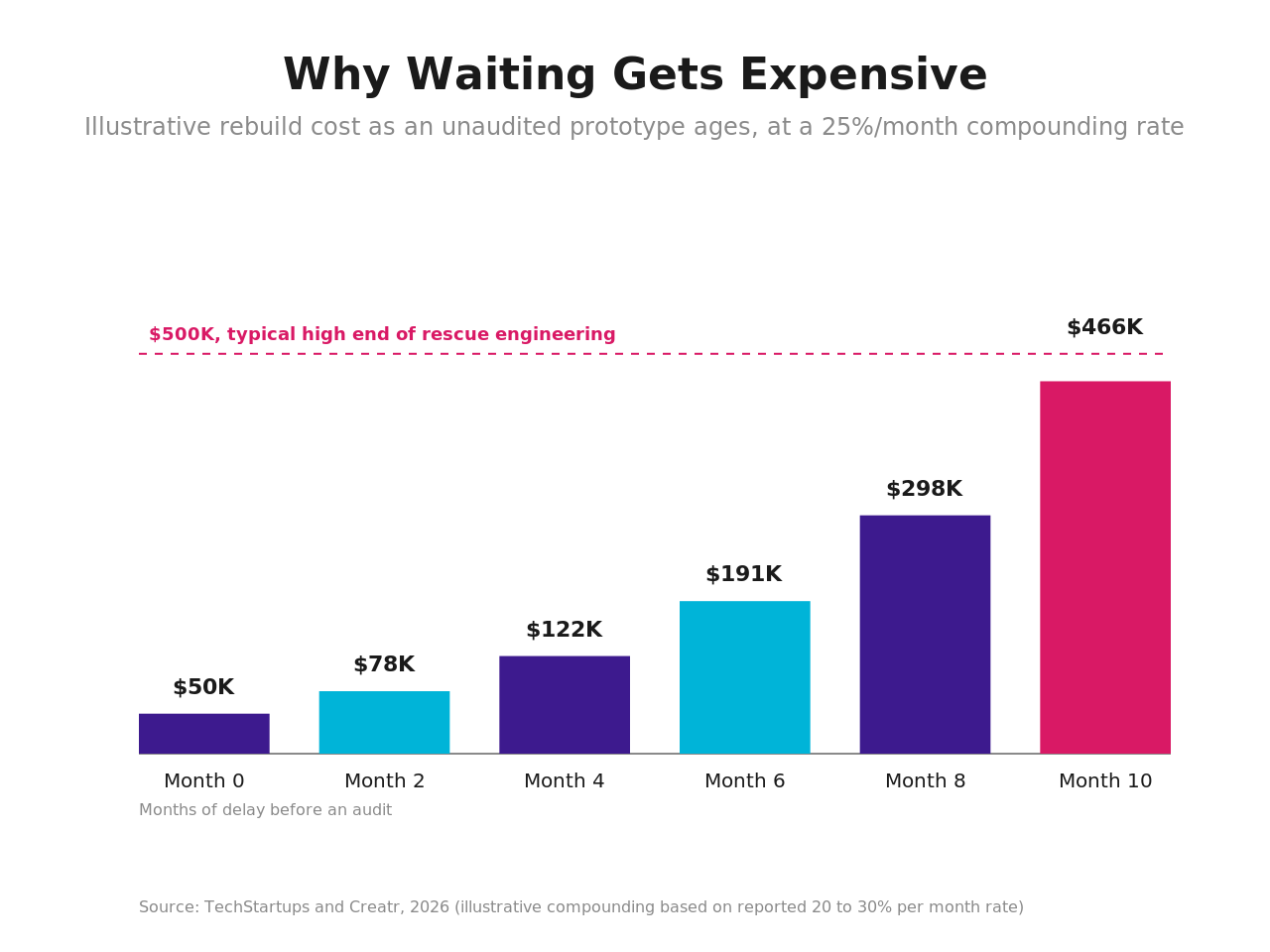
The numbers make this concrete. Roughly 10,000 startups tried to build production apps with AI coding assistants over the past year. More than 8,000 of them now need a partial rebuild or rescue engineering, at $50,000 to $500,000 each, according to two independent 2026 analyses that landed on the same figure (TechStartups, Creatr).
Security researchers at Escape.tech scanned 5,600 live, publicly deployed vibe-coded apps and found more than 2,000 high-impact vulnerabilities and 400 exposed secrets. Roughly one in three shipped with a serious, exploitable flaw (Forbes).
The cost compounds while you wait, too. Every month you spend adding features on top of an unaudited foundation adds an estimated 20% to 30% to the eventual rebuild bill, because each new feature creates a dependency on the exact structure that will need to be untangled later.
The right response is a fast, honest audit, made at month two, while the fix still costs a fraction of what it costs at month twelve.
The Keep, Fix, Rebuild audit
Most production-readiness advice treats a vibe-coded prototype as one thing: harden it, add tests, add monitoring, ship. That treats a module that's genuinely fine the same as one that will corrupt customer data in month three, and it wastes money proving the fine parts are fine.
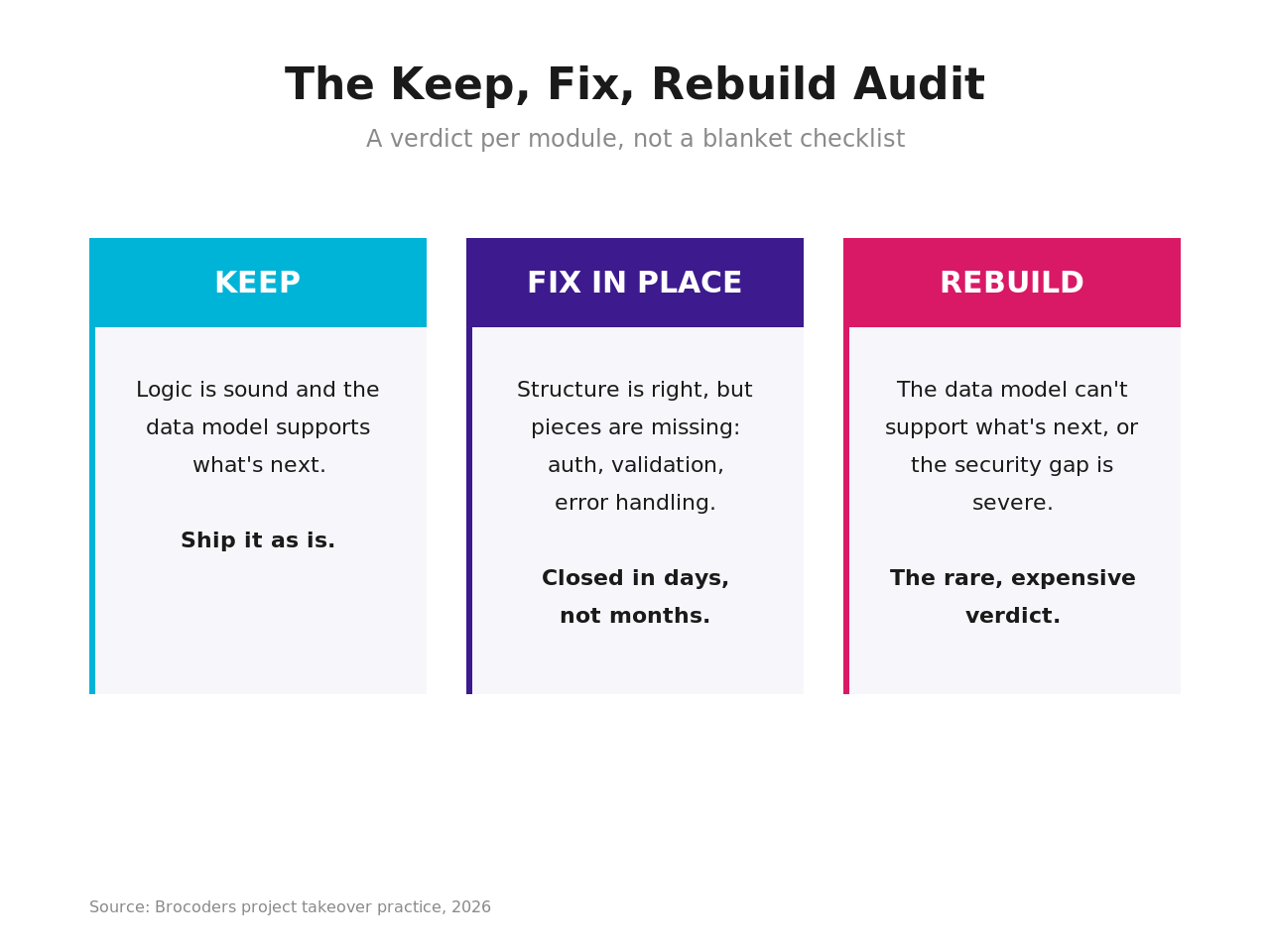
We run a different process on project takeovers here in Brocoders: audit the prototype module by module, and give each one of three verdicts.
Keep. The logic is sound and the data model supports what you need next. Ship it as is. No engineering budget wasted proving something that already works.
Fix in place. The structure is right but specific pieces are missing: authentication that isn't locked down, a webhook that doesn't verify its signature, error handling that only covers the happy path. A senior engineer can usually close these in days, not months, without touching the core architecture.
Rebuild. The data model itself can't support what the product needs to do next, or the security gap is severe enough that real users are exposed right now. This is the expensive verdict, and it's also the rare one. Most prototypes only need it on the two or three modules that were never designed to hold real load.
Doing this per module, not per app, tells you exactly where the real remaining work sits, instead of forcing a rebuild of the parts that were already right.
What we've seen from the inside
One of our own business analysts prototyped a logistics client's carrier payment reconciliation workflow using V0, then Replit, before the real build started. The tables looked right in a demo and fell apart the moment the data got messy: fifty-plus columns, inconsistent status labels, financial rounding rules scattered across components instead of one place. We wrote up exactly what broke and why, because it's the same pattern we see in almost every prototype that reaches us for a takeover.
It was fast and honest work, but it was never built to touch a real carrier's money. Knowing that early is exactly what a Keep, Fix, Rebuild audit is for.
Where this leaves you
If your prototype passed the demo, you're already ahead of most founders in this position. Here in Brocoders, that's where we start the audit.
We build SaaS and AI-native products the same way whether we're starting from a blank page or a prototype someone else generated: senior architects own the structure, AI handles the fast parts, and every generation gets checked for the kind of security gaps Escape.tech found in one in three vibe-coded apps before it ever reaches a customer. We've shipped MVPs from a blank page in as little as 3.5 months, and we bring the same discipline to a prototype that already exists.
That's how we approach MVP development for founders starting today, and it's the same lens we bring to auditing a prototype someone else built. If a module needs a full rebuild, that's a project we handle often.
The founders who come out ahead get the audit at month two instead of month twelve.
Frequently Asked Questions
No. A demo proves the concept works for the specific path you clicked through. Production readiness means the app holds up under real users, real data, and real load, including the paths no one clicked through in the demo.
A demo shows the happy path working once, in front of you. A production-ready app has error handling for the paths that aren't happy, access control enforced at the data layer, and a data model built for what the product needs to do next.
Industry data puts rescue engineering at $50,000 to $500,000, depending on how much was built on top of the original foundation before an audit happened (TechStartups, Creatr). An audit first narrows that range fast, because most prototypes only need a full rebuild on a handful of modules.
It depends on the module. If the data model supports where the product is going, fix the specific gaps: authentication, validation, error handling. Reserve a rebuild for the modules where the model itself can't support the next phase, or where the security exposure is severe.
You audit it. A scan of 5,600 live vibe-coded apps found roughly one in three shipped with a serious, exploitable vulnerability, most often missing access control or unvalidated webhooks (Escape.tech research via Forbes). Assume that risk exists until an independent review rules it out.
At minimum: database access control per table, authentication on every protected route, webhook signature validation, exposed secrets in the codebase, and whether the data model supports multi-tenant isolation if the product needs it. Each item gets a keep, fix, or rebuild verdict on its own, not a single pass or fail for the whole app.