
In June 2026, OpenAI spun its forward deployed engineers into a separate Deployment Company. Anthropic is building its own forward deployed consulting arm. Google, Salesforce, and Databricks are all hiring for the title, and Deloitte launched a practice it literally named Forward Deployed Engineering. For a job most people had never heard of two years ago, that is a lot of corporate machinery moving at once.
So here is the plain answer. A forward deployed engineer (FDE) is a software engineer who embeds inside a client's team, writes and deploys production code in the client's own systems, and stays until that software runs reliably in production. They attend the client's standups. They commit to the client's repo. They own the technical work end to end, from a messy real-world problem to a thing that actually ships.
That is the whole definition. The interesting part is why every AI lab suddenly wants an army of them, and what that says about how software gets built and bought.
TL;DR: A forward deployed engineer embeds with a customer and ships production code inside their systems, owning delivery until it runs. Palantir coined the title and AI labs made it famous, but the model itself is how good software partners have worked for years. For founders and eng leaders, the real takeaway is that forward deployment is a delivery model you can buy, not just a $400K role you have to recruit.
What an FDE actually is
The role blends two jobs that usually live far apart. One is the senior engineer who can architect and ship production software. The other is the customer-facing person who sits with users, learns their domain, and figures out what to actually build. An FDE is both, in one seat.
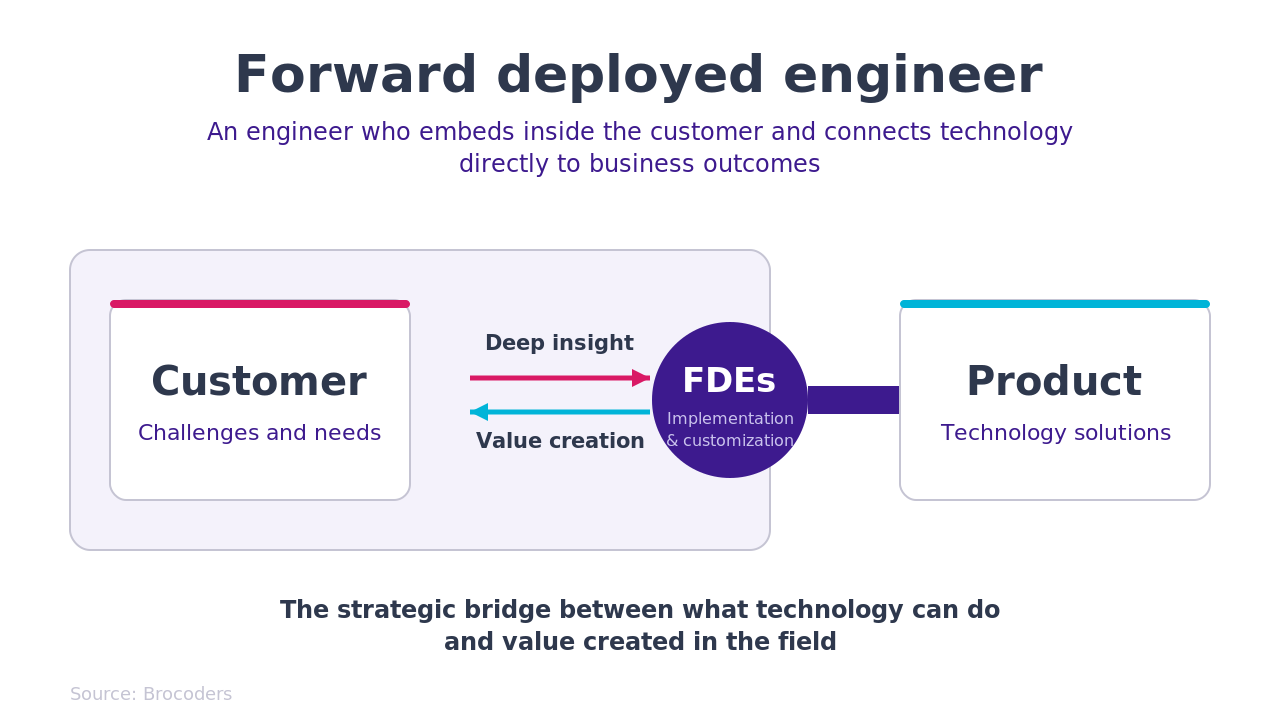
The differentiator that matters: an FDE writes and deploys code. A technical account manager talks about the product. A consultant recommends what you should do. An FDE builds the system and keeps building until it works in your environment, with your data, under your constraints.
That is why the role tends to attract people who have shipped under pressure. The work is ambiguous by design. You are dropped into a problem space that is often undefined, and you are expected to leave with running software.
Where the role came from: Palantir to OpenAI
Palantir coined the term and built its early growth around it. Their FDEs were post-sale engineers who closed the gap between a signed contract and working code in production, a stretch that traditional consulting never really covered. Consultants delivered slides and recommendations. Palantir's FDEs delivered deployed software, and the company's whole commercial model leaned on it.
For years this stayed mostly a Palantir thing, with similar roles hiding under other names like customer engineer at Google. Then generative AI arrived and the title went mainstream fast.
By 2026 the demand looks like a land grab. As The Pragmatic Engineer put it, the scramble to hire FDEs is the clearest market signal yet that the hard part of AI has moved from building models to making them work inside a business. OpenAI, Anthropic, Google Cloud, Salesforce, and Databricks are all hiring. Some are spinning up entirely separate deployment companies to house these engineers, because the work looks more like services than product.
What an FDE does (and what they don't)
The day-to-day varies, but the shape is consistent. An FDE embeds with a customer, learns the domain well enough to spot what the customer can't articulate, and co-develops a solution in the customer's stack. They build integrations, wire up data pipelines, fine-tune models or agentic workflows, debug production issues, and stay through launch.
Where people get confused is the overlap with two adjacent roles. Here is the clean split.
| Role | When in the cycle | What they deliver | Owns production? |
|---|---|---|---|
| Solutions engineer (SE) | Pre-sale | Demos and proof-of-concepts to help close the deal | No |
| Consultant | Any stage | Reports, recommendations, strategy | No |
| Forward deployed engineer | Post-sale | Working software shipped in the client's systems | Yes |
The SE sells the vision of what could exist. The consultant tells you what you should do. The FDE builds the thing that didn't exist yet and owns it until it runs. If you remember one distinction, make it that one.
Why AI made the FDE the hottest job in tech
Foundation models are now a commodity you can rent through an API. The value isn't in having access to a good model. It's in getting that model to do something useful inside a specific company, with that company's messy data, weird edge cases, and compliance rules.
That last mile is hard, and it doesn't yield to a generic SaaS subscription. A Fortune 500 doesn't need another dashboard. They need someone to sit with their operations team, understand the actual workflow, and build the agentic system that fits it. That work is custom, contextual, and iterative.
So AI labs hit a wall. They could ship powerful models, but customers couldn't turn them into business outcomes alone. The answer was to send engineers into the customer to do it for them. Hence the hiring spree, and hence the separate deployment companies. The model is the easy part now. Deployment is the moat.
Forward deployment is where dev shops are heading
Here is the part the careers articles miss. Forward deployment looks new because it got a famous name, but the underlying model has a longer history. Good software partners have worked this way for years, well before OpenAI made it a headline.
Think about how most outsourcing actually works. Staff augmentation rents you a pair of hands and leaves the thinking to you. Fixed-bid project work rents you a spec, then disappears once the invoice clears. Both leave the hardest part, owning the outcome in your real environment, on your side of the table.
The forward deployed model closes that gap. You get an engineer who learns your domain, works inside your codebase, and stays accountable for the software running in production. That is what we in Brocoders have done on engagements for years.
On PayPilot, a Canadian payroll fintech, we started with 5 engineers and grew the embedded team to 13 as the work expanded. The team audited the client's existing codebase, flagged scalability bottlenecks, took full ownership of frontend development, and integrated with QuickBooks and Xero. When the 2022 invasion of Ukraine forced the team to relocate, they resumed within 3 weeks and still delivered on schedule. The CEO's words: "there is no doubt in our mind that we wouldn't be where we are at with our project today without Brocoders' contribution."
On AreaButler, a German PropTech startup, a Brocoders engineer joined the client's team and was managed directly by the CEO. He shipped a GPT-3.5 integration, rebuilt the payment flow around PayPal, and solved real estate data imports across mismatched CRM formats. The product now saves agents up to 86% of their location-research time and keeps visitors on listings 39% longer. That is forward deployment, just without the 2026 job title.
You don't have to hire a $400K Palantir alumnus to get this. The model is something you can buy.
The Forward Deployment Test
Plenty of vendors will relabel staff augmentation as "forward deployed" now that the term is hot. Here is a quick diagnostic to tell the real thing from the rebrand. A genuine FDE engagement passes all four.
- Writes production code in your repo. Not advice, not wireframes. Commits that ship. On AreaButler, the engineer wrote and merged the authentication and payment code directly.
- Owns delivery to production. Accountable for the software actually running, not just for hours logged. The PayPilot team owned frontend delivery end to end and reported to the client's UI lead.
- Brings domain depth, not just hands. Learns your business well enough to spot problems you didn't specify. PayPilot's payroll rules and integrations took real ramp-up, and the team documented them in Coda so quality held as it scaled.
- Stays past launch. Sticks around through the rough patches and the next phase. We've been embedded with EveryPig since 2016, rebuilding their swine-logistics platform across multiple phases as the product grew.
If a partner only clears two of these, you have staff augmentation with better marketing. That is fine if hands are all you need. Just name it honestly.
What it takes to be an FDE: skills and salary
If you're an engineer eyeing the role, the bar is broad rather than deep in any one niche. Almost every posting asks for backend or full-stack fundamentals, comfort with APIs, integrations, and data pipelines, working knowledge of cloud infrastructure, and the confidence to debug production systems live. On top of that, you need to be able to sit across from a customer and translate a vague problem into a plan.
The strongest predictor of success isn't a credential. It's having shipped end to end at an early-stage startup. If you were one of the first 10 engineers somewhere, you've already talked to customers, worn every hat, and pushed code to keep the company alive. That is the job.
Pay reflects the demand. Reported figures vary by source, so treat these as market signal and verify current numbers before you negotiate. At Palantir, average total comp sits around $238,000, with staff-level FDEs reported above $630,000. OpenAI and Anthropic have landed roughly in the $350,000 to $550,000 band for mid-to-senior levels, and the broader market spans about $171,000 to $415,000 depending on company tier and seniority.
Where this leaves you
The forward deployed engineer is having its moment because AI made the last mile the whole game. The title is new. The model, an engineer who learns your domain, ships in your stack, and owns the result, has been quietly working for years.
If that is what your next project needs, you can buy it. Take a look at how we build embedded product teams and own delivery through to production.
Frequently Asked Questions
A forward deployed engineer is a software engineer who works embedded inside a customer's team, writes and ships production code in the customer's own systems, and stays until the software runs reliably. The job combines deep engineering with direct, customer-facing problem solving.
A solutions engineer works pre-sale, running demos and proof-of-concepts to help close a deal. A forward deployed engineer works post-sale, building and deploying the actual production system. The SE sells the vision; the FDE ships the reality and owns it through launch.
Reported total compensation ranges widely. Palantir averages around $238,000, with staff-level FDEs above $630,000, while OpenAI and Anthropic sit roughly between $350,000 and $550,000 for mid-to-senior roles. The broader market runs about $171,000 to $415,000. Verify current figures before relying on them, since the market is moving fast.
Because the hard part of AI shifted from building models to making them work inside a specific business. Foundation models are now easy to access, but turning them into real outcomes requires someone embedded in the customer's domain and data. FDEs do that last mile.
No. Palantir popularized the title and the AI labs amplified it, but the embedded delivery model exists across the industry. Good development partners have run forward deployed engagements for years under names like dedicated team or embedded engineering.
Yes, and for many companies that is the practical route. Agencies that embed engineers in your team, ship in your codebase, and own outcomes are running the forward deployed model. Here in Brocoders, we've done exactly this on fintech, PropTech, and logistics products for years.