Construction staffing marketplace from kick-off to beta in 10 weeks
TradeFlex, a US marketplace for construction trades, went from a founder's brief to a closed beta in 10 weeks, then into production and a second phase with payments, chat and crew accounts.
Industry
Construction trades staffing
Location
USA
Client since
September 2025
Status
Ongoing
10 weeks
Kick-off to closed beta
8 weeks
To the full work order lifecycle, end to end
Jan 2026
Production on the client's AWS
5.0
Clutch rating for quality, schedule, cost and referral
Kick-off on Oct. 2, 2025, closed beta on Dec. 12, 2025, production in mid-January 2026.
TradeFlex is a US marketplace where construction companies post work orders and independent tradespeople and crews apply, work, log hours and get paid.
Two-sided marketplace: companies post work orders, independent contractors and crews apply
First market
HVAC, launching in North Carolina
Engagement
September 2025 to October 2026: discovery, MVP, Phase 2
Team
2 to 5 Brocoders people: PM, backend, frontend, QA
Services
Product discovery, MVP development, marketplace development, payments integration, AI feature development
The problem TradeFlex set out to solve in construction staffing
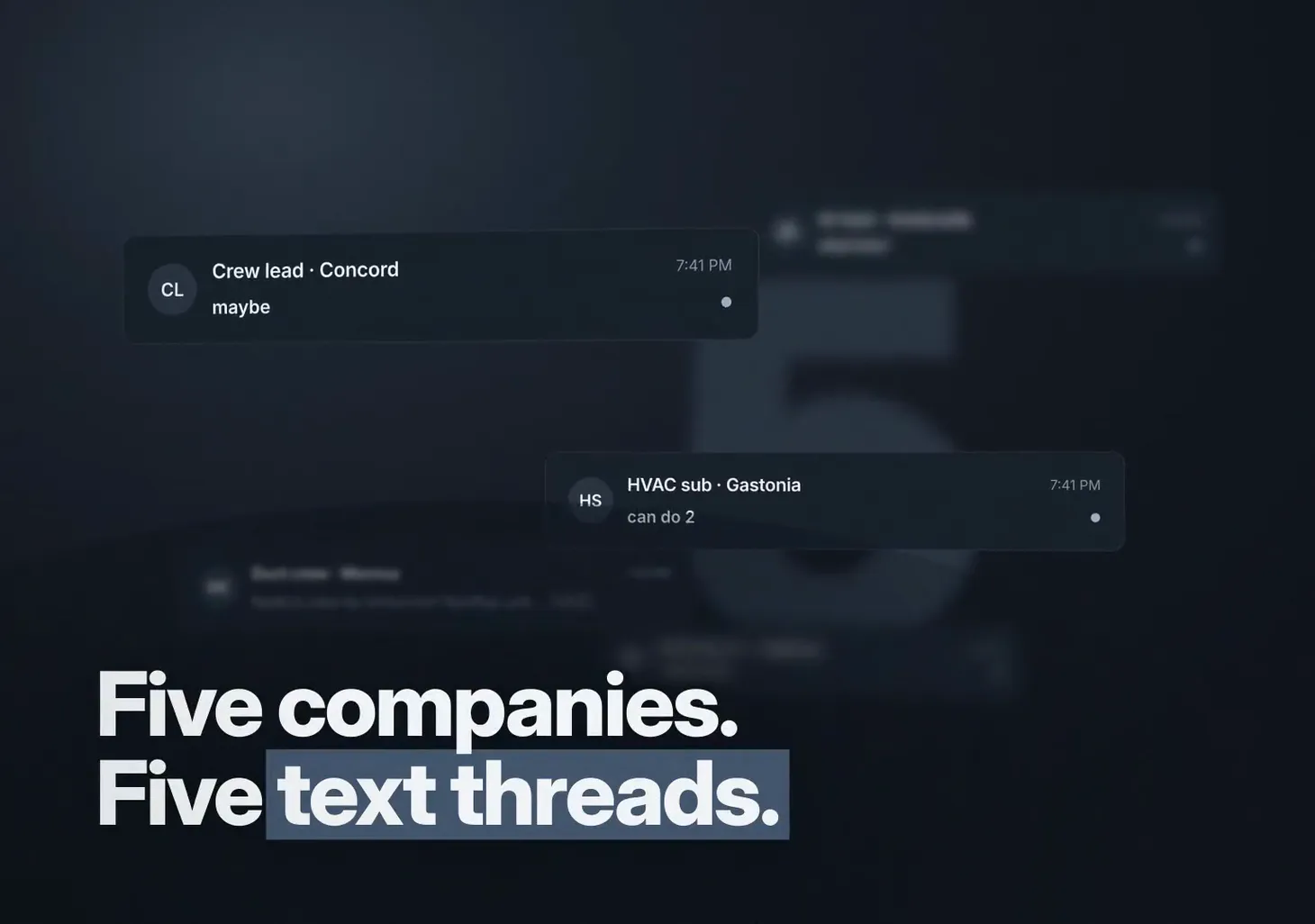
Construction schedules swing. A company may need 50 people on site one month and 20 the next, so it keeps a core crew and fills the gaps with hourly subcontractors or temp agencies. Joe Elliott, CTO/COO and original founder of TradeFlex, saw the cost of that in his first 4 years on commercial construction projects.
"Managing these subcontractors is sometimes a full-time job for a company employee (constant texts/emails/contracts/etc...) and often a middle-man is involved that charges a 35-45% premium on the worker's pay."
Joe Elliott CTO/COO and original founder, TradeFlex
TradeFlex removes the middleman: companies post work orders directly, qualified contractors apply, and the platform handles hours, invoices and payouts. The founders set the goal of cutting the time companies spend on subcontractor staffing by 80%.
The TradeFlex product film: from a pasted job request to a paid invoice and a rated crew.
2 weeks of discovery before the first line of code
We started with a 2-week discovery: 3 workshops with the founders, each followed by a written summary.
Oct. 8, 2025: Authentication and work orders
Oct. 10, 2025: Marketplace and order publishing
Oct. 14, 2025: Notifications, AI and invoicing
The output was a roughly 42-page requirements specification marked production-ready on Oct. 27, a product requirements document (PRD) and a UI design specification. On Oct. 24 we reviewed the scope against the budget together and moved some admin features to the backlog, so the MVP boundary was written down and agreed before the build. Read more about our MVP development process.
What the TradeFlex marketplace does
Work orders. A company creates a work order with trade, location, dates, rate and headcount.
Applications. Individual contractors and crews apply, and the company approves who works.
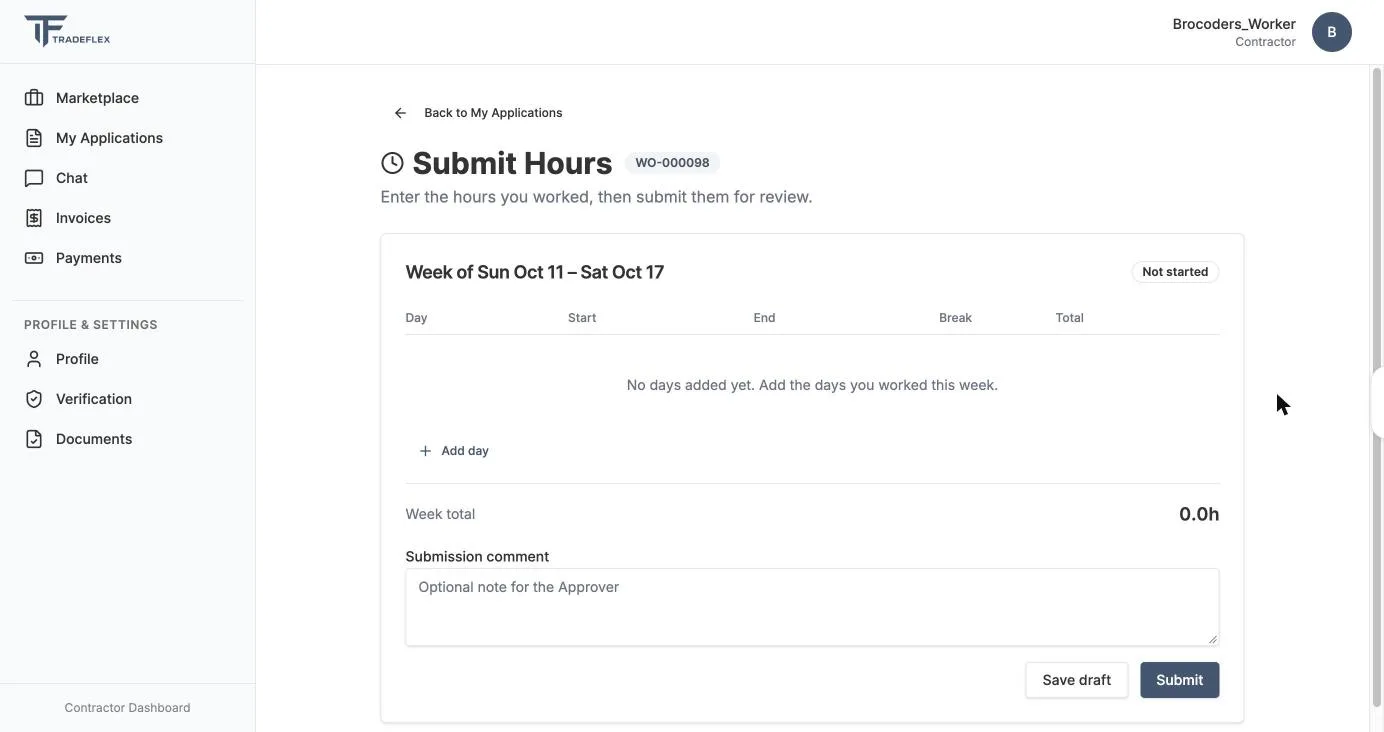
Hours approval. Contractors submit hours, the company approves them, and invoices are generated from approved hours.
Ratings. Both sides rate each job, so reputation comes from work done on the platform.
Notifications. Email notifications through AWS SES at each step.
Admin panel. The TradeFlex team manages users and work orders.
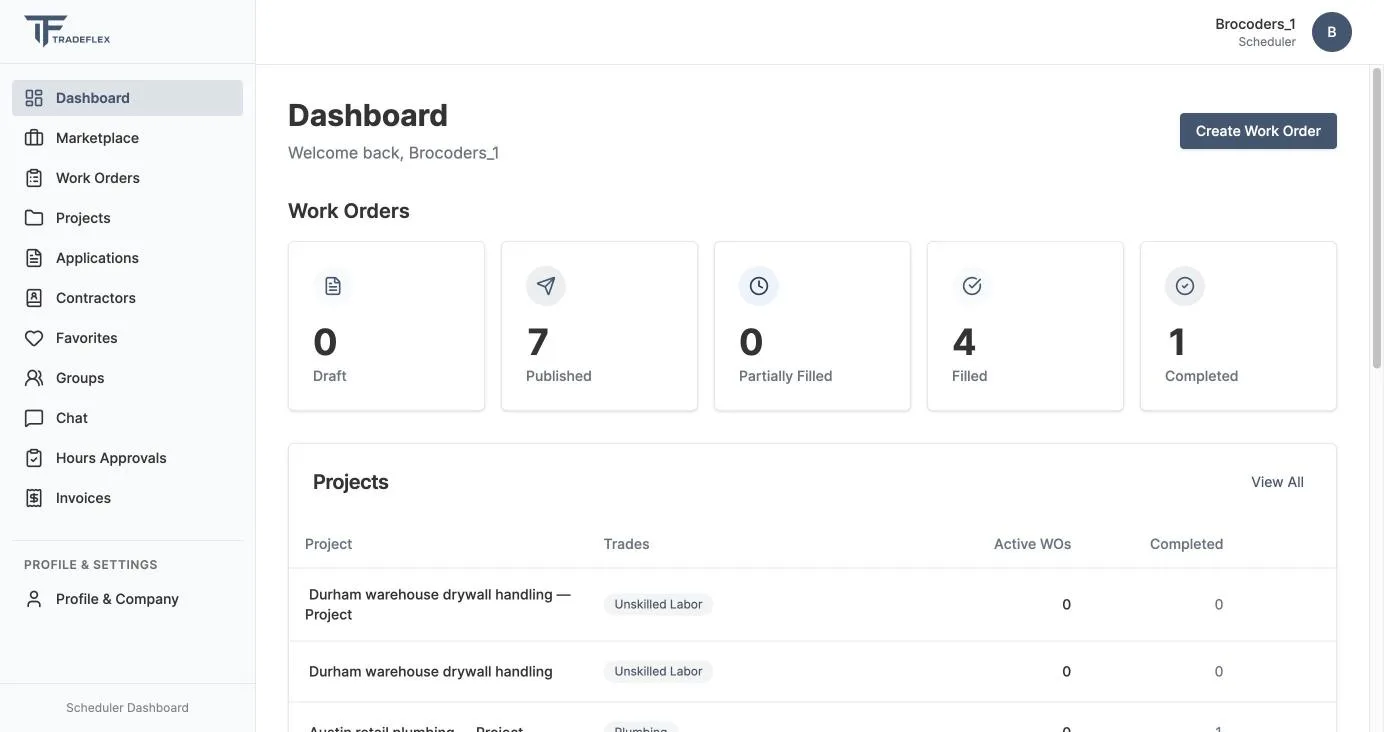
The company dashboard: work orders by status and the projects they belong to.The contractor side: hours entered by day and sent to the company for approval.
By Nov. 28, 2025, 8 weeks after kick-off, the full lifecycle worked end to end: create, apply, invoice, pay, rate.
AI that turns a job request into a work order
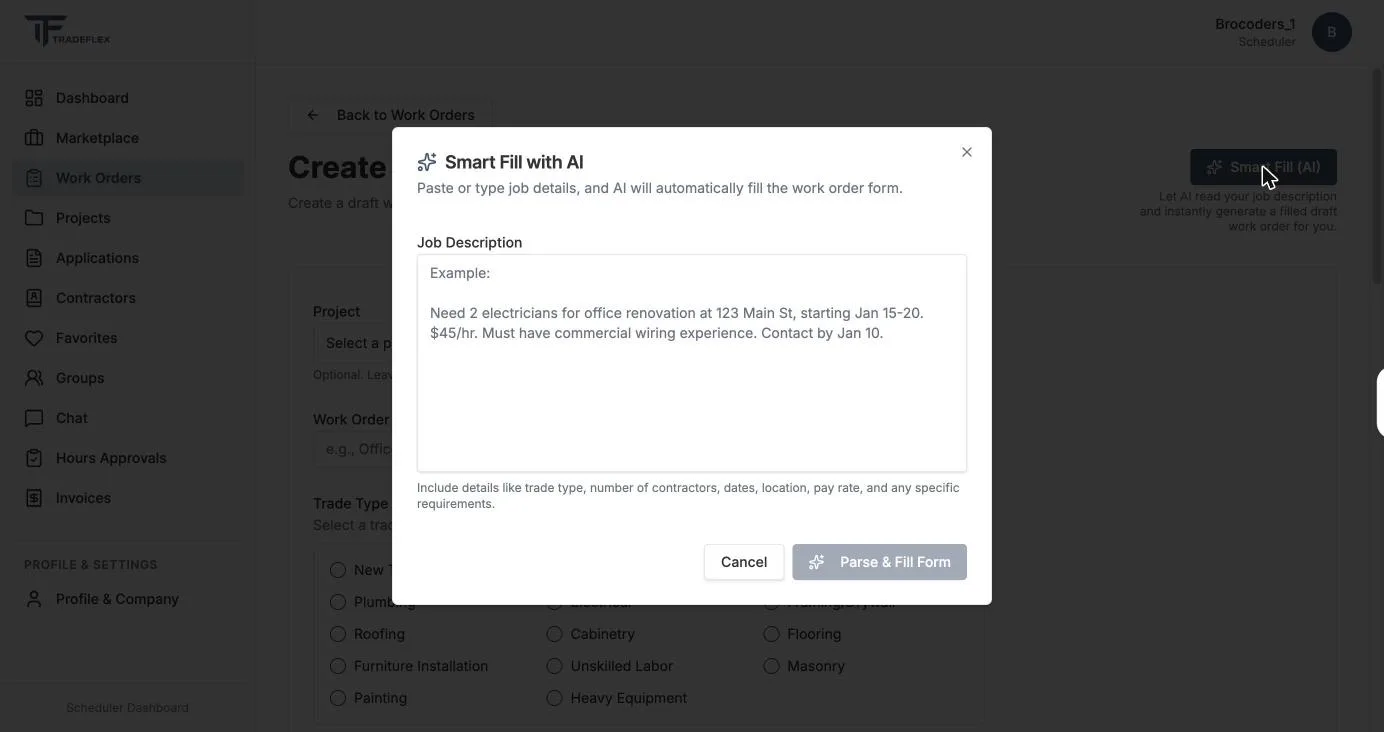
Companies often get work requests as a few lines in an email. Smart Fill, which Joe calls AI Fill, is the AI assistant in the TradeFlex work order form: a company pastes the request as it came in, and Smart Fill turns that free text into a structured work order and asks clarifying questions when a trade is ambiguous, for example "Installer". We built its questions from the intake script Joe already used with customers.
Smart Fill in the work order form: paste the request, get a filled draft.
Joe tested Smart Fill during the beta:
"I also tested the AI Fill functionality with a real order received from one of our customers, and it worked perfectly."
Phase 2: payments, chat and crews for the construction staffing marketplace
Phase 2 started in April 2026 with 3 more workshops and a modular PRD. Phase 2 also moved the backend from Express, a lightweight Node.js framework, to NestJS, a more structured one.
Payments. Stripe Connect (Stripe's product for marketplaces that pay out to third parties) with ACH bank transfers: the company is charged for approved hours, and the contractor receives their pay net of the platform fee, with 1099-K reporting (the US tax form for payment platforms) filed by Stripe.
Subscriptions. Companies need an active subscription to post new work.
Chat. Group and direct threads with attachments and a daily digest, built on Firebase.
Contractor groups. Companies keep their own vetted contractors and offer work to them first.
Crew accounts and direct payment. A crew lead manages a team and can be paid for the whole crew.
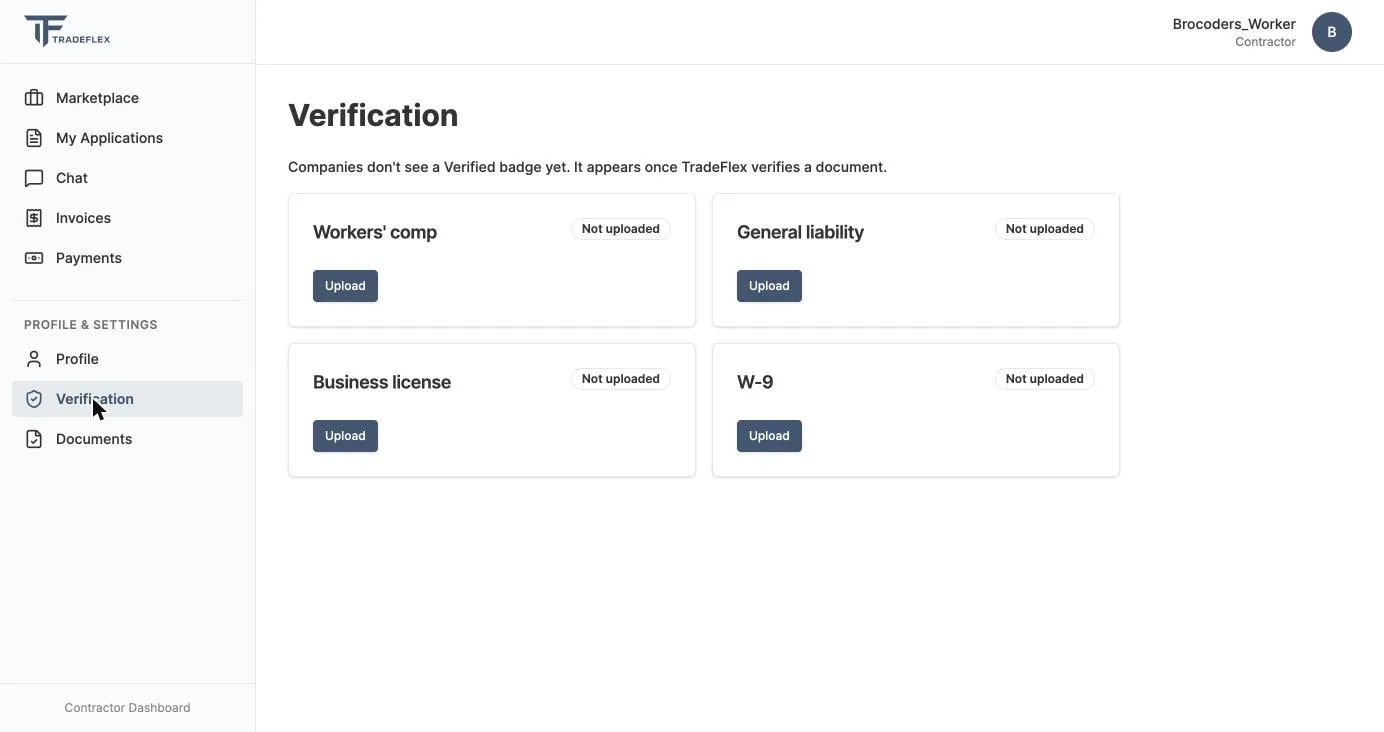
Admin-created work orders and contractor verification. The TradeFlex team can post on a company's behalf and check contractors' documents.
Disputes. The TradeFlex team handles disputes between companies and contractors in the admin panel.
Contractor verification: the documents TradeFlex checks before a contractor gets the Verified badge.
A new scope agreed in August went from a workshop on Aug. 26, 2026 to working code on Sept. 29. In October 2026 Phase 2 is in final client testing.
Decisions that shaped the TradeFlex build
Decision
Options
Why
Ship the MVP on Express (a lightweight Node.js framework), rebuild on NestJS (a more structured one) in Phase 2
Refactor during the MVP, or ship first
Protect the beta date and the budget. The rebuild started in April 2026
Build payments on Stripe in-house, ACH only
Third-party payout providers or Stripe
Control over the money flow and fees
Own chat on Firebase
Paid chat services (StreamChat, Twilio Conversations) or our own chat on Google's Firebase
Lower monthly running cost
Build contractor groups in Phase 2
Defer or build now
The first large customer needed its own vetted contractors
"BroCoders was great at explaining different options with pros/cons and helping us manage the development process."
Joe Elliott CTO/COO and original founder, TradeFlex
How we worked with TradeFlex
A demo every Friday, with a written recap after each call
Weekly status reports from May 2026: progress by module, budget, and what we needed from the client
Spec-driven development from the first commit in October 2025: we write the specification first and build against it with AI coding tools
Requirements as PRD modules, delivered as user stories with backend and frontend subtasks
Project
manager
Backend
engineer
Frontend
engineer
QA
engineer
"They have been well-organized, consistently hit budget and schedule milestones, and are finalizing delivery of exactly what we asked for."
Joe Elliott CTO/COO and original founder, TradeFlex
TradeFlex results so far
Live
In production on the client's AWS since January 2026
2
Customers on the platform, October 2026
Phase 2
Payments, chat, crews and verification built, in final client testing
5.0
Clutch rating from the client for quality, schedule and cost
Customer count as reported by Joe Elliott, October 2026.
Use of the platform is still early: the founders are finishing Phase 2 before they ramp up sales and marketing.
What's next for the construction staffing marketplace
The near-term plan is to prove the concept in TradeFlex's local market in North Carolina, show a good experience for both companies and workers, and then grow quickly from there. The long-term mission is to help workers raise their pay and build their skills, and to strengthen the construction capabilities of the American workforce.
"We would love to see thousands of workers join TradeFlex, beginning as unskilled construction helpers, using the opportunities the platform provides to develop the skills and relationships they need to have successful careers in construction."
Joe Elliott CTO/COO and original founder, TradeFlex
Building a marketplace MVP with Brocoders
Brocoders has built software products since 2014, with its main development division in Estonia. Today Brocoders is an AI-native team. We run discovery, MVP development and the second phase with a team of 2 to 5 people (PM, engineers, QA). TradeFlex was built with spec-driven development and AI coding tools and went from kick-off to beta in 10 weeks.
"There's nothing they need to improve; they've been amazing."
Questions about building a construction staffing marketplace like TradeFlex
How long did it take to build the TradeFlex MVP?
The MVP took 10 weeks from kick-off to closed beta, including 2 weeks of discovery. It reached production in January 2026, about 15 weeks after kick-off.
How do contractors get paid on TradeFlex?
The company approves hours, the platform charges it by ACH through Stripe Connect, and the contractor receives their pay net of the platform fee.
How much did the TradeFlex MVP cost?
TradeFlex keeps the budget confidential. The MVP scope was set against the budget in a joint review on Oct. 24, 2025, and Joe Elliott rated Brocoders 5.0 for cost on Clutch.
Can a construction company keep its own contractors on the platform?
Yes. Contractor groups let a company keep its vetted people and offer work to them first, and crew accounts let one lead manage and be paid for a team.
What does Smart Fill, the AI feature, do?
Smart Fill, the TradeFlex AI assistant, turns a free-text job request into a structured work order and asks follow-up questions when the trade is unclear.
Tell us how your trade works today. We'll come back with questions and a first-release plan that fits your budget.