
You have a wireframe in Figma, a spec doc, and a design partner who just said yes. The hard question is what happens next: what a team actually does between that wireframe and a working product, and how long each step takes. Most guides answer with the same tidy checklist and never show a single build they ran themselves. This one walks the exact MVP development process we in Brocoders use, with named projects and real delivery times, from 6 weeks to 3.5 months.
TL;DR: MVPs rarely fail during coding. They fail in the gap between the spec and the first line of code, where scope quietly grows until an 8-week build becomes a 6-month one. Our process closes that gap: lock scope in discovery, turn the wireframe into an interactive prototype that serves as the spec, then let a senior engineer own the architecture. Proven builds: Revenue Boosters in 3.5 months, CoreHealth in 6 weeks.
Why most MVPs stall before the first line of code
MVPs go wrong in planning, long before the build. Scope grows week by week until the version that was meant to take 8 weeks is a 6-month project before anyone writes real code.
The numbers back this up. The Project Management Institute found that 52% of software projects experience scope creep, and it is the primary factor in 43% of project failures (PMI). For a founder spending a first check, that is the difference between a product in the market and a budget spent on a build nobody shipped.
Three things pull founders into scope creep. Attachment to the full vision, so the MVP feels embarrassingly thin. Fear that early users will judge a small first version harshly. And competitor envy, where every feature you see on a rival's site feels mandatory.
In 2026 there is a fourth trigger. Many founders now arrive with a vibe-coded prototype that demoed beautifully and fell apart under real users. The wireframe and the demo are useful. What is missing is a locked spec that says exactly what version one includes and, just as importantly, what it leaves out.
The MVP development process: 5 phases from spec to live
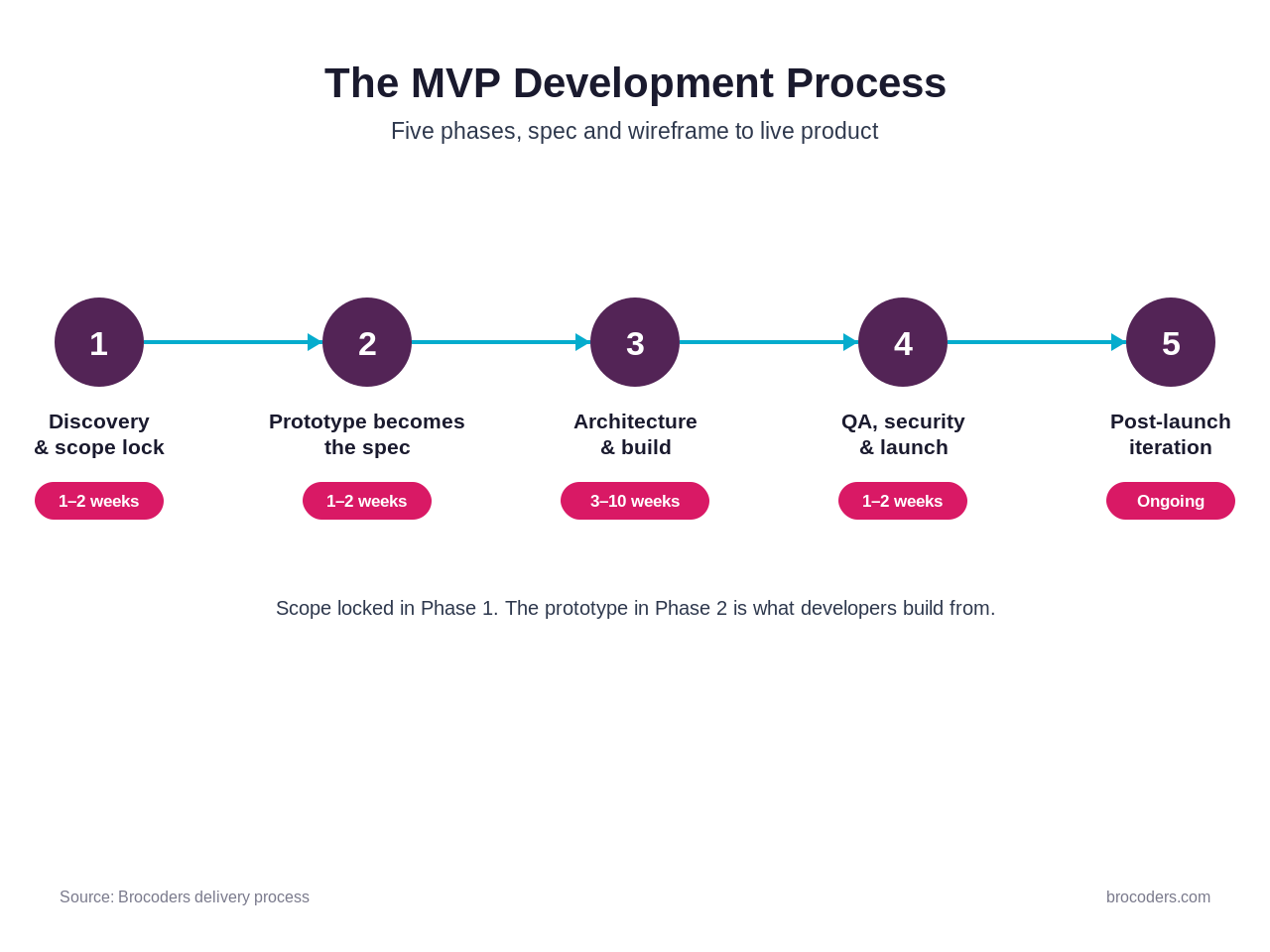
Here is the sequence we run, phase by phase, with who owns each step and roughly how long it takes.
Phase 1: Discovery and scope lock
Duration: 1 to 2 weeks. We turn the spec into a must-have-only feature set and a written list of user stories, then lock it. This is where 20% to 40% of the requested scope gets cut, because it belongs in version two. Founders often enter through a paid discovery or solution session in the $10K to $15K range, which produces the locked scope, a delivery roadmap, and a real estimate before anyone commits to a full build.
Phase 2: The prototype becomes the spec
Duration: 1 to 2 weeks. We turn the wireframe into a fully interactive prototype that shows every screen state and the complete interaction logic: invite sent, status changed, error shown, success confirmed. Developers then build against something concrete rather than guessing at intent. That single step removes the most common source of rework, where an engineer hears something technically close but functionally different from what the founder meant.
Phase 3: Architecture and build
Duration: 3 to 10 weeks, depending on scope. Engineers build the real product using the prototype as a design source, with real data-fetching, real hooks, and performance owned by a senior architect. Boilerplates for SaaS development with NestJS and React Native speed up the start, so the team spends its time on the parts that are specific to your product.
Phase 4: QA, security, and launch
Duration: 1 to 2 weeks. Automated tests, a security and QA pass over the code, then a soft launch to a small group of real users. We also wire in event tracking before launch, not after, so the MVP measures something from day one. Plenty of MVPs ship with no instrumentation at all, which leaves the founder guessing in production instead of learning.
Phase 5: Post-launch iteration
Duration: ongoing. Monitor, fix, and prioritize the next slice against real usage. A well-scoped MVP is a front door to a longer product relationship. Condogenie came in as an Upwork MVP and grew into a multi-year product relationship, which is the pattern a disciplined first version sets up.
Three MVPs, three real timelines
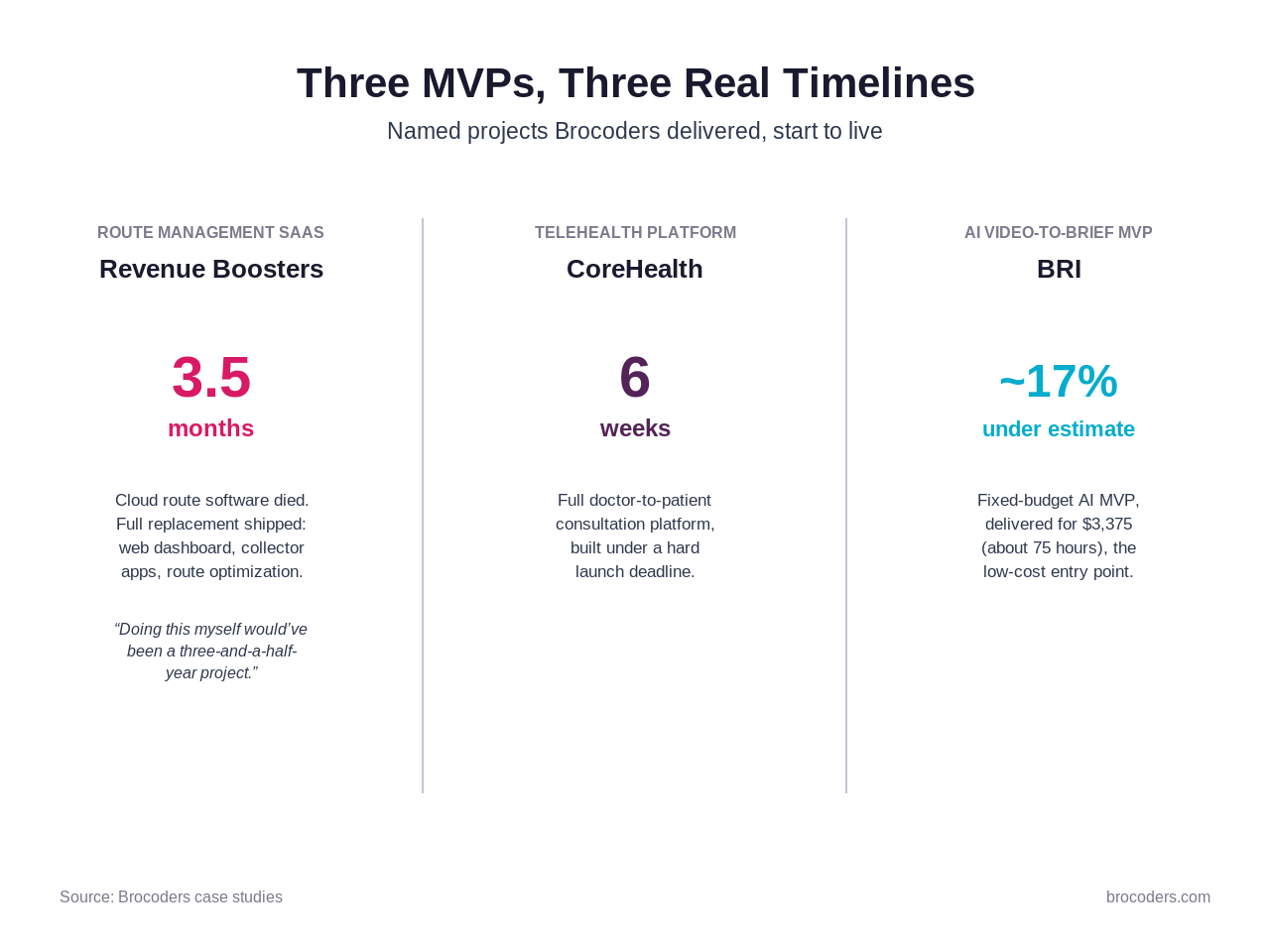
The process only matters if it ships. Here are three builds and how long each took.
Revenue Boosters, a route management SaaS, delivered in 3.5 months. This amusement operator's cloud route software died, and the team needed a replacement fast. We built the full product from scratch: a web dashboard, mobile apps for collectors, and route optimization. The owner's verdict: "Doing this myself would've been a three-and-a-half-year project." Full story on the Revenue Boosters case study.
CoreHealth, a telehealth platform, delivered in 6 weeks. A full doctor-to-patient consultation platform built under a hard deadline. Details on the telehealth platform case study.
BRI, a fixed-budget AI MVP, delivered about 17% under estimate at $3,375. For a budget-sensitive founder, this is the low-cost, AI-assisted entry point: a working first version for the price of a laptop, delivered under the quoted hours.
Where AI-native delivery changes the process
Founders now ask how we use AI before they ask anything else, so here is the honest version.
AI changed who does what on a build. Product managers now produce the working interface and its full interaction logic, developers concentrate on backend, architecture, and performance, and many builds no longer need a separate designer seat. The handoffs that used to run designer to frontend developer to QA now overlap, which is where most of the time savings come from. The biggest speedup from AI came from removing the handoffs between roles.
Speed comes with a human on top. A drag-and-drop feature that used to be a slow, multi-person job was built with AI in about twenty minutes, then hardened for performance by one engineer, and shipped in well under an hour. AI writes faster code, and the architect makes it the right code.
Security is built into the workflow, not hoped for. We run an automated pass over AI-generated code, and it has caught genuinely critical issues, including key-stealing injection paths, that would otherwise have shipped. A clean security report is part of our definition of done. If you want the product itself to be AI, our AI development and integration work starts from the same discipline.
The MVP build sequence: what to build first
When you cut scope in Phase 1, this is the order that keeps an 8-week build from becoming a 6-month one.
- The one core loop that proves the product's value, the exact job your design partner said yes to.
- Authentication and the single most important data object.
- The admin or back-office view, often generated straight from the existing backend schema.
- Event tracking, wired in before launch so you learn from real usage.
- Everything else, parked in the post-launch backlog. If a feature does not serve the first item on that list, it waits. That is the whole discipline.
From wireframe to live: the short version
Lock the scope in discovery, make the prototype the spec, let a senior engineer own the architecture, and instrument the product before you launch it. That is how a wireframe becomes a live MVP in weeks rather than a build that drifts for months. If you want the process run for you, here is our MVP development service.
Frequently Asked Questions
Five phases: discovery and scope lock, turning the wireframe into an interactive prototype, architecture and build, QA and security and launch, then post-launch iteration. The order matters, because locking scope and prototyping before the build is what prevents the timeline from doubling.
Between 6 weeks and 3.5 months for most products, including discovery. CoreHealth's telehealth platform shipped in 6 weeks; Revenue Boosters' route management SaaS shipped in 3.5 months. The main driver of the timeline is scope discipline, not team size.
A wireframe is a static layout of each screen. A prototype is an interactive version that shows real states and flows, which we use as the build spec. An MVP is the live product with the smallest set of features that delivers real value to real users.
A realistic floor for a custom SaaS MVP is around $80K, with most builds running higher depending on scope. Smaller AI-assisted MVPs can start much lower: BRIO was delivered for $3,375, about 17% under its estimate.
Yes. We treat the prototype as a design source, keep what works, and rebuild the parts that break under real users with proper architecture and tests. The prototype becomes an input to the spec instead of wasted effort.
You do, fully, with no lock-in. Boilerplates only accelerate delivery; they do not tie you to us, and you can take the codebase anywhere.