
AI has found its way into every regulated product built in 2026, and while it promises faster underwriting, faster diagnosis support, and faster drug approvals, companies now have to prove that every answer it gives traces back to something real, not just to a log entry.
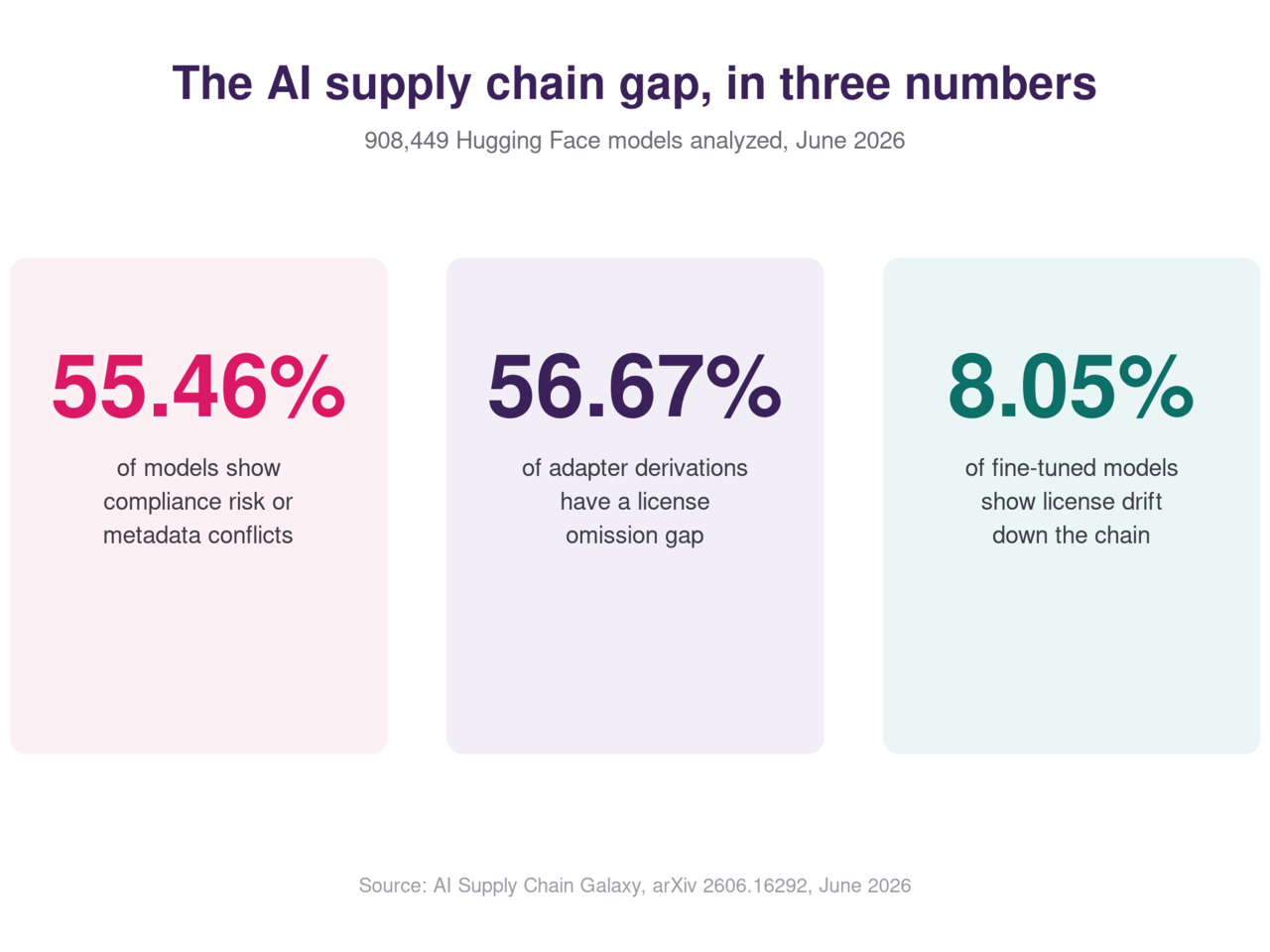
You'd be hard pressed to find a regulated product built this year that doesn't touch AI somewhere in its decision path, and the AI supply chain underneath those products is not as clean as most teams assume. A 2026 supply chain audit of Hugging Face found that 55.46% of nearly a million models carry compliance risks or missing metadata, while adapter derivations, the fine-tuned add-ons teams build on top of base models, show a 56.67% license omission rate.
On the regulator's side, oversight is moving just as fast. US banking supervisors are already asking, in routine exams, how banks map AI across lending and sanctions screening, according to reporting from Reuters, while the EU AI Act's transparency rules apply from 2 August 2026 regardless of how ready a company feels.
A complete decision log and a source-traceable answer are not the same achievement, and treating them as interchangeable is exactly where compliance work on regulated AI products tends to stall.
It's clear that logging what an AI system did is no longer enough on its own, and companies building AI into regulated products need a strategy for tracing answers to their source, scoring them for fairness, and disclosing them honestly as AI-generated from the start.
TL;DR: A complete AI audit trail proves an action happened. It doesn't prove the answer can be traced back to a real source, and 2026's own regulatory and empirical research shows most AI systems still can't clear that bar. Closing it takes four checkpoints beneath the log: source-linked, path-logged, proof-scored, and mark-disclosed.
The checklist everyone already follows
Ask a compliance lead what an AI audit trail means in 2026 and you'll get roughly the same answer everywhere, log the decision with a timestamp in UTC, a unique decision ID, the model version that acted and on whose authority, the inputs and the output, and whether a human reviewed it, then keep that record for at least six months under the EU AI Act's Article 19 retention rule, which applies to the logs Article 12 already requires those systems to generate automatically.
It's a real standard and a fairly earned one, since regulators are done treating it as optional: the EU AI Act's transparency rules under Article 50 apply from 2 August 2026, alongside the high-risk obligations in Annex III, while US banking supervisors aren't waiting for a finished AI-specific rulebook either, with Reuters reporting in June 2026 that examiners are already asking banks, in routine reviews, to map exactly where AI touches lending, KYC checks, and sanctions screening, down to vendor governance and kill switches.
So teams build the log, fill every field, and a lot of them stop right there, because the checklist reads like a finish line when it's really only the first one.
Why a complete log still isn't proof
A log records that something happened, though it was never built to tell you whether the thing that happened was built on solid ground.
Look one layer beneath the decision log, at the models and datasets an AI system actually runs on, and the picture gets shakier than a filled-in checklist would suggest: a June 2026 analysis of 908,449 models on Hugging Face, published as AI Supply Chain Galaxy, found that 55.46% carry compliance risks or metadata conflicts, that adapter derivations, the fine-tuned add-ons teams bolt onto base models, have a 56.67% license omission rate, and that fine-tuned models show an 8.05% license drift rate, meaning the terms quietly changed somewhere down the chain.
Go further upstream, to the datasets themselves, and it gets worse still, since a 2026 audit of 29,000 dataset descriptions on Hugging Face and Zenodo, published in the AIS eLibrary, found that complete provenance chains, tracing raw data through every preparation step to the model it trained, are exceptionally rare, and that even datasets tied directly to downstream model training, the ones with the strongest incentive to disclose, mostly don't have one either.
Your decision log can be flawless and still sit on top of a model built from a dataset nobody can fully trace, because the log answers what happened, not whether any of it was trustworthy to begin with.
There's a second, sharper problem underneath the log as well, since auditable and most accurate are not the same design goal, and treating them as interchangeable can push a team toward the wrong model entirely: a 2026 clinical AI fairness study compared a logistic regression model against a random forest model on the same prediction task, and while logistic regression scored higher on accuracy at 75.2% versus 70.1%, it was also significantly more biased, with an equal opportunity difference of 0.256 (p=0.0080) against 0.055 for random forest, a gap reported as 57% less bias for the lower-accuracy model.
Five accuracy points bought a model that discriminated more, and in a regulated context that's not a rounding error, it's the difference between a model you can defend and one you can't, regardless of what the decision log says about it.
The Glass Box Standard
Here's the frame we use with clients building AI features for regulated products, four checkpoints that sit one level beneath the audit log and determine whether an answer is actually traceable back to something real, and we call it the Glass Box Standard.
- Source-linked. Every answer names the exact document, dataset row, or record it drew from, not just the model that produced it.
- Path-logged. The retrieval and reasoning steps are captured, not only the final output.
- Proof-scored. Explainability and fairness metrics travel with the answer instead of living in a separate report nobody reads.
- Mark-disclosed. A machine-readable marker flags what's AI-generated, so no one downstream mistakes it for a human decision.
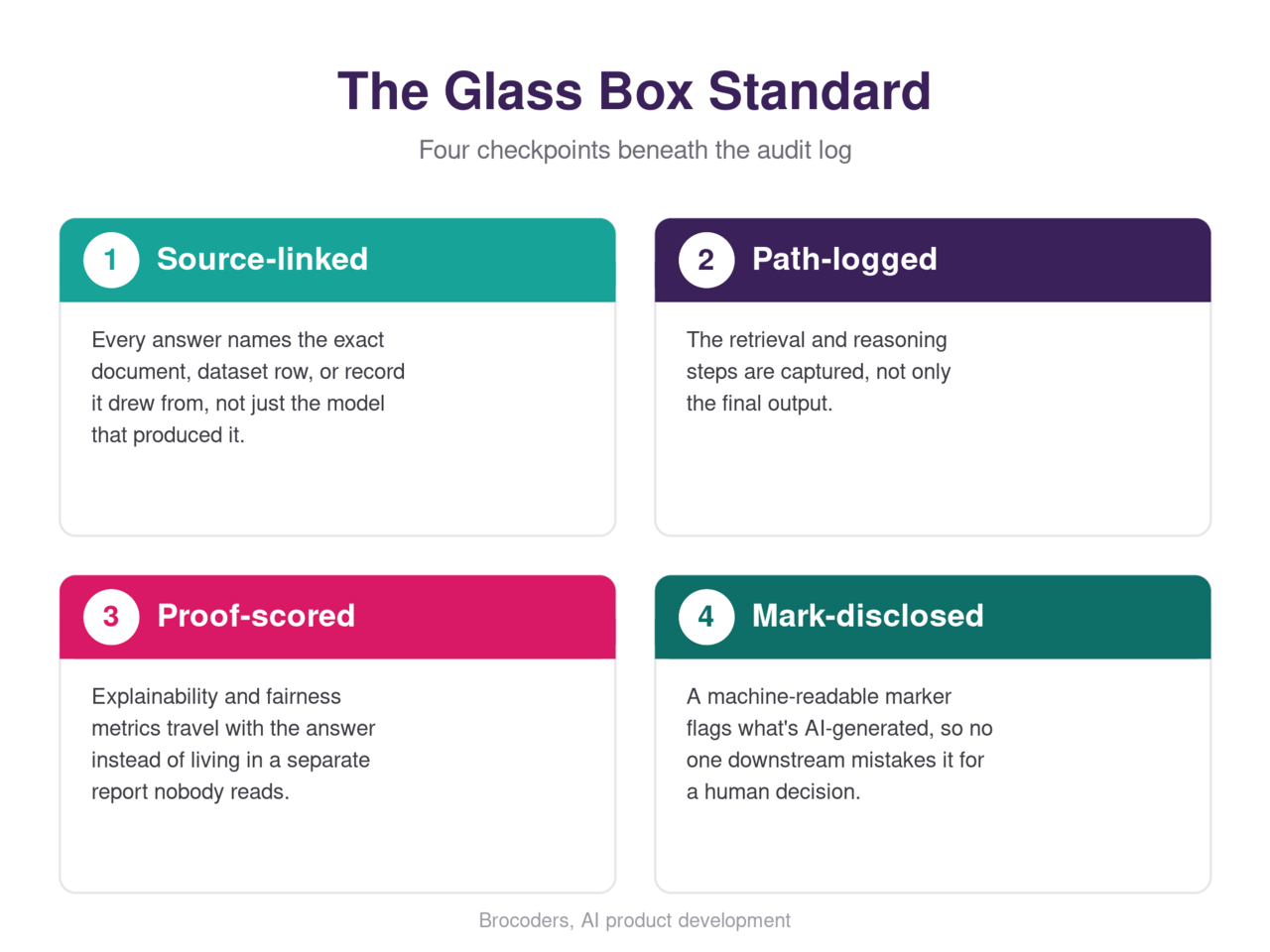
None of these checkpoints replace the audit log, they sit underneath it instead, closer to where the actual risk lives.
Source-linked, path-logged, proof-scored, mark-disclosed
Source-linked is the checkpoint most AI systems fail quietly, since it's the difference between "the model produced this" and "this came from page 12 of the maintenance manual you uploaded last March," and given how rare complete provenance chains turn out to be even at the dataset level, this has to be built deliberately rather than assumed as a side effect of good engineering. Tooling is starting to catch up: Cisco's open-source Model Provenance Kit, released in April 2026, fingerprints models at the weight level and reconstructs provenance chains even when a model's own documentation is missing, hitting 96.4% accuracy and 98.1% precision across 111 test pairs, and it's roughly how Brocoders approaches AI features with traceability in mind as well, checking what a model or dataset actually is before building an answer on top of it.
Path-logged goes beyond what was the output to what did the system touch to get there, which is exactly what banking supervisors are asking for when they request a map of where AI touches lending or sanctions screening, and it means an agentic workflow that reads from one system and writes into another needs its tool calls and data sources on the record, not just its final answer.
Proof-scored means the fairness and explainability numbers ride along with the answer rather than sitting in a separate audit binder, and the clinical AI study above is the proof this matters, since a team that only checked accuracy would have picked the more biased model and never known it, which is why both scores need to travel with every answer instead of living in a report nobody opens.
Mark-disclosed is the newest and thinnest layer of the four, and while the EU AI Act's Article 50 guidelines require machine-readable marks on generative AI content so people know when they're looking at AI output, a disclosure mark only proves the content was AI-generated, saying nothing about which dataset or document actually informed it, which is exactly why the first three checkpoints still have to carry the real weight. Skipping it isn't free either: Article 99 sets the penalty for Article 50 non-compliance at up to EUR 15 million or 3% of global annual turnover, whichever is higher.
What this means for regulated-product teams right now
The timeline is not generous: the FDA and EMA jointly released 10 guiding principles for AI in drug development on 14 January 2026, naming transparency and traceability of AI-generated evidence as core requirements across the entire drug product lifecycle, the EU AI Act's high-risk obligations apply from 2 August 2026 with the remaining provisions phasing in through 2027, and US banking supervisors aren't waiting for their own AI-specific rule to start asking the traceability question in exam rooms today.
Meanwhile the market is voting with its budget, since explainable AI tooling is valued anywhere from USD 6.5 billion to 11.3 billion in 2026 depending on which research firm you read, with every estimate converging on 13% to 20.7% compound annual growth through the early 2030s, and every firm naming compliance as the driver.
The risk most teams underestimate sits one level below the audit log, in the AI supply chain underneath their own product, the base models, the adapters, and the datasets they didn't build in-house, and if more than half of the models on the largest public repository carry compliance risk or missing metadata, the odds that a given vendor stack is clean by default are not good, which is reason enough to check it directly before an auditor or an enterprise customer's security team checks it for you.
What a source-traceable answer looks like in production
We build with security and source-linking as defaults from the first sprint, which is simply how we structure AI development and integration work: AI writes the first pass faster, and a senior architect owns the structure, the security posture, and what happens when the model gets it wrong.
The clearest example we can point to is AskAC.ai, an AI assistant we built for Compressor World that answers technical questions about industrial compressors around the clock, drawing from more than 4,000 indexed product manuals and spec sheets, with every answer tracing back to a specific source document and zero hallucinated specs or invented part numbers, built to stop routine support questions from bleeding into missed sales opportunities and to turn researchers browsing manuals into people ready to request a quote, with the traceability designed into the build from day one.
It's not the only place we've built AI with compliance in mind either: an AI-driven micro-learning platform we built for universities runs transcript analysis for compliance and engagement reporting alongside its automated exams, the same instinct to make the AI layer checkable rather than opaque, just applied to a different industry.
That's the standard worth building toward for any AI feature going into a regulated or trust-sensitive product, one that shows its sources by default rather than needing an explanation stitched together after the fact.
Frequently Asked Questions (FAQ)
It's a chronological record of what an AI system did, covering the inputs, the output, the model version, the timestamp, and whether a human reviewed or overrode the decision, and it answers what happened rather than where the answer actually came from.
An audit trail logs the event, while a source-traceable answer goes one layer deeper, tying the specific output back to the specific document, dataset row, or record that produced it, which means a team can have a perfect log and still not be able to say where the underlying content came from.
The majority of the Act's rules, including the high-risk obligations under Annex III and the transparency rules in Article 50, apply from 2 August 2026, requiring machine-readable marks on generative AI content and clear disclosure when people interact with an AI system, a deep fake, or a biometric or emotion-recognition tool, with full rollout of the remaining provisions expected by 2 August 2027.
Because the log only covers the decision layer, saying nothing about whether the model underneath was trained on properly sourced data or whether the answer it gave can be traced to a real document, and empirical audits in 2026 found that complete provenance chains are exceptionally rare even in public model and dataset repositories, so a clean log can still sit on top of a model nobody can actually trace.
Finance, healthcare, and pharma are furthest along, driven by US banking supervisors' active exam questions, the joint FDA and EMA guiding principles for AI in drug development, and the EU AI Act's high-risk obligations, and any vendor selling AI features into these industries inherits the same expectation by default.
Yes: a 2026 clinical AI study found a model with 5 fewer accuracy points showed 57% less bias than its more accurate counterpart, and in a regulated context, the fairer model can be the more defensible choice even at a measurable accuracy cost.
Treat source-linking, path-logging, and proof-scoring as part of the architecture from the first sprint rather than a compliance pass added before launch, since AI can generate the implementation fast while a senior architect still owns where the data comes from and how the answer traces back to it, which is the model we use on every AI build, including AskAC.ai.