
Last updated: November 2026. Compiled by the Brocoders proptech team, who build owner, resident and rental platforms for operators.
Search "best tenant management software" and many of the top results come from a vendor on the list. TurboTenant's guide for small landlords ranks 14 products, places TurboTenant second and calls it the "natural starting point" for 1 to 10 doors. ManageCasa's pricing guide recommends ManageCasa. Neither explains how it ranked anything.
That matters because the buyers are not alike. A landlord with three doors and an operator with 400 units type the same query. Their tools are priced in different ways. Some "free" plans move the cost to tenants, and some per-unit plans start at 30 or 50 units. Small owners are a large share of the market: in the Census Bureau's 2015 Rental Housing Finance Survey, the latest with this breakdown that we found, individual investors owned about three in four US rental properties (74.4%) and 47.8% of rental units, as Harvard's Joint Center for Housing Studies reports.
A disclosure first. Brocoders wrote this list. We do not sell a tenant management product of our own. We build owner, resident and rental platforms for clients, and since 2018 we have built and run CondoGenie, a client's condo and HOA platform. As a vendor in the category, we leave our own work off the list to keep the comparison fair. We scored 13 products from their own pricing pages and Capterra profiles, and 12 made the list. We split them into two groups by the buyer each product is built for and scored each one on five signals we call the Rental Fit Test.
TL;DR: Pick by buyer type first, because tools built for management companies and tools built for independent landlords price and behave differently. Then judge each product on the five Rental Fit Test signals, especially who pays the fees and whether you can reach your data through an API. If no platform fits one workflow, keep the platform and build only the missing piece.
The Rental Fit Test
Every product on this list collects rent, screens applicants and logs maintenance requests. How deep those features go varies, so test them in a demo, but five other signals separate the products faster.
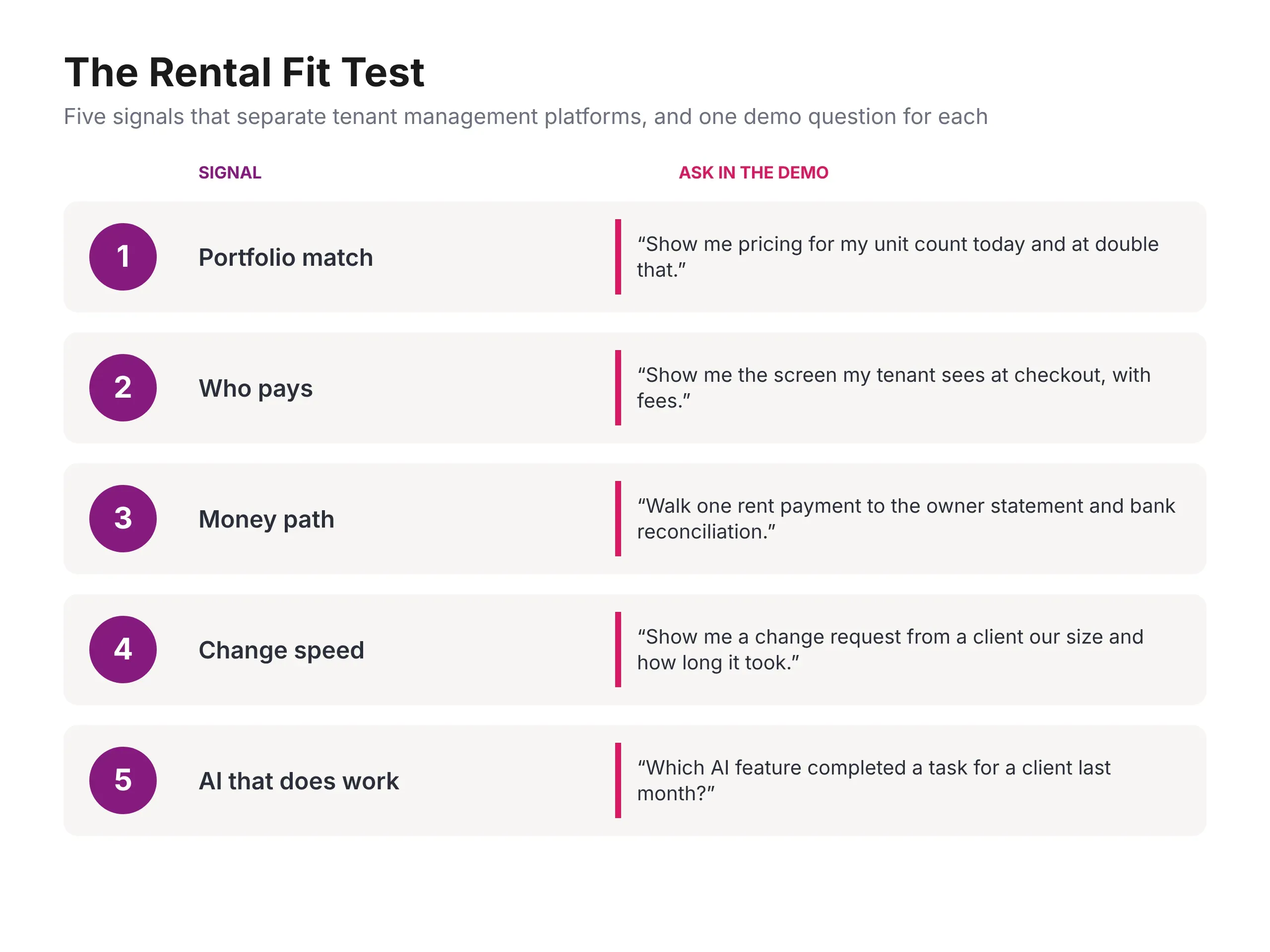
1. Portfolio match. Check the unit minimum and the unit cap first. AppFolio's Core plan has a 50-unit minimum, according to its pricing page. Rentvine starts new accounts at 30 units. TenantCloud caps active leases by plan. A good tool fits the portfolio you will have in two years.
2. Who pays. "Free" usually means the tenant pays. Innago is free for landlords, and tenants pay $2 per bank payment plus a card fee, though landlords can cover them. On Avail's free plan, tenants pay $2.50 per bank transfer. That is a fair model, but tenants should hear about it from you, not from the checkout screen.
3. Money path. Follow a rent payment from the tenant to the owner statement. Does the product handle trust accounting and bank reconciliation, or does it hand you a file for QuickBooks? Rentec Direct keeps trust accounting in its PM edition, and TenantCloud puts bank reconciliation in Pro. David Roberson, Principal at Esquire Property Management Group, runs 350+ units on AppFolio and puts it this way: "Daily record-keeping and reconciliation is paramount to maintaining statutory compliance and peace of mind in our business."
4. Change speed. Ask what happens when you need something the product does not do. An open API lets you or a developer connect your own tools without waiting for the vendor's roadmap. DoorLoop now includes full API access in every plan. AppFolio gives read-only API on Plus and read-write on Max. Several small-landlord tools publish no API at all. Also ask whether you can export all your data and whether the product sends webhooks when records change. Our property management software integrations page explains what such a connection takes.
5. AI that does work. Split AI claims into two kinds. Some AI drafts listings and replies. Other AI does back-office work, such as processing bills or answering portfolio questions. Most pricing pages name AI features without saying what they do, so ask for a live example.
How we built this list
| Item | Value |
|---|---|
| Data collected | 17 November 2026 |
| Products scored | 13 |
| Products on the list | 12 |
| Rating source | Capterra rating and review count per product, read on 17 November 2026 |
| Pricing source | Each vendor's own pricing page, rechecked in a second, AI-assisted pass the same day |
Scoring:
| Evaluation factor | Weight | What we measured |
|---|---|---|
| Portfolio match | 20% | Unit minimums, caps and the size the vendor says it serves |
| Who pays | 20% | Published tenant fees, payment fees and who carries them |
| Money path | 25% | Published trust accounting, owner statements and reconciliation |
| Change speed | 20% | Public API and which plans include it |
| AI that does work | 15% | Published AI that completes tasks, not only drafts text |
Each factor got 0 to 3 points: 0 for nothing published, 1 for a claim without detail, 2 for detail with gaps and 3 for a full, published answer. The score measures what a vendor publishes, not how good the product is in use. A product with quote-only pricing scores lower because a buyer cannot check it before a sales call.
Inclusion criteria: a live product sold to landlords or property managers in the US, a public pricing page or a Capterra profile, at least one primary source we could check, and a Fit Test score of 38 or more.
Score threshold: products needed 38 of 100 to make the list.
Excluded, with reasons: Yardi Breeze scored 35 of 100, below the threshold, because its pricing page publishes no API, AI or fee detail, though its price is clear: $1 per unit with a $100 monthly minimum for residential, per Yardi. Yardi Voyager, RealPage and Entrata serve enterprise multifamily operators. Stessa and Baselane start from bookkeeping and banking. Zillow Rental Manager is a listing and rent collection tool. ManageCasa and Hemlane had too little primary data to score. CondoGenie is ours.
Editorial note: "Best for" lines are our interpretation of the evidence, not vendor statements. Products appear in score order inside each group. Capterra figures are as shown on 17 November 2026 and drift by a few reviews a week. We did not use G2 ratings, because the pages we could reach showed conflicting figures.
Comparison table
| # | Platform | Built for | Starting price | Minimum or catch | Capterra | Fit Test score |
|---|---|---|---|---|---|---|
| 1 | AppFolio | 50+ units | $1.49/unit/mo | 50 units and a minimum spend | 4.5 (1,892) | 67 |
| 2 | Buildium | Up to 5,000 units | $65/mo | Onboarding fee on Growth and Premium | 4.5 (2,236) | 62 |
| 3 | DoorLoop | Growing managers | $2.50/unit/mo | Minimum spend and unit count (not published) | 4.8 (719) | 55 |
| 4 | Propertyware | Single-family portfolios | $1.00/unit/mo, $250/mo minimum | Implementation fee of 2x monthly price | 3.9 (325) | 42 |
| 5 | Rentvine | Management companies | $2.50/unit/mo | 30-unit minimum plus platform fee | 4.7 (11) | 40 |
| 6 | Rent Manager | Mixed portfolios | Quote only | Implementation package | 4.6 (662) | 38 |
| 7 | Rentec Direct | 1 to 2,500 units | $50/mo | Trust accounting in PM only | 4.6 (179) | 83 |
| 8 | TenantCloud | Small portfolios | $15/mo annual | Lease caps per plan | 4.3 (451) | 68 |
| 9 | Avail | Independent landlords | Free; $9/unit/mo Plus | Tenants pay $2.50 per bank transfer on free plan | 4.6 (276) | 53 |
| 10 | TurboTenant | 1 to 60+ units | Free; $149/yr paid | Card fee 3.49% | 4.6 (108) | 47 |
| 11 | Innago | Any size | Free | Tenants pay $2 per bank payment | 4.9 (540) | 42 |
| 12 | RentRedi | Small portfolios | $12/mo annual | $29.95 month to month | 4.5 (180) | 40 |
Scores run 0 to 100 and reflect what each vendor publishes, so a higher score means a buyer can check more before a sales call. Starting prices use different units (per unit, per month, per year), so price your own unit count on each vendor page.
Built for management companies
These six products sell mainly to property management companies. Most set a unit or spend minimum, so they fit best above about 50 units.
1. AppFolio: an all-in-one platform with a size floor
| Built for | Starting price | Minimum | Capterra |
|---|---|---|---|
| Management companies, 50+ units | $1.49/unit/mo (Core) | 50 units and a minimum spend | 4.5 (1,892) |
Sources: AppFolio pricing, Capterra
AppFolio sells three plans: Core from $1.49 per unit a month, Plus from $3.20 and Max from $5.00. Each carries a minimum spend, which AppFolio quotes on request.
What the plans add: Plus adds advanced budgeting and accounting, maintenance scheduling with automated billing, and read-only API access. Max adds a leasing CRM and read-write API access.
AI: Core includes Realm-X Assistant and Messages, and Plus adds Realm-X Flows. The pricing page names these features but does not describe them.
Limitation: the 50-unit minimum on Core rules out small landlords, and API access starts only on Plus.
Best for: management companies above 50 units that want one vendor for accounting, tenants and owners.
2. Buildium: mid-market depth with published prices
| Built for | Starting price | Minimum | Capterra |
|---|---|---|---|
| Residential and association managers | $65/mo (Essential) | Onboarding required on Growth and Premium | 4.5 (2,236) |
Sources: Buildium pricing, Capterra
Buildium publishes three plans: Essential from $65 a month, Growth from $202 and Premium from $420. Portfolios above 5,000 units get custom pricing.
Payment fees: incoming bank payments cost $2.35 each on Essential and $1.35 on Growth; Premium makes them free for 12 months, then $0.60. Cards cost 2.99%. Managers can pass these fees to tenants as a convenience fee, as Buildium explains; otherwise the manager pays. Applicants pay $35 for screening if you choose that option.
AI: Buildium lists Lumina AI and AI Bill Scan, and Premium includes the "Full AI and Automations suite, plus Open API". The page names the features without describing them.
Limitation: "All new Buildium customers purchasing our Growth or Premium plan must use our customized Onboarding service", per its pricing page, and the open API is a Premium feature.
Best for: managers with a few dozen to several hundred units who want a mid-priced single system. Rich Blanchard, who has managed residential property in Boston for 20+ years on Buildium, explains why many stay: "It's always more beneficial to keep what your used to than spend a large sum of money on software that can do what buildium already does."
3. DoorLoop: per-unit pricing with an API in every plan
| Built for | Starting price | Minimum | Capterra |
|---|---|---|---|
| Growing landlords and managers | $2.50/unit/mo (One) | Minimum spend and unit count apply (not published) | 4.8 (719) |
Sources: DoorLoop pricing, Capterra
DoorLoop replaced its Starter, Pro and Premium plans in 2026 with One, Connect and Multiply. One starts at $2.50 per unit a month and drops to as low as $1.50 per unit above 100 units. Every plan carries a minimum: "Minimum spend and units apply. Contact us for details," says its pricing page, so get the figure for your portfolio before you compare.
Change speed: full API access comes with the base plan, so every DoorLoop customer can connect other tools.
Limitation: the 2026 plan change means older reviews and comparison pages quote prices that no longer exist. Price your own portfolio on the live page.
Best for: managers who expect to grow past 100 units and want API access without a top-tier plan.
4. Propertyware: built for single-family portfolios
| Built for | Starting price | Minimum | Capterra |
|---|---|---|---|
| Single-family rental managers | $1.00/unit/mo (Basic) | $250, $350 or $450 a month | 3.9 (325) |
Sources: Propertyware pricing, Capterra
Propertyware, part of RealPage, sells Basic at $1.00 per unit a month, Plus at $1.50 and Premium at $2.00, with monthly minimums of $250, $350 and $450, per TrustRadius' listing of its pricing. Billable units move in 50-unit steps.
Change speed: API access costs an extra $1 per unit a month on any plan.
Limitation: implementation costs twice the monthly subscription, and its Capterra rating is the lowest on this list.
Best for: managers of large single-family portfolios who need an API and can budget for implementation.
5. Rentvine: one plan, priced per unit
| Built for | Starting price | Minimum | Capterra |
|---|---|---|---|
| Property management companies | $2.50/unit/mo | 30 units plus a monthly platform fee | 4.7 (11) |
Sources: Rentvine FAQ, Capterra
Rentvine charges one per-unit price. "You simply pay $2.50 per unit you manage," says its FAQ, and new accounts start at a 30-unit minimum plus a platform fee the page does not state.
Change speed and AI: Rentvine lists an open API and AI tools, including an MCP connection, as platform features. The FAQ does not say which are in the base price.
Limitation: only 11 Capterra reviews, so the rating rests on a small sample, and the platform fee is unpublished.
Best for: management companies above 30 units that prefer one plan to tier upgrades.
6. Rent Manager: configuration for mixed portfolios
| Built for | Starting price | Minimum | Capterra |
|---|---|---|---|
| Residential, commercial and mixed portfolios | Quote only | Implementation package | 4.6 (662) |
Sources: Rent Manager pricing, Capterra
Rent Manager sells Basic, Plus and Premium bundles behind a quote form, so no price appears on its site.
Change speed: an Open API add-on "gives your developers read and write access to your data".
AI: Orion AI covers a writing assistant, Smart AP and AR, Instant Insights and an MCP connector. AI call summaries need Rent Manager's phone service.
Limitation: you cannot compare cost without a sales call, which pulled its Fit Test score down.
Best for: operators above 100 units with mixed property types who want deep configuration and developer access.
Built for independent landlords
These six products sell mainly to landlords who manage their own units. All have a free plan or a low flat price, and some, like Rentec Direct, scale into the hundreds of units.
7. Rentec Direct: real accounting at a small-landlord price
| Built for | Starting price | Minimum | Capterra |
|---|---|---|---|
| Landlords and managers, 1 to 2,500 units | $50/mo (Pro and PM) | Price rises with units | 4.6 (179) |
Sources: Rentec Direct pricing, Capterra
"Rentec Pro and Rentec PM start at $50 per month," per its pricing page, and both rise with unit count. Above 2,500 units, pricing is by quote.
Who pays: each active property gets one free incoming bank payment a month, and extra payments cost $0.50. Visa, Mastercard and Discover cost 2.95%, paid by the tenant or the manager. Screening packages cost $10 to $18.
Money path and change speed: the PM edition adds trust account management and reporting. Pro includes "access to the API, Zapier Integrations, and Bank Sync", and PM includes everything in Pro.
Limitation: trust accounting is in PM only, and the Starter edition has no API.
Best for: small landlords and growing managers who want proper accounting and an API before they need a large platform.
8. TenantCloud: tiers that add accounting
| Built for | Starting price | Minimum | Capterra |
|---|---|---|---|
| Landlords and small managers | $15/mo (Starter, annual) | Lease caps of 10, 30 and 60 | 4.3 (451) |
Sources: TenantCloud pricing, Capterra
TenantCloud sells Starter at $15 a month, Growth at $29.17 and Pro at $50, billed annually, with Business from $100. Properties and units are unlimited, but active leases cap at 10, 30 and 60.
Who pays: tenants pay $1.95 per bank payment on Starter, $1.75 on Growth and $1.50 on Pro. Applicants pay for screening.
Money path: Pro adds bank reconciliation and tax reports.
Limitation: the lease cap, not the unit count, forces upgrades, and the page lists Zapier rather than an open API.
Best for: landlords with up to 60 active leases who want rent collection and light accounting in one place.
9. Avail: free plan with local lease templates
| Built for | Starting price | Minimum | Capterra |
|---|---|---|---|
| Independent landlords | Free; Plus $9/unit/mo | Per unit on Plus | 4.6 (276) |
Sources: Avail pricing, Capterra
Avail, owned by Realtor.com, offers a free Unlimited plan and Unlimited Plus at $9 per unit a month. Plus adds faster payments, custom applications and lease templates, and a property website.
Who pays: on the free plan, "tenants pay $2.50 per bank transfer". Plus waives that fee. Card payments cost 3.5% on any plan.
AI: lease clauses and disclosures come from a feature called LocalAssist, which the page does not describe.
Limitation: at $9 per unit, Plus costs $450 a month at 50 units, so check the flat-price tools in this group before you upgrade.
Best for: landlords with a handful of units who want free tools and state-specific leases.
10. TurboTenant: a free start for first-time landlords
| Built for | Starting price | Minimum | Capterra |
|---|---|---|---|
| Landlords, 1 to 60+ units | Free; Essentials $149/yr | Prices step up by unit band | 4.6 (108) |
Sources: TurboTenant pricing, Capterra
TurboTenant offers a free plan, Essentials and Pro. For 1 to 10 units, Essentials costs $149 a year and Pro $199. At 61+ units, they cost $349 and $999. "Most of our users have between 1 – 50 units," says its pricing page.
Who pays: renters pay for screening ($45 or $55) and 3.49% for cards. Bank payments cost $2, "typically paid by the tenant", and TurboTenant waives the fee on its top plan, per its support center.
AI: a free Lease Agreement Audit tool "analyzes your lease for legal compliance within 15 seconds".
Limitation: no API is published, and the card fee "cannot be waived".
Best for: landlords with their first one to ten doors.
11. Innago: no software fee for landlords
| Built for | Starting price | Minimum | Capterra |
|---|---|---|---|
| Landlords, any size | Free | Tenants pay payment fees | 4.9 (540) |
Sources: Innago vs Avail, Capterra
Innago is free for landlords at any unit count. Tenants pay $2 per bank payment and 2.99% by card, and "Landlords can pay these fees if they want to."
Limitation: no API or AI features appear in its published material, so the score rests on fees and portfolio fit.
Best for: landlords who want zero software cost and will explain the payment fees to tenants.
12. RentRedi: flat price, unlimited units
| Built for | Starting price | Minimum | Capterra |
|---|---|---|---|
| Landlords, small portfolios | $12/mo (annual) | $29.95 month to month | 4.5 (180) |
Sources: RentRedi pricing, Capterra
RentRedi costs $12 a month billed annually or $29.95 month to month, with "Unlimited units". The price does not change with portfolio size.
Limitation: RentRedi's pricing pages show different tiers, so check the plan on the page you sign up from. No API is published.
Best for: landlords who want one flat price as the portfolio grows.
Author entry: build the fringe
Unranked. Brocoders wrote this list, so we do not score ourselves.
Most operators should not build their own tenant management software. The property managers who answered our HARO query said so plainly. "We would never think of building our own software," Rich Blanchard told us. Yardi's CEO agrees from the vendor side. "I don't think any one of our clients wants to be in the vibe coding business long term. They're real estate companies," Rob Teel said in a PLOT interview in October 2026 (around 36:00).
Teel also drew a line, later in the same interview (38:35 to 42:06): "Buy the platform, build the fringe." He would not rebuild accounting or financial reports. He would build "a pocket of functionality that is very specific to my company", such as a forecasting method or a maintenance workflow the standard app does not cover. He warned about "a hidden cost maintaining code" too.
That fringe is the work we do. For C.I.A. Services, in HOA management since 1984 with about 150 associations and 50,000 properties in Houston and San Antonio, we built MyRedDog. It is a PWA, so owners install nothing from an app store. It reads live data from RedDog NextGen, the client's own system, and from the company website without duplicating it. Owner updates and photos write back into RedDog. Owners see open invoices, payment plans, liens, payoff requests, violations and documents. The core system stayed in place.
Not a fit: under about 100 units, buy one of the 12 products above. A custom build adds a development cost and an ongoing maintenance cost, the "hidden cost" Teel names, and a small portfolio rarely spreads that over enough units to beat a subscription. We are also not a product you can buy off the shelf: a custom product development project starts with a two-week Solution Design. Our longer answer to the build question is in should property managers build their own software.
How to choose
Demos show the happy path. These five questions, one per Fit Test signal, take you off it.
- "Show me pricing for my unit count today and at double that." This exposes minimums, caps and tier jumps.
- "Show me the screen my tenant sees at checkout, with fees." This tells you who pays and whether the fees will surprise anyone.
- "Walk one rent payment from the tenant to the owner statement and the bank reconciliation." If the answer involves an export, you will repeat that export every month.
- "Show me the API docs, the data export and which plan includes them." An API on the top tier only is a cost you will meet later.
- "Which AI feature completed a task for a client last month, and what was it?" This separates working agents from drafting tools.
Price is rarely the reason operators look beyond a platform. Jeremy T. of Argo Property Group, which built its own system, wrote on LinkedIn that "most of the major players aren't that expensive on a per-unit basis"; seeing the whole portfolio in one place was the reason. Ask about portfolio reports early.
What tenant management software costs
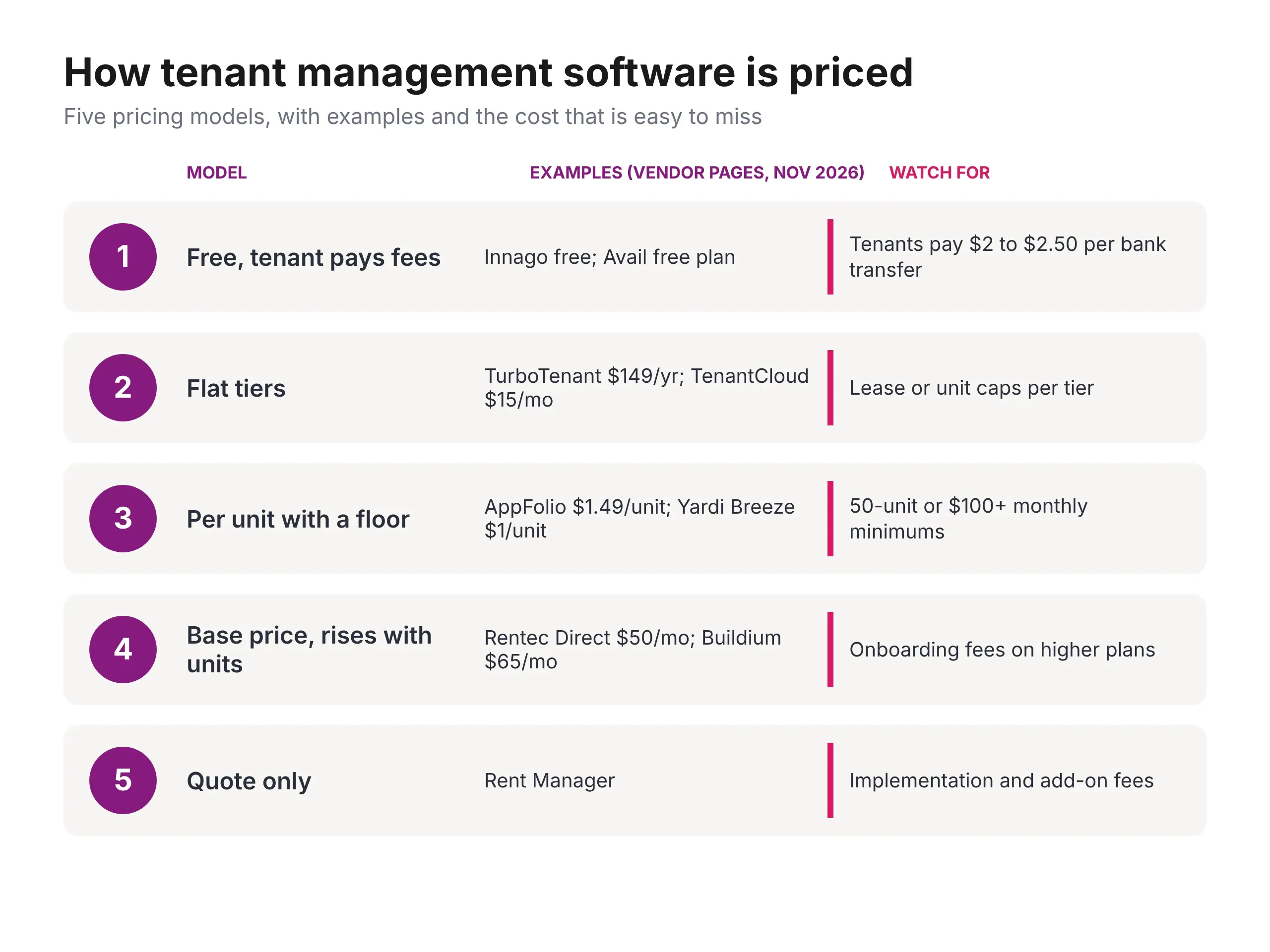
| Pricing model | Examples | Published entry price | Watch for |
|---|---|---|---|
| Free, tenant pays fees | Innago, Avail (free plan) | $0 to landlord | Tenants pay $2 to $2.50 per bank payment |
| Flat tiers | RentRedi, TurboTenant, TenantCloud | $12/mo (annual) to $15/mo; TurboTenant $149/yr | Lease or unit-band caps |
| Per unit with a floor | Propertyware, AppFolio, Rentvine, DoorLoop | $1.00 to $2.50/unit/mo | 30- or 50-unit minimums, minimum spend, Propertyware implementation at 2x monthly |
| Base price that rises with units | Rentec Direct, Buildium | $50 to $65/mo | Onboarding fees on higher plans |
| Quote only | Rent Manager | Not published | Implementation and add-on fees |
Add screening ($10 to $55 per applicant across the products above), card fees of 2.95% to 3.5%, and onboarding or implementation where it applies. Prices come from vendor pages read on 17 November 2026 and change often.
FAQ
What is the best tenant management software? It depends on who you are. For management companies, AppFolio, Buildium and DoorLoop scored highest in our Rental Fit Test. For independent landlords, Rentec Direct, TenantCloud and Avail led. Run the five demo questions before you choose.
Is there free tenant management software, and what is the catch? Yes. Innago, Avail and TurboTenant offer free plans. The catch is that tenants usually pay payment and screening fees, or that key features sit in paid tiers. Tell tenants about the fees before they meet them.
How much does tenant management software cost per unit? Per-unit plans on this list run from $1.00 (Propertyware Basic) to $2.50 (Rentvine, DoorLoop) per unit a month, usually with a minimum. Flat plans for small landlords start free or at $12 to $15 a month. Add screening and payment fees.
What is the difference between tenant management and property management software? Tenant management covers the renter's side: listings, applications, leases, rent and requests. Property management software adds owner accounting, trust accounting, vendor payments and reporting. Most products on this list do both, and small-landlord tools lean toward the tenant side.
Do tenant management platforms use AI, and what does it do? Most now list AI features, but few pricing pages describe them. Rent Manager's Orion AI lists Smart AP and AR, and TurboTenant offers an AI lease audit. Ask whether the AI drafts text or completes work, and ask for a live example.
When should a property manager build custom software instead of switching? Rarely for the whole system. Keep the platform for accounting and tenant records, and build only the workflow it cannot handle, such as a portfolio report or an owner app. Below about 100 units, buy instead.
How did you compile this list, and are you biased? Brocoders compiled it. We do not sell tenant management software, but we build platforms for clients and run CondoGenie, so we excluded our own work. Scores follow the weighted method above, and each profile links its sources.
Why trust this page
The Brocoders proptech team produced this page. On 17 November 2026 we read each product's pricing page and Capterra profile, scored the published evidence, and then rechecked every price and rating against the primary pages in a second, AI-assisted pass the same day. Propertyware's per-unit rates come from TrustRadius, because its own pricing page displays them in a broken format. We did not verify vendor-reported customer counts, AI capabilities beyond the vendor's own wording, or anything a vendor gives only on a sales call. Quotes from property managers come from replies to our HARO query, offered for publication. Rob Teel's quotes come from the linked interview (35:27 to 42:06). Prices, ratings and review counts change over time. Verify current data on each vendor's site before you shortlist.
The test lasts longer than the list. Prices and ratings will move next quarter, but the five questions still apply. If none of the 12 fits one workflow, keep the platform you run and talk to us about the piece it is missing. Our property management software development page shows what that work looks like.