
Founders rarely call us about modernization. They come with one of 3 problems: the product looks dated next to a newer competitor, the infrastructure doesn't scale with the customers they now have, or the team can't add the features customers ask for. Underneath all 3 we usually find the same thing, technical debt. Every change costs more than the one before it, so the team stops making the changes customers would notice.
The interface is the easy part. In our experience, a team can refresh screens with modest effort, and AI design and coding tools make that faster still. Billing, integrations, architecture under load and tenancy are different. Each one changes how money and many customers' data move through the product, and in our view none of them should be changed without an architect who owns the design.
SaaS modernization is the work of changing a live SaaS product's code, architecture and integrations while paying customers keep using it. Subscriptions keep billing, tenants keep their data, and releases keep going out. That last condition is what makes it different from rebuilding an internal system or starting a new product.
TL;DR: SaaS modernization updates a subscription product without stopping it. Clients arrive with a dated interface, infrastructure that doesn't scale, or features they can't add. The interface can be refreshed with modest effort. Billing, integrations, architecture under load and tenancy need an architect, because a mistake there reaches every customer's data or invoice. In our view the work is mostly about paying down technical debt before it blocks the roadmap, because the framework, the runtime and the payment API all age on a published schedule. We also think it is the groundwork for any AI plan, because AI agents can only work with a product that exposes clean data and clear permissions. We have modernized CondoGenie, a condo management SaaS, since 2018, and its active users grew from 1,398 in 2019 to 19,324 in 2025.
What SaaS modernization is, and what it is not
The term gets mixed up with 3 other kinds of work. The difference decides who you hire and what you pay for.
| Term | What it means | Who it is for |
|---|---|---|
| SaaS modernization | Changing a SaaS product that already has paying customers, without taking it offline | SaaS companies with a live product |
| Legacy to SaaS | Turning an internal or single-client system into a product other companies can buy | Companies whose own software has outside demand. Covered in our legacy application modernization guide |
| SaaS migration | Moving a company's own operations onto a vendor's SaaS, as Oracle uses the term | Companies buying software, not selling it |
| A redesign | A new interface on the same code | Products whose code is in good shape |
A redesign is the cheapest part of the work, and it is worth doing early because customers see it. Our recent builds show how fast interface work goes with AI tools. For Pacholi Monitor, a tax deadline SaaS for accountants, our project manager prototyped screens with Claude, and the product went from kick-off to launch in 9 weeks, from 12 May to 16 July 2026. TradeFlex, a staffing marketplace for construction trades, was built spec-first with Claude Code from the first commit and reached closed beta about 10 weeks after kick-off, on 12 December 2025. Both were new products rather than modernizations, but the interface work is the same kind of work. On its own it rarely solves the request that starts the conversation. In our experience, if the interface looks dated because nobody dares change the code behind it, new screens on top of the same code soon run into the same problem.
Why a working SaaS product still needs modernizing
A SaaS product ages even when nobody touches it, because the software it is built on has published end dates.
- The framework. Ruby on Rails gives each minor release bug fixes for 1 year and security fixes for 2 years after its first release, under the maintenance policy announced in October 2024. Under that policy, security support for Rails 7.2 was set to end on 9 August 2026.
- The runtime. Node.js 18 and every earlier version are end of life, which means no more security patches. The long-term support window for Node.js 20 ran to April 2026.
- The payment API. Stripe releases new API versions every month without breaking changes, and twice a year it ships a major release that does include them. The API version you run controls more than your own requests. It also shapes the webhooks Stripe sends you and the automated billing Stripe runs for you, such as generating the invoice for a new subscription period.
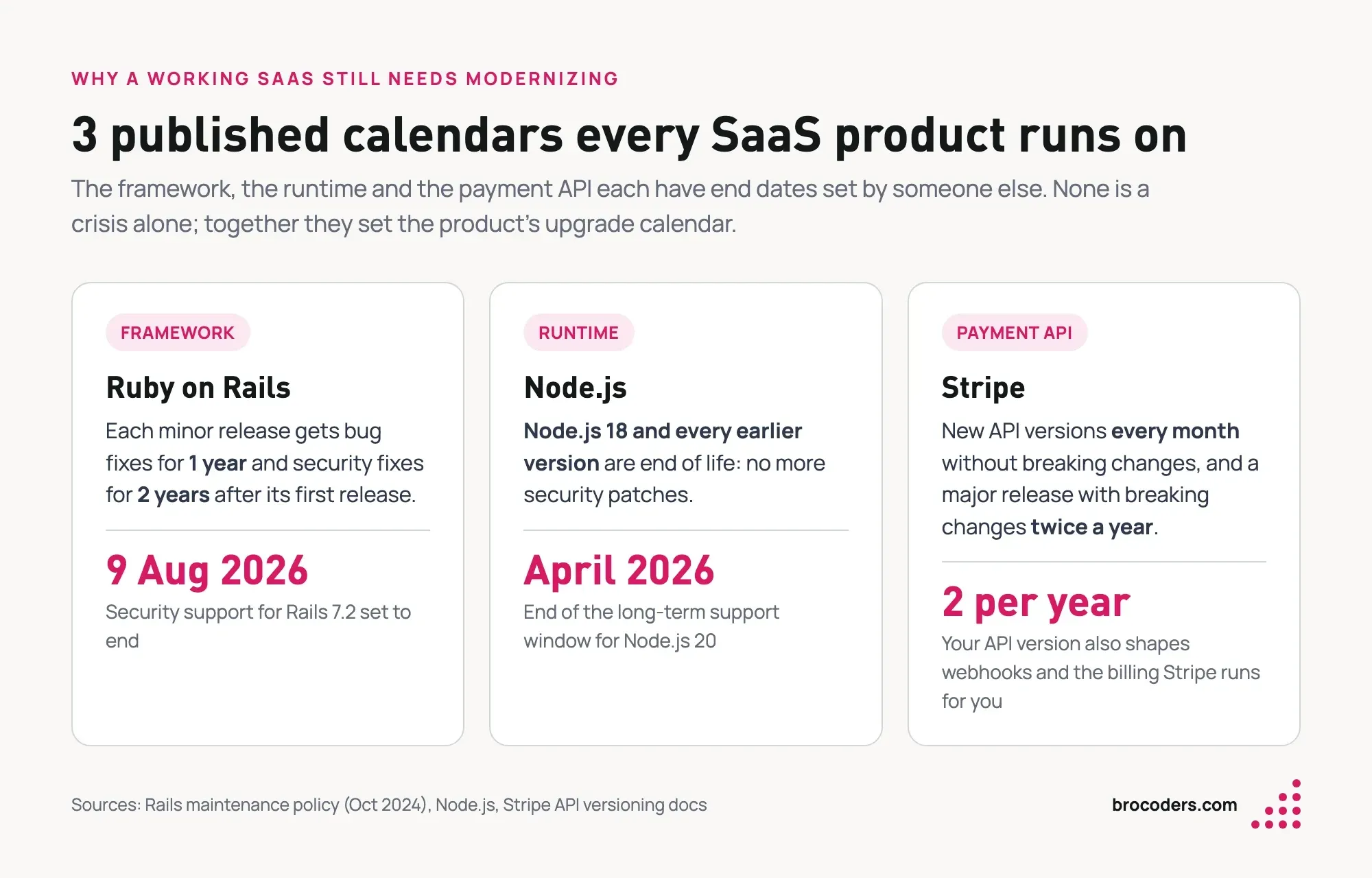
None of these dates is a crisis on its own, but together they set a calendar for the product. In our experience, a team that skips upgrades for a few years ends up with one nobody can scope, and the security review a large customer sends over starts asking about it.
We think this is what most writing on the topic gets wrong. It treats SaaS modernization as a choice of technology, such as microservices or cloud-native. In our experience the real driver is technical debt: the extra cost every change carries because earlier changes were never finished, upgraded or tested.
What SaaS modernization changes: 5 areas
Most SaaS products need work in some of these areas, rarely all of them at once.
| Area | What changes | Example from our work |
|---|---|---|
| Runtime and framework | Upgrades to supported versions of the language, framework and build tools | CondoGenie: Rails upgrade scoped in June 2025 and released on 15 August 2025, with feature work going on in parallel. The frontend build tools are now moving to Node.js 24 LTS, which retires the old CRA and Webpack builder and unblocks TypeScript and React upgrades |
| Tests and releases | A test suite the team trusts, and releases that don't depend on one person's laptop | CondoGenie: the test suite moved to Playwright between June and September 2025. In August 2026 the product shipped 5 production releases |
| Billing and integrations | Payment API versions, accounting and partner integrations kept current against live subscriptions | CondoGenie: Stripe API version migration in February 2026, on a product billing 4 subscription tiers through Stripe and Rotessa |
| Architecture under load | Splitting the parts that slow each other down, so growth in one part doesn't drag the rest | Adact, a no-code gamification SaaS: campaign configuration (PostgreSQL) was split from game-session analytics (MongoDB on AWS Lambda) |
| Tenancy | Moving from one customer per installation to many customers on one platform, with each customer's data kept apart | CondoGenie: the founder's 2009 system, GeniePad, served a single building. From 2018 we rebuilt it as a multi-tenant SaaS, and the first release came after 18 months |
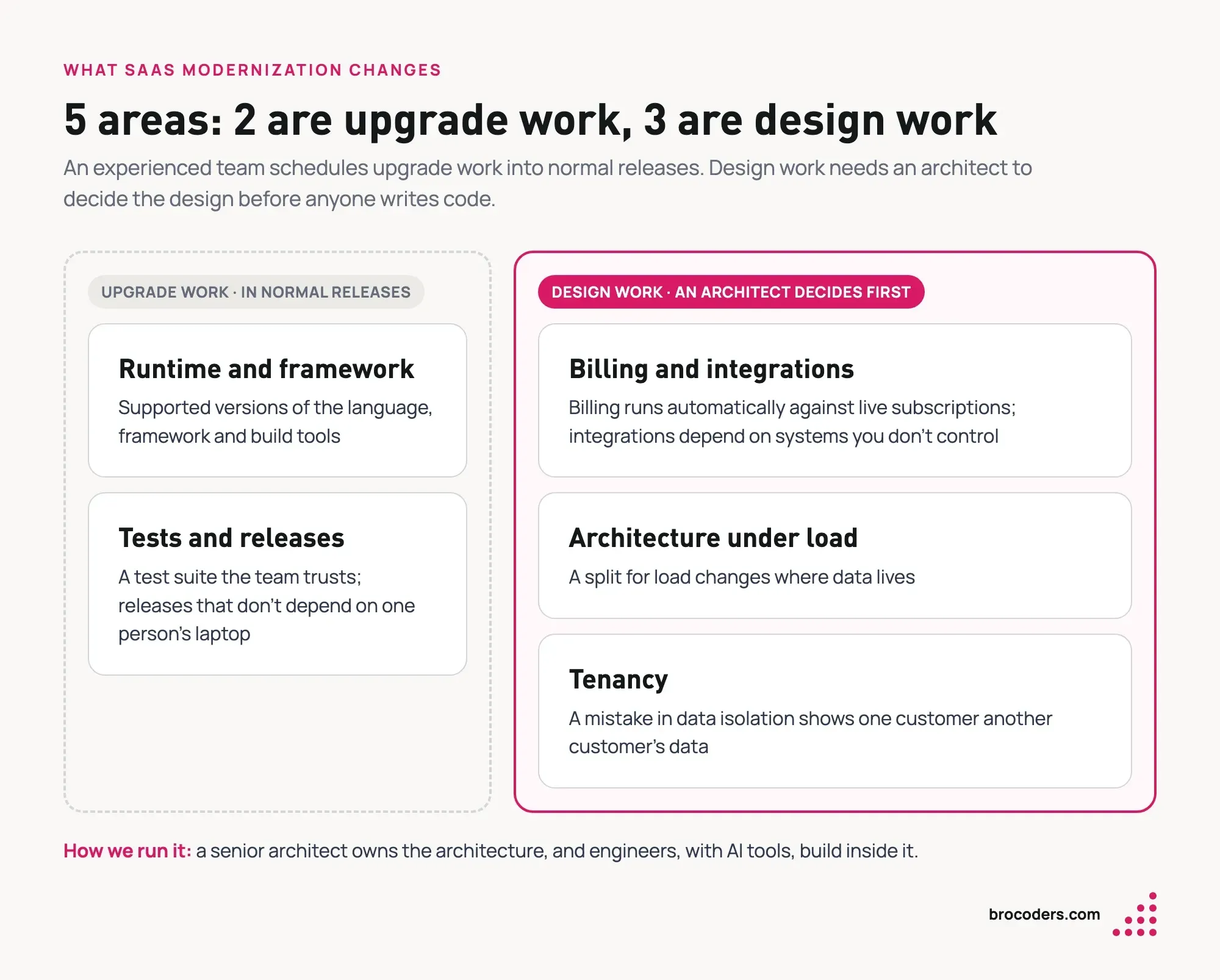
The first 2 areas are upgrade work that an experienced team can schedule into normal releases. The last 3 are design work. Billing runs automatically against live subscriptions, integrations depend on systems you don't control, a split for load changes where data lives, and in a multi-tenant product a mistake in data isolation shows one customer another customer's data. Each of them needs an architect to decide the design before anyone writes code. That is how we run them: a senior architect owns the architecture, and engineers, with AI tools, build inside it.
If you are planning tenancy work, AWS describes the main ways to keep customers apart as the silo, pool and bridge models. Our own notes are in multi-tenant SaaS architecture.
2 ways to do it: upgrade in place or rebuild part of it
You can start modernizing a SaaS product right away, in small steps. Any rebuild, though, has to be designed before it starts. The SaaS products we have modernized needed one of 2 approaches, and CondoGenie, the longest-running, has needed both.
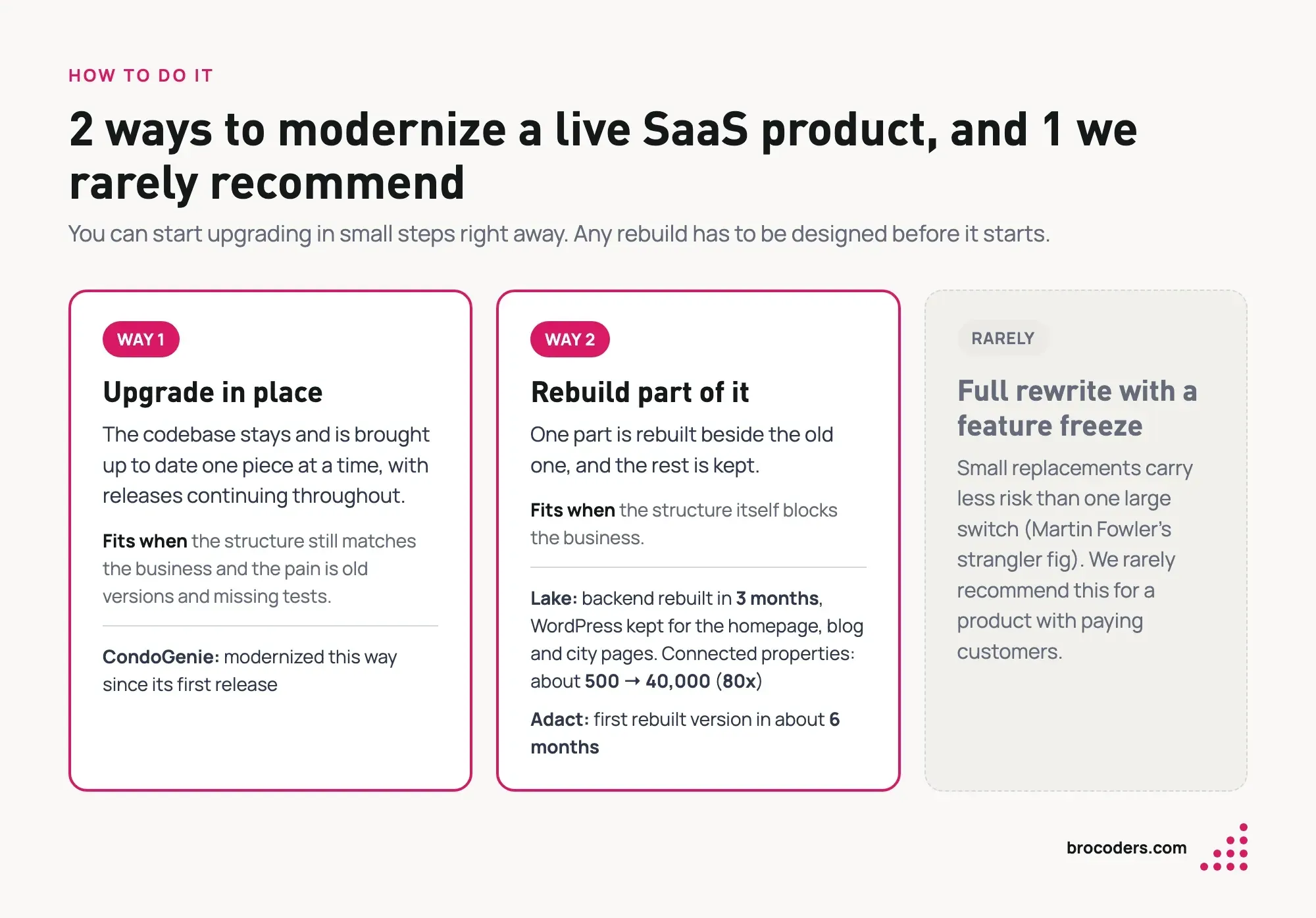
Upgrade in place. The codebase stays and gets brought up to date one piece at a time, with releases continuing throughout. This fits when the product's structure still matches the business and the pain is mostly old versions and missing tests. CondoGenie has been modernized this way since its first release.
Rebuild part of it. One part of the product gets rebuilt beside the old one, and the rest is kept. This fits when the structure itself blocks the business. Lake, a vacation rental marketplace, ran on WordPress, and data from property management systems stopped syncing, so property managers who had agreed to list walked away. We rebuilt the backend in 3 months, from 25 February to 27 May 2025, and kept WordPress for the homepage, blog and city pages, so search rankings held. Separately from the rebuild timeline, Lake's connected properties went from about 500 to 40,000, an 80x increase.
Adact shows the same choice made early. Its founder brought a working MVP and asked us to prepare it for large numbers of users before they arrived. The first rebuilt version took about 6 months, and the engagement ran 39 paid months in total, including the rebuild. One agency's 10-day campaign on the platform drew 567,077 landing-page visitors and 478,846 completed games. "We've tested the product and acquired two million interactions without experiencing downtime or bug issues," said Kalev Kärpuk, Adact's CEO.
A full rewrite with a freeze on new features is the third option, and we rarely recommend it for a product with paying customers. Martin Fowler's strangler fig explains why: small replacements carry less risk than one large switch. Our legacy application modernization guide walks through the steps, and refactor vs rewrite covers the decision at code level.
What founders argue about, and what they hand over
Over 8 years with CondoGenie we noticed a pattern. Its founder approved every infrastructure change without debate: the Rails upgrade, the Playwright tests, the Stripe API migration, the move to Node.js 24. He argued, in detail, about anything his customers would see or feel.
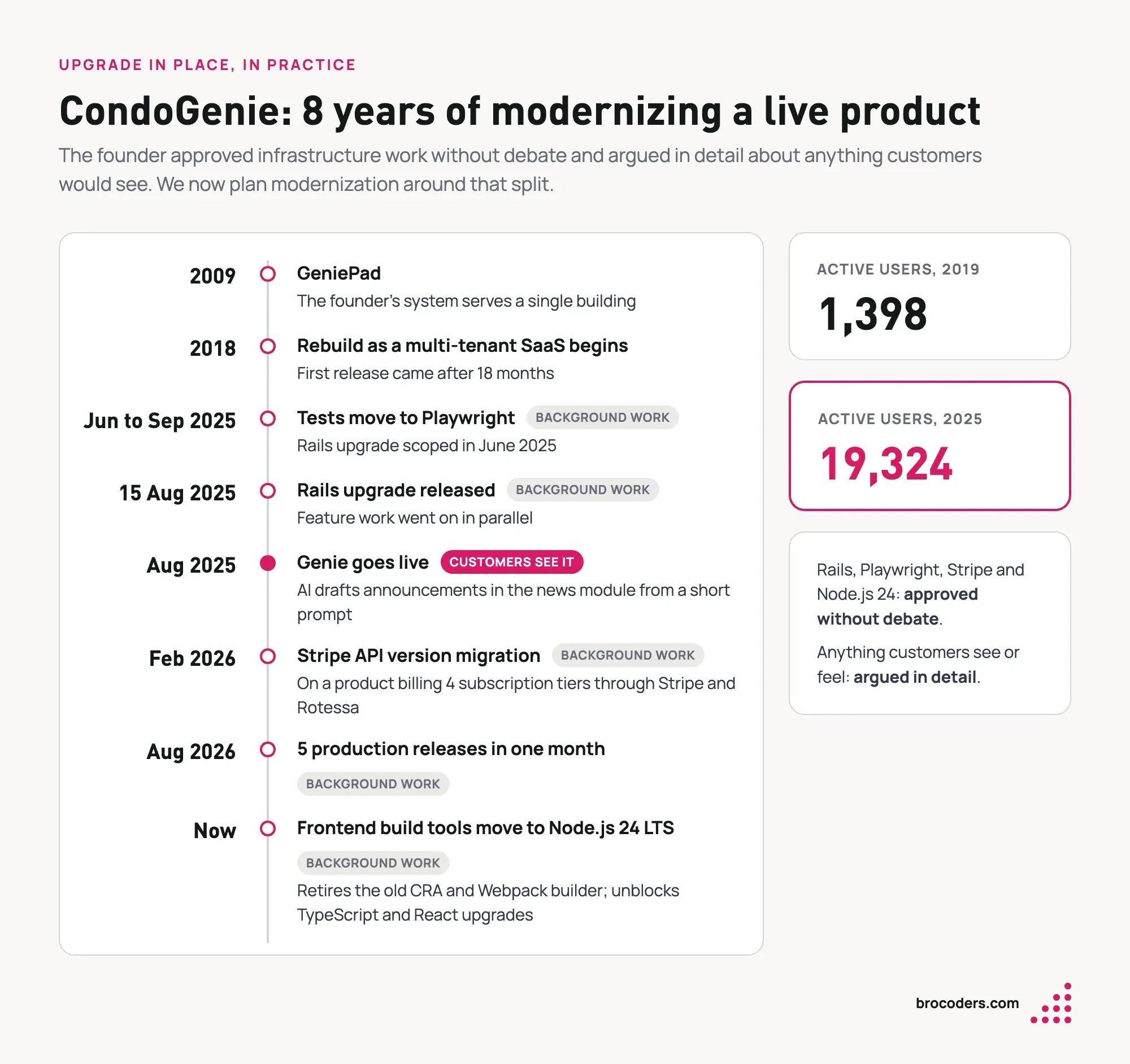
We now plan modernization around that split. Work customers never see goes ahead in the background, as part of the normal release cycle. Work customers will notice, such as a new interface, a pricing change or a moved feature, gets its own plan, its own timing and a notice to users. In our experience, most of the risk sits in that second group.
Is SaaS dead? AI as a business strategy question for an existing SaaS
For a SaaS company, AI is a business strategy decision first and a technical one second: what customers will still pay for when an agent does part of the work.
In December 2024 Microsoft CEO Satya Nadella said SaaS applications "will probably collapse in the agent era" because "they are essentially CRUD databases with a bunch of business logic", and that "the business logic is all going to these AI agents" (OfficeChai). In February 2026, after Anthropic launched plug-ins for its Claude Cowork agent, the S&P 500 software and services index fell nearly 13% over 5 sessions (Reuters via BNN Bloomberg). J.P. Morgan analyst Mark Murphy said it felt like "an illogical leap" to read that much into the plug-ins.
The reality so far is slower than the headlines. Gartner expects over 40% of agentic AI projects to be canceled by the end of 2027 because of "escalating costs and unclear business value", and estimates that only about 130 of the thousands of agentic AI vendors are real, calling the rest "agent washing". It also expects 33% of enterprise software applications to include agentic AI by 2028, up from less than 1% in 2024 (Reuters, citing Gartner).
In our view, the SaaS products at risk are the ones an AI agent can't work with. An agent needs 3 things from your product: data it can read, actions it can call through an API, and permissions that keep one customer's data away from another's. Those are the same things SaaS modernization fixes. A product with untested code, an undocumented API and tenant boundaries enforced only in the interface isn't ready for agents to read it or act in it.
An AI strategy for an existing SaaS product usually comes down to 3 moves, in this order:
- Add AI where customers already work. Genie, CondoGenie's AI feature, drafts announcements in the news module from a short prompt. It has been live since August 2025 on a platform first written in 2009. We think the years of in-place upgrades are what made it a feature release rather than a separate project.
- Open the product to agents. That means a documented API and, increasingly, a Model Context Protocol (MCP) server, the open standard AI tools use to connect to other systems. Anthropic counted more than 10,000 active public MCP servers in December 2025, when ChatGPT, Gemini and Microsoft Copilot already supported it. Every action an agent can take needs the same tenant and permission checks a human user goes through. Our own platform, Bridge, uses MCP for actions against live systems, with human approval on critical ones.
- Revisit pricing. If one agent does the work of several users, per-seat pricing stops tracking value. We wrote about this in the SaaS apocalypse explained.
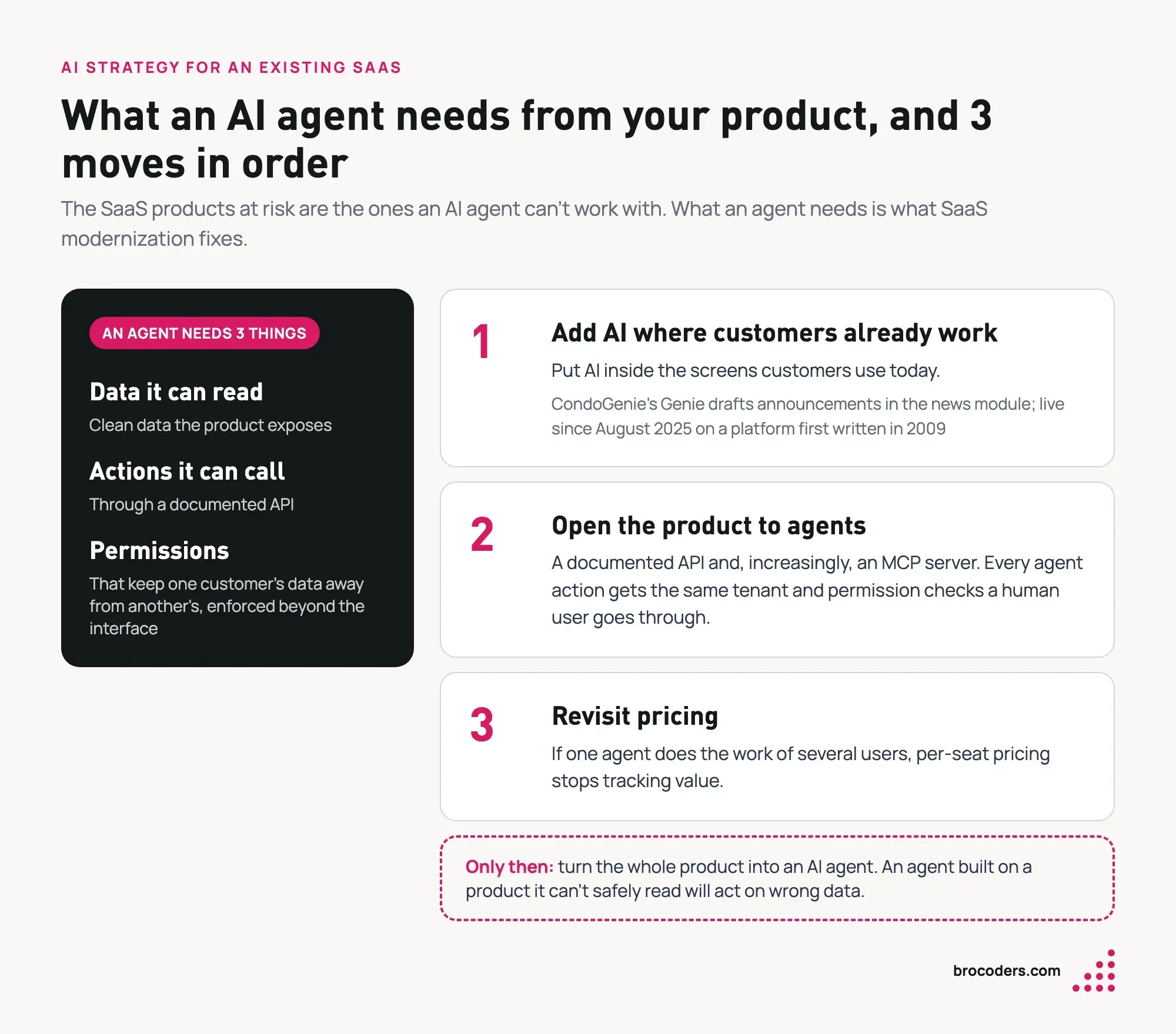
Turning a whole SaaS product into an AI agent comes after these 3 moves. An agent built on a product it can't safely read will act on wrong data.
Where to start
Start with an answer to one question: which parts of your product can be upgraded in place, and which need rebuilding? Our software audit answers it in a fixed time for a fixed price: Essential, $5,000 in 5 business days, or Standard, $9,900 in 10 business days. You get an architecture map, a security and data review, a test-coverage assessment, a prioritized risk register, and a written recommendation that is allowed to say "don't rebuild". The full path after the audit is on our application modernization page.
FAQ
SaaS modernization is changing a live SaaS product's code, architecture and integrations while paying customers keep using it. It typically covers runtime and framework upgrades, tests and releases, billing and integrations, architecture under load, and tenancy.
Legacy application modernization covers any old system, including internal tools nobody pays for. SaaS modernization is the subset where the system is the product: it bills customers every month, holds many customers' data, and can't stop for a rewrite.
Continuously, in small steps. The framework, the runtime and the payment API all have published support windows, so a product that skips upgrades for a few years builds up work that is harder to scope.
We don't think so. AI agents need clean data, documented APIs and strict permissions to work with a product, and SaaS products that have them become more useful to agents. We think products that lack them are the ones at risk.
They speed up interface work and routine upgrades. In our view, billing, integrations, architecture under load and tenancy still need an architect to decide the design, because a mistake there reaches every customer's data or invoice.
It depends on the area. Lake's backend rebuild took 3 months. Adact's first rebuilt version took about 6 months. CondoGenie's rebuild into a multi-tenant SaaS took 18 months to the first release, and its in-place modernization has continued since.