
On a Thursday, a title company (the firm that handles the paperwork and money in a home sale) emails an HOA management company. It needs a statement of everything the owner of a Florida home owes the homeowners association, because the sale closes next week. The owner is 2 quarters behind on dues, and last month the association's board added a one-time charge for a new roof.
Florida gives the association 10 business days to send that statement. If the figure is too low, the association can't collect the difference from the buyer. Management companies lose time and money on this kind of work around the books: the balance a buyer relies on, the notices that must go out before a lien (a legal claim on the home), and the payment plans some states require associations to offer.
TL;DR: HOA accounting software has to do 3 things: keep the books, apply each association's rules and state law to every owner's account, and show the results to owners, boards and title companies on time. General accounting tools such as QuickBooks only keep the books, and many HOA platforms are strongest there too. A management company can usually add the missing rules and owner-facing views around the system it already runs.
- What HOA accounting software has to do that a business ledger does not
- Why QuickBooks and generic ledgers break for HOAs
- Liens and payoff requests: where the clock starts
- The three-layer model: ledger, rules, owner view
- Building around the existing system
- Where to start
What HOA accounting software has to do that a business ledger does not
Every unit in an association carries its own running account, and every charge on it comes from the declaration (the association's governing documents) or a board vote.
In practice, the software has to handle:
- Regular assessments: the monthly or quarterly dues, billed to every owner on a fixed schedule
- Special assessments: one-time charges for a roof, a pool or a lawsuit, split between units by each unit's percentage share, square footage or a flat amount, as the declaration says
- Fund separation: operating money for day-to-day bills kept apart from reserve money, the savings for big future repairs, which governing documents and auditors usually expect
- Delinquency: late fees, interest and collection costs, each with its own rule about when it may be charged
- Liens and payoffs: the lien that secures unpaid assessments, and the payoff figure, exactly what an owner owes when the home sells or refinances
Three documents carry that payoff figure, and the names vary by state. A payoff statement is the general term. In Florida, the formal version is an estoppel certificate, and the association is bound by the amount it states. Some states use a resale certificate, which adds other disclosures about the association.
Why QuickBooks and generic ledgers break for HOAs
A generic ledger here means general business accounting software, such as QuickBooks, built for a company that bills customers and pays suppliers from one pool of cash. Small self-managed associations often run on it, and HOA money strains it in 3 places.
The first is fund separation. In QuickBooks, a reserve fund is just an account name, and nothing stops a landscaping check from drawing on reserve cash. CommunityPay, which sells HOA software, argues that QuickBooks can show that mistake later but can't block it.
The second is the owner's account. A balance is built from dues, special assessment installments, fines and fees, and when an owner pays only part of it, the law can decide which charges get paid first.
Texas is the clearest example. Property Code 209.0063 applies a payment first to overdue assessments, then current assessments, then attorney's fees and collection costs, and fines last. Accounting software that pays off whatever bill is oldest first breaks that rule without anyone noticing.
The third is splitting a special assessment. Take, say, a $400,000 roof across 180 units by percentage share, with some owners paying in full and others in 12 installments. A general ledger makes someone calculate each unit's share and schedule by hand.
A small association with clean books and an accountant who knows them can live with QuickBooks, as Condo Control points out. A management company running many associations can't, and it usually moves to an HOA platform. The next section shows the work that even a good platform can leave undone.
Liens and payoff requests: where the clock starts
The hardest part of HOA accounting is time and law: the deadlines, notices and fee limits the system has to get right.
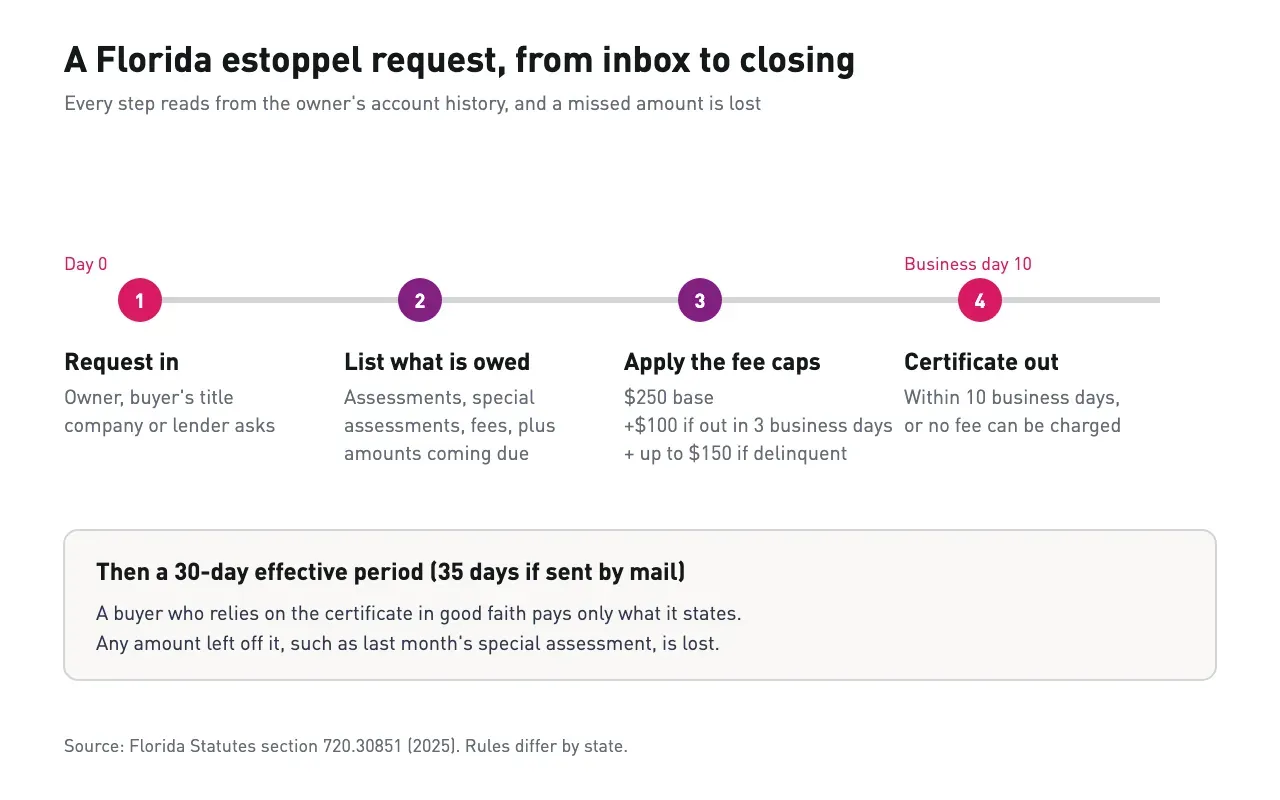
Take Florida. Under section 720.30851, the association must issue an estoppel certificate within 10 business days of the request. The fee is capped at $250, plus $100 for delivery within 3 business days and up to $150 more when the owner is behind on payments.
Miss the deadline, and the association can't charge a fee at all. The certificate must list every amount owed and everything coming due while it stays valid, which is 30 days (35 if sent by mail).
If the certificate understates the debt, the association can't collect the missing amount from a buyer who relied on it. If last month's roof charge is left off, the association loses it.
Texas sets its clock on collections. Before an owner can be charged a collection agency's fees, section 209.0064 requires a notice by certified mail. It must list each overdue amount, explain any payment plan options and give the owner at least 45 days to pay before further collection action. Under section 209.0062, associations with more than 14 lots (individual homes or plots) must offer payment plans of at least 3 months, and they may turn down plans longer than 18 months.
Each of these rules depends on a dated record: when every notice went out, whether the owner is on a plan, which installments are still due. A general ledger records amounts and dates of entries, with no place for notice history or plan status. Rules differ by state and change with each legislative session, so check the state's statute with an association attorney before building a process on them.
The three-layer model: ledger, rules, owner view
When we in Brocoders look at an association's accounting setup, we sort it into 3 layers, because each one fails in a different way.
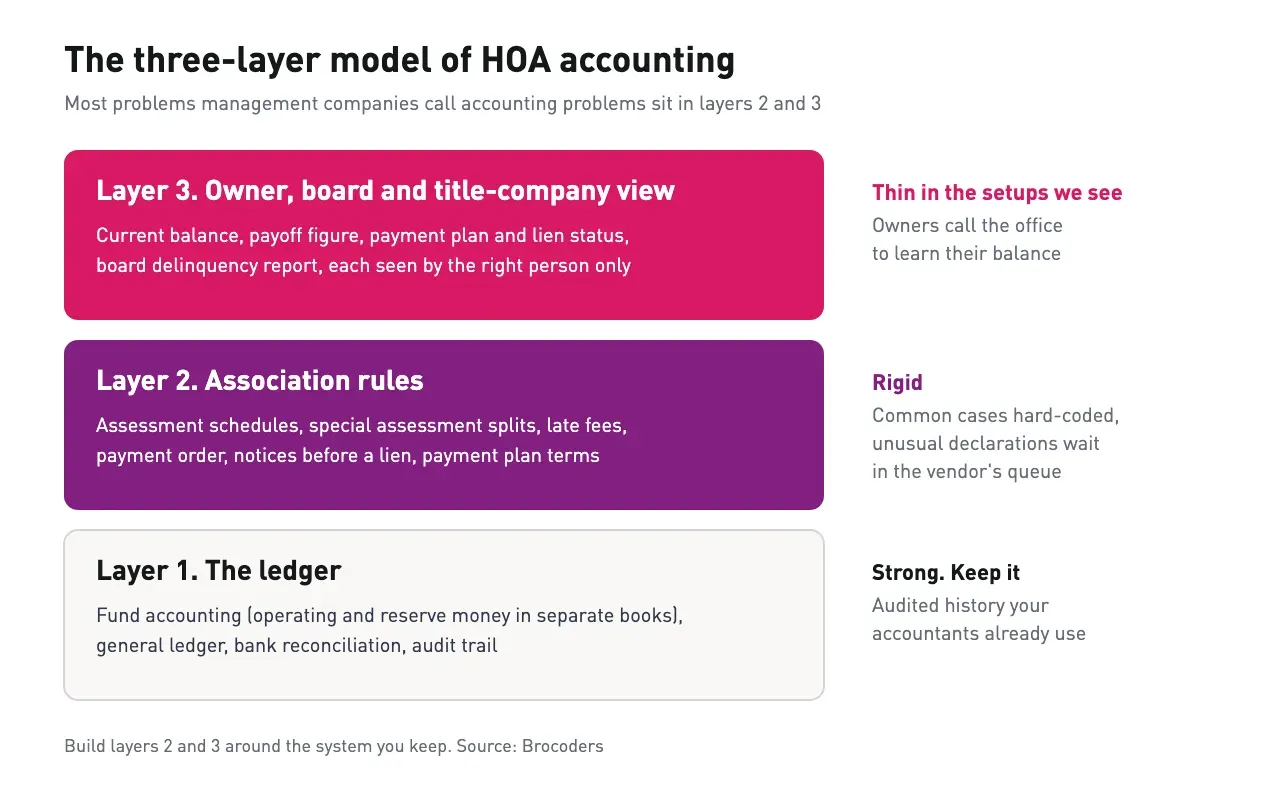
Layer 1, the ledger. The books themselves: operating and reserve money kept separately, the general ledger, matching the books to bank statements, and a record of who changed what. Most HOA platforms do this well. Keep it.
Layer 2, the association rules. Assessment schedules, special assessment splits, late fee timing, payment order, notices before a lien and payment plan terms, all taken from each declaration and each state statute. In the setups we have seen, off-the-shelf platforms build in only the common rules, and an unusual one waits until the vendor gets to it.
Layer 3, the owner, board and title-company view. The current balance, the payoff figure, the plan status, the lien status and the board's report of who is behind, each seen by the right person only. This is often the thinnest layer, which is why owners call the office.
In those setups, platforms are strong at layer 1, rigid at layer 2 and thin at layer 3. Switching accounting platforms to get better rules or an owner portal means moving years of audited history, when the books were never the problem.
Building around the existing system
C.I.A. Services has managed HOAs in Houston and San Antonio since 1984 and manages about 150 associations. Its books and rules live in RedDog NextGen, C.I.A.'s own management system, which Brocoders did not write. C.I.A. wanted owners to see their own accounts, and the company that maintained RedDog could not take on an owner app.
We built MyRedDog, a separate owner and board portal that reads its data from RedDog. RedDog already calculated balances, liens and payoffs, so the rules stayed there with the books. The gap C.I.A. had was layer 3, and that is the layer we built.
In the portal's My Property area, owners see their open invoices, account activity, payment plans, liens and payoff figures, exactly as RedDog calculates them. Board members pull reports that RedDog generates on request. Access is split into 5 levels, from owners and owners of several units to board members, staff and administrators, and staff can see the portal as a given owner sees it. MyRedDog is a website that works like a phone app, so owners install nothing from an app store.
If a platform's rules are the problem too, a layer-2 service can sit beside it in the same way, reading from the books and writing back only what the rules produce.
We also know these platforms from the inside. Since 2018 our team has built and run CondoGenie, a client's condo and HOA management platform used by over 550 condominium and HOA associations. For a company still choosing a platform, our guides to HOA management software and the best HOA management software cover the buy side.
Where to start
A useful first step is to count the requests staff answer by hand in a typical month:
- Balance and payoff requests from owners and title companies
- Estoppel or resale certificates, with their deadlines
- Payment plan setups and missed-payment checks
- Overdue notices and lien or collection referrals
- Board requests for reports on overdue accounts and reserves
Sort each one by layer. A payoff request, for example, needs 2 things: rules that calculate the figure (layer 2, inside the platform or beside it) and a screen that shows it to the title company (layer 3). If most requests land in layers 2 and 3, the company needs those pieces built around its current system, the work we do for property management companies.
Our product development work starts with a 2-week, fixed-price design phase we call Solution Design. It produces a tested prototype, an architecture recommendation and a roadmap, and the client owns every deliverable, including the right to take it to another vendor. Our HOA software case studies show that work in production.
Frequently Asked Questions
A small self-managed HOA can, if someone sets up separate operating and reserve accounts and checks them carefully. QuickBooks won't stop reserve cash from paying operating bills, and it can't produce estoppel or resale certificates.
An estoppel letter, or estoppel certificate, states what an owner owes the association on a given date, so a buyer or lender can close. Florida requires it within 10 business days and caps the base fee at $250. Other states set their own deadlines, and some use a resale certificate instead.
An association can usually record a lien for unpaid assessments once its declaration and state law allow, often after a written notice and a period for the owner to pay. An association attorney can confirm the exact sequence in each state.
Record it as a separate charge on each owner's account, split by the method the declaration sets, and keep it in the fund it was raised for, often the reserve fund. Installment plans need a schedule per unit, so payoff figures include installments still to come.
A management company rarely needs to. The accounting system holds years of audited history, and an owner portal, payoff requests and board reports can be built as a separate layer that reads from it. C.I.A. Services did this with RedDog NextGen and kept its books where they were.