
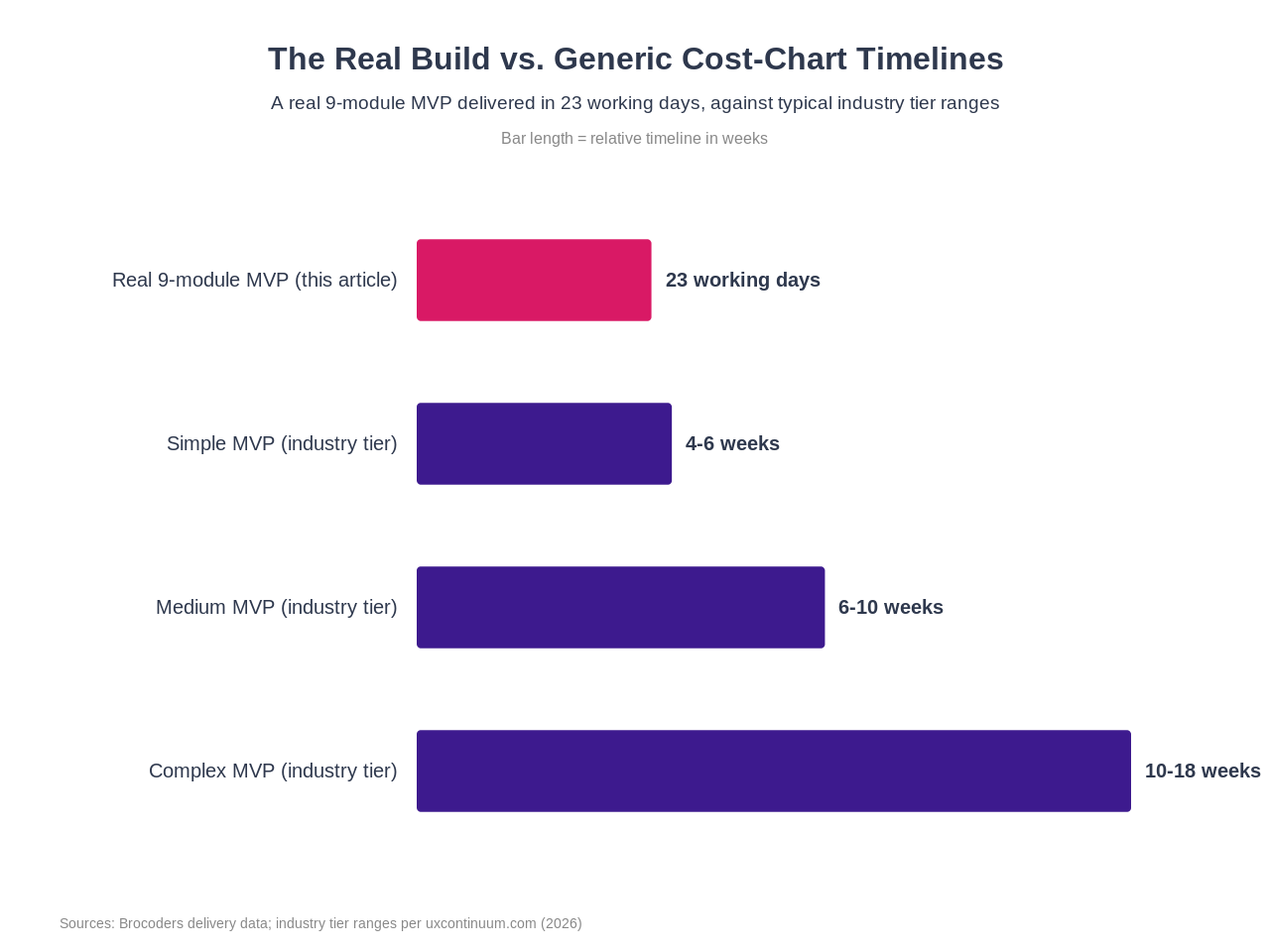
Search "how much does a SaaS MVP cost" and you'll land on the same chart nine times in a row. Simple MVP: $8,000 to $25,000. Medium MVP: $25,000 to $55,000. Complex MVP: $55,000 to $150,000 (source). Nobody tells you what "medium" actually means, and nobody shows you where those numbers came from.
We're going to do something different here. Instead of another invented tier table, we're walking through the real hour count and module list from an actual MVP we delivered, at the rate we actually billed it, so you can see exactly where the money goes.
TL;DR: Generic MVP cost charts use made-up complexity tiers with no real project behind them. This article walks through a real 9-module SaaS MVP built in 23 working days at a $45/hour blended rate, module by module, landing around $27,000 in development hours alone. A second real, clean invoice from a smaller AI-feature build ($3,375 for 75 hours) confirms the rate holds at a different scope. Use the module breakdown here as your own starting template, then add QA, PM, and discovery overhead before you commit to a number.
Every MVP cost chart you've seen is a guess
Read through the current crop of MVP cost articles and a pattern shows up fast. Every single one uses a composite, hypothetical team: a made-up number of developers, a made-up hourly rate by region, a made-up number of weeks. The tiers sound precise ("$25,000 to $55,000, 6 to 10 weeks") but no article names the actual features included, the actual hours worked, or the actual invoice behind the number.
That's not dishonest, exactly. It's just a guess dressed up as a data point. And if you're the founder trying to decide whether $30,000 or $80,000 is the right budget for your product, a guess doesn't help you plan anything.
So here in Brocoders, we're going to show our work. Below is the real module list, the real timeline, and the real blended rate from an MVP we delivered this year for a fintech client, plus a second, cleanly invoiced smaller build, so you can see the math instead of a tier.
What actually goes into an MVP's hour count
Most cost charts sort MVPs by vague "complexity." What actually drives hours is much more specific: how many functional modules the product needs, how much of that logic is genuinely hard (not just CRUD screens), how deep the QA and security pass has to go, and how much project management, business analysis, and design overhead runs alongside development the whole time.
A SaaS MVP for a regulated or compliance-adjacent industry, for example, needs one module that's substantially harder to build than the rest: the piece that encodes the actual business logic correctly. Everything else, authorization, dashboards, notifications, is comparatively standard work. Knowing which module is the expensive one, and why, matters more than knowing your "tier."
The real MVP: 9 modules, 23 working days, one rate
We delivered a fixed-scope MVP for a fintech accounting client this year: a standalone, mobile-first web app (installable, works offline, no app store approval cycle needed) built to give business owners real-time visibility into their accountant's compliance status. Nine contracted functional modules, plus two optional stretch goals delivered on top.
The numbers that make this a real data point rather than a guess:
- 9 of 9 contracted modules delivered, plus 2 stretch goals not in the original scope
- 23 working days from kickoff to delivery handover
- 122 QA test cases, 98% executed, across iOS, Android, and desktop
- 18 of 18 security checks passed, zero findings
- One full-time developer, plus part-time project management, business analysis, QA, and UI/UX support
- $45/hour blended rate across backend, frontend, QA, and PM work
- Estimation ran on PERT (a weighted minimum/average/maximum formula), not a single guessed number per task
That's the difference between a real delivery and a marketing tier. Every hour below is tied to one of these nine actual modules.
The cost calculation, module by module
This is not a reproduced invoice. It's a transparent, hour-by-module model built from the real 9-module scope above, at our actual $45/hour blended rate. The client's exact invoice is confidential to that engagement, so we're not quoting it here. What we can share is the module list, the 23-working-day timeline, and the rate, and that's enough to build an honest working model from.
| Module | What it covers | Est. hours | Cost at $45/hr |
|---|---|---|---|
| Infrastructure & base UI | CI/CD, mobile-first design system, full installable PWA | 45h | $2,025 |
| Authorization | Registration, email verification, session handling, password recovery, lockout | 60h | $2,700 |
| Core entity + auto-generating engine | The single highest-value piece of engineering in the build | 130h | $5,850 |
| Connection/invite flows | Invite codes, accept-links, view-only secondary access | 50h | $2,250 |
| Dashboards (both roles) | Weekly and aggregated views, synced on a polling cycle | 40h | $1,800 |
| Admin module | Delivered as 10 screens against 3 originally contracted | 70h | $3,150 |
| Notifications | In-app, email, and messaging-bot channels with per-channel toggles | 35h | $1,575 |
| Custom tasks | A secondary, non-automated task type | 20h | $900 |
| QA + security pass | 122 test cases across 3 platforms, 18 security checks | 90h | $4,050 |
| PM/BA/UI-UX overhead | Requirement clarification, backlog, weekly status decks, design, throughout | 60h | $2,700 |
| Total (approx.) | 9 modules plus a full QA and security pass | ~600h | ~$27,000 |
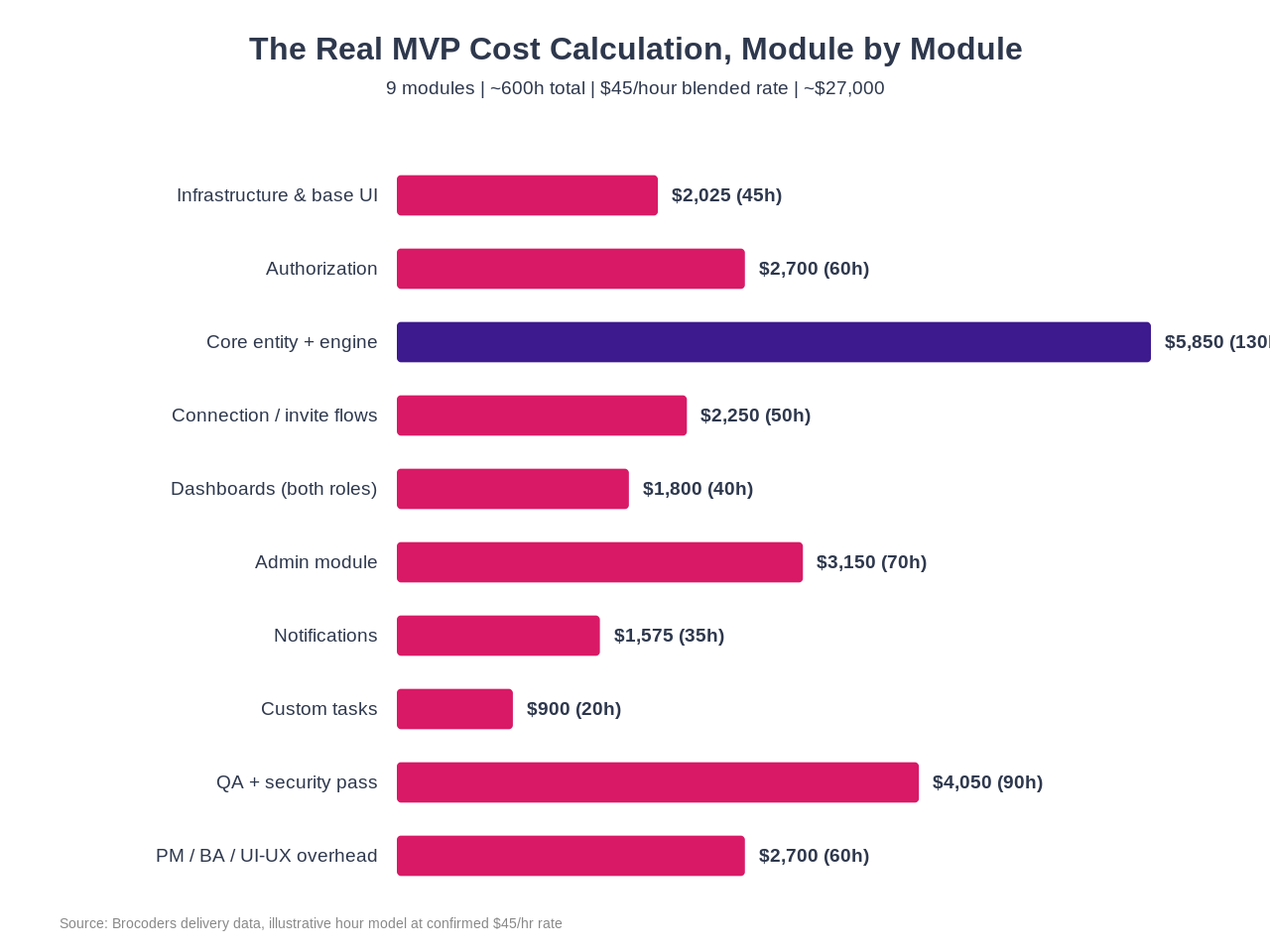
That ~$27,000 is a constructed illustrative total built from apportioned hours, not the client's own invoice. Think of it as a template you can hold your own MVP scope against: which of these nine buckets does your product need, and which ones can wait for a version 2?
A second real number: a $3,375 AI feature build
For a smaller, cleaner comparison point: a fixed-budget AI feature build we delivered this year, a video-to-brief generation tool, came in at $3,375 total for 75 hours, about 17% under the original estimate. That works out to the same $45/hour rate, just at a much smaller scope: one core AI-powered feature rather than a full 9-module product.
Put the two together and you get a real range instead of a marketing tier: a single, sharply-scoped AI feature lands in the low thousands, while a full 9-module product with real QA and security depth lands around the high twenties. Everything in between depends on how many of those nine buckets your product actually needs.
What the tier tables leave out
Three things the generic charts almost never account for, all present in the real numbers above:
QA and security depth. 90 of the roughly 600 hours in the table above, 15% of the whole build, went to testing and security across three platforms. A tier chart that only counts feature-building hours understates the real number by exactly this much.
PM, BA, and design overhead running the whole time. Development hours aren't the only hours. Ten percent of the total above is coordination and design work that never shows up as a "feature" but has to happen for the feature hours to land correctly.
Scope that grows mid-build, on purpose. The admin module in this real build shipped with 10 screens against 3 originally contracted, because the team and client agreed it was worth the extra hours. A rigid fixed-tier quote doesn't leave room for a good scope conversation like that one; an hour-based model does.
How to get your own real number
The honest answer to "how much will my MVP cost" is always going to be "it depends on which modules you need," and the fastest way to find that out isn't a guess, it's a scoped discovery conversation. Here in Brocoders, MVP development starts with a short discovery session that produces an actual module list, an hour estimate per module using the same PERT method described above, and a straight answer on rate, before you commit to anything. If the product you're scoping leans more on an AI feature than a full multi-module build, our AI development team runs the same estimation process at the smaller scope shown in the $3,375 example above. You can see how this plays out across real products in our SaaS development case studies, or get in touch directly to start your own discovery session.
Frequently Asked Questions
It depends heavily on how many functional modules your product needs and how deep the QA and security pass has to go. A real 9-module MVP with full QA and security testing landed around $27,000 in development hours at a $45/hour rate; a single, sharply-scoped feature can cost as little as $3,000 to $4,000 at the same rate.
Rates vary widely by region and seniority, commonly $20 to $60/hour offshore versus $80 to $150/hour for US-based senior developers. A blended rate across backend, frontend, QA, and PM work (as used in the real example above) sits around $45/hour for a senior, distributed team.
A real 9-module product with full QA and security testing took roughly 600 hours across a single full-time developer plus part-time support roles, delivered over 23 working days. A smaller, single-feature build can take as little as 75 hours.
Offshore rates commonly run $20 to $60/hour versus $80 to $150/hour for US-based senior developers (source), but a lower hourly rate doesn't automatically mean a lower total cost if the team needs more hours to reach the same QA and security bar. Compare total hours to reach a defined QA depth, not just the rate per hour.
Project management, business analysis, UI/UX design, and a full QA and security pass all run alongside development and typically add 20 to 25% on top of raw feature-building hours, based on the real breakdown above.
A full 9-module product with real QA depth can be delivered in about a month (23 working days) with a focused team; a single AI-powered feature can ship in one to two weeks.
An hourly, module-by-module estimate (using a method like PERT, which weighs minimum, average, and maximum hours per task) gives you room to adjust scope honestly mid-build, the way the admin module above grew from 3 to 10 screens by agreement. A rigid fixed-price quote on an unscoped idea leaves no room for that conversation.