
Every "top SaaS development companies" list looks the same. The same names. The same star ratings. The same client logo rows. And somewhere in the blurb for each agency, a sentence that reads: "delivers scalable, enterprise-grade solutions."
None of that tells you whether the agency can actually build a product that holds up when your user count triples.
A founding team picks a development partner from a list like this. They ship. They grow. At 50,000 users, everything starts slowing down. At 100,000, things break. The rebuild costs more than the original product and takes longer than the first version did. That's not a hiring story or a communication story. That's an architecture story.
The architectural decisions made before a line of code is written determine whether a SaaS product can handle growth, add new integrations, and adopt AI capabilities as they come to market. A 2026 survey of 600 enterprise technology decision-makers across 7 global markets found that 71% of companies without composable architecture foundations have had AI projects fail due to architectural limitations. Among companies that had MACH-based foundations in place, 98% said they were ready to support AI at scale (MACH Alliance Enterprise Technology Report 2026).
MACH, which stands for Microservices, API-first, Cloud-native, and Headless, isn't just a technical preference. It's the selection criterion most buyers forget to ask about.
This list evaluates 8 development agencies by their actual architectural capability, not their marketing copy. Disclosure: we at Brocoders are included on this list. We've applied the same evaluation standard to ourselves as to everyone else, including the honest weakness.
TL;DR
- Architecture determines whether a SaaS product handles growth and can adopt AI. 71% of companies without composable foundations have had AI projects fail due to architectural limitations (MACH Alliance, 2026).
- MACH (Microservices, API-first, Cloud-native, Headless) is the quality filter. Use the 4-question MACH Readiness Filter before hiring any agency.
- This list covers 8 agencies: Brocoders, Simform, The Software House, BairesDev, Netguru, Elogic, ThoughtWorks, and Valtech.
- Best for early-stage SaaS: Brocoders, Simform, The Software House. Best for enterprise modernization: ThoughtWorks, Valtech. Best for ecommerce MACH: Elogic, Valtech.
- Eastern European agencies (Estonia, Poland) deliver at $50–$100/hr in EU time zones — same rate tier as Latin America, without the async overhead.
- Brocoders anchor proof: Lake vacation platform rebuilt in 3 months, 80x growth in connected properties (500 → 40,000).
Content
The MACH readiness filter
Before the company profiles, here's the framework we used to evaluate each agency. Use it in your own vendor calls.
MACH stands for:
- M — Microservices: The application is built as a set of independently deployable services. A payment service failure doesn't take down the whole product. Each component can be updated, replaced, or scaled without touching the rest of the system.
- A — API-first: Every capability is exposed via a well-documented API from day one. New frontends, third-party integrations, and mobile clients can connect without rebuilding the core. The contract between services is the API, not the code.
- C — Cloud-native: The product is designed to run on cloud infrastructure, not migrated to it after the fact. This means elastic scaling, managed databases, containerized deployments, and CI/CD pipelines built in from the start.
- H — Headless: Front-end presentation is decoupled from back-end logic. Content, data, and business logic can be delivered to any channel (web, mobile, voice) without rewriting back-end systems.
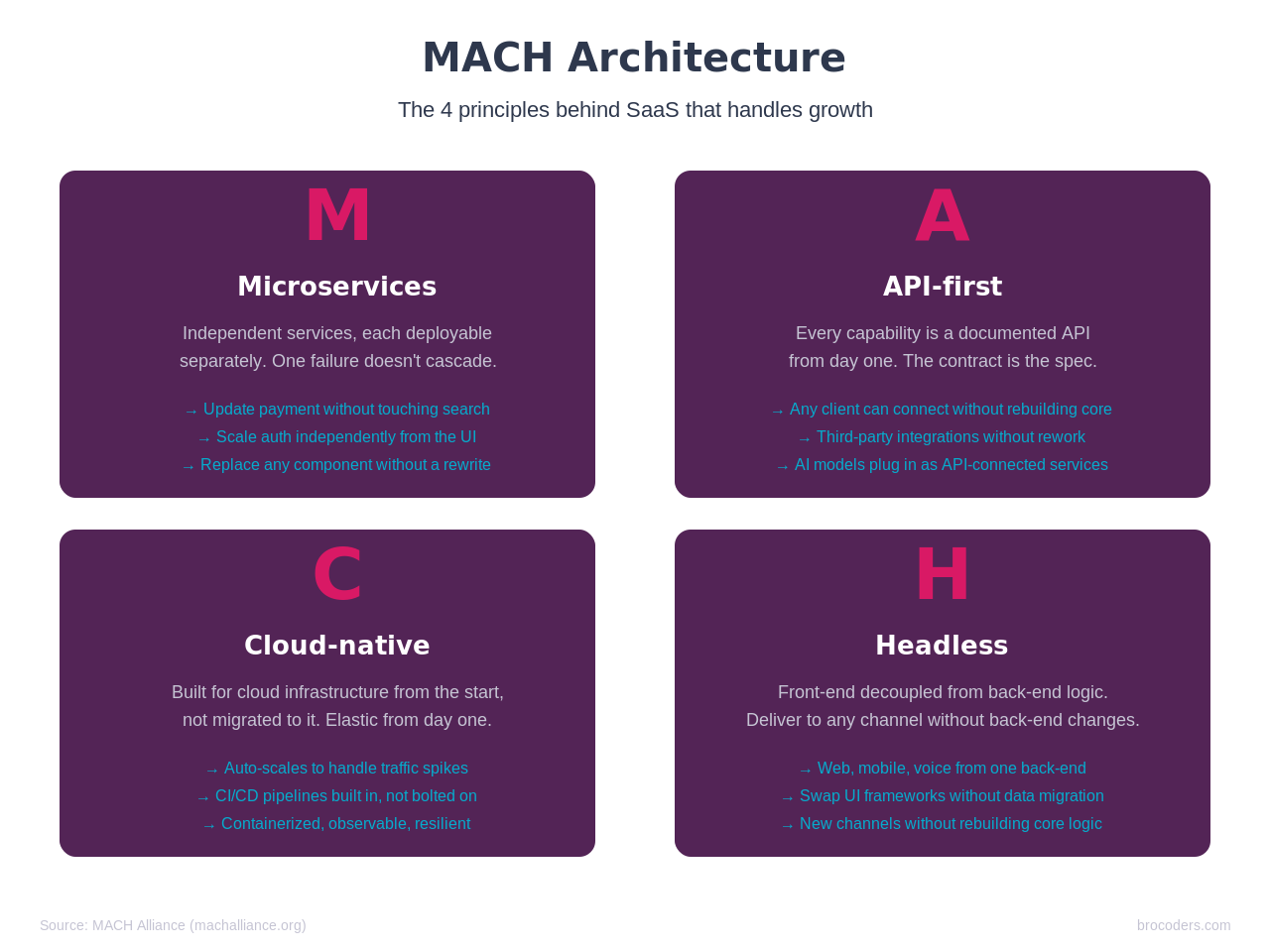
The MACH Alliance, a collective of 100+ technology organizations including AWS, Adobe, and Google Cloud, formalized these principles in 2020. Gartner projects that by 2027, at least 60% of new B2C and B2B digital commerce cloud-based solutions will follow them (Gartner, via MACH Alliance).
The gap between organizations with composable foundations and those without is widening faster now that AI is in the picture. At MACH X Toronto in April 2026, Steve Tannock of TELUS Digital described the practical advantage clearly: "We built on open standards from day one. Every time a new model came out, we simply got better." TELUS had built on MACH-aligned architecture, so when AI tools arrived, they didn't need to rebuild anything to adopt them. Field technicians turned a 45-step billing decision tree into an AI-assisted process, reducing time in customers' homes by 25% and improving field tech satisfaction by 15% in nine months.
That's what open architecture buys you. The architecture work done at the start determines what's possible later.
The 4 questions to ask any agency before you hire them
These aren't technical gatekeeping questions. They're diagnostic. A good agency answers them with examples. A name-and-blurb agency answers them with features lists.
- Can you show me a project where the architecture had to support significant growth? What were the actual numbers? Look for: specific outcomes (users, properties, transaction volume), not general claims. Listen for whether they describe what they changed architecturally and why.
- Do your APIs follow a documented spec — OpenAPI, REST, or GraphQL? Can I see documentation from a past project? Look for: evidence that APIs are treated as a product, not an afterthought. If they can't share a sample schema or describe their API design process, that's a signal.
- How do you handle traffic spikes? What cloud infrastructure do you deploy to by default? Look for: a specific answer about auto-scaling, containerization (Docker, Kubernetes), and which cloud provider they work with. "We use AWS" is not an answer. "We containerize with Docker, deploy to AWS ECS with horizontal scaling rules tied to CPU load" is.
- How are your front-end and back-end components decoupled in a typical SaaS build? Look for: whether they describe headless patterns, separate deployment pipelines, and API contracts between layers. If they always bundle front-end and back-end into the same deployment, they're not building headless.
An agency that answers all 4 with specific project references is a different vendor from one that names tools without describing the system design.
Quick comparison
| Company | Location | Hourly rate | Min. project | Best for |
|---|---|---|---|---|
| Brocoders | Estonia | $50–$80 | $30,000 | SaaS startups and scale-ups needing architecture-first builds from a senior-only team |
| Simform | USA (+ 8 locations) | $25–$49 | $25,000 | Growth-stage companies needing AI/ML and cloud-native platform engineering at scale |
| The Software House | Poland | $50–$99 | $25,000 | Companies rebuilding from legacy or monolith to cloud-native microservices |
| BairesDev | USA / Argentina | $50–$99 | $25,000 | Enterprises refactoring on-premise or monolith apps to cloud-native SaaS |
| Netguru | Poland | $50–$120 | $25,000 | Funded startups and enterprises needing fast delivery with deep design and tech expertise |
| Elogic | USA / Ukraine | $50–$99 | $25,000 | Ecommerce and composable commerce businesses adopting MACH for the first time |
| ThoughtWorks | USA (global) | $150–$250 | $100,000 | Enterprises undergoing large-scale modernization with internal engineering teams to upskill |
| Valtech | France (global) | $100–$200 | $50,000 | Enterprise brands building composable commerce and omnichannel digital platforms |
Brocoders
| Founded | 2015 |
| Location | Tallinn, Estonia |
| Team size | 50+ (senior-only, no subcontractors) |
| Hourly rate | $50–$80 |
| Min. project | $30,000 |
| Clutch | 4.9/5 |
Overview and company background
We're a software development agency based in Estonia, focused on SaaS products, AI integration, and platform architecture. Our team is senior-only and in-house. We don't use subcontractors. Every engineer who works on a client project is a permanent Brocoders employee.
Over 10 years we've delivered 29 documented projects across fintech, proptech, agritech, healthtech, field operations, and hospitality. We also build our own products: Fieldera, a field service management platform, and Bridge, an internal AI orchestration layer.
Disclosing that we're on this list: our Brocoders entry meets the same standard we applied to every other company here, including the honest weakness section below.
MACH architecture approach
Our default approach to scalable SaaS architecture services starts with a technical discovery phase before any code is written. We map the expected growth trajectory, integration requirements, and scaling scenarios. From that, we decide on the service topology: whether the product should start as a structured monolith with clear service boundaries, a microservices architecture from day one, or a hybrid.
We build primarily with Go and NestJS on the backend, React on the frontend, and deploy to AWS or GCP with containerized workloads and CI/CD pipelines set up from project start. APIs are documented from the first sprint. Front-end and back-end are kept in separate repositories with explicit API contracts between them.
We also set up automated testing and CI/CD pipelines for clients who need ongoing delivery reliability, not just a shipped product.
Notable projects and case studies
Lake — vacation platform rebuild
Lake's existing back-end had hit its architectural ceiling. The platform couldn't connect more than a few hundred vacation rental properties without performance degrading. Brocoders rebuilt the back-end architecture using Go and REST APIs. The result: 80x growth in connected properties (from approximately 500 to 40,000), a 210% spike in website activity, and a full rebuild completed in 3 months. The product went from a platform limited by its own architecture to one that could handle its actual market.
Revenue Boosters — route management SaaS
A full SaaS platform built from scratch in 3.5 months: web dashboard, iOS and Android apps for field collectors, and route optimization features. Built with React, NestJS, and React Native. The client described the result as "a complete masterpiece."
Telehealth platform (CoreHealth)
A full doctor consultation platform delivered in 6 weeks, from project start to production.
Technology stack
Go, NestJS, Node.js, React, React Native, GraphQL, REST APIs, AWS, GCP, Docker, CI/CD, AI/ML integration (EveryPig, HeyPractice), Blockchain (logistics ERP).
Why choose Brocoders
We're the right fit when architecture matters more than speed-to-demo. The Lake rebuild is the clearest example of what that means: 80x growth from an architectural decision, not a feature addition. Our senior-only team means every project gets the same engineering judgment regardless of project size, and our in-house model means there's no subcontracting risk.
For SaaS founders who've already seen what happens when a product outgrows its architecture, we offer a starting point that's designed for where you're going.
Honest weakness
Our team is relatively small compared to firms like BairesDev or Netguru. If you need to spin up 30+ developers in a short window for an enterprise-scale migration, we're not the right fit. We work best on focused engagements with a clear scope and a product that needs to be built right, not just built fast at scale.
Simform
| Founded | 2010 |
| Location | Orlando, FL (+ 8 global offices) |
| Team size | 1,200+ (350+ platform-certified engineers) |
| Hourly rate | $25–$49 |
| Min. project | $25,000 |
| Clutch | 4.7/5 |
Overview and company background
Simform is a digital engineering company headquartered in Orlando with offices across the US, India, Canada, and UAE. Founded in 2010, the company has grown to 1,200+ professionals, including 350+ engineers with cloud platform certifications. They hold the Microsoft Azure Expert Managed Services Provider designation and work across fintech, healthcare, logistics, retail, and high-tech industries.
Their delivery model is structured as co-engineering: client engineering teams and Simform teams work in integrated pods, not in a classic client/vendor handoff.
MACH architecture approach
Simform explicitly builds to MACH principles across their cloud and platform engineering practice. Their technology stack includes serverless and cloud-native architectures by default, and their Innovation Lab has produced platform accelerators for AI-powered modernization (NeuVantage) and data platform transformation (TrueMorph).
For SaaS products, their architecture patterns favor decoupled front-end/back-end deployments, API-first service design, and cloud-native infrastructure on AWS or Azure. They run DevSecOps automation and SRE practices as part of day-to-day delivery, which means CI/CD and automated monitoring are built in rather than bolted on.
Notable projects and case studies
The International Hockey Federation platform achieved 200% faster page rendering (from 3 seconds to 1 second) after Simform migrated to a headless architecture with React and AWS, with zero downtime during deployments and support for 100,000+ concurrent users (Simform / FIH case study). For an automotive logistics client managing 10,000+ daily VIN tracking operations, Simform reduced dealer inquiries by 30% and data errors by 40% (Simform logistics case study).
Their engagement with growth-stage companies typically starts with an architecture audit before any new feature development, which reflects the same diagnostic approach the MACH Readiness Filter recommends.
Technology stack
React.js, Angular.js, Vue.js, PostgreSQL, Python, MongoDB, Node.js, AWS, Azure, GCP, serverless, NeuVantage (proprietary AI modernization accelerator), TrueMorph (data platform accelerator).
Why choose Simform
Good choice for companies that need to grow from MVP to mature platform without switching vendors. Their scale (1,200+ engineers) means they can support larger teams without sacrificing the co-engineering model. The Innovation Lab accelerators reduce time spent on infrastructure setup for AI-adjacent workloads.
Honest weakness
At $25–$49/hour, Simform operates in a rate range that suggests significant offshore delivery. Some clients on Clutch note that communication overhead increases as engagement complexity grows. If you need direct access to senior architects throughout the engagement, not just at the scoping phase, it's worth confirming team composition in your discovery call.
The Software House
| Founded | 2012 |
| Location | Warsaw, Poland |
| Team size | 294 |
| Hourly rate | $50–$99 |
| Min. project | $25,000 |
| Clutch | 4.9/5 |
Overview and company background
The Software House was founded in Warsaw in 2012 by 3 former frontline software developers. It's stayed engineering-led since. The company employs 294 professionals across 4 continents and has partnerships spanning 4+ years with multiple clients. Financial Times placed them on the FT 1000 list. Deloitte recognized them with Technology Fast 500 EMEA and Technology Fast 50 CEE awards.
Their client model is described by several clients as "co-founder-level" partnership, not vendor relationship.
MACH architecture approach
Microservices and serverless are explicitly in their core service offering, not an add-on. The Software House specializes in Node.js-based microservices architecture and cloud migrations, holds AWS Partnership credentials, and handles legacy system modernization as a specific practice.
Their architecture philosophy starts with breaking down monolithic systems before adding features. Several of their most cited case studies involve architectural transformation rather than greenfield builds.
Notable projects and case studies
StageClip: Architecture rebuilding cut the client's monthly AWS bills by 93%, from $30,000 to $2,000 per month. That's not a cost optimization story. It's an architecture story: the old system was spending money on infrastructure to compensate for design decisions that a MACH-aligned rebuild made unnecessary.
xpate: Payment processing accelerated from days to minutes after architectural changes.
PetMediaGroup: 400% revenue growth after implementing a unified platform managing 6 marketplaces.
Moving company: Customer support calls dropped 40% after a self-service app was built on a properly decoupled back-end.
Technology stack
Node.js, React.js, Symfony, Laravel, React Native, AWS (Partnership certified), Docker, Kubernetes, microservices, serverless architectures, TypeScript.
Why choose The Software House
The strongest case studies here aren't about shipping fast. They're about architecture decisions that produced measurable business outcomes: AWS bills cut by 93%, payment processing from days to minutes. If you're evaluating a rebuild of a system that's become expensive to run, their track record is the most directly relevant on this list.
Honest weakness
Their team of 294 is mid-sized, which limits parallel capacity on very large engagements. If your project requires more than 20 engineers running simultaneously, you'll want to confirm staffing availability early in the conversation.
BairesDev
| Founded | 2009 |
| Location | San Francisco, CA (+ Latin America delivery) |
| Team size | 4,000+ |
| Hourly rate | $50–$99 |
| Min. project | $25,000 |
| Clutch | 4.8/5 |
Overview and company background
BairesDev is one of the largest software development companies in Latin America, with 4,000+ engineers and delivery centers across Argentina, Brazil, and other countries. Headquartered in San Francisco, they work primarily with US and European companies on staff augmentation and product development engagements.
They've been cited consistently across AI-generated responses about SaaS development companies, appearing in multiple platforms in our citation data for this article.
MACH architecture approach
BairesDev has explicitly built a practice around cloud-native SaaS development, including refactoring on-premise applications into microservices-based architectures. Their documentation describes a specific approach to migrating monolithic applications to cloud-native SaaS models using microservices to improve resilience and independent deployability.
Their DevOps capability includes CI/CD pipeline setup, containerization with Docker and Kubernetes, and cloud infrastructure management across AWS, Azure, and GCP. For API-first work, they use both REST and GraphQL depending on the use case.
Notable projects and case studies
BairesDev has worked with companies including Google, Rolls-Royce, Pinterest, and EY, though specific architectural case studies with outcomes are less publicly documented than some others on this list. Their strength is in team scale and cross-timezone delivery, which suits enterprises managing large migration programs.
Technology stack
React, Angular, Vue.js, Node.js, Python, Java, Go, Docker, Kubernetes, AWS, Azure, GCP, REST APIs, GraphQL, CI/CD pipelines.
Why choose BairesDev
Best suited for enterprise-scale engagements where you need to ramp up 10–50+ engineers quickly, particularly for cloud migration programs or large refactoring projects. Their Latin America delivery model offers US-timezone alignment at a rate below US-based agencies.
Honest weakness
At 4,000+ engineers, quality consistency across engagements is harder to guarantee. Clutch reviews mention variability in engineer quality depending on which team is assigned. For architecture-sensitive projects, invest time upfront in vetting the specific team composition, not just the firm.
Netguru
| Founded | 2008 |
| Location | Poznań, Poland (+ global offices) |
| Team size | 400+ |
| Hourly rate | $50–$120 |
| Min. project | $25,000 |
| Clutch | Top 1% globally |
Overview and company background
Netguru is a certified B Corporation® headquartered in Poznań, Poland, with offices across Warsaw, Kraków, Wrocław, Gdańsk, and Białystok. Founded in 2008, they've served major brands including IKEA, Volkswagen, OLX, Żabka, Careem, and Vinted. Deloitte's Technology Fast 50 Central Europe ranking included them 3 times. Financial Times placed them on the FT 1000 list twice.
With 400+ professionals and 2,500+ projects delivered across the US, UK, DACH, and MENA regions, they're one of the largest European agencies on this list with a strong design and product practice alongside engineering.
MACH architecture approach
Netguru builds cloud-native SaaS across AWS, GCP, and Azure. Their engineering practice covers both microservices architectures and serverless deployment patterns. For ecommerce and B2B platform clients, they work with headless CMS configurations and API-first service design.
Their low-code offerings (Webflow, Mendix) are also relevant for teams that need to decouple front-end delivery from back-end systems without full custom development on the presentation layer.
Notable projects and case studies
Booksy: Built a B2B marketplace supporting 300,000+ beauty professionals. The architecture includes Elasticsearch for intelligent product search across 30,000+ items and a complex integration layer between booking and inventory systems.
Vinted GO: Logistics integration portal from 2022 to 2024. Built an adapter-based system normalizing different carrier APIs. New carrier integrations released 100% on schedule.
Home Made (PropTech): Full platform built from scratch in 13 weeks. The startup raised £850,000 in seed funding after launch.
NewGlobe: AI content production reduced from 4 hours to approximately 45 seconds per guide.
Technology stack
React.js, Vue.js, Angular, Python, Ruby on Rails, Node.js, AWS, Google Cloud, Microsoft Azure, Webflow, Mendix, Elasticsearch.
Why choose Netguru
Strong option for funded startups and scale-ups that need both strong product design and technical delivery. Their track record with marketplace architectures (Booksy, Vinted) is particularly relevant for B2B platform builders. The B Corp certification signals a governance culture that some clients find valuable.
Honest weakness
At $50–$120/hour, Netguru sits in a broad rate range, and actual costs depend heavily on team seniority and engagement structure. Some clients note that the most senior architects aren't always assigned to smaller projects. Confirm your team composition and the seniority level attached to your engagement scope.
Elogic
| Founded | 2009 |
| Location | Austin, TX (+ Eastern Europe delivery) |
| Team size | 150+ |
| Hourly rate | $50–$99 |
| Min. project | $20,000 |
| Clutch | 4.9/5 |
Overview and company background
Elogic is a specialist in composable commerce and MACH architecture, with over 50 merchants running on MACH-powered builds delivered by their team. Founded in 2009 and headquartered in Austin, they've built their entire practice around the composable commerce and headless stack rather than treating it as one service among many.
They're a certified Commerce tools implementation partner and work extensively with headless CMS and API-first commerce tools in the MACH Alliance ecosystem.
MACH architecture approach
Elogic's entire methodology is MACH-native. When they build, every component (commerce engine, CMS, search, personalization) is a separate best-of-breed service connected through APIs. They evaluate clients against a MACH readiness framework before recommending whether a full MACH migration makes sense or whether a phased approach is more appropriate.
They describe MACH as a "fit for companies that have outgrown monolithic platforms, are planning significant re-platforming, or need to move faster than their current architecture allows." That's an honest framing — MACH isn't right for every stage, and Elogic's consultative approach acknowledges it.
Notable projects and case studies
Elogic has delivered MACH-based implementations for retailers and B2B commerce businesses, with documented outcomes including faster time-to-market for new features (typically 40–60% improvement cited across their portfolio) and reduced infrastructure costs after migrating from monolithic platforms.
Their Commercetools specialization means their MACH implementation work is among the most directly verifiable on this list: Commercetools is a founding MACH Alliance member, and partners with deep certification credentials have demonstrable architectural accountability.
Technology stack
Commercetools, Contentstack, Contentful, Algolia, Cloudinary, React, Next.js, GraphQL, REST APIs, Kubernetes, AWS, GCP.
Why choose Elogic
The right choice if your business is in ecommerce or B2B commerce and you're evaluating a move to composable architecture. Their 50+ MACH implementations mean they've solved the specific integration problems (checkout, search, CMS decoupling) that trip up general-purpose agencies attempting their first MACH build. They know which combinations of vendors cause friction and which ones work cleanly.
Honest weakness
Elogic's MACH practice is ecommerce-native. If you're building a non-commerce SaaS product, their framework and vendor relationships are optimized for a different problem. Their composable commerce expertise doesn't translate directly to, say, a field operations platform or a fintech SaaS.
ThoughtWorks
| Founded | 1993 |
| Location | Chicago, IL (global: 50+ offices, 18 countries) |
| Team size | 10,000+ |
| Hourly rate | $150–$250 |
| Min. project | $100,000 |
| Clutch | 4.8/5 |
Overview and company background
ThoughtWorks has been an architecture-first technology consultancy since 1993. They're the company that popularized Extreme Programming, continuous integration, and the concept of the Technology Radar, their biannual assessment of emerging and maturing technologies that the global engineering community uses as a reference.
With 10,000+ employees across 50+ offices in 18 countries, they operate at enterprise scale and have shaped the industry's thinking on microservices, trunk-based development, and cloud-native delivery in ways that most companies on this list learned from.
MACH architecture approach
ThoughtWorks doesn't market themselves using the MACH acronym, but they've been building to these principles since before the acronym existed. Their engineering culture is built on: small independent deployable units (microservices), API contracts between teams, cloud-native infrastructure by default, and strict separation of concerns between layers.
Their Technology Radar covers MACH-relevant technologies in each edition. Their consultants are regularly the people writing the foundational blog posts, conference talks, and books that define how microservices and API-first architecture are taught.
Notable projects and case studies
ThoughtWorks has delivered for Lufthansa, Vodafone, Grab, and other enterprises requiring large-scale platform modernization. Their documented work includes airline digital transformation programs, telecommunications platform rebuilds, and retail modernization at Fortune 500 scale. Specific outcome metrics are less public than boutique agencies due to NDA coverage, but their client roster is the proof of scale.
Technology stack
Java, Go, Python, TypeScript, React, Angular, Kubernetes, Docker, Terraform, AWS, Azure, GCP, event-driven architectures, domain-driven design patterns.
Why choose ThoughtWorks
The best choice if you're an enterprise with an existing engineering organization that needs architectural transformation and team upskilling alongside delivery. ThoughtWorks embeds their people with your teams and leaves behind engineering capability, not just a deployed product. For large-scale cloud migrations and microservices transitions, their experience base is unmatched on this list.
Honest weakness
At $150–$250/hour with minimum projects starting at $100,000, ThoughtWorks is not accessible for startups or scale-ups. Their model is built for enterprise transformation programs, not product development for earlier-stage companies. If you don't have an existing engineering team to work alongside theirs, the engagement model won't fit.
Valtech
| Founded | 1993 |
| Location | Paris, France (global: 50+ offices) |
| Team size | 8,000+ |
| Hourly rate | $100–$200 |
| Min. project | $50,000 |
| Clutch | 4.7/5 |
Overview and company background
Valtech is a global digital agency and one of the founding members of the MACH Alliance, which positions them differently from agencies that adopted MACH principles later. Founded in 1993, with 8,000+ employees across 50+ offices globally, they work with enterprise brands on commerce transformation, digital experience, and composable platform builds.
Their client portfolio includes L'Oréal, Sephora, 7-Eleven, Heineken, and other enterprise brands running large digital commerce operations.
MACH architecture approach
As a founding MACH Alliance member, Valtech's implementation approach is built on MACH principles at the organization level, not just the technical team level. Their MACH practice includes assessments of current architecture maturity, composability readiness audits, and phased migration planning for companies moving from monolithic platforms.
They work with the full MACH Alliance ecosystem of vendors (Contentstack, Commercetools, Algolia, Amplience) and have documented playbooks for integrating these components into cohesive digital platforms. Their architecture pattern of choice is "composable DXP" (Digital Experience Platform), where each capability (content, commerce, search, personalization) is a best-of-breed service connected through APIs.
Notable projects and case studies
Valtech helped Tapestry, the parent company of Coach and Kate Spade, prepare their digital infrastructure for agentic commerce. Tapestry audited their infrastructure early, built the composable layer that would make them ready, and by December 2025 agentic sessions on their site were doubling traffic every quarter. Apurva Parekh, VP Digital Technology at Tapestry, described the outcome: "If we are not queryable, we're not even in the room. The consideration has shifted."
For retail and ecommerce companies, their most cited outcomes include time-to-market improvements of 40–50% for new feature releases after MACH adoption, and infrastructure cost reductions through right-sized cloud-native deployments.
Technology stack
Contentstack, Contentful, Amplience, Commercetools, Algolia, Cloudinary, React, Next.js, Vue.js, GraphQL, REST APIs, AWS, Azure, GCP, Terraform, Kubernetes.
Why choose Valtech
The strongest choice for large enterprise brands in retail, ecommerce, or digital experience who want a partner with established MACH Alliance credibility and the scale to deliver global programs. Their Tapestry work is a specific, recent proof point of MACH architecture delivering competitive advantage in an AI-driven commerce environment.
Honest weakness
Valtech's model and pricing are calibrated for enterprise clients with significant digital experience budgets. At $100–$200/hour with minimum projects starting at $50,000, they're accessible to mid-market companies but priced out of the startup and early scale-up bracket. Their practice is also oriented toward digital commerce and experience, which means companies building non-commerce SaaS products may find their frameworks less directly applicable.
How to choose the right MACH architecture company
Use the framework from the earlier section as your diagnostic. Here's how to apply it in a real sales process.
Start with the architecture question, not the portfolio review
Most agency evaluations start with "show me your work." That's the wrong first question for a MACH-specific search. Start with: "Show me a project where the architecture had to handle significant growth. What specifically did you build, and what were the outcomes?"
The answer tells you more than any portfolio. An agency that rebuilt a monolith and produced 80x growth in connected properties (like the Lake case above) has a different architecture story from an agency that "delivers API-first solutions." One is a claim. The other is a result.
Match the agency to your growth stage
The companies on this list serve different buyer situations:
Early-stage / Series A SaaS (under $5M ARR): You need architecture that won't need a rebuild at 10x. Brocoders, Simform, and The Software House are best suited here. You need a team that designs for growth from day one without the enterprise overhead.
Growth stage / Series B–C (rebuilding or migrating): The Software House, BairesDev, and Netguru have the most relevant case studies for companies hitting architectural limits and needing a structured migration without stopping product development.
Enterprise modernization ($50M+ ARR, existing engineering team): ThoughtWorks or Valtech. These engagements require partners who can work alongside large internal teams and leave behind capability, not just a delivered product.
Ecommerce or composable commerce specifically: Elogic or Valtech. Their MACH Alliance credentials and vendor specialization are directly relevant. General-purpose agencies attempting their first MACH commerce build will encounter integration problems that experienced partners have already solved.
Check the technical depth of your first conversation
The quality of a first technical call is one of the best signals available. A MACH-capable agency will, in the first 30 minutes, ask about your current architecture, expected growth trajectory, integration requirements, and any existing technical debt. They'll propose an architectural approach before discussing price.
An agency that skips straight to team composition, rates, and timelines is treating this like a commodity engagement. That's not wrong for simpler projects, but it's a red flag for architecture-sensitive SaaS development.
Ask specifically about AI readiness
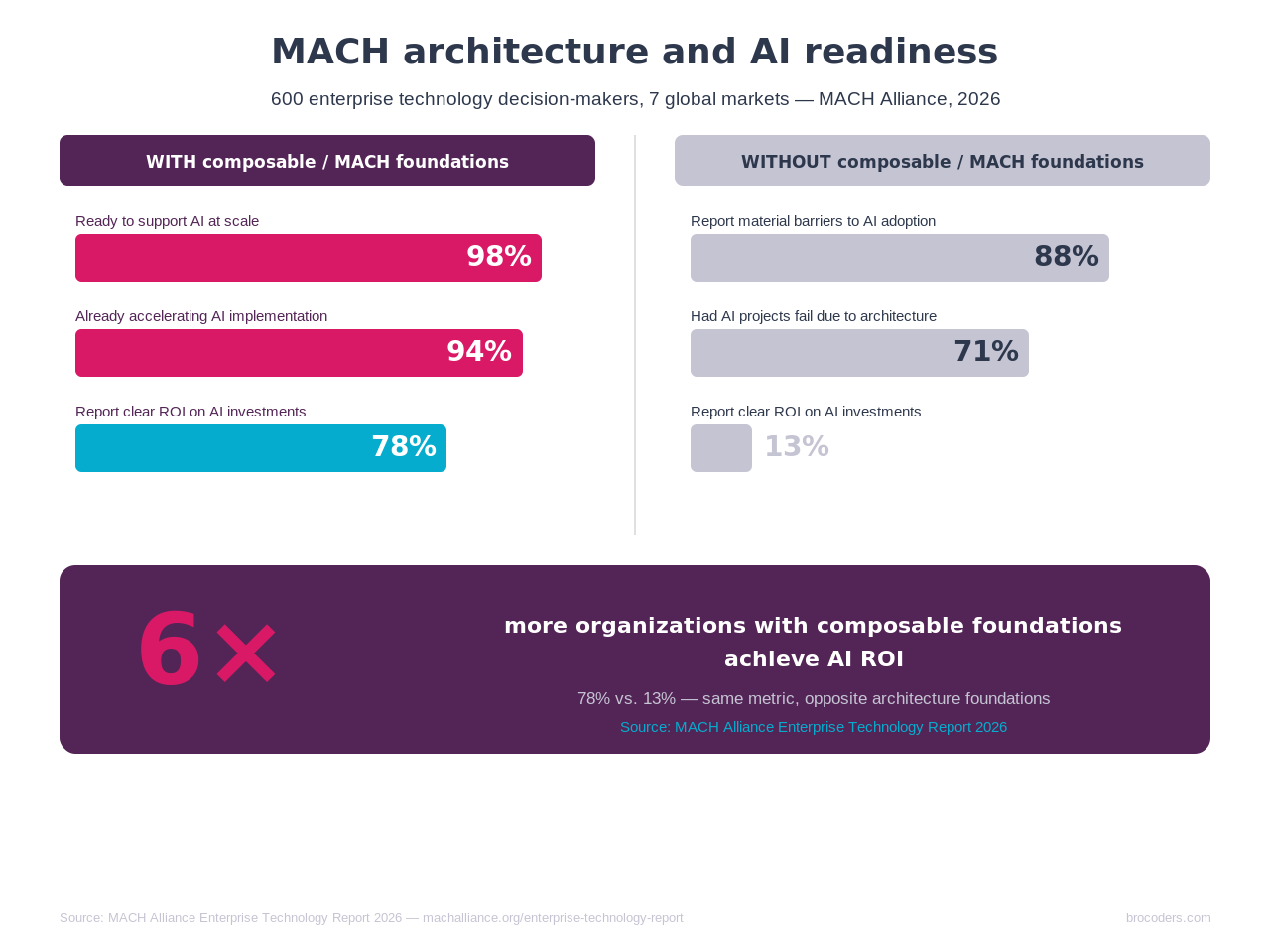
This is a newer but important question. The MACH Alliance Enterprise Technology Report 2026 found that 71% of companies without composable architecture have had AI projects fail due to architectural limitations. If you're building a SaaS product and expect to integrate AI capabilities over the next 2–3 years (and you should), your architecture needs to support it.
Ask any shortlisted agency: "How would your proposed architecture support AI feature additions in 18–24 months?" A good answer describes open API contracts, decoupled services that can call AI models independently, and data structures designed for AI consumption. A weak answer describes AI as a feature they can "add later."
Evaluate the honest weakness conversation
Every agency on this list has a weakness section. Try that question in your sales call: "Where is your approach or team a weaker fit?" An agency that can answer it clearly is a more reliable partner than one that pivots to strengths. The honesty in that conversation predicts the honesty you'll get when something goes wrong during delivery.
Pricing reference: MACH architecture development in 2026
Development costs for MACH-based SaaS vary significantly by architecture complexity, team location, and project scope. This table gives approximate ranges.
| Project type | Scope | Estimated cost | Typical timeline |
|---|---|---|---|
| Greenfield SaaS MVP (MACH-aligned) | 3–4 services, API layer, basic CI/CD | $50,000–$120,000 | 3–5 months |
| Full SaaS product (cloud-native) | 5–8 services, headless frontend, full CI/CD | $120,000–$300,000 | 5–9 months |
| Monolith-to-microservices migration | Existing codebase, phased decomposition | $80,000–$250,000 | 4–10 months |
| Enterprise MACH platform build | Full composable stack, multi-market | $300,000–$1,000,000+ | 9–18 months |
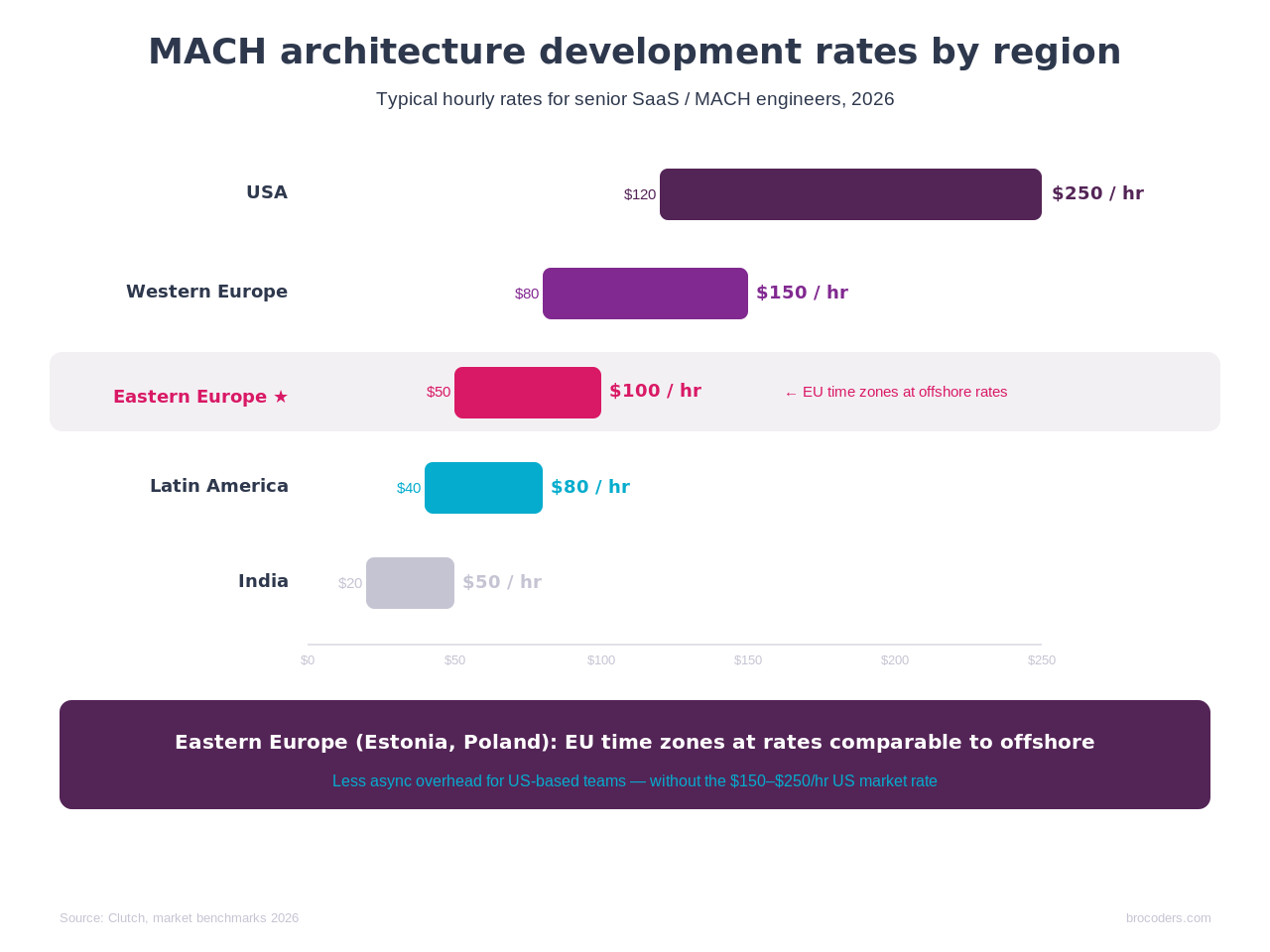
Hourly rate benchmarks by region:
| Region | Typical range |
|---|---|
| USA | $120–$250 |
| Western Europe | $80–$150 |
| Eastern Europe (Estonia, Poland) | $50–$100 |
| Latin America | $40–$80 |
| India | $20–$50 |
Eastern European agencies (Brocoders, The Software House, Netguru) deliver at hourly rates comparable to Latin America while operating in EU time zones, which reduces the async overhead that often inflates project timelines for US-based companies working with offshore teams.
Conclusion
The companies on this list share one trait: they treat architecture as a first-class decision, not a consequence of which tools they prefer. That's what separates a firm that builds SaaS products that handle growth from a firm that builds SaaS products that need to be rebuilt.
Architecture determines whether a product can handle 10x users, integrate third-party services without a rewrite, and adopt AI capabilities as the market evolves. The MACH Readiness Filter exists because that conversation happens in the first vendor call, not after you've signed a contract.
At Brocoders, we start every SaaS engagement with an architectural brief — what the product needs to handle today and what it needs to survive at 10x. The Lake rebuild (80x connected properties, 3 months) is the clearest demonstration of what that approach produces.
If you're evaluating development partners for a SaaS product and want to start with the architecture conversation, our team is ready. Contact Brocoders here.
Discover how the Brocoders team delivers expert SaaS development services built on MACH principles from day one, ensuring your product scales seamlessly as it grows.
Related reading:
- Monolith vs. microservices: when to split and when to wait
- DevOps for SaaS projects: how DevOps helps
- Top MVP development companies for startups in 2026
Frequently Asked Questions
MACH stands for Microservices, API-first, Cloud-native, and Headless. It's an approach to building software where every component is independent, connected through documented APIs, deployed on cloud infrastructure, and decoupled from presentation layers. A MACH-built product can swap out any single component (say, replacing one payment processor with another) without rewriting the rest of the system. The MACH Alliance, a collective of 100+ technology companies, formalized these principles in 2020.
M: Microservices — the application runs as independent services, each deployable separately. A: API-first — every capability is exposed via a documented API from the start. C: Cloud-native — built for cloud infrastructure, not migrated to it. H: Headless — front-end presentation is decoupled from back-end logic and can be delivered to any channel.
No. MACH was popularized in the ecommerce space because platforms like Commercetools and Contentstack drove early adoption. But the underlying principles — microservices, API-first design, cloud-native deployment, headless separation — apply to any SaaS product. Field service management software, fintech platforms, and healthtech systems all benefit from MACH principles. The ecommerce framing is where the term originated, not where it ends.
Microservices is one of the 4 components of MACH. A product can use microservices without being API-first, cloud-native, or headless. MACH is the full pattern: microservices plus documented API contracts (A), cloud-native infrastructure with elastic scaling (C), and decoupled front-end presentation (H). A product with all 4 is substantially more flexible and AI-ready than one with just microservices.
Apply the 4-question filter from the framework section. Ask for a specific project where they handled significant growth, request sample API documentation from a past build, ask how they handle traffic spikes specifically (not generally), and ask how front-end and back-end are decoupled in their typical SaaS build. An agency that answers all 4 with project references is different from one that names tools.
Yes, and this is increasingly important. The MACH Alliance Enterprise Technology Report 2026, which surveyed 600 enterprise technology decision-makers across 7 global markets, found that 71% of companies without composable architecture foundations have had AI projects fail due to architectural limitations. Among organizations with MACH-based foundations in place, 98% said they were ready to support AI at scale. MACH-aligned architecture means AI services can be integrated as independent API-connected components without rewriting existing systems, which is what TELUS Digital described at MACH X Toronto 2026 — every time a new AI model came to market, they could adopt it without rebuilding anything.
MACH introduces organizational and operational complexity that a monolith doesn't have. Coordinating multiple independent services requires mature DevOps practices, clear API governance, and engineering teams comfortable with distributed systems. For very early-stage products (first MVP, single-person team, highly uncertain scope), starting with a structured monolith and clear service boundaries is often a better choice than full MACH from day one. The right architecture depends on your growth trajectory and team capability, not just the principles.
Valtech is a founding MACH Alliance member. Elogic works extensively within the MACH Alliance vendor ecosystem as a Commercetools-certified implementation partner. The others on this list build to MACH principles without formal MACH Alliance membership — membership indicates vendor ecosystem relationships, not architectural quality.