
According to Buildium's 2026 Renters' Report, 84% of renters expect a reply within 24 hours. That is hard to hit when requests arrive by text, email, and voicemail and never land in one place.
A tenant texts on Friday evening: "Small drip under the kitchen sink, no rush." The message sits on the property manager's personal phone, between a vendor invoice and a family group chat. On Monday, the tenant downstairs calls about a brown stain on the ceiling. A plumber's visit has turned into drywall, paint, and a second unhappy household.
The request had no record: no owner, no urgency level, no promised reply time. Most tenant management best practices focus on being responsive and friendly. Tenants judge you on what happens after they press send, and that depends on the record.
This guide is built on one rule, One Request, One Record. It shows how to apply it from screening to move-out, and where AI agents (software that handles a task from start to finish, such as logging a request) can take work off your team and where they must stay out.
TL;DR: Many tenant management failures start at intake, when a request lands with no record. Give every request one record with a channel, tier, owner, promised update time, and closed date, and reply within 24 hours. AI agents can run intake, triage, and follow-up on that record, but they can't decide who gets housed.
What tenants actually judge you on
Tenants judge you mostly on how you handle maintenance requests. In Buildium's 2026 Renters' Report, a survey of 1,500 U.S. renters, those satisfied with maintenance are 57% more likely to renew. AppFolio's 2026 Renter Preferences Report, based on 3,002 renters, reports a larger effect: residents satisfied with maintenance are 81% more likely to renew, and 3 times more likely to recommend their property manager.
Both are vendor surveys, so read the exact percentages with care. The direction is still hard to miss. Maintenance handling is one of the strongest tenant retention levers a property manager controls, and maintenance handling is mostly a process problem. A fast plumber does not help if the request reached you 3 days late.
Tenants also chase what they can't see. In CondoGenie's usage data for the 6 months to May 2025, residents created 10,526 requests and posted 22,634 comments on them, about 2 comments per request. The product itself started from slow replies. Rafal Dyrda, CondoGenie's CEO and Founder, built its first version in 2009 while serving on his Edmonton condo board:
"The condo board met once a month. That is when they reviewed all the letters from that correspondence mailbox. Then it took another month to make the decisions and reply to the resident."
Rafal Dyrda, CEO and Founder, CondoGenie
The One Request, One Record model
The rule is simple: every tenant request gets exactly one record, and that record has 5 fields.
| Field | Why it matters | Example |
|---|---|---|
| Channel in | Shows where requests arrive, so none get lost in a side channel | Portal, text, email, voicemail |
| Tier | Sets how fast you must act | Emergency, urgent, routine |
| Owner | One named person is responsible until it closes | "Dana, maintenance coordinator" |
| Promised update time | What you told the tenant, so you can keep it | "Update by Tuesday 12:00" |
| Closed date | Lets you measure time to close and spot slow vendors | March 14, 4:40 p.m. |
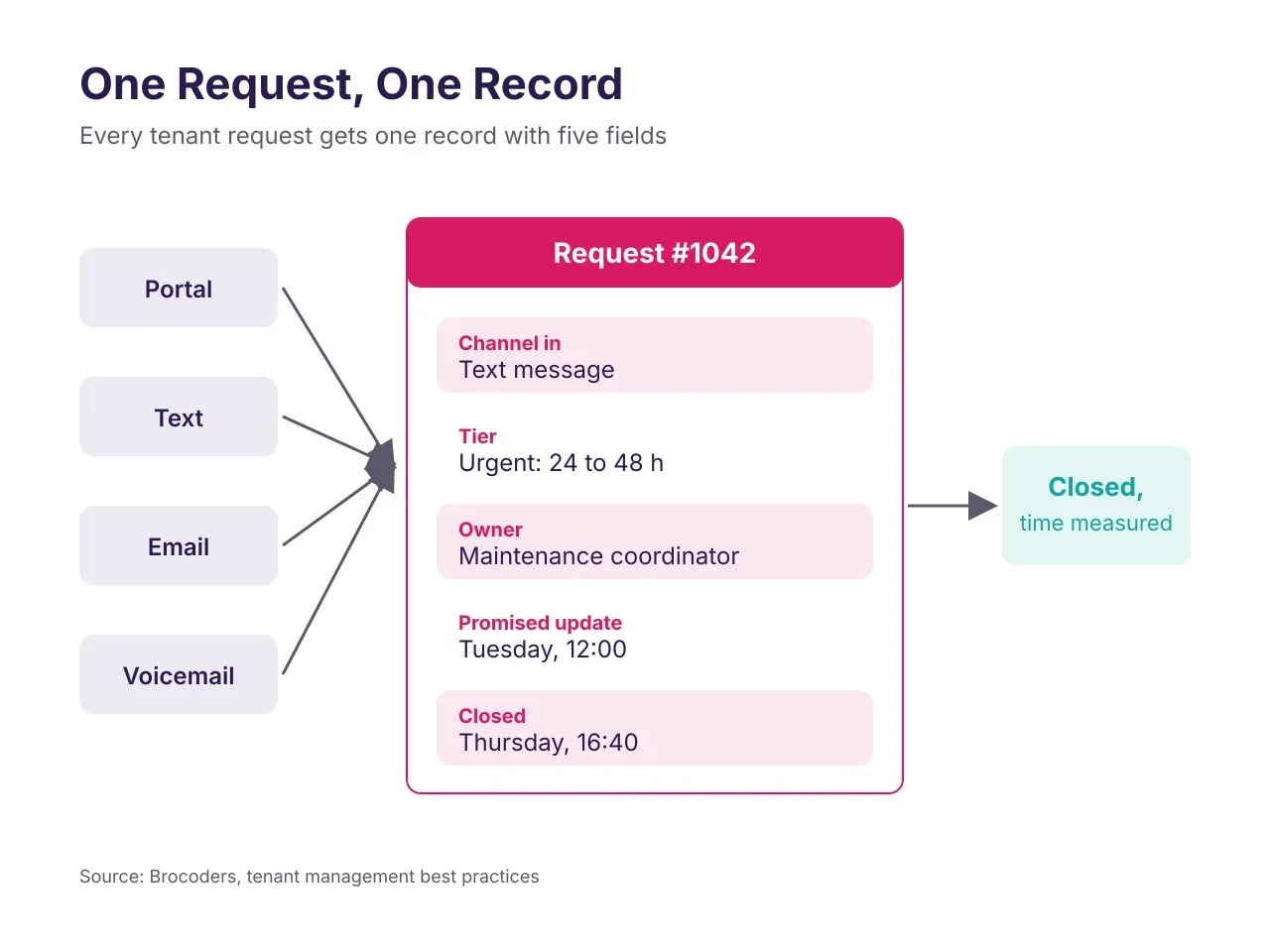
Property managers describe the same structure from their own practice. On a BiggerPockets thread about maintenance requests, Zion Mulangala recommends one record per issue with the unit, date, photos, status, next action and owner. Jimmy Lieu in Columbus logs the time each request came in, who handled it and when it was completed.
The record matters more than the tool you keep it in. A shared spreadsheet with these 5 columns beats an expensive platform where half the requests still arrive by text and never get entered.
Set triage tiers and put them in the lease
Without tiers, every request feels urgent to the tenant and nothing feels urgent to the team. Stephen Delahoussaye, who runs a property management company in Nashville, uses 3 tiers and writes them into the lease addendum:
- Emergency, same day: active water leaks, no heat in winter, no air conditioning (AC) above 90°F.
- Urgent, 24 to 48 hours: problems that affect daily living but cause no damage yet.
- Routine, within a week: everything else, scheduled.
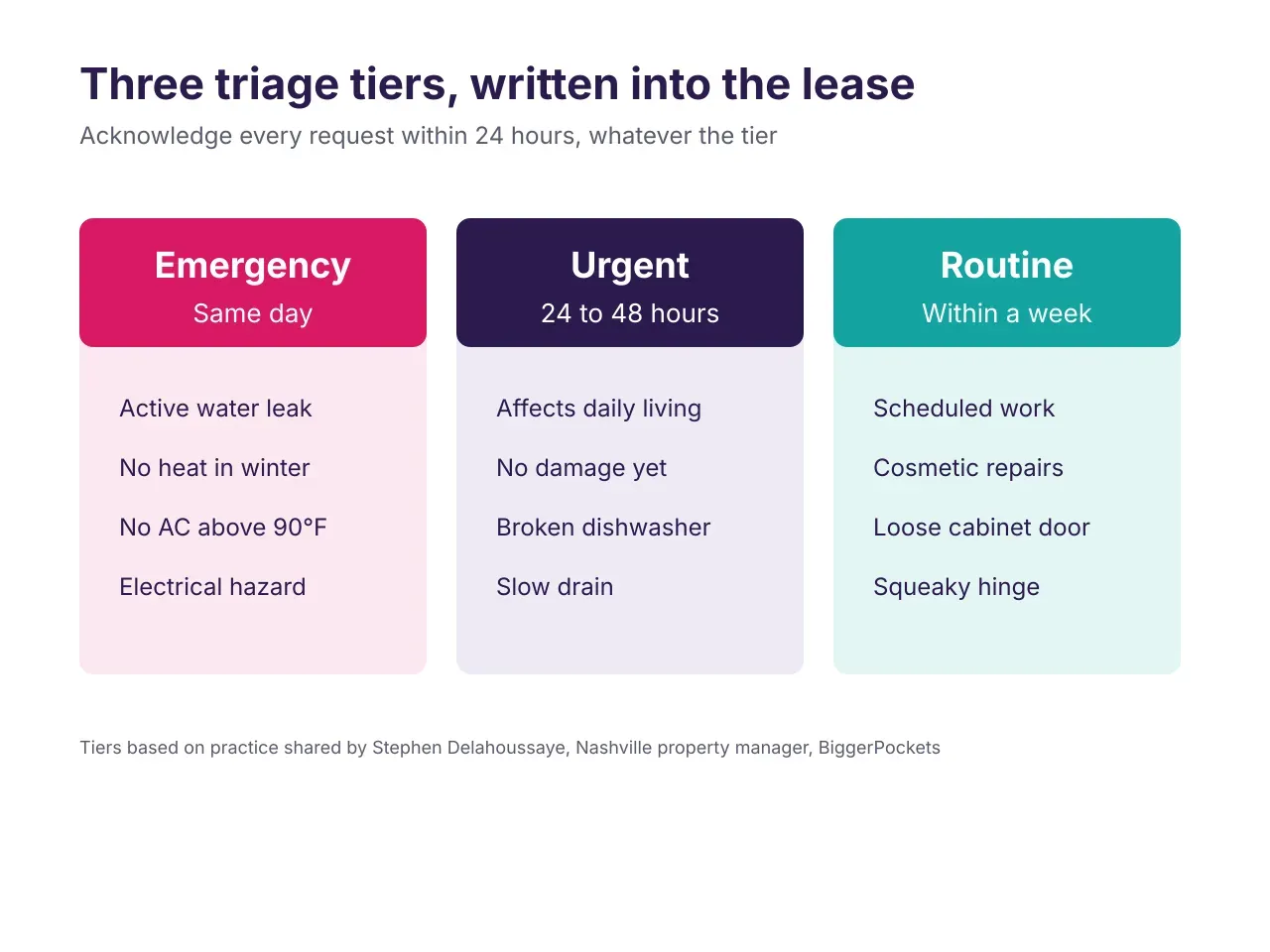
Putting the tiers in the lease does 2 things. Tenants know what to expect before they ever submit a request, and your team has a written standard to triage against instead of guessing.
Tiers also shape the software. When Brocoders rebuilt CondoGenie, it built a maintenance module, and the data later backed that choice: 40% of resident requests are repairs. The module has recurring inspection schedules, checklists, task assignment to several staff members, and QR codes that open an asset's maintenance record on site. Routine work gets scheduled in advance instead of arriving as new requests. When a case is unclear, Adam Bartomeo in Cape Coral suggests a plain test: would you treat this as urgent in your own home?
Move every request to one channel
A clear maintenance request process takes normal requests through one intake channel and keeps one phone line for emergencies only. The risk it removes, as Jojo Kamson puts it on the same BiggerPockets thread, is requests getting lost between channels before triage even starts. Marc Winter in Northeast Pennsylvania runs exactly that: an online form or text for normal requests and a 24/7 hotline reserved for emergencies.
The channel works when you keep 3 habits:
- Require a photo. Delahoussaye requires photos with every request because they separate a minor drip from a real emergency. Ali Johnson in Ohio goes further and asks for a photo or the code on the appliance's data plate so he can diagnose the likely part before a truck rolls.
- Acknowledge within 24 hours, even without news. John L Bennett acknowledges every request within a day, update or not. In tenant communication, a reply like "Received, I'll update you by tomorrow" costs 10 seconds and removes many follow-up calls.
- Tell tenants what is happening. Johnson's message "Issue identified, the exact part is on order" stops tenants from thinking nobody is working on it.
The same logic works for violations, not only repairs. In the C.I.A. Services owner app Brocoders built, each compliance violation keeps its letters, owner updates, and photos in one place, so neither side has to dig through email to see where it stands.
Apply the record across the tenant lifecycle
Maintenance is where the record matters most, but it works at every stage of the tenant lifecycle.
| Stage | What the record holds | Why it matters |
|---|---|---|
| Screening | Date received, criteria applied, decision | The same written criteria for every applicant is your best protection in a fair housing dispute |
| Move-in | Keys, utilities, condition report with photos, first-week check-in, each with an owner and date | AppFolio found residents satisfied with move-in are 31% more likely to plan to renew |
| During the lease | Tier, channel, 24-hour acknowledgment, closed date | The core of the model |
| Renewal | A renewal record opened about 90 days before the lease ends, with the request history attached | Buildium found 28% of renters plan to move within a year, and 66% of undecided renters would renew at the same rent |
| Move-out | Move-out photos against the move-in report, each deduction with its reason | A clean record prevents many deposit disputes |
At renewal, the request history shows how the tenancy went: slow closes and repeat issues are warning signs worth a conversation.
Let tenants answer their own questions
Some of what tenants ask doesn't need a person at all. CondoGenie, a condominium and homeowners association (HOA) management platform Brocoders has rebuilt and modernized since 2018, serves over 550 associations and, as of October 2026, over 80,000 registered users. In its May 2025 usage review, 40% of resident requests concerned maintenance and repair, 15% community rules and complaints, and 12% document or form retrieval.
Rules and documents together make up more than a quarter of the requests, and a tenant portal could answer many of them. Condo residents and renters ask about different things in the details, but the split between repairs and questions a document could answer is a useful benchmark for any rental portfolio.
C.I.A. Services, an HOA management company covering more than 50,000 properties in Houston and San Antonio, faced a similar issue. Owners could not see their own information in the legacy system without calling staff. The owner and resident app Brocoders built gives owners direct access to documents, financials, violations, and requests, with separate access levels for owners, residents, and board members. For how off-the-shelf products compare, see our review of the best HOA management software.
Self-service closes the easy requests before they become calls, and the record tracks the rest.
Where AI agents fit in tenant management
AI agents fit on top of the request record, starting with intake, triage, and follow-up. Vendors now pitch AI as the answer to tenant management, so it helps to know where the industry actually is.
In the 2026 AI property management report by the National Association of Residential Property Managers (NARPM) and AppFolio, 78% of screened fee managers said their firm uses some form of AI, and 751 of them took the full survey.
Yet half run a mix of unconnected tools, only 7% use agentic AI (tools that act on their own, such as booking a vendor, rather than only suggesting), and only 9% have measured a business outcome from it. Asked about results, 42% said AI improved maintenance resolution time, which is their own view rather than a measured result.
The pattern behind those numbers is the same as the leaking sink. An agent can't triage or follow up on a request that lives in someone's personal texts. AI only works on requests that are already in the record. Once the record exists, each agent can take responsibility for one or two of its fields. The agent names below are ours, for illustration:
| Agent | What it does | Record field it touches | Person keeps |
|---|---|---|---|
| Intake Agent | Pulls requests from text, email, portal, and voicemail into one record. Asks for a photo and sends a ticket number and update time | Channel in, promised update time | Nothing (low risk, easy to correct) |
| Triage Agent | Assigns emergency, urgent, or routine against the lease tiers. Pages the on-call person for emergencies | Tier | Confirming emergencies |
| Dispatch Agent | Reads the photo or data plate, suggests the likely part, picks a vendor, books routine jobs | Owner (vendor assigned) | Spend above a set limit |
| Promise Keeper | Watches every promised update time and chases vendors before it passes | Promised update time | Nothing |
| Resident Q&A Agent | Answers rules, document and payment questions from the lease, quoting the clause | Closes the record | Exceptions and disputes |
| Notice Drafter | Drafts announcements, reminders and renewal notices | n/a | Sending legal notices |
| Renewal Risk Agent | Flags tenants whose request history suggests a move-out | Flag on tenant record | The outreach and any offer |
| Inspection Agent | Compares move-in and move-out photos and drafts a condition report | Move-out record | Deposit deductions |
| Owner Report Agent | Writes a weekly owner summary of open requests, time to close and spend | Reads all fields | Commentary on problems |
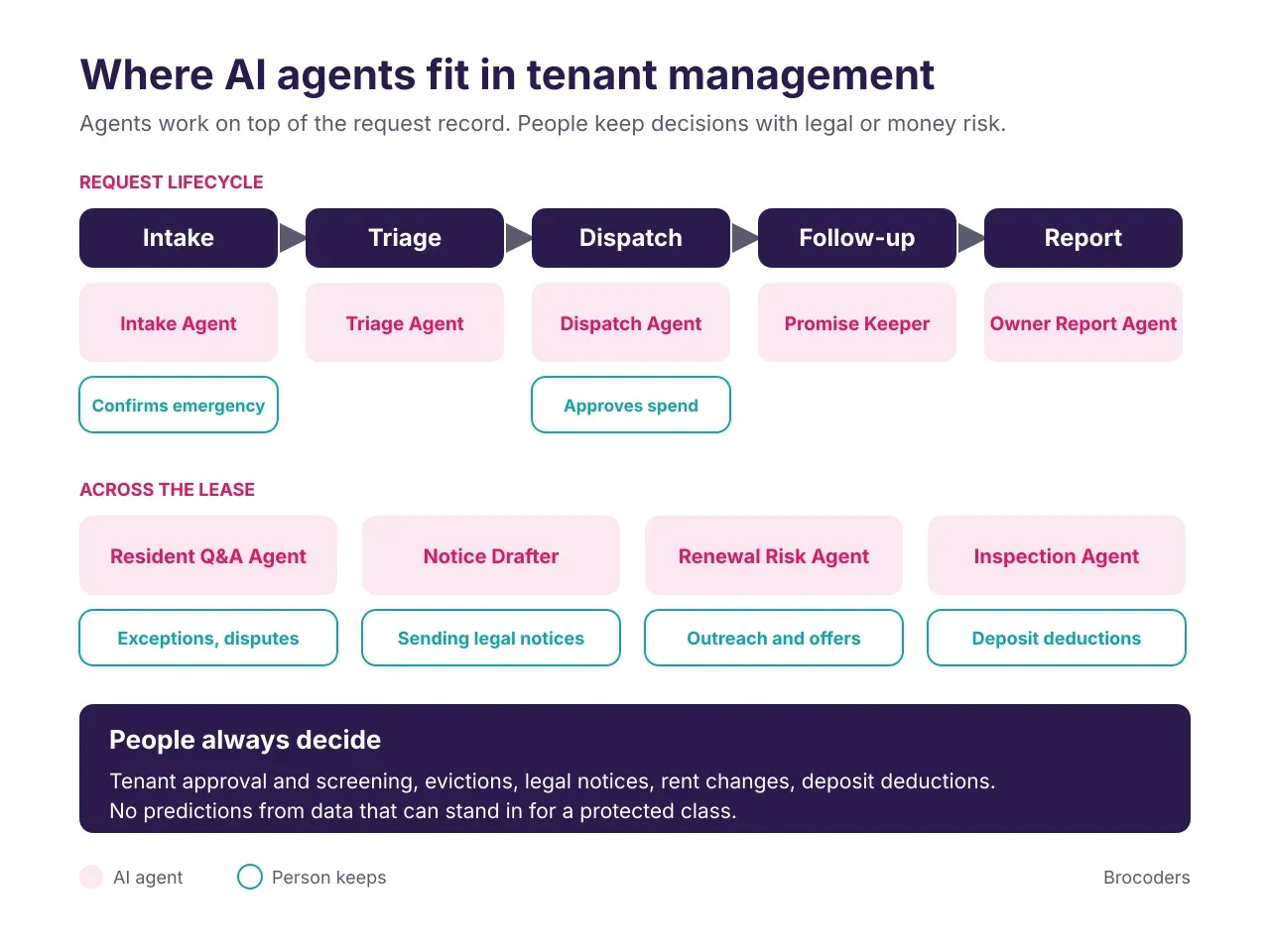
Start with the Intake Agent, the Triage Agent, and the Promise Keeper. Their mistakes are easy to spot and correct, and emergencies still go to a person. Dispatch can follow, since it matches what managers already trust: in the NARPM survey, 51% were comfortable with AI scheduling maintenance, the only task to win majority support. The Promise Keeper also covers small requests, the ones most likely to slip while the team is busy with emergencies.
Some decisions should stay with people, whatever a vendor promises:
- Who gets approved as a tenant. In November 2024, SafeRent Solutions settled a class action for about $2.3 million and agreed to stop scoring certain applicants who use housing vouchers. Screening scores need human review.
- Evictions, legal notices, rent changes and deposit deductions.
- Any prediction built on data that can stand in for a protected class. A renewal risk flag should use request history, never demographics.
CondoGenie's Genie assistant, which Brocoders built, works like a Notice Drafter: it drafts community announcements from a short prompt and has been live in production since August 2025. On AreaButler, a PropTech platform where Brocoders worked as an augmented engineering team, the product generates property and location descriptions in German, English, and French.
When spreadsheets stop working
You may not need software yet. Theresa Harris makes the point on BiggerPockets that small portfolios need records, not software. Delahoussaye, from his own experience, says self-managing without a system breaks down past 3 or 4 units. Either way, the 5 fields come first.
Signs you have outgrown a spreadsheet:
- Requests still arrive in channels that never reach the sheet.
- You can't tell how long requests take to close without counting by hand.
- Owners ask for reports that take an afternoon to build.
- You want AI agents but have no single place for them to read and write.
Some managers have the record but can't change the software around it. A communications manager at a US residential community told us: "When I ask for functionality changes on something very simple, it can take 9 to 12 months."
Most firms should start with an off-the-shelf property management system (PMS). A custom layer, meaning software built on top of your PMS that connects it to your portal and tools, makes sense when the PMS can't run your workflow, or when your data and AI tools sit in separate systems that don't talk to each other. For a sense of cost: off-the-shelf pricing starts at about $1 per unit a month (Yardi Breeze), so 10,000 units cost at least $120,000 a year. Under about 100 units, off-the-shelf is usually the better buy, and we say so on the first call. Above that, compare both over 3 to 5 years. A code audit of the system you run costs $5,000 for 5 business days.
That is the gap Brocoders works on in property management software development: connecting the record, the resident portal and the agents into one system.
FAQ
What is tenant management? Tenant management is everything a landlord or property manager does to find, house, and keep tenants: screening, move-in, handling requests, renewals, and move-out. In practice, most of the work is handling requests well and on time.
What are the best practices for managing tenants? Give every request one record with a channel, tier, owner, promised update time, and closed date. To manage tenants well, set response tiers in the lease, take requests through one channel, and acknowledge each within 24 hours. Use the same written criteria for every applicant.
How fast should a landlord respond to a maintenance request? Acknowledge every request within 24 hours. In Buildium's 2026 survey, 84% of renters expect that. Fix emergencies the same day, urgent issues within 24 to 48 hours, and routine work within a week.
What counts as an emergency repair? Anything that threatens safety or causes ongoing damage: active water leaks, flooding, electrical hazards, gas smells, no heat in winter, or no AC in extreme heat. Habitability rules vary by state, so write your own list into the lease addendum.
Do I need property management software to manage tenants? Not for a few units: a shared spreadsheet with the 5 fields works until requests start slipping between channels or reporting takes hours.
How can AI help with tenant management? AI agents can collect requests from every channel, sort them by urgency, chase overdue updates, and answer routine questions from the lease. They work only on top of a clean request record. Keep people in charge of screening, legal notices, and money decisions.
Is it legal to use AI for tenant screening? It can be, but it carries fair housing risk: SafeRent settled a class action for about $2.3 million in 2024 over its screening scores. Have a person review every decision and apply the same written criteria to all applicants. This isn't legal advice, so check your setup with a fair housing attorney.
Back to the drip under the sink. With one record, Friday's text would have been logged, sent an acknowledgment, and been tagged urgent, either by a person or by an agent. The tenant downstairs would never have noticed.