
Last updated: Oct. 29, 2026. Researched and written by the Brocoders takeover team. Firm data checked on each firm's own website and Clutch profile between Oct. 1 and Oct. 29, 2026.
A stalled software project is one that has stopped moving before launch: the team left or slowed down, the code is partly built, and nobody is shipping new work. The product may be 70% done, with a release date or a customer still waiting for it.
At that point, the owner needs a new team to take over the existing code and finish it. This guide compares 6 software project rescue companies that offer this as a dedicated service.
We in Brocoders rescue stalled projects too. A vendor that ranks its own competitors stays credible only if it doesn’t rank itself, so we left Brocoders off the list. Our own rescue record is in the author box at the end.
Most buyers start with Clutch reviews and a portfolio scan, and many now ask ChatGPT for a shortlist. Those show who is reliable. They say much less about the real projects behind a firm’s rescue claims, so for each company we looked for published case studies: what was broken, what the team did, and what changed.
TL;DR: Of 16 software project rescue firms we checked, 1 publishes a price for its first audit (Fluvius, $1,900 for 3 days), 2 publish a rescue with both a number and a timeline, and 4 have no Clutch profile we could find. Pick a firm by the way your project stalled, then ask it for a priced audit, a measured rescue, and written handover terms before you sign. The firms below are grouped by situation and listed A to Z inside each group, so the order is not a ranking.
How we chose these 6 firms
We started from 16 firms that run a page dedicated to rescuing or finishing someone else's software. To make the list, a firm needed that dedicated page, company data we could verify (location, founding year, team size), and at least one rescue case described on its own site, named or not. Six of the 16 firms met all three.
We then read each firm's rescue page and Clutch profile and scored it against the Handover Evidence Test. It takes about 20 minutes per firm, and you can run it yourself:
| Signal | What good looks like |
|---|---|
| 1. Situation match | The rescue page names your situation in your words: stalled agency, AI prototype, acquired code, legacy stack |
| 2. Bounded first step | An audit with a stated duration, scope, and price, and the report is yours if you stop |
| 3. Measured rescue proof | At least one described rescue with a duration and a measured result |
| 4. Handover terms | Written commitments on repositories, cloud accounts, and credentials moving into your ownership |
| 5. Fit floor | A published minimum budget or rate band, so you know before the call whether you fit |
We read each signal from the firm's own rescue page, plus its case pages for signal 3. Yes means the firm meets the signal in full as described above, Partly means it meets part of it (the cell says what is missing), and No means we found nothing. Situation match is Yes when the rescue page names the situation the firm is listed under. We show which signals each firm meets instead of a total, so no score turns into a ranking. Most firms meet the signals in part, and only Fluvius meets most of them in full. The "Fit for rescue projects" line under each profile is our editorial reading of the evidence, and the firms did not review it.
ENO8, Moravio, and Saritasa also appear on MageComp's September 2026 list, which groups rescue firms by buyer type. This guide groups them by situation and adds the evidence check.
What 16 rescue firms publish, and what they leave out
Rescue firms publish their process and leave out the evidence. Of the 16 firms we checked, only Fluvius prices its first audit. Fluvius and HyperProductive are the only 2 that describe a rescue with both a number and a timeline. Liquid Intent, Soundlining, H Product Studio, and Soligent (4 of the 16) have no Clutch profile we could find.
That gap matters more in a rescue than in a new build. A rescue buyer has already paid one team for code that didn't ship, and a price, a measured result, and written ownership terms protect the second payment.
Here is how the 6 listed firms score on each signal:
| Firm | Situation match | Bounded first step | Measured rescue proof | Handover terms | Fit floor on own site |
|---|---|---|---|---|---|
| Fluvius | Yes | Yes ($1,900, 3 days) | Yes (6 months, 1 engineer) | Yes | No (minimum on Clutch only) |
| HyperProductive | Yes | Partly (free, no duration) | Yes (6 months to go live) | No | No |
| Moravio | Yes | Partly (free, days to weeks) | Partly (2 weeks of analysis, no result number) | Partly (analysis materials) | No |
| Saritasa | Yes | Partly (free code review) | Partly (named cases, no number) | Partly (complete source code at the end of development) | Yes |
| ENO8 | Yes | Partly (no price) | Partly (result number, no duration) | No | No |
| ISHIR | Yes | Partly (no price) | Partly (named clients, no number) | No | No |
Quick comparison of the 6 firms
The table sorts the firms by situation, then A to Z. Clutch data as of Oct. 16, 2026.
| Firm | Situation | HQ | Clutch rating (reviews) | Min. project | Rate | First step |
|---|---|---|---|---|---|---|
| Fluvius | Stalled or quiet vendor | Sacramento, CA | 4.9 (6) | $50,000+ | $50 to $99/h | $1,900 audit, 3 days |
| HyperProductive | Stalled or quiet vendor | Cleveland Heights, OH | No reviews | $10,000+ | $150 to $199/h | Free assessment |
| Moravio | Stalled or quiet vendor | Prague, Czechia | 4.9 (23) | $25,000+ | $50 to $99/h | Free consultation, then analysis |
| Saritasa | Stalled or quiet vendor | Irvine, CA | 4.8 (108) | $50,000+ | $100 to $149/h | Free code review |
| ENO8 | Delivery breakdown | Dallas, TX | 4.9 (14) | $25,000+ | $100 to $149/h | Chat, pause, audit |
| ISHIR | Mobile app | Dallas, TX | 4.9 (19) | $10,000+ | $50 to $99/h | Code and architecture audit |
If your agency or developer stalled or went quiet
Pick from this group when the code exists and the previous team slowed down, missed its dates, or left. All four rescue pages name this case: a vendor that stopped delivering or went quiet, or a developer who left mid-build. Their published proof differs. HyperProductive and Moravio describe takeovers from a developer who vanished or a supplier the owner left, Saritasa tags its takeovers without numbers, and Fluvius's one measured rescue is a legacy rewrite.
Fluvius (Sacramento, California): a priced audit and written ownership terms
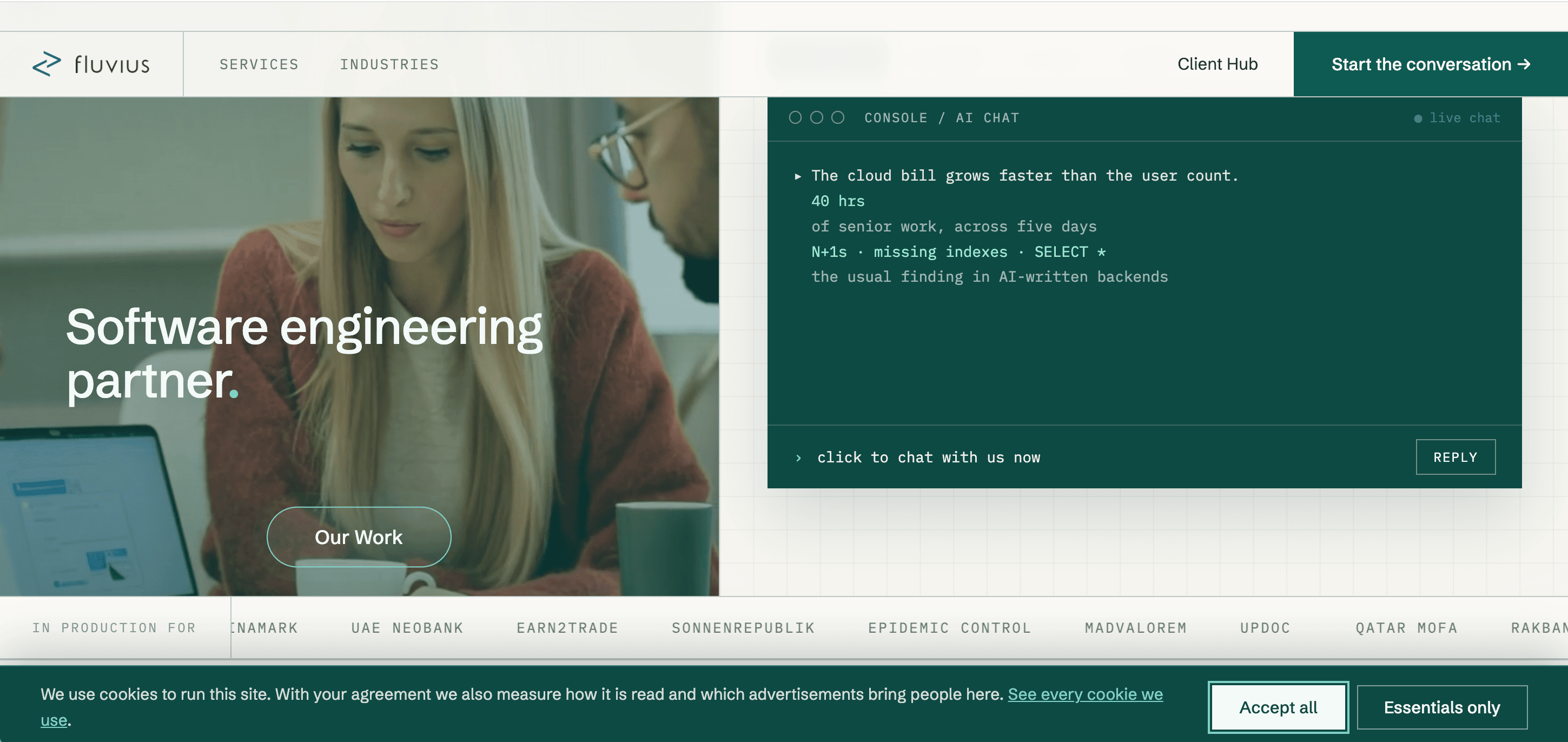
Overview: Fluvius is a US product studio that pitches "a stalled or vibe-coded build, made production-grade." It holds a 4.9 Clutch rating across 6 reviews. It is the only firm we checked with a priced first step: a Code & Developer Audit at $1,900 fixed, delivered in 3 days with a written, effort-estimated fix plan.
Core focus:
- Vendors that went quiet after payment, AI prototypes failing with real users, and sole developers who left
- A free 30-minute triage call, the priced audit, then senior-led rescue work
- Node.js and NestJS, React, and AI-generated codebases, with fintech experience
Real project examples & client quotes:
- Unnamed client, 14-year-old Go backend: one senior engineer, working with AI tools, rewrote the backend in Node.js in 6 months, against quotes of about 2 years. The system stayed in service during the rewrite.
- Earn2Trade: Fluvius built a back office that serves 8,000+ monthly active users.
- Fluvius's rescue page names AI-generated prototypes as a situation it takes on, but it publishes no rescue of one. The Go rewrite is its measured rescue proof.
Strengths:
- The clearest handover line we found: "Repos, credentials, cloud accounts and domains secured in your name."
- One of only 2 firms out of 16 that publish a rescue with both a number and a timeline
Weaknesses / considerations:
- Only 6 Clutch reviews, and the strongest rescue case is unnamed
- The firm takes "one senior track at a time," so a start date can slip if that track is busy
Key stats:
- Employees: 50 to 249 (Clutch)
- Clutch reviews: 6
- Average rating: 4.9/5.0
- Hourly rate: $50 to $99
- Minimum project: $50,000+
- Founded: 2017
- Headquarters: Sacramento, California, US
- Distinction: The only firm of the 16 that prices its first audit, and the only one of the 6 listed that puts ownership transfer in writing.
Fit for rescue projects: An owner whose vendor went quiet or whose sole developer left, and who wants a priced, 3-day answer before committing a budget. Clutch lists a $50,000 minimum for the rescue work after the audit.
HyperProductive (Cleveland Heights, Ohio): small crew, long-running results
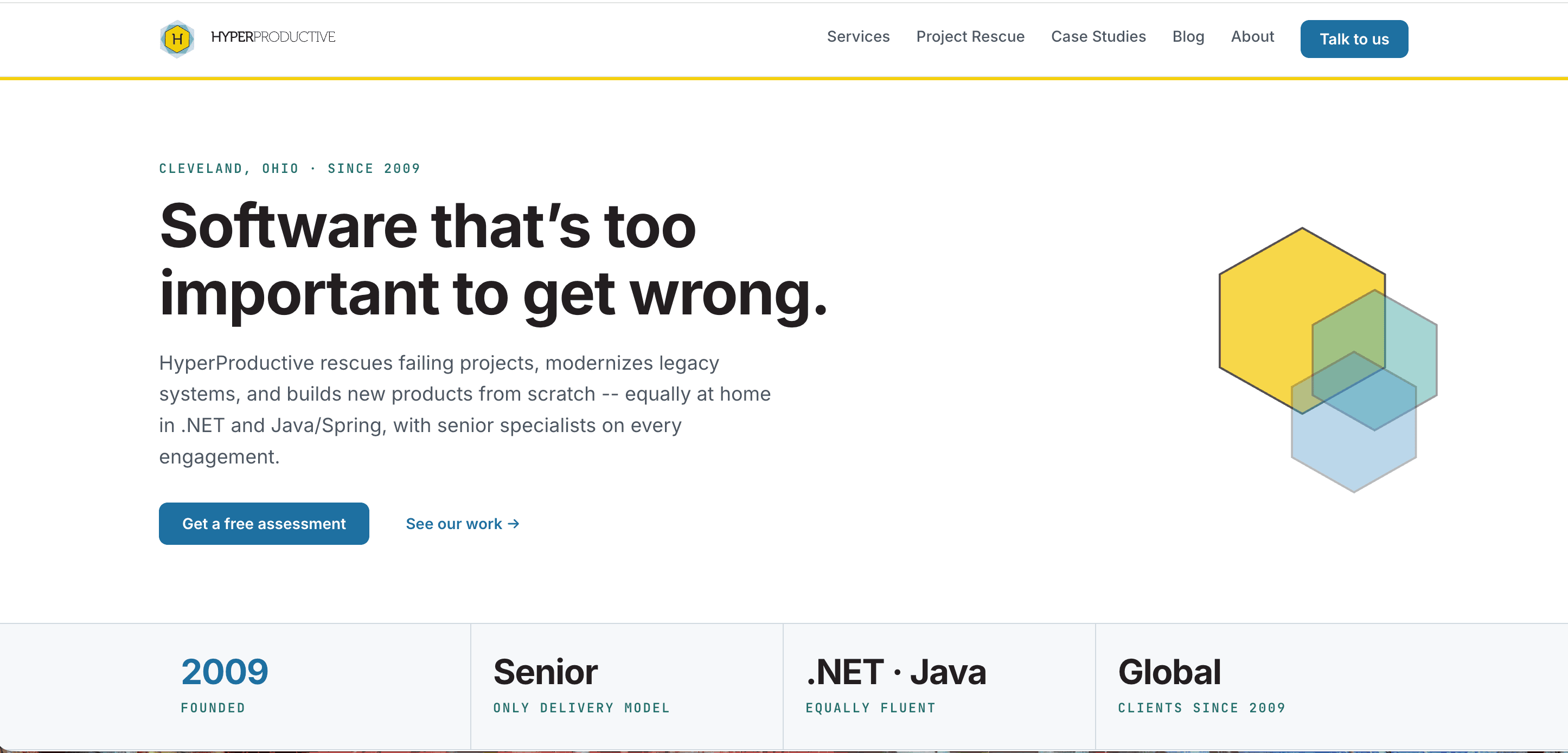
Overview: HyperProductive is a small Ohio firm that focuses on software project rescue and application modernization. It has no Clutch reviews yet, and it publishes the two most specific rescue stories we found among the 16 firms. It offers a free project assessment.
Core focus:
- Stalled, troubled, and over-budget projects, including apps left unfinished by another developer
- Small senior crews on long-overdue internal systems
- Java and Spring, .NET, iOS, Azure, and AWS
Real project examples & client quotes:
- American Greetings: a mainframe order system was "three years into a two-year project" with an estimate of "two more years". HyperProductive took it live in 6 months, and the work won the client's Chairman's Award.
- Hinkley: the developer of a distributor iPad app "simply vanished" weeks before launch. HyperProductive shipped the app on time, and the case says it has kept it running for 12 years.
Strengths:
- One of only 2 firms out of 16 with a rescue that carries both a number and a timeline
- A takeover case with 12 years of production behind it
Weaknesses / considerations:
- No Clutch reviews and a team of 2 to 9 people
- The founding year differs between its website (2009) and Clutch (2019)
Key stats:
- Employees: 2 to 9
- Clutch reviews: 0
- Hourly rate: $150 to $199
- Minimum project: $10,000+
- Founded: 2009 (website) or 2019 (Clutch)
- Headquarters: Cleveland Heights, Ohio, US
- Distinction: The most specific published rescue stories among the 16 firms we checked.
Fit for rescue projects: An owner whose developer vanished or whose internal system is long overdue, and who wants a small senior crew. Ask for references directly, since there are no third-party reviews to read.
Moravio (Prague, Czechia): European takeovers that continue into development
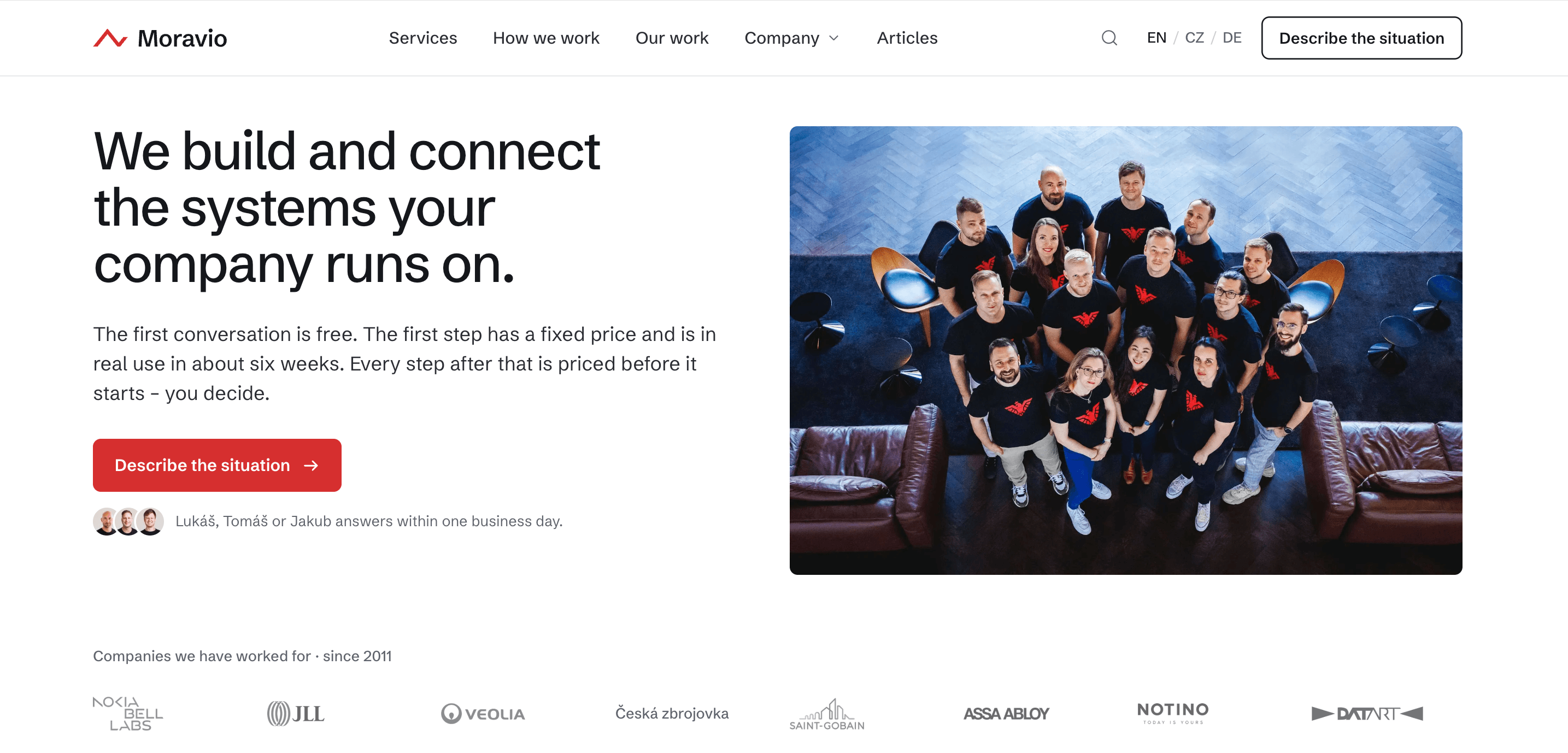
Overview: Moravio is a Czech development company that runs a software project rescue service and a separate AI rescue page. It holds a 4.9 Clutch rating across 23 reviews. Its rescue process starts with a free consultation, then an analysis that "can take from a few days to a few weeks, depending on the size of your project."
Core focus:
- Projects that stopped, slowed, ran over time or budget, or lack promised features
- Analysis, then continued development by the same team
- Offices in Prague, Ostrava, and Barcelona, for buyers who want a European time zone
Real project examples & client quotes:
- Spanamo (wellness booking): Moravio took over the booking platform, listed in its portfolio as a takeover. The case gives no metric or date.
- Unnamed auction portal: the owner had left its previous supplier. Moravio spent about 2 weeks on analysis, then reworked the schema, fixed security issues, and built a new interface (case).
Strengths:
- Two described takeovers, one with the analysis length stated
- Across 23 Clutch reviews, clients mention on-time delivery and steady communication in Slack and Jira
Weaknesses / considerations:
- Neither takeover case carries a metric or a date
- The website gives two team sizes ("fifty-strong" and "45+")
Key stats:
- Employees: 50 to 249
- Clutch reviews: 23
- Average rating: 4.9/5.0
- Hourly rate: $50 to $99
- Minimum project: $25,000+
- Founded: 2011
- Headquarters: Prague, Czechia
- Distinction: A European team that takes over a stalled build and keeps developing it.
Fit for rescue projects: An EU company that wants a team in a European time zone to take over and keep building. A buyer who needs a fixed audit price before sharing code should start elsewhere.
Saritasa (Irvine, California): long-term takeovers with a stated budget floor

Overview: Saritasa is a US software company founded in 2005 with the largest review base on this list: a 4.8 Clutch rating across 108 reviews. It starts takeovers "with a free Code Review" and is the only firm here that publishes a spending figure: "On average, our project takeover clients spend a minimum of $80,000 a year, but often that figure goes much higher."
Core focus:
- Missed deadlines, poor code, budget overruns, and unreliable previous vendors
- Long-term development after the takeover, plus a Vibe To Viable service for apps built with AI coding tools
- .NET, PHP and Laravel, Python, Angular and React, and mobile
Real project examples & client quotes:
- BJ's Restaurants: tip-sharing software, tagged on the site as a code takeover. No outcome numbers are published.
- Electronic Form I-9 compliance software: a second case tagged as a takeover, also without numbers.
Strengths:
- More Clutch reviews (108) than the next 3 firms on this list combined
- A written promise to "pass over the complete source code so that your project is yours" once development is finished
Weaknesses / considerations:
- "We cannot fix-cost project takeovers," and Saritasa declines projects "limited to only bug fixes"
- Some reviewers flag early estimates that moved during the project
Key stats:
- Employees: 206 team members (company website), 50 to 249 on Clutch
- Clutch reviews: 108
- Average rating: 4.8/5.0
- Hourly rate: $100 to $149
- Minimum project: $50,000+
- Founded: 2005
- Headquarters: Irvine, California, US, with an office in Tampa
- Distinction: The only firm on this list that tells you its takeover budget floor up front.
Fit for rescue projects: A US mid-market company that wants a long-term development partner after the rescue and plans to spend around $80,000 a year or more. A founder with a fixed, small budget will not fit.
If an AI-built prototype breaks with real users
Pick this when the first version came out of an AI coding tool (Cursor, Lovable, Bolt, or similar) and stopped holding up once real users arrived. Fluvius, ISHIR, and Saritasa name this case on their rescue pages, and Saritasa runs a separate Vibe To Viable service for it. None of the 6 firms on this list publishes a rescue of an AI-built app, so ask for the same priced audit as any rescue, plus a reference from a similar case, before you sign.
If delivery broke down under the previous team
Pick this when the product is live but the previous team's releases slowed, broke, or stopped being visible to you. The work here starts with stopping development.
ENO8 (Dallas, Texas): pause, audit, then rebuild
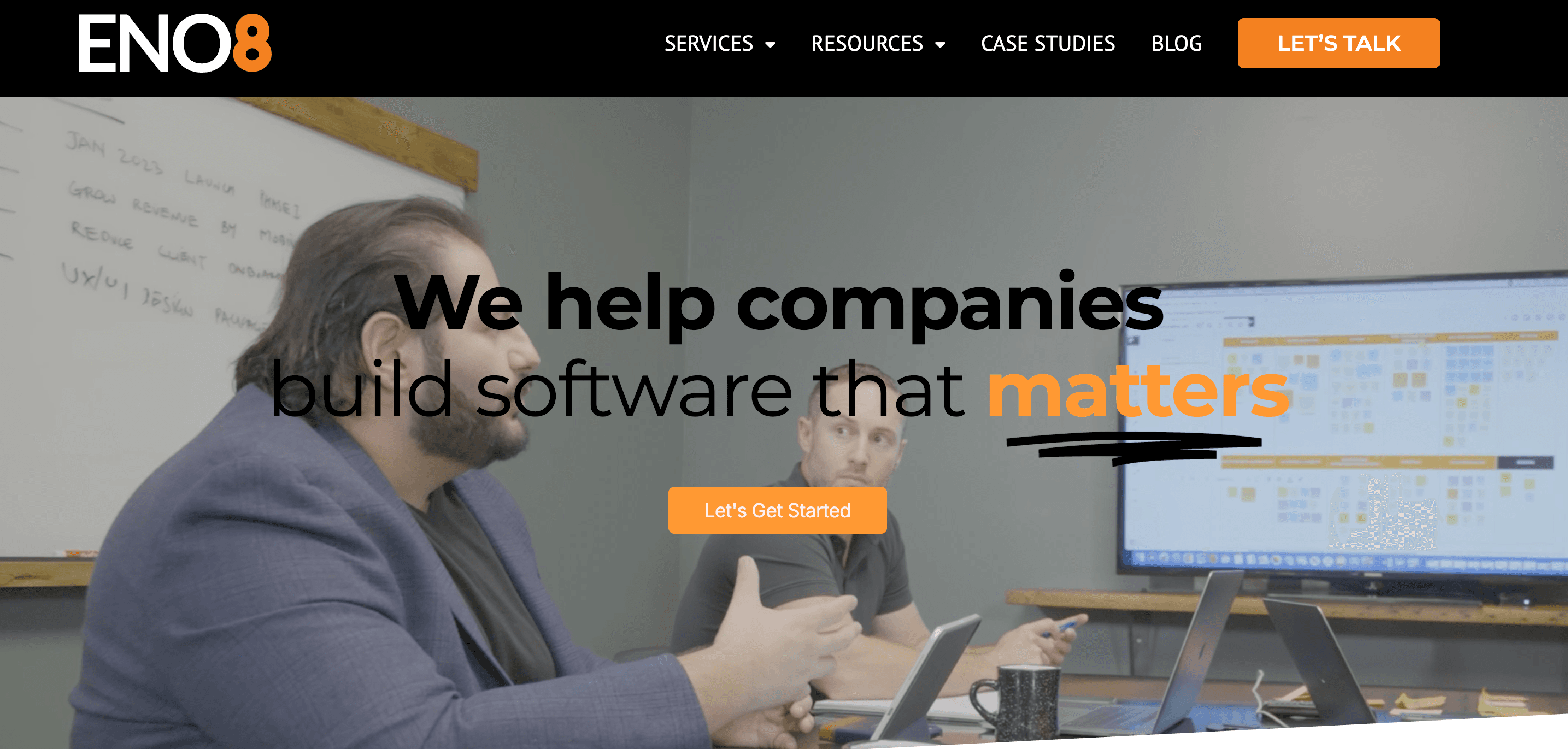
Overview: ENO8 is a Dallas product studio founded in 2016 with a 4.9 Clutch rating across 14 reviews. Its rescue process starts with a chat, then "We begin by pausing the software project," then an audit and reengineering.
Core focus:
- Vendors that aren't delivering, in-house teams without capacity, and a flailing or failed V1
- A deliberate pause, an audit, and a rebuild of release and delivery practice
- Custom software, mobile, and AI products
Real project examples & client quotes:
- Kanarys: the previous partner shipped slow, error-prone manual releases. ENO8 assessed the stack, recovered certificates, keys, passwords, and the codebase from the incumbent, and moved releases to CI/CD.
"Now, product releases happen on a weekly basis where it used to be monthly or once every other month."
ENO8, Kanarys case study
Strengths:
- A rescue case that shows the access recovery step, the one most buyers underestimate
- Across 14 Clutch reviews, clients describe a team that raises roadblocks early
Weaknesses / considerations:
- A team of 2 to 9 people, and no dates on the Kanarys case
- In 2 reviews, clients mention team turnover slowing progress
Key stats:
- Employees: 2 to 9
- Clutch reviews: 14
- Average rating: 4.9/5.0
- Hourly rate: $100 to $149
- Minimum project: $25,000+
- Founded: 2016
- Headquarters: Dallas, Texas, US
- Distinction: A rescue that starts by pausing the build before the audit.
Fit for rescue projects: A startup whose V1 is live but whose delivery stalled under the previous partner, and who wants a pause and a reset before more code is written. ENO8's rescue page also names a failed V1, but its published case is a delivery rescue like this one. A buyer who needs a large team on day one should look at Saritasa or Moravio.
If a mobile app is unstable or pulled
Pick this when a consumer app crashes, fails store review, or was pulled, and the previous agency or freelancer is gone. Mobile rescues often depend on store accounts and signing keys, so check who holds them before you call anyone.
ISHIR (Dallas, Texas): named rescue clients across web and mobile

Overview: ISHIR is a software company founded in 1999 with offices in Dallas and Noida. It holds a 4.9 Clutch rating across 19 reviews. Its rescue service starts with "a full code review and architecture audit" and names startups that begin with "vibe coding" as a rescue case.
Core focus:
- Undefined scope, missing skills, poor quality, budget overruns, and vibe-code debt (missing tests and security gaps)
- Web and mobile rebuilds, including Flutter and React
- Delivery teams in India, Latin America, and Eastern Europe
Real project examples & client quotes:
- Concentra: the company "faced the sudden removal of its mobile app from the App Store," and ISHIR worked a phased plan to get it reinstated.
- Express Chiropractic: ISHIR rebuilt an outdated mobile app in Flutter and ReactJS.
- ezLocator: a named rescue client, quoted below.
"While there were moments when timelines slipped slightly, they always communicated clearly and adapted."
Jon Schultz, CEO, ezLocator
Strengths:
- Names 3 rescue clients, so you have companies to ask about before signing
- Across 19 Clutch reviews, project management and on-time delivery come up most often
Weaknesses / considerations:
- The rescue page gives no numbers, dates, or handover terms
- The audit has no published price
Key stats:
- Employees: 50 to 249
- Clutch reviews: 19
- Average rating: 4.9/5.0
- Hourly rate: $50 to $99
- Minimum project: $10,000+
- Founded: 1999
- Headquarters: Dallas, Texas, US, with an office in Noida, India
- Distinction: Named rescue clients, including an app pulled from the App Store.
Fit for rescue projects: A buyer who wants named rescue references and offshore rates. Get the handover terms in the contract, because the rescue page doesn't state them.
One situation no firm above covers: code that came with an acquisition and that your in-house team can't run. None of the 16 rescue pages we checked publishes an offer for standing up acquired software in the buyer's own cloud, so ask for that scope by name.
Six checks from first email to handover
Run these 6 checks in order. Each one protects the next payment, and each one is something a rescue firm can answer in writing.
| Stage | What to ask for | Red flag |
|---|---|---|
| 1. First request | Sign an NDA, then send read-only access to the repo and a one-page history: who built it, when work stopped, what's live | A firm that asks for the code before an NDA, or quotes before anyone has seen it |
| 2. Intro call | One described rescue similar to yours, with a date and a number | Only logos, or "dozens of rescues" with no detail |
| 3. Audit | A fixed price, a fixed duration, and a report you keep if you stop | An open-ended "discovery" billed by the hour |
| 4. Access handover | A written list of repos, cloud accounts, domains, and credentials moving into accounts you own, with a date | The new firm hosts everything in its own accounts |
| 5. Stabilisation | A fixed window (Fluvius publishes a stabilise phase in weeks 2 to 6) with a list of what "stable" means | New features start before the build is stable |
| 6. First release | A dated release in your own environment that your team can deploy again without the vendor | A release only the vendor can repeat |
Stage 4 is where most buyers lose their bargaining position. Of the 6 firms above, only Fluvius puts the transfer of repositories, credentials, cloud accounts, and domains in writing on its rescue page, so ask the other 5 to put it in the contract.
Stage 3 decides whether you rebuild or keep what you have. Ask the audit to answer module by module, and treat a full-rewrite verdict that arrives before anyone has read the code as a sales quote.
What software project rescue costs
A rescue costs two separate things: an audit that tells you what to keep, and the rescue work itself. Firms publish very little about either, so here is everything we found:
- Audit: Fluvius charges $1,900 for a 3-day code audit. Brocoders publishes $5,000 for a 5 to 10 business-day audit (our own price, listed for comparison). The other 5 firms on the list offer a free call or review, or don't state a price.
- Ongoing takeover: Saritasa states that on average its takeover clients spend a minimum of $80,000 a year.
- Finishing a stalled build: Brocoders quotes $80,000 to $300,000+, priced after the audit (our own price, listed for comparison).
- Minimum projects on this list: from $10,000 (ISHIR, HyperProductive) to $50,000 (Fluvius, Saritasa), per each firm's Clutch profile.
Get the audit price in writing before you share the code. The audit decides everything that follows, including whether the second team spends its first month repeating the first team's work.
Pick by situation, then make the firm prove the handover
Start with the group that matches how your project stalled: a vendor or developer that went quiet, an AI-built prototype, a delivery breakdown, or a broken mobile app. Inside that group, the firm that shows a measured rescue and puts the handover in writing has already answered the questions the others leave for the sales call.
Every firm on this list will tell you it can rescue your project. The Handover Evidence Test tells you which ones have shown it.
Why you can trust this page
We read every rescue page and Clutch profile between Oct. 1 and Oct. 9, 2026, rechecked the Clutch data and quoted pages on Oct. 16, 2026, rechecked the firms' rescue and case pages on Oct. 28 and 29, 2026, and used no other list as a source. We quote firms in their own words. We did not interview the firms or their clients, so case details are as each firm publishes them.
We excluded Beehive Software, Clear Measure, Dom & Tom, Gurzu, Liquid Intent, Soundlining, H Product Studio, Soligent, and Webisoft (a rescue page, but no rescue case we could find on their own site), and Cognito Works (we couldn't verify its company data). Large integrators such as EPAM (minimum project on Clutch: $100,000+) were outside the 16: we started from firms whose rescue offer fits the budget of a stalled build at a startup or mid-size company.
Review data, team sizes, hourly rates, and minimum project thresholds change over time. Verify current data directly on each company's Clutch profile and website before shortlisting. We recheck this page every quarter.
About the author
Last updated: Oct. 29, 2026.
Brocoders is a software development company founded in 2014 and based in Tallinn, Estonia, with 87 specialists. Of our delivered client engagements, 23% were takeovers or modernizations of software the client already ran. Brocoders is not ranked in this guide. Here are 4 of our takeovers, with dates:
- CoreHealth (telehealth, UK): the previous contractor could no longer support the platform. We studied the old codebase in discovery and replaced it, carrying over the client's product flows, doctors, and documentation. We built version 2.0 starting discovery in July 2023, with a working demo 5 weeks into development (Sept. 15, 2023) and the MVP in October 2023. The customer's budget had to be spent within 6 weeks, and one platform now serves retail patients, pharmacies, and secure custodial healthcare.
- HeyPractice (EdTech, Germany): we took over an inherited codebase with enterprise customers already live. A free technical audit in early October 2021 came back before the quote, and we kept the database, models, and migrations, replaced the API, business logic, and frontend, and moved hosting to AWS with CI/CD. It went into production in March 2022, 5 months after the audit.
- Gokada (ride-hailing, Lagos): we took over a working MVP built by another IT company in July 2018, replaced its separate rider and driver apps with one cross-platform app, rebuilt the design and logic, and built the admin panel. The first release shipped in early 2019, and updates driven by driver and rider feedback raised daily ride requests 2.5 times in the first 6 months. The platform handled 1.5M ride requests in total before the engagement ended in February 2020.
- ShineUp (proptech): after an acquisition, we redeployed ShineUp into the buyer's own AWS account at a fixed price in 2 to 3 weeks and walked their team through it. That is the acquired-code case none of the 16 firms above publishes an offer for.
If your situation fits one of these, our project takeover services page lists the audit, handover terms, and prices.
Frequently Asked Questions
A software project rescue company takes over code another team wrote and left unfinished, unstable, or unsupported. The work usually runs in 4 steps: an audit of the code and access, moving accounts and credentials to the owner, a stabilisation period, and then completion of the build. Good rescue firms tell you which parts to keep before they quote the rest.
Fluvius is the only firm on this list that publishes an audit price: $1,900 for 3 days. Brocoders, which wrote this guide, charges $5,000 for 5 to 10 business days (our own price). Finishing the build costs far more. Saritasa states that on average its takeover clients spend a minimum of $80,000 a year, and Brocoders quotes $80,000 to $300,000+ for a stalled build (our own price).
Decide after an audit that goes module by module. Most rescues keep part of the old system: at HeyPractice, Brocoders kept the database, models, and migrations and replaced the API, business logic, and frontend. A full-rewrite recommendation made before anyone reads the code is a sales quote.
Fluvius publishes a 3-day audit and a stabilise phase in weeks 2 to 6, and Moravio's analysis took about 2 weeks in its auction-portal case. The rescues with dates in this guide reached a working version in 5 weeks of development (CoreHealth, a Brocoders project) and took 6 months in two cases: Fluvius rewrote a legacy backend while it stayed in service, and HyperProductive took a stalled order system live. A larger system with live users takes longer, and the audit should give you the estimate.
Get admin access to the repository, cloud accounts, domain registrar, app-store accounts, and every third-party service, plus credentials and documentation. Then rotate every key the old vendor held. In ENO8's Kanarys case, the new team had to recover certificates, keys, and passwords from the incumbent before work could start.
Yes. Fluvius, ISHIR, and Saritasa name AI-generated or vibe-coded apps on their rescue pages. Ask for the same audit as any rescue, because AI-generated code often runs fine in a demo and breaks on authentication, data handling, or load.
We found 16 firms with a dedicated rescue page and kept the 6 with verifiable company data and at least one rescue case described on their own site, named or not. Then we scored those 6 against the 5 signals of the Handover Evidence Test. The scores describe the firms and did not decide who made the list. Brocoders does rescue work, so we left ourselves off the list and put our dated cases in the author box.