
If you've spent years running an accounting practice, managing a field service crew, or building HR programs inside a company that actually had burnout problems to solve, you already have the one thing every vertical AI success story requires: you know where the real workflow breaks. That knowledge is the product. The software is just the part that gets built afterward.
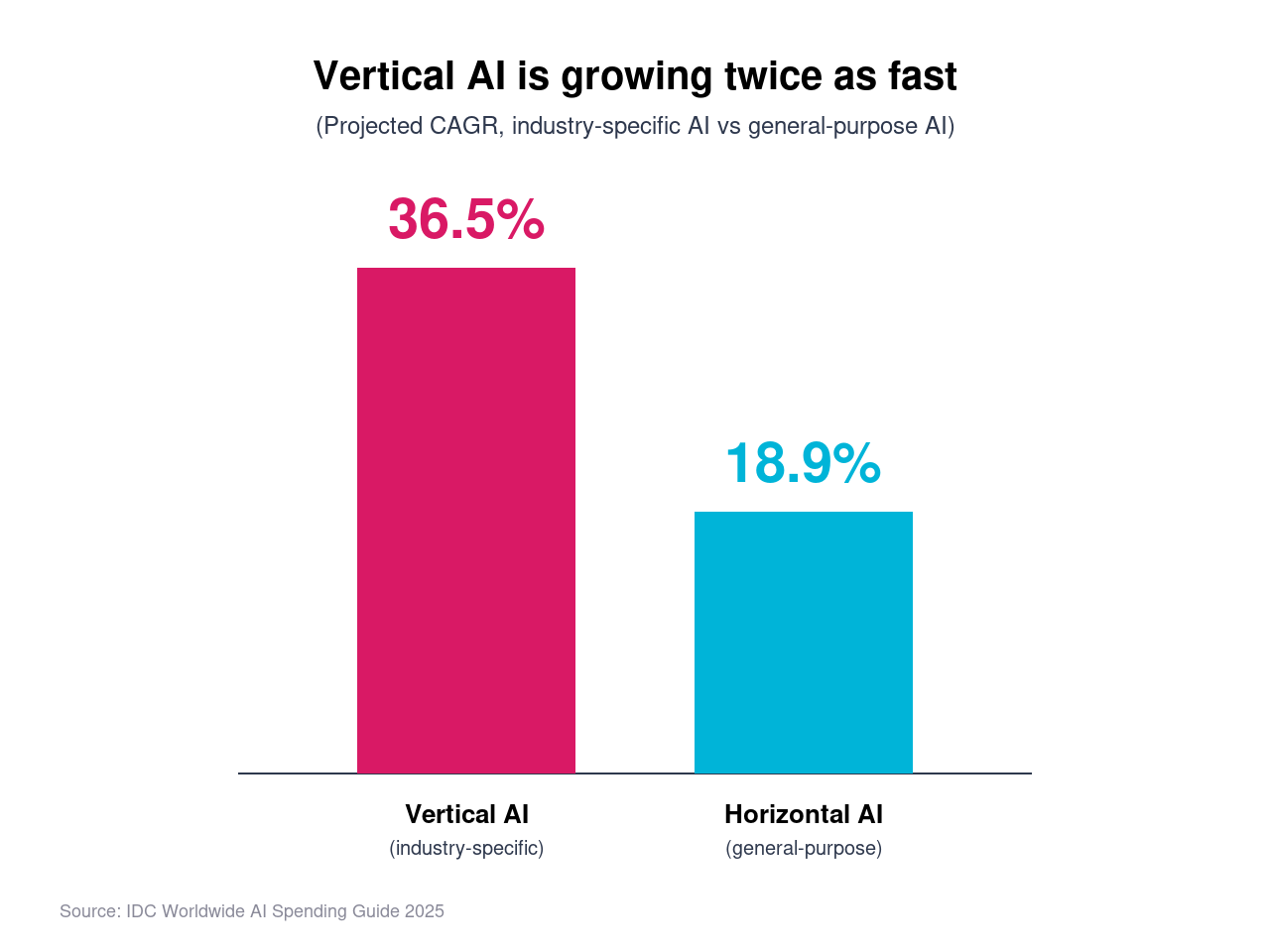
This matters because the market data on vertical AI is now impossible to ignore. According to a report citing IDC's Worldwide AI Spending Guide, industry-specific AI spending is growing at a 36.5% CAGR, more than twice the 18.9% rate for general-purpose AI tools. Y Combinator has gone further, arguing that vertical AI agents could end up 10 times bigger than the SaaS companies they replace, because they capture the labor spend an industry already pays people, not just its software budget.
But that data doesn't explain who actually wins. The founders and operators who succeed at vertical AI aren't the ones who picked a hot category off a trend report. They're the ones who spent years inside a specific business, in accounting, in field service, in HR, in logistics, and got tired of watching software vendors who'd never done the job try to guess at what it needed.
TL;DR: Vertical AI products are growing roughly twice as fast as horizontal AI tools, and Y Combinator thinks the category could be 10x the size of the SaaS market it's replacing. But the market thesis doesn't explain who wins inside that category. The winners are operators and domain experts who already understand a specific business deeply, accountants, field service veterans, HR and health specialists, not founders shopping for a narrow niche to build in. We've built vertical products both ways, from our own FSM expertise (Fieldera, a full platform generated in about 5.5 days for $1,609 in AI spend) to products designed around a client's operational depth (a deadline and workflow tool built for accountants, a workforce platform built on longevity science). The pattern holds every time: the product is only as vertical as the knowledge behind it.
The industry norm everyone already agrees with
Ask anyone building software in 2026 whether vertical AI beats horizontal SaaS, and you'll get the same answer. Vertical wins.
The data backs it up. According to IDC's spending forecast as cited by ACTGSYS, global enterprise AI spending is forecast to reach $307 billion in 2026, with industry-specific solutions growing at that 36.5% CAGR against 18.9% for general-purpose tools. The global vertical AI SaaS platform market was valued at $94.86 billion in 2025 and is projected to reach roughly $1.42 trillion by 2034. On the efficiency side, Forbes reported in March 2026 that the top 20 AI agent startups are averaging revenue-per-employee ratios that exceed Microsoft's $1.8 million and Meta's $2.2 million, a gap driven almost entirely by vertical, narrowly scoped products rather than horizontal ones.
Y Combinator's own framing explains why the number is this large: a vertical AI agent doesn't just take share from a SaaS competitor. It takes share from the labor budget an industry already pays people to do the work, a far bigger number than any software line item. That only works, though, if the product actually understands the work being replaced, which is where the category gets misread.
None of this is controversial anymore. It's the industry norm.
What the thesis leaves out: knowledge, not just narrowness
Here's what every article repeating the CAGR stat and the YC quote skips over. Vertical doesn't mean small. It means specific, and specific requires knowing something a horizontal tool never learns.
Entrepreneurs who haven't worked inside a domain don't reliably choose to build the software for it, and when they do, it usually shows. A founder who's never run a field service crew doesn't know that pulling every data field a company has "creates a gigantic mess for people," a line one field service operator used describing exactly this failure mode on a call with Rodion Salnik, Brocoders' co-founder (internal call transcript, not a public interview). A founder who's never sat inside an HR department measuring burnout doesn't know that engagement scores can stay flat while actual burnout climbs from 38% to 66%, the exact blind spot a workforce diagnostic platform we built was designed to close by measuring physical and mental capacity instead of self-reported sentiment. A founder who's never managed a bookkeeping practice doesn't know why an accountant needs real-time visibility into deadlines rather than another generic task list, which is the specific problem a client's accounting deadline and workflow platform was built to solve for a market of accountants and the small businesses they serve.
That's the part missing from the market-size argument. The bottleneck isn't whether the category is narrow enough. It's whether the person defining the product has actually done the job the software is meant to replace or support. Miss that, and a vertical AI build ends up exactly as generic as the horizontal tool it was supposed to beat, just with a narrower label on the pitch deck.
So the question worth asking isn't "should I build vertical." That's already answered. The question is whether you, or the team defining the product with you, actually understand the operations well enough to know what the software needs to encode.
Operator vs tourist, a framework
We call this Operator vs Tourist. Two builders can target the exact same vertical and produce completely different products.
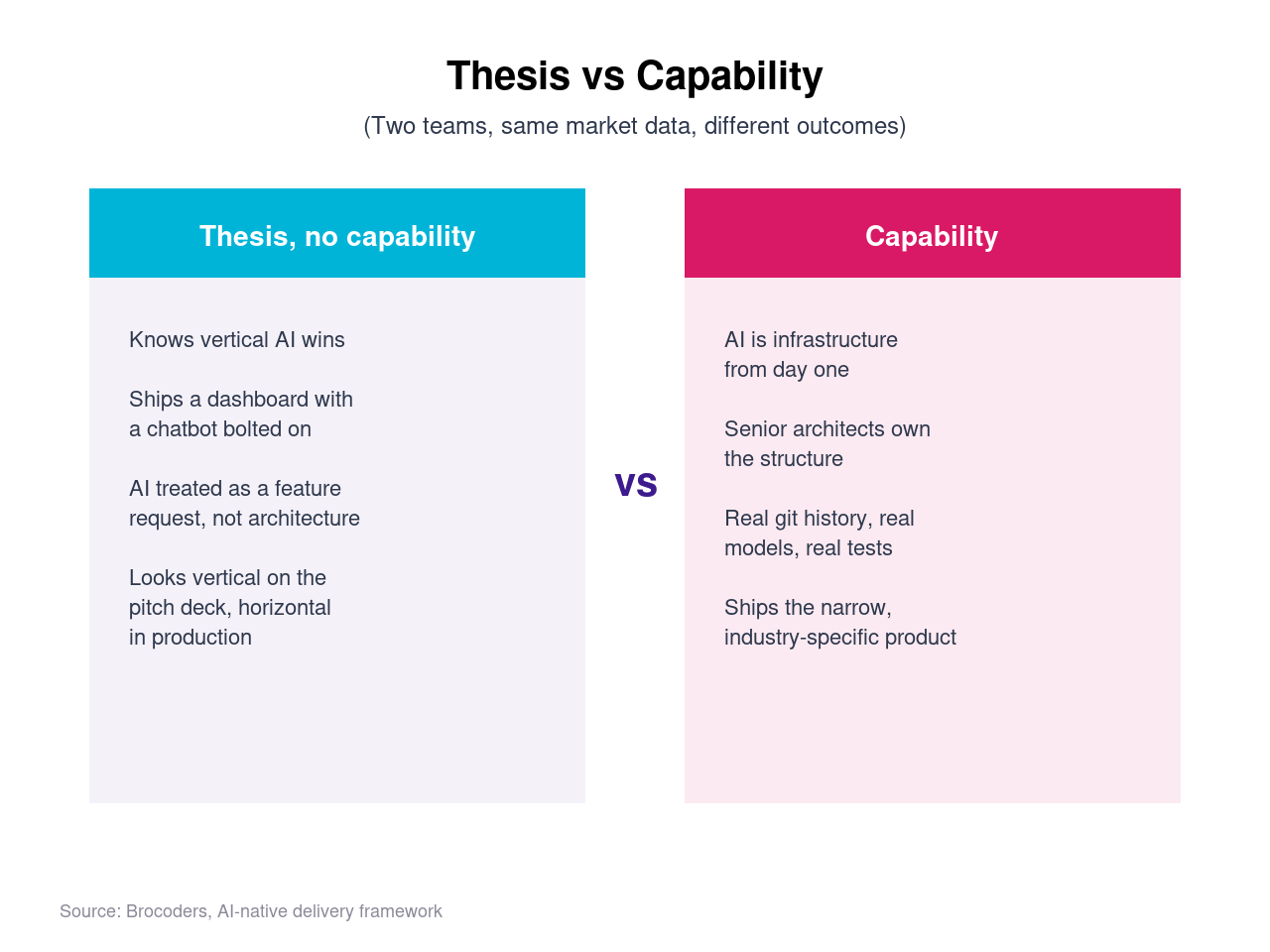
A tourist picks a vertical because the market data says it's growing, then builds the product around assumptions about the industry rather than lived experience in it. The result usually looks like a horizontal SaaS dashboard wearing an industry's vocabulary: same generic fields, same generic workflow, just relabeled. The tourist often defaults to pulling in every piece of data available and hoping the interface sorts it out, because they don't have the operational judgment to know what actually matters.
An operator has already done the job, or is building directly with someone who has, and treats that experience as the actual specification. They know which stakeholders' requests to prioritize and which to ignore, because they've seen a software rollout drown under conflicting requests from project management, finance, HR, and resource management all asking for different things at once. They know where the real friction is, not where a market report says the friction should be.
Delivery capability still matters. An operator with the right knowledge still needs a team that can build AI-native, with senior architects owning the structure and a real, inspectable codebase instead of a demo that collapses under real users. But delivery speed without operator knowledge just produces a fast tourist. The knowledge has to come first.
What operator-built vertical AI actually looks like
We've built this pattern from both directions, our own domain expertise and a client's.
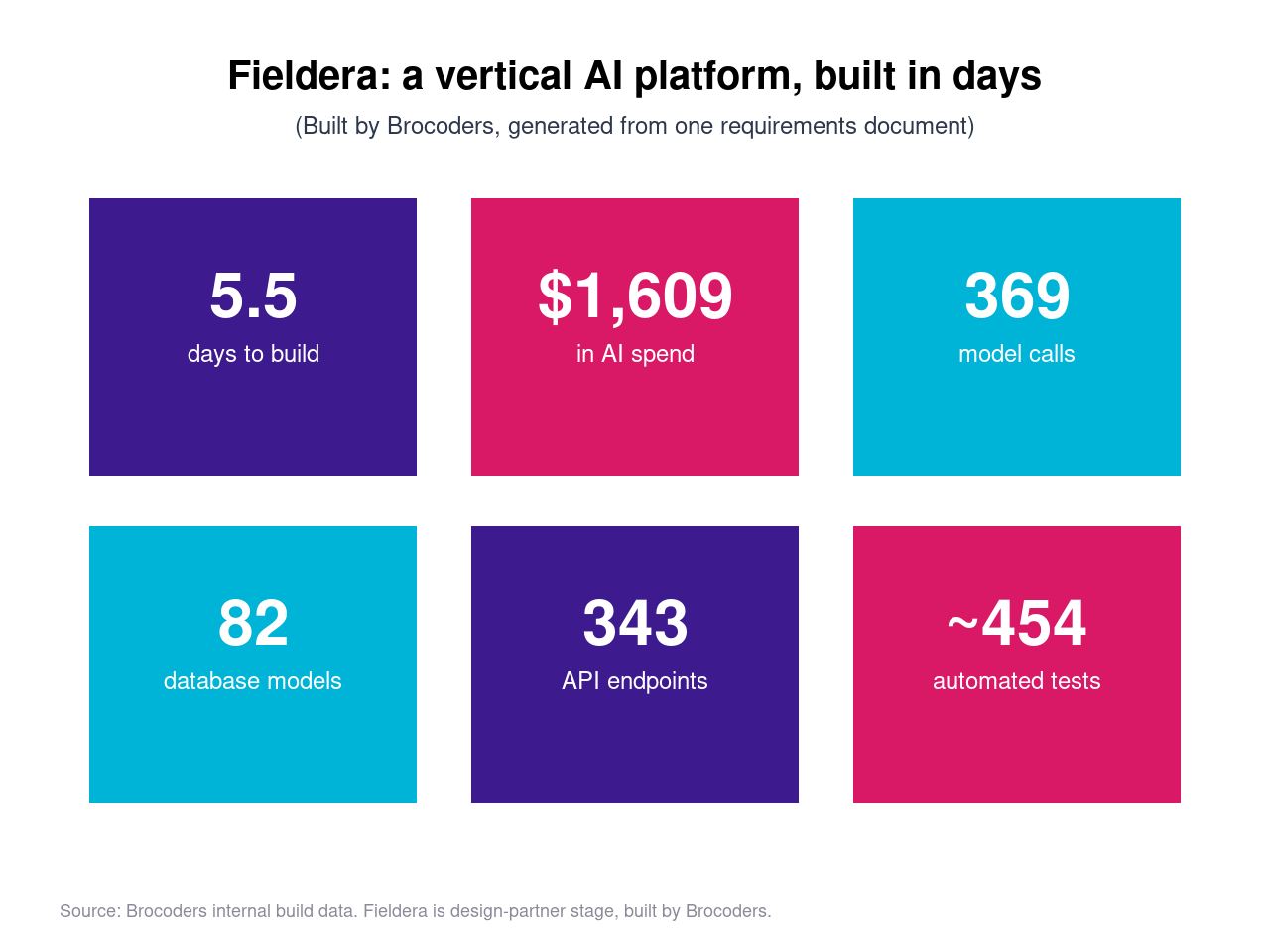
Fieldera, built by Brocoders, is a field service management platform generated from a single requirements document by our AI orchestrator, built on FSM expertise we'd already developed through prior client work in the space. The build took about 5.5 days and $1,609 in AI spend across 369 model calls, producing 82 database models, 343 API endpoints, and roughly 454 automated tests, with a conventional git history any engineer could read and pick up from. Fieldera is at the design-partner stage today, not a proven deployed platform, but the build shows what happens when domain depth and AI-native delivery combine.
The same pattern holds when the operational knowledge comes from the client instead of from us. One client, a digital ecosystem for accountants and the small businesses they serve, is built as two connected products on shared infrastructure: a job board and marketplace for accountants, and a task and deadline management tool that gives business owners real-time visibility into their accounting workflow. That structure only makes sense if you've watched an accounting practice actually run, which is exactly the knowledge the product was built around.
Another client, a workforce diagnostic platform we took from concept to production, is a sharper example of the same principle. Instead of another generic engagement survey, it applies longevity science to measure an employee's physical and mental capacity to execute company strategy, not just how they feel about it, because a generic survey vendor would never have known that engagement scores and real burnout rates can move in opposite directions. EveryPig runs on an AI and machine-learning powered platform built for one industry, pork production, covering supply chain planning and pig health data that a horizontal logistics tool would have no reason to model. A long-term fintech client running accounting automation for over five years, and an EdTech platform combining a learning management system with AI-powered proctoring (both under NDA, referenced without names), round out the pattern.
None of these are the same product, and none of them could have been designed by someone without real exposure to the operations underneath them.
Turning what you know into the product: the steps that matter
If you're an operator sitting on years of experience in a specific industry, here's what actually turns that knowledge into a vertical AI product, based on how we build and on what we've heard directly from operators evaluating this shift.
Write down what you know that a vendor never learns. Before any software gets designed, list the operational judgment calls you make that an outsider wouldn't know to make. An accountant knows which deadlines actually put a client at risk versus which ones are routine. An HR leader knows engagement scores can lie. A field service manager knows which stakeholder requests to prioritize. This list is the actual product spec, not a feature wishlist.
Map the operations before you map the data. The instinct in most software builds is to pull every field a business has and let the interface sort it out later. That's backwards, and it's the exact mistake a field service operator described on a call with Rodion Salnik: pulling all the data out "just creates a gigantic mess for people." Start from what the business actually does day to day, not from what it happens to store.
Identify the real stakeholders, not the obvious ones. Vertical builds fail when a team assumes project management, finance, HR, and resource management all want the same thing from the software. They don't, and a build trying to satisfy every request at once satisfies no one. An operator already knows whose needs actually drive the workflow. Start there.
Design for flexibility, not configuration. Rigid enterprise platforms force companies into drag-and-drop field configuration, which looks flexible but isn't, and it's exactly why companies routinely choose custom development instead: a rigid platform can't implement a workflow "in their way, how they want it." A true vertical build is architected around the business's actual process from the start.
Price for how the business actually operates. Per-seat pricing punishes companies for growing and charges the same whether the software gets used constantly or occasionally. Usage-based pricing, tied to actual consumption, matches cost to value in a way per-seat licensing never does.
Build around the systems already in place. Most established businesses aren't starting from zero. They have a CRM, a finance system, existing tools. A vertical build needs a modular, API-first architecture that connects to what's already there rather than demanding a full migration on day one.
Compress the part that actually takes time: communication, not code. Enterprise rollouts on rigid platforms can take a year to a year and a half from signed contract to full usage, and the delay is rarely the software itself. It's what happens when the people who'll actually use the system weren't consulted early, so problems surface only after the software hits daily workflows. Involving the right people from week one shortens this more than writing code faster does.
Make changes a conversation, not a support ticket. In a horizontal SaaS product, a workflow change means a support request and a wait. In an AI-native vertical build, describing what needs to change can trigger the system regenerating the relevant piece directly, instead of a team manually reconfiguring settings months later.
The market data has already told you vertical wins. What it can't tell you is whether you, or the team you hire, actually understand the business well enough to build the specific version instead of a relabeled generic one. That's the conversation worth having before any budget gets committed, and it's the one we have with operators before we write a line of code.
Have deep experience in a specific industry and think it should be software? Talk to us about your AI product, or see what we built from our own FSM expertise at fieldera.ai.
Frequently Asked Questions
You need deep operational knowledge of it, either your own or a co-founder's or close advisor's. That's different from formal industry credentials. What matters is whether you know the workflow well enough to know what a generic software vendor would get wrong, the way an accountant knows which deadlines actually carry risk, or a field service manager knows which stakeholder requests to trust.
Vertical AI is built for one industry or workflow and ships with the domain knowledge, compliance logic, and integrations that workflow needs already built in. Horizontal SaaS, including SaaS with an AI feature added on top, is built to serve many industries at once, which means the user has to supply the context a vertical tool would already know, and the vendor has to guess at what that context is.
The 36.5% versus 18.9% CAGR figure is reported via IDC's Worldwide AI Spending Guide, though we found it through a secondary source rather than IDC's own release, worth confirming directly if you're citing it further. Y Combinator's 10x thesis comes directly from its own published analysis of vertical AI agents. What's worth being skeptical of is any company claiming to build "vertical AI" without operational depth or a real build behind it.
Yes, and it's one of the more common requests we get. It usually starts with the founder or an operator on the team documenting the operational knowledge the current product is missing, then re-architecting the parts where AI should be doing domain-specific work, not just adding a chat window.
It depends on scope, but our own Fieldera build shows the outer edge of what's possible: a full platform, 82 database models and 343 API endpoints, generated in about 5.5 days for under $2,000 in AI spend. Most client builds land somewhere between that and a traditional multi-month timeline, largely depending on how much operational discovery the workflow requires, not how much code needs to be written.
The data suggests the opposite. YC's argument is that a vertical AI product's addressable market includes the labor spend an industry already pays people, typically far larger than the software budget a horizontal tool competes for. Narrow scope and small market size are not the same thing, especially when the narrowness comes from real operational depth rather than an arbitrary category choice.