
Every Monday, someone on your team exports rent rolls from the property management system, pulls vacancy data from a second tool and pastes both into a spreadsheet so the leadership meeting has one portfolio number. The system runs the ledger and every lease, so turning it off would stop rent. It cannot give your owners, tenants and managers what they now ask for.
This guide shows how commercial property management software modernization works without replacing the system. The examples come from residential, HOA and rental portfolios we in Brocoders have worked on, and the pattern is the same for commercial ones.
TL;DR: Keep your property management system (PMS) as the system of record for accounting and leases, and build the portals, dashboards and integrations around it. Building around it is the right call when payments, finances and security stay with one architecture owner and are properly tested. Start with an audit of what you have, before anyone quotes a replacement.
Why commercial property management software gets stuck
A PMS that has run your portfolio for 15 years holds the ledger, every lease and every payment history, which makes each new request harder to meet. Three problems come up again and again.
The system of record cannot be turned off. Rent, CAM reconciliations and owner statements all run through it. Any change risks a missed billing cycle, so changes stop.
The same property lives in 2 places. Leasing tracks units in one tool, accounting in another, and the website in a third. When the numbers disagree, a person decides which one is right, usually by hand, usually on Monday.
Owners and tenants cannot help themselves. An owner who wants a statement emails the office. A tenant who wants to see a balance calls.
Each request is small, and together they fill a staff member's week.
At C.I.A. Services, an HOA manager we worked with, owners called staff for information the PMS already held, and the company website kept a second set of data. All three problems come from the same place: the PMS was built to keep the books, and the business now needs it to talk to people and to other systems.
Replace, rehost or build around: what each one costs you
You have 3 realistic options, and each one solves a different problem.
| Option | What changes | What it costs you | When it fits |
|---|---|---|---|
| Replace the PMS | Ledger, leases and workflows move to a new system | A data migration of every lease and balance, retraining every team, a cutover period | The vendor is ending support, or the system cannot hold your lease terms at all |
| Rehost it | The same software moves to newer servers or the cloud | Infrastructure work only | Your hosting is the risk, and the features are fine |
| Build around it | The PMS keeps the books, and new portals, dashboards and integrations connect to it | A fringe you own and have to maintain | The books are fine and the gaps are in reporting, self-service and connections |
Building around the system is the option that targets the Monday spreadsheet directly. C.I.A. Services chose it: RedDog, its PMS, kept the books, and the owner app was built around it. For the code-level choice, see refactor or rewrite.
Keep the platform, build the fringe, and control what touches money
Plenty of operators now build their own tools around the PMS, and AI coding tools make it cheaper to start.
The PMS vendors see it too. Rob Teel, CEO of Yardi, put it plainly on PLOT Live at YASC: "Buy the platform, build the fringe." The fringe is the layer you build around the PMS. PLOT Live is a commercial real estate show, and this episode was recorded at YASC, Yardi's Advanced Solutions Conference.
Teel also named what he would not hand to a quick build: "an intercompany multicurrency journal", "a new financial report", and "every business logic rule in our database". Those belong to the PMS.
That gives you a clear split:
- The platform keeps: the general ledger, journals, financial reporting, lease accounting and the business rules behind them
- The fringe gets: owner and tenant portals, portfolio dashboards, integrations with your other tools, workflow automation and AI agents that read from the PMS through its API
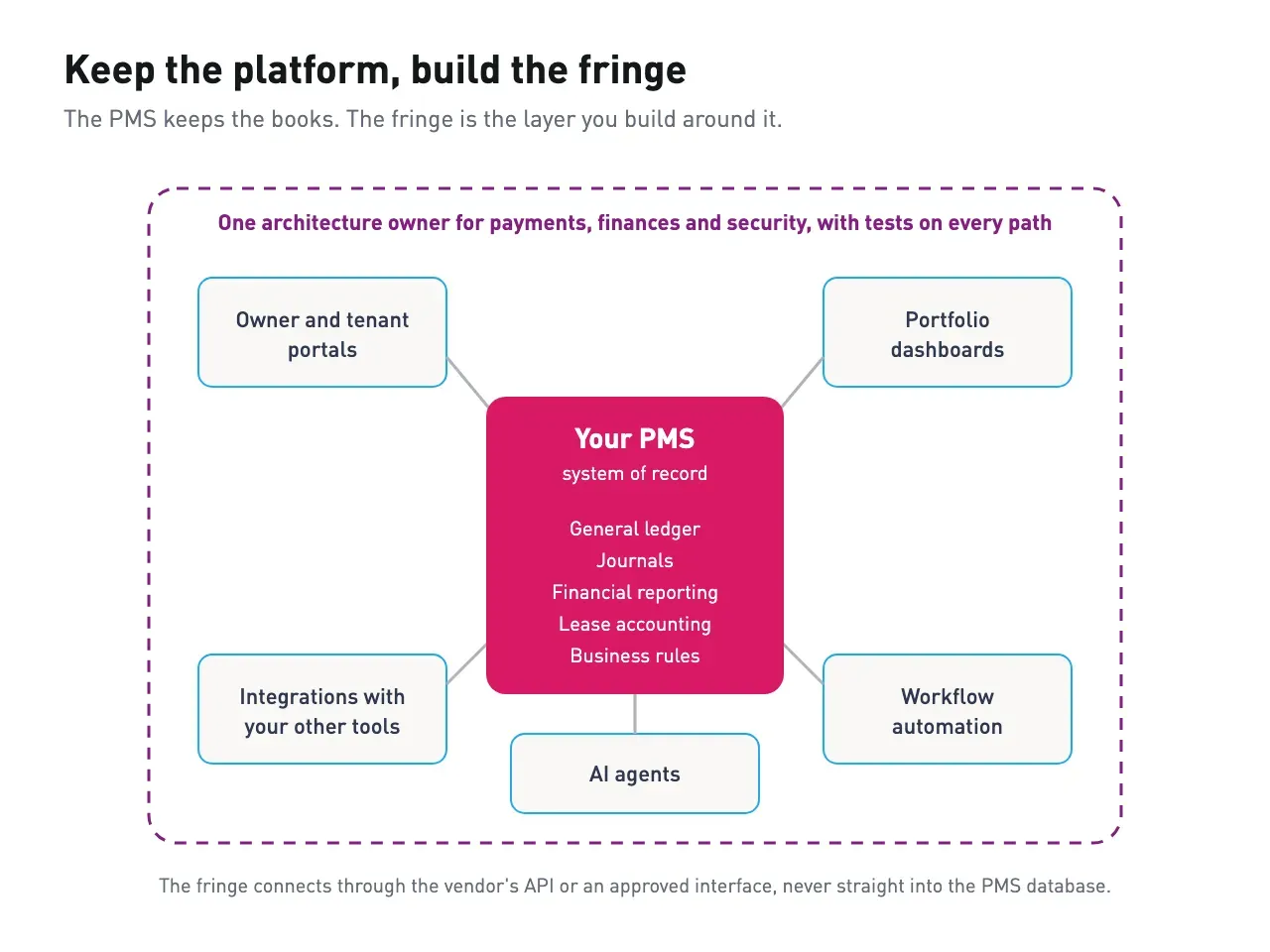
The split holds under one condition. Payments, finances and security stay with one architecture owner (one team, yours or one partner, that decides how they are designed), and every path that touches them has tests.
A portal that shows a balance is fringe. A portal that writes a payment into the ledger touches the books and needs the same care as the ledger.
Someone also has to own the code after launch. Teel warned that "There is a hidden cost maintaining code that a lot of folks don't realize", and that in-house agents go stale. For the wider method behind this approach, see our guide to legacy application modernization.
Commercial property management software modernization in 5 steps
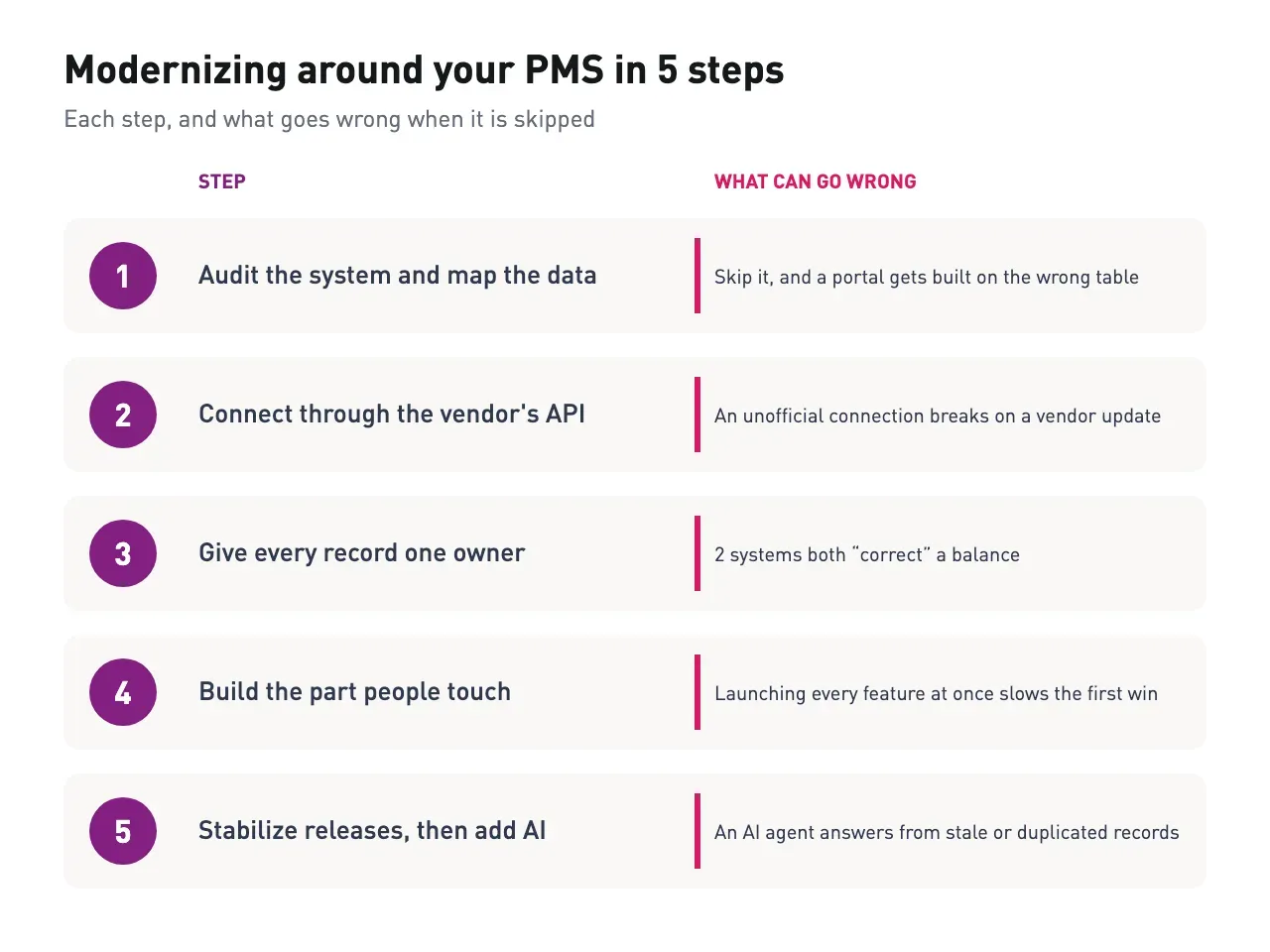
1. Audit the system and map the data. List every place a property, a lease, a tenant and a payment lives, and which system is the source for each.
What can go wrong: skip this, and the team builds a portal on top of the wrong table.
2. Connect through the vendor's API or an approved interface. Read from the PMS and write back only through the channels the vendor supports. Writing straight into a hosted PMS database can break the vendor's own rules, and on hosted systems it is usually not possible at all.
What can go wrong: an unofficial connection that breaks on the vendor's next update.
3. Give every record one owner. Decide which system owns each payment, balance, unit and permission, and put tests around every sync that touches money. The fringe copies or displays, and the owning system decides.
What can go wrong: 2 systems both "correct" a balance, and the team cannot tell which one the auditor will see.
4. Build the part of the fringe people actually touch. Owner and tenant portals, staff dashboards and reports go here. A progressive web app (a website that installs like an app) skips app-store releases entirely.
What can go wrong: launching every feature at once, when the one request that fills the most inbox time would prove the layer sooner.
5. Stabilize releases, then add AI. Get automated tests, a staging copy of the system for trying releases, and monitoring in place before adding AI features, so a model reads clean data through the same rules as everyone else. CondoGenie, a condo and HOA management platform we work on, runs its AI that drafts association news posts on a codebase covered by an automated test suite.
What can go wrong: an AI agent that reads stale or duplicated records and answers confidently with the wrong number.
What this looks like on a live portfolio
Before: C.I.A. Services, a full-service HOA management company since 1984 that manages over 150 community associations in Houston and San Antonio, ran its operation on RedDog NextGen, its property management system. Owners could not see their own information without calling staff, and the company's website held a second set of data.
After: we built an owner and resident app that pulls live data from RedDog and from the website without duplicating records, and writes owner updates and photos back into RedDog.
Five access tiers, from owners to administrators, each see their own slice, and staff can view the app exactly as an owner does. It ships as a web app, so there is no app-store download or native release cycle.
RedDog stayed the system of record the whole time. We supported the app until June 2025.
If you own the platform yourself, the same thinking applies to your own code. CondoGenie is a condo and HOA management SaaS we have worked on from 2018 to present. It was replatformed with 9 years of data migrated while the business stayed live.
Since then it has been upgraded in place, including a framework upgrade, an automated test suite and a payments provider update. Its active users grew from 1,398 in 2019 to 19,324 in 2025.
Lake, a US vacation rental marketplace, had its backend rebuilt in 3 months, and property managers' prices and availability now sync from their own systems. Lake has 6 PMS partnerships, and its connected properties grew from about 500 to 40,000.
What to look for in a modernization partner
The checklist below describes how we in Brocoders work, so read it as our standard and hold any vendor, including us, to it:
- An audit before a proposal. You get a written keep, fix or rebuild call before anyone prices the build.
- A call with your PMS vendor or integration partner before the quote. On Lake, we spoke to the integration partner before quoting.
- Respect for decisions you have already made. If your team has picked an architecture, a good partner builds it.
- Demos every 2 weeks. You see the working software as it grows.
- A plan for maintenance. Someone owns the fringe after launch.
Our application modernization services promise an honest audit before a proposal, then a rebuild that fixes what has to be correct and leaves the rest alone, so the business does not stop while the system changes underneath it.
Where to start this quarter
Write down every portfolio number your team still builds by hand, and every request owners and tenants still send by email. Rank both lists by the staff hours and the money each one costs. The top item is your first project.
Then get the system mapped before anyone writes code. Our software audit is a fixed-scope review: Essential at $5,000 or Standard at $9,900, delivered in 5 or 10 business days, with a written refactor-or-rebuild recommendation.
If your PMS is the right core, the audit will say so and show you what to build around it. For wider industry work, see our property management software development and proptech software development pages.
Frequently Asked Questions
You do not have to. When the ledger and leases work, keep the PMS as the system of record and build portals, dashboards and integrations around it. Replace it only when the vendor ends support or it cannot hold your lease terms.
We can, through each vendor's API or another interface the vendor approves, and the vendor's accounting rules stay in the vendor's system.
Decide which system owns each record type, and have the fringe read from that owner without keeping a competing copy. On C.I.A. Services, the app combines live data from RedDog and the company website without duplicating records.
It can, if the sync is designed around how often the data changes and which system wins when 2 values disagree. On Lake, property managers' prices and availability sync from their own systems after the backend rebuild.
The software audit takes 5 or 10 business days, and the build length depends on what it finds.
The partner who builds it, or your team after a handover of tests, documentation and access. Agree on which before the build starts.
Start with the manual report or inbound request that costs your team the most time, and map the systems behind it with a software audit.